

 4.9
4.9 4.5
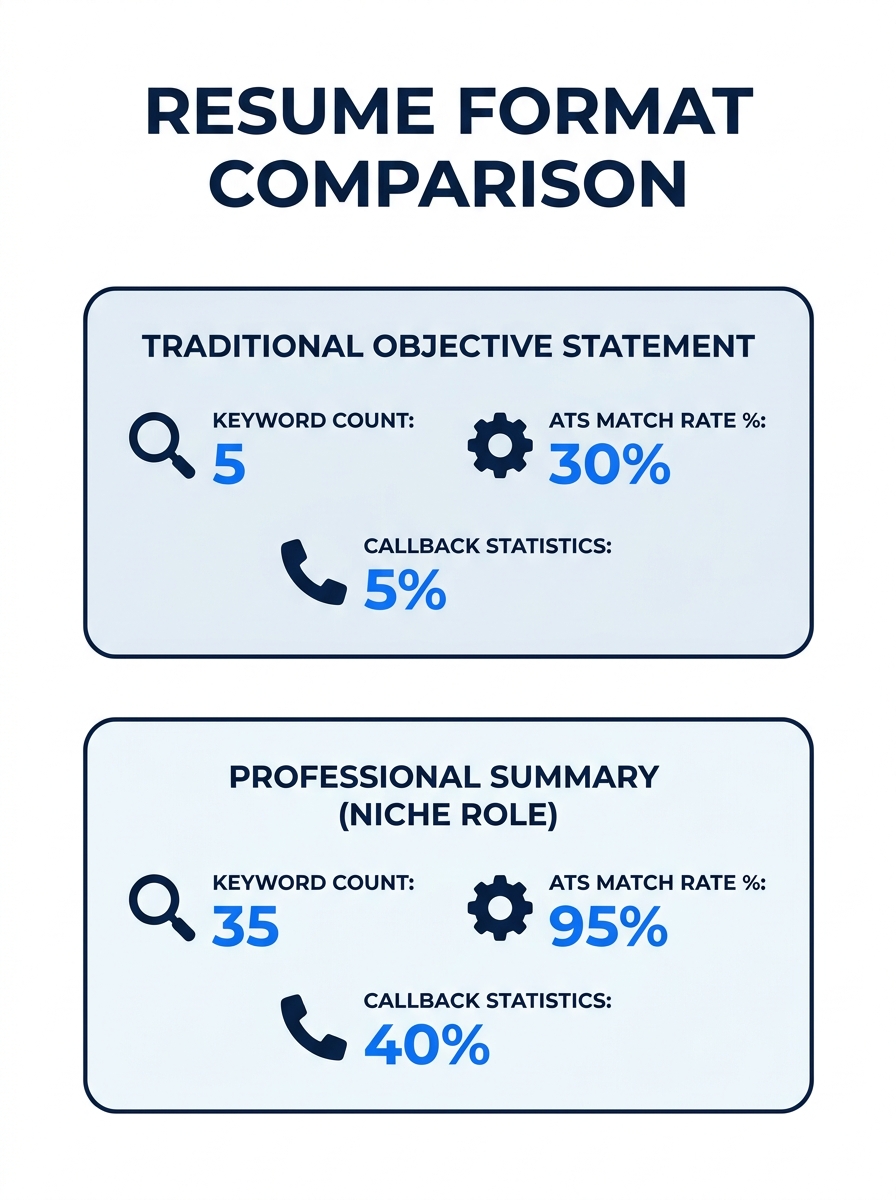
4.5Career summaries outperform resume objectives for niche professionals with two or more years of experience, producing 340% more interview callbacks according to The Interview Guys’ 2026 analysis. Objectives retain a narrow role for career changers entering specialized fields, but only when rewritten to center employer value.
Why Niche Fields Broke the Old Objective Formula
The resume objective was built for a different labor market. When “Seeking a challenging position that will allow me to grow professionally” appeared at the top of a resume in 1998, it served as a polite handshake, a signal of availability. That language persisted for decades across industries. But niche professions exposed its core weakness: an objective tells the employer what you want, and in a field where every open role already implies high specialization, nobody reading your resume needs that information. As Indeed’s career guidance now frames it, “resume objectives are typically used by people with few professional accomplishments or those who want to switch careers.” For someone already embedded in a specialty, that framing carries the wrong signal entirely.
The specificity problem runs deeper than tone. A generic headline like “Sales Executive” positions you as industry-neutral, while “Medical Sales Executive” immediately communicates specialization, according to LinkedIn’s niche resume guidance. That same logic applies to the opening block of your resume. An objective like “Seeking a role in environmental engineering where I can apply my skills” wastes 15 words without naming a single credential, certification, or measurable outcome. In a field where hiring managers look for PE licensure, specific EPA regulatory knowledge, or stormwater modeling proficiency, those 15 words are a missed opportunity to match the vocabulary they’re scanning for. The Bauer College of Business at the University of Houston frames the distinction clearly: “A resume summary outlines your experience and skills to highlight your accomplishments. It builds a powerful impact on your resume to capture the sight of the employer.”
And then there’s the ATS layer. Applicant Tracking Systems now process the vast majority of resumes before any human sees them, and they reward keyword density in a way that objectives structurally can’t deliver. A two-line objective contains roughly 20 to 30 words, maybe three or four matchable terms. A summary of the same length can pack in role title, years of experience, two to three hard skills, a quantified result, and a domain-specific tool name. When ATS passage rates run 42% higher for achievement-focused summaries, the math alone should make niche professionals pause before defaulting to an objective statement. If you’ve been wrestling with how ATS systems interpret your content, the opening block of your resume is where the translation gap begins.
The Summary’s Structural Advantage in Specialty Hiring
Why does the summary format dominate in niche hiring? Because specialty roles are defined by accumulated, verifiable expertise, and a summary is the only opening format built to carry that weight. Jobscan’s analysis puts it directly: summary statements “focus more on the company’s needs, not the needs of the job seeker.” That inversion matters enormously when you’re applying for a role as a computational fluid dynamics engineer or a pediatric neuropsychologist. The hiring manager reading your resume doesn’t need to know your aspirations. They need to know your throughput, your tools, your certifications, and whether your previous work maps to the problems sitting on their desk right now.
Consider the practical difference. An objective for a technical specialist might read: “Technical Specialist with 5 years of experience in IT systems support and optimization, seeking an opportunity to contribute to a forward-thinking team.” That sentence names experience duration and a broad domain, but it doesn’t differentiate you from the other 40 applicants who wrote the same thing. A summary for the same candidate rewrites the math: “IT systems specialist with 5 years in enterprise support environments, proven ability to troubleshoot complex infrastructure issues, and a documented record of enhancing system efficiency by 20% through automated monitoring deployment.” The second version names a quantified achievement, a specific method, and implies familiarity with automation tools. For readers wondering how to turn infrastructure work into concrete resume language, this is the pattern that survives both the algorithm and the human reviewer who gets 6 to 7 seconds with your document.
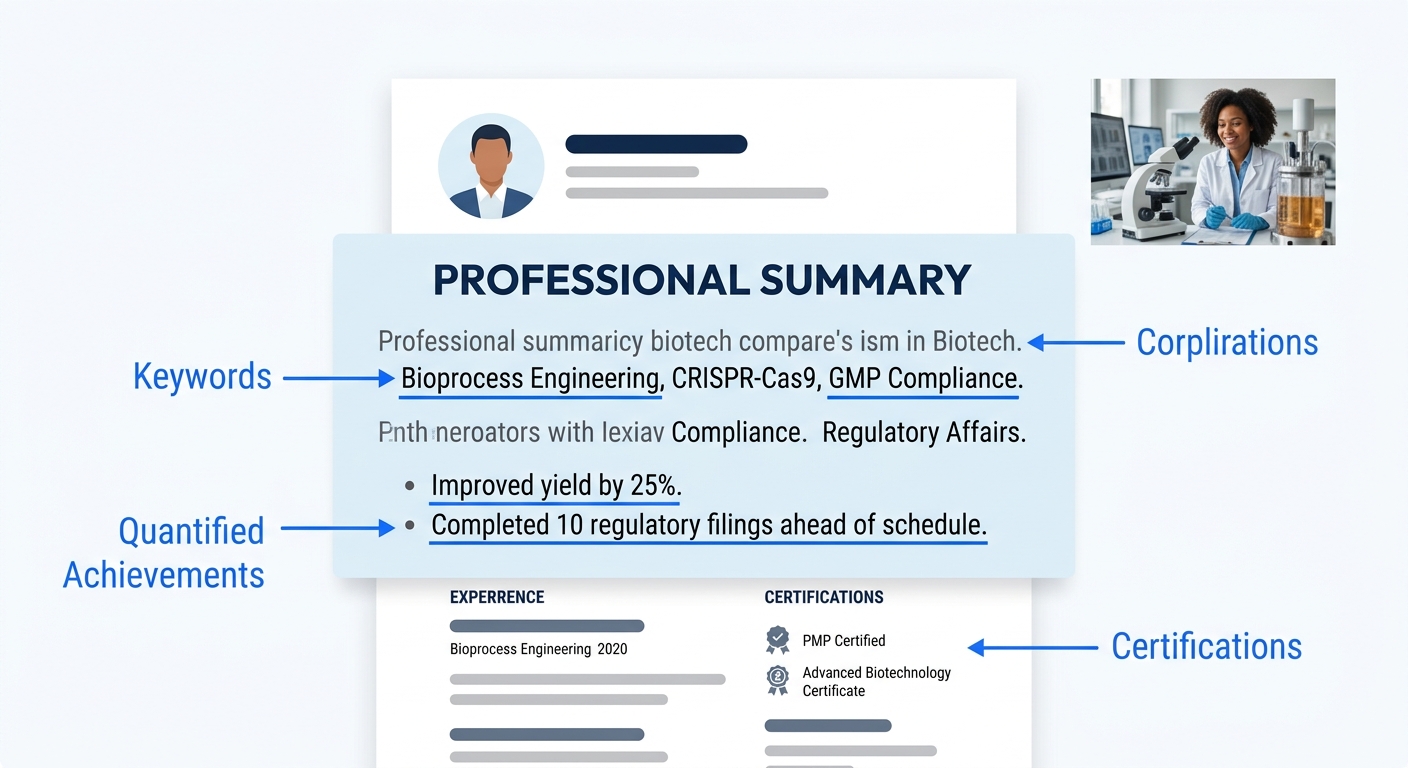
The keyword integration question deserves its own attention. Indeed’s ATS guidance recommends weaving “role-specific terms like ‘customer service’ or ‘calendar management'” naturally into your professional summary, and the advice scales up dramatically for niche fields. A regulatory affairs specialist in biotech, for instance, needs to surface terms like FDA 510(k), post-market surveillance, DHF documentation, and risk management per ISO 14971. An objective can’t hold that density without reading like a parts list. A summary can, because it’s built around the architecture of “I did X using Y and achieved Z.” Huru.ai’s niche resume guide recommends analyzing 3 to 5 job ads in your target specialty to extract recurring terminology, then layering it into your summary so the language reads naturally while still triggering the right keyword matches.
There’s a compounding effect, too. When 78% of recruiters spend fewer than 10 seconds on your opening statement, the information density of a summary pulls double duty. It satisfies the ATS keyword scan on the first pass, and it gives the human reviewer a compressed proof-of-fit on the second. A summary reading “Computational chemist with 8+ years of experience in molecular dynamics simulations and drug discovery pipelines, utilizing Schrödinger Suite and Gaussian to accelerate lead optimization by 40%” delivers value at both stages. The objective equivalent would need twice the word count to convey half the information.
When an Objective Still Earns Its Space
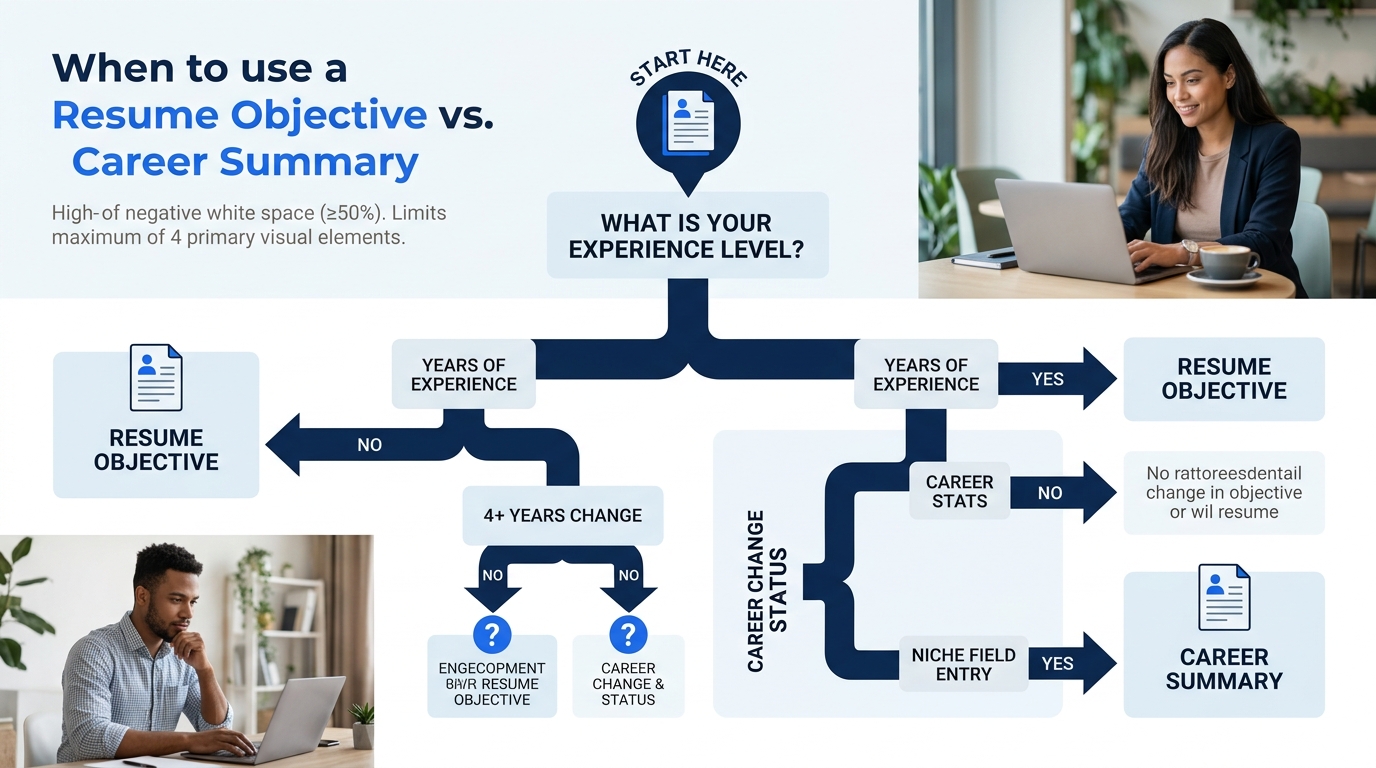
The resume objective isn’t dead. It’s just been relegated to a much smaller box of appropriate use cases, and professionals considering one need to understand exactly when it still makes strategic sense. The clearest case is career transition. If you’re a PhD microbiologist moving into biotech regulatory affairs, your work history won’t obviously connect to your target role, and a summary of past lab research might confuse more than it clarifies. An objective does something a summary can’t in this scenario: it names the destination and draws a direct line between what you’ve done and where you’re headed. Written well, it reads like this: “PhD microbiologist transitioning to biotech regulatory affairs, bringing 5 years of laboratory compliance experience and FDA audit participation to ensure product safety and submission readiness.” That’s 50 words of tight, directional positioning that explains the career shift while proving relevant transferable expertise.
Entry-level candidates in niche fields face a related problem. When you have fewer than 2 years of professional experience, a summary risks inflating thin credentials into something that reads as bluster. The University of Houston’s Rockwell Career Center notes that summaries work best for candidates with “2-3 years of work experience,” and that guidance holds especially true in specialties where the gap between academic training and professional practice is wide. A recent graduate entering clinical research coordination, for example, serves themselves better with a focused objective that names their degree, relevant coursework, GCP certification status, and the type of research environment they’re targeting. The signal the hiring manager receives isn’t “this person lacks experience” but rather “this person knows exactly which part of our field they want to enter.”
The modern objective isn’t about what you want from the employer. It’s about what the employer gains from your direction.
But there’s a critical rewrite required for any objective used in a niche application. The old formula of “Seeking a role in X to grow my skills in Y” centers your development, not the employer’s problem. Every career advisor worth listening to has flipped this structure. The functional modern objective puts employer value first, candidate intent second. If you’re pivoting into aerospace systems engineering after a decade in automotive, “Automotive systems engineer with 10 years of FMEA and APQP methodology experience, targeting aerospace propulsion quality assurance where these reliability frameworks apply directly” communicates transfer value rather than personal ambition. For anyone navigating this kind of specialty pivot, the challenge is similar to what displaced engineers face when repositioning after a layoff: the opening block has to do the work of translating your past into their future.
Where the Conventional Advice Falls Short
The binary framing of “objective OR summary” has become standard guidance across career sites, resume builders, and coaching platforms. And like most binary framings, it oversimplifies the actual decision niche professionals face. The real question isn’t which format to pick from a menu. The real question is whether your resume’s first 50 to 100 words communicate specialized value densely enough to survive an ATS keyword scan, a 6-second recruiter glance, and the deeper read by a hiring manager who knows the difference between someone claiming domain expertise and someone demonstrating it.
That distinction matters because niche fields don’t all behave the same way. A clinical pharmacologist applying to a large hospital system will hit an ATS wall if their opening lines lack measurable outcomes and specific certifications. A conservation geneticist applying to a 12-person nonprofit lab might have their resume read cover-to-cover by the principal investigator, making keyword optimization irrelevant and narrative clarity everything. The advice to “always use a summary” assumes a screening pipeline that doesn’t exist in every specialty. And the advice to “use an objective only when switching careers” ignores situations where a research-focused candidate is applying to a highly specific subdomain within their own field and needs to flag intent with precision that a general summary can’t achieve. If you’ve encountered the problem of resume builders pushing one-size-fits-all templates, this is the same structural issue wearing different clothes.
What remains genuinely uncertain is how AI-driven screening will reshape this calculation over the next two to three years. The current data favors summaries overwhelmingly for ATS passage, and the 340% callback advantage is hard to argue against. But as screening algorithms grow more sophisticated at parsing intent and context, the rigid keyword-matching advantage of summaries over objectives may narrow. The professionals who will navigate this best aren’t the ones who memorize a rule about which format to choose. They’re the ones who treat their resume’s opening block as a positioning statement, dense with the specific vocabulary, tools, certifications, and quantified results that define their niche, regardless of whether the label at the top says “Summary” or “Objective.” The format is a container. What you put inside it, and how precisely it maps to your specialty, is the part that determines whether someone calls you back.