

 4.9
4.9 4.5
4.5The phrase “responsible for overseeing production operations” appears on an enormous share of manufacturing resumes, and it communicates almost nothing. A plant supervisor who kept a $4M line running at 96% OEE and a floor lead who watched a dashboard for eight hours both describe their work this way. Hiring managers scanning these resumes can’t distinguish between the two candidates, and they don’t have time to guess. According to a Jobscan analysis, resumes with quantifiable achievements receive 40% more callbacks than those without. For production professionals, the gap between what you actually accomplished and what your resume says about it is often wider than in any other field, because the data you need is sitting in shift reports, ERP dashboards, and maintenance logs you stopped looking at the day you left that job.
These seven rules will help you pull real numbers out of your production experience and shape them into manufacturing experience bullets that a hiring manager can evaluate in seconds. Some of the rules will feel obvious. A few will contradict advice you’ve seen elsewhere. All of them are grounded in how production metrics actually work and what recruiters in manufacturing actually look for.
Mine your production logs before you write a single bullet
The single biggest mistake production professionals make on their resumes is trying to remember numbers from memory. Memory is bad at this. You’ll round down, hedge, and end up writing “improved efficiency by approximately 10-15%” when the actual figure was 22%.
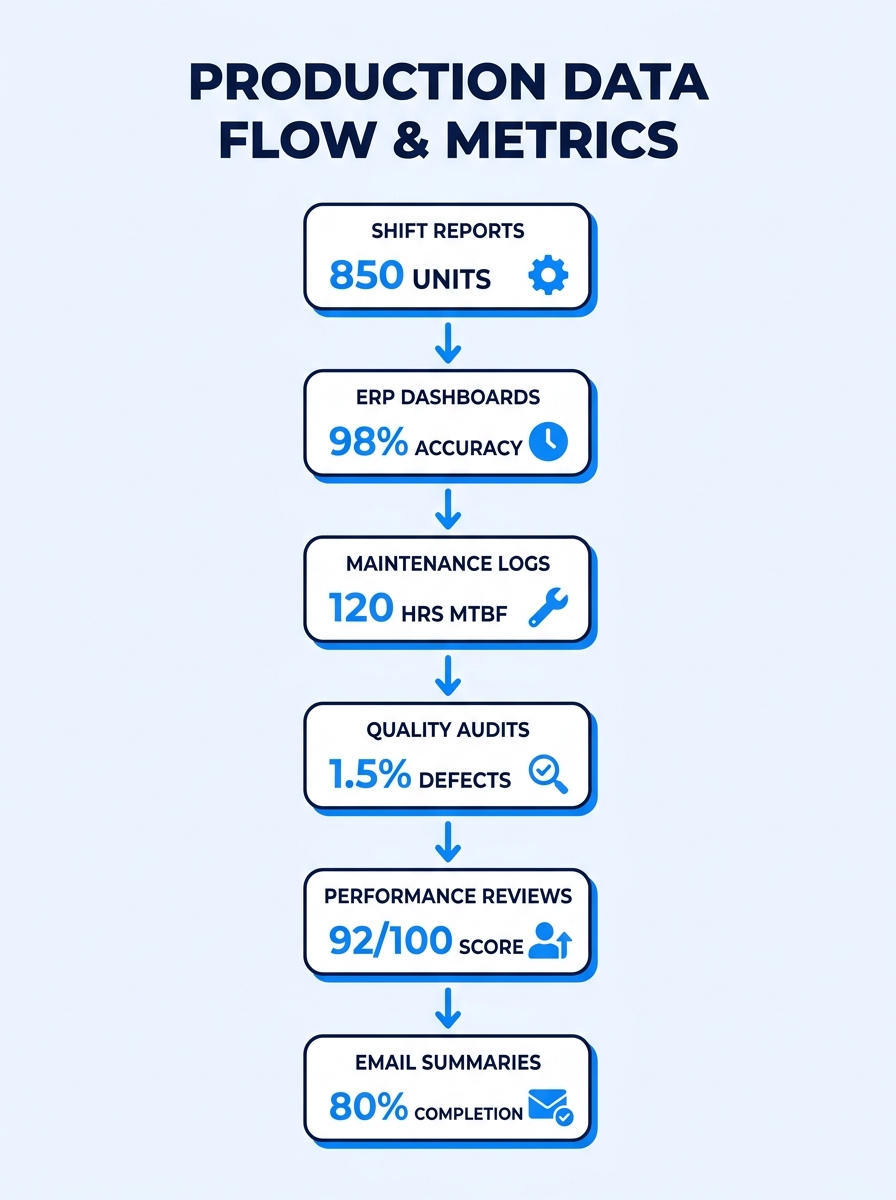
Before you touch your resume, gather source material. Pull up old shift reports, production summaries, ERP exports, or even photos you took of whiteboards during Kaizen events. If you’ve left the company and can’t access internal systems, check your email for automated report summaries, performance reviews that referenced specific metrics, or any documents you saved during your tenure.
The metrics that matter most in production roles fall into a few predictable buckets. According to NetSuite’s catalog of manufacturing KPIs, the critical indicators include throughput (units produced per hour or shift), OEE (Overall Equipment Effectiveness), scrap/defect rates, downtime, and on-time delivery percentages. If you worked anywhere near a production floor, you touched at least two of these whether you realized it or not.
This rule breaks when you’re very early in your career and genuinely didn’t have access to production data. In that case, skip ahead to Rule 6, which covers how to borrow upstream metrics.
Always convert time savings into dollar figures
Time saved sounds impressive in conversation but falls flat on paper. “Reduced changeover time by 45 minutes per shift” makes a hiring manager think, “Okay, and what did that do for the business?” You need to close the loop.
The math is usually simpler than people expect. If you eliminated 45 minutes of downtime on a line staffed by six operators earning an average of $28/hour, that’s $126 in direct labor savings per shift. Multiply by the number of shifts per year, and you’ve got an annual figure. As one engineering career resource breaks down in detail, even modest per-shift savings compound into five- and six-figure annual numbers that look significant on a resume.
A before-and-after example:
Before: “Reduced changeover time on packaging line.”
After: “Cut packaging line changeover time from 90 to 45 minutes per shift, recovering 547 production hours annually and saving an estimated $76,500 in labor and lost throughput.”
The second version gives a hiring manager three concrete reference points: the magnitude of the improvement, the annualized time recovery, and the dollar value. When you’re building budget and schedule metrics on resumes, this kind of translation is what separates a forgettable bullet from one that gets circled in red pen.
This rule breaks when your dollar estimates require so many assumptions that they become fiction. If you need more than three multiplication steps to get from your action to a dollar figure, use the time or percentage figure instead and let the interviewer do the napkin math.
Anchor every bullet to one of four metric categories
Production environments generate dozens of trackable metrics, but resume bullets work best when they map to one of four categories that hiring managers instinctively scan for:
- Volume: Units produced, orders fulfilled, batches completed, lines managed
- Efficiency: OEE scores, cycle time reductions, changeover improvements, uptime percentages
- Quality: Defect rates, scrap reduction, first-pass yield, customer return rates
- Cost: Dollar savings from waste reduction, labor optimization, material substitution, energy consumption
When you’re drafting manufacturing experience bullets, tag each one with its category before you finalize the wording. If you find that all six of your bullets fall under “Volume,” you’re painting yourself as someone who can run output but might not care about quality or cost. Spread your bullets across at least two or three categories, with emphasis on whatever the target job description highlights.
If you’re working on replacing weak resume language with action-driven results, this framework gives you a concrete scaffold. Instead of vaguely “strengthening” a bullet, you pick a metric category and build toward a specific number.
If all six of your bullets fall under “Volume,” you’re painting yourself as someone who can run output but might not care about quality or cost.
This rule breaks for roles that genuinely live in one metric category. A quality engineer should have mostly quality-focused bullets. A maintenance manager’s resume should lean heavily on efficiency and uptime. Match the category distribution to the role, not to an arbitrary ratio.
Name the baseline before you claim the gain
“Increased throughput by 18%” is a good bullet. “Increased throughput from 1,200 to 1,416 units per shift (18% improvement)” is a better one. The baseline number gives your claim weight because it tells the reader the scale of the operation you were working in. An 18% improvement on a line that was already running 5,000 units per shift is a different achievement than the same percentage on a 200-unit artisan operation.
This principle applies across every metric category. For quality: “Reduced scrap rate from 4.2% to 1.8%.” For cost: “Lowered material waste from $34,000/month to $21,000/month.” For schedule adherence: “Improved on-time delivery from 82% to 97% over a six-month period.”
Baselines also protect you during interviews. When you’ve written the starting number on your resume, you’ve already prepped for the inevitable follow-up question. You won’t get caught flat-footed when someone asks, “What was the situation before you got involved?”

If you’re rebuilding your resume after a layoff or career disruption, having concrete baselines ready makes the reconstruction process dramatically faster. You’re not staring at a blank page trying to remember what you did. You’re filling in a template with real numbers.
This rule breaks for highly sensitive financial data. If your former employer would reasonably object to you sharing specific production volumes or cost figures, use percentages alone and be prepared to discuss the context verbally in interviews.
Prefer percentages for improvements, raw numbers for scale
There’s a persistent debate about whether to use percentages or raw numbers on resumes. The answer depends on what you’re trying to communicate.
Use percentages when you’re showing improvement or change. “Reduced defect rate by 57%” is easier to parse than “Reduced defects from 14 per 1,000 units to 6 per 1,000 units.” The percentage tells a faster story.
Use raw numbers when you’re showing the scope of what you managed. “Supervised a team of 42 across three shifts” communicates scale in a way that no percentage can. “Managed an annual materials budget of $2.3M” gives the reader an instant sense of how much responsibility you carried.
When quantifying production impact for your resume, combine both formats in the same bullet when it makes sense: “Managed $2.3M annual materials budget and reduced spending by 12% through vendor renegotiation and waste tracking.” The raw number establishes scale, and the percentage shows your effect on it.
Production resume metrics land hardest when the reader can picture the operation and the improvement in a single pass. If they need to do mental math to understand your bullet, you’ve lost them. Given that hiring managers spend only seconds on an initial scan, clarity beats cleverness every time.
This rule breaks when raw numbers are more impressive than the equivalent percentage. Saving $1.2M sounds better than “reduced costs by 3%” on a $40M budget, even though the percentage looks small. Use whichever version makes your contribution sound most substantial while remaining honest.
Tie your individual role to the line’s total output
Production work is collaborative by nature. The line runs because dozens of people do their jobs well, and hiring managers know this. Your resume still needs to show what you specifically contributed. The trick is connecting your individual actions to the team’s measurable outcomes without claiming sole credit.
Use construction like: “Led the root cause analysis that identified bearing failure as the source of 73% of unplanned downtime on Line 4, contributing to a 31% reduction in monthly downtime hours after corrective action.” You’ve named your specific action (the analysis), the finding (bearing failure), and the team result (31% reduction) while making it clear you were a key contributor, not the only person involved.
For earlier-career professionals who didn’t own a process end-to-end, you can borrow upstream metrics by describing the volume or pace of the environment you worked in. “Operated CNC equipment in a facility producing 8,000 units per day with a 99.2% first-pass yield standard” tells a reader you performed at a high-output, high-quality standard even if you can’t claim credit for setting that standard.
When you’re preparing for the interview that follows, these collaborative-but-specific bullets give you natural story hooks. You can walk through the diagnosis, your role in the fix, and the measured result.

This rule breaks when you genuinely were the sole person responsible. If you single-handedly reprogrammed a PLC that eliminated a bottleneck, say so plainly: “Reprogrammed PLC logic on filling station, eliminating a 12-minute bottleneck and increasing line output by 340 units per shift.”
Round strategically, but never fabricate
Precision on a resume signals credibility, but false precision signals the opposite. Claiming you “reduced costs by 14.7%” when you’re reconstructing a figure from memory three years later will invite scrutiny you can’t survive. Round to the nearest whole percentage or the nearest thousand dollars. “Reduced costs by approximately 15%” reads as honest. “Reduced costs by 14.73%” reads as either obsessively documented or made up, and the reader has no way to know which.
Warning: If you can’t back up a number during an interview with a reasonable explanation of how you arrived at it, leave it off the resume. One fabricated metric discovered during a reference check can disqualify you from the entire process.
Use “approximately” or “roughly” when you’re estimating, and use exact figures only when you have documentation. This distinction matters more in production and manufacturing than in other fields because the numbers are often auditable. Scrap rates, OEE scores, and throughput figures live in databases that your former employer still has access to.
This rule breaks when an employer explicitly asks for estimates. Some job applications include fields for “approximate budget managed” or similar prompts. In those cases, a reasonable estimate clearly labeled as such is expected and welcome.
When These Rules Collapse
Every framework has limits, and this one is no exception.
If you worked in a highly classified or regulated environment where production data is proprietary, you may need to strip specific figures and rely on relative descriptions: “Improved yield by double digits” or “Managed a multimillion-dollar materials budget.” These are weaker than precise numbers, but they’re better than violating an NDA.
If your production role was so new that you didn’t have time to generate measurable results, focus on the scale and complexity of the environment you worked in rather than improvements you drove. Describing the throughput, team size, and quality standards of your workplace establishes that you operated at a certain level, even without a personal achievement attached.
And if you’re pivoting out of production into a different industry entirely, the quantification skills you’ve built here transfer directly. Budget and schedule metrics on resumes work in project management, operations, logistics, and supply chain roles. The language changes; the math stays the same. If that career shift is on your radar, the career pivot playbook covers how to reframe your production experience for a new audience.
The core principle behind all seven rules is simple: hiring managers trust numbers because numbers are harder to fake than adjectives. Every vague phrase on your resume is a missed chance to show what you actually did. The data exists in your work history. Your job is to find it, frame it, and put it where a recruiter can see it in under ten seconds.