
 4.9
4.9 4.5
4.5ResumeBuilder.com’s 2026 architecture resume guide condensed the entire hiring-manager scan into a single sentence: license status, design focus, one or two flagship projects, and BIM tools. Those four elements, visible within the first five seconds, determine whether an architect’s application moves forward or gets filtered out. The portfolio, long considered the only document that mattered in architecture hiring, doesn’t even enter the conversation until after the resume clears the initial gate.
That ordering represents a fundamental change in how firms evaluate candidates. And most architects haven’t caught up with it, because they’re spending 40 hours refining a portfolio that a hiring manager might never open, while sending out a resume that could have been written by anyone in any field.
When the Portfolio Was the Whole Application
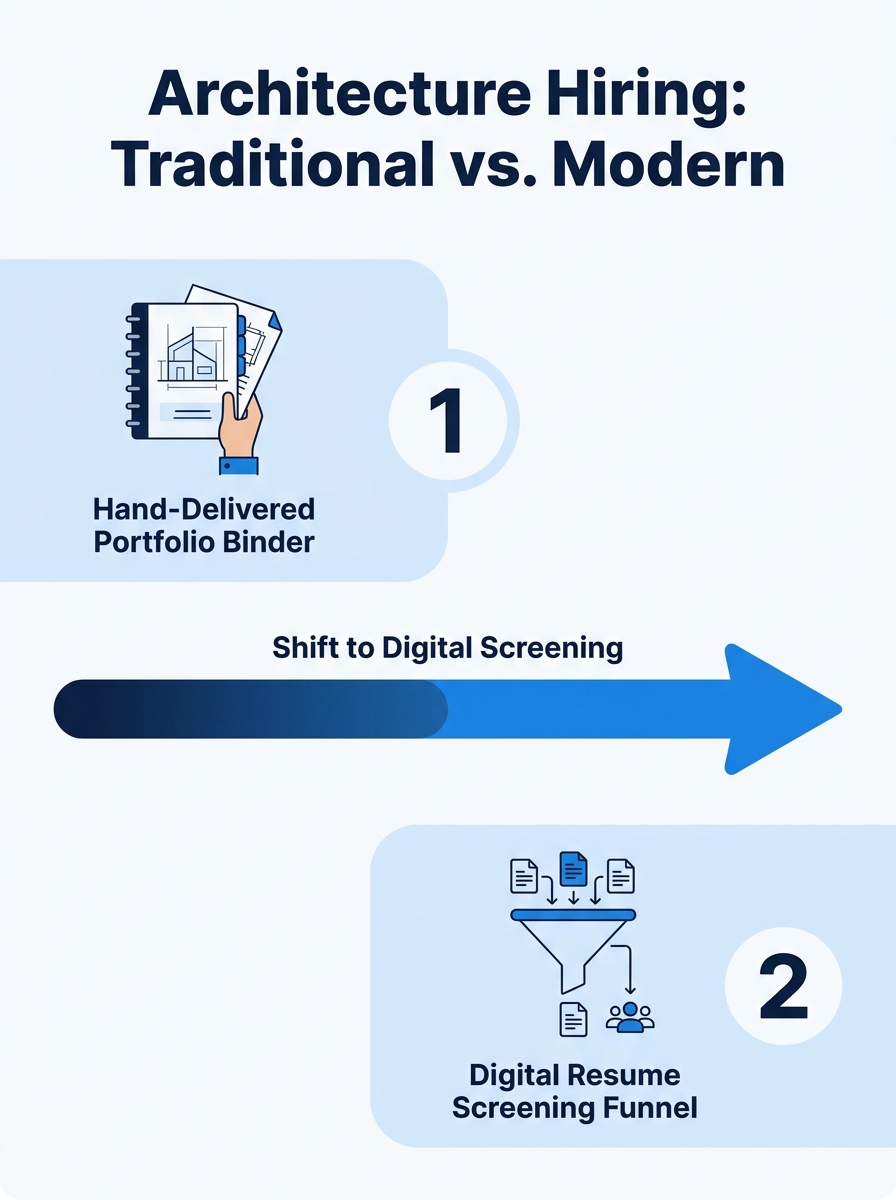
For most of the profession’s modern history, architecture hiring revolved around one document: the portfolio. You graduated, compiled your studio work into a carefully designed book, printed it at a copy shop (or later, exported it as a PDF), and hand-delivered it to firms you admired. The resume was an afterthought, a single sheet tucked into the front pocket of a presentation binder.
This made sense. Architecture is a visual discipline. Hiring managers at design-focused firms wanted to see your eye, your process, your ability to compose a page. The AIA has consistently noted that hiring managers in design prioritize the portfolio over almost every other application material. That priority hasn’t disappeared. What changed is what happens before anyone looks at your portfolio.
When Applicant Tracking Systems Entered Architecture
Architecture firms resisted the corporate hiring stack longer than most industries. Small studios with 10 or 15 employees didn’t need applicant tracking systems when they received a handful of applications for each opening. But as firms grew and the volume of digital applications increased, even mid-size practices began adopting ATS platforms. The same screening tools used by tech companies and financial institutions started filtering architect applications based on keyword matches, formatting compatibility, and section structure.
This created a new first gate that had nothing to do with design ability. Your resume now had to pass a machine before it reached a human. If your BIM tools resume placement buried Revit and Navisworks in an image-based skills graphic (the kind with progress bars and tiny icons), the ATS couldn’t read them. If you listed “Design Development” without the abbreviation “DD,” a keyword filter might miss it. If your resume was a single stylized image exported from InDesign, the parser saw a blank page.
Architects who understood how ATS screening works adapted their materials. Those who didn’t kept submitting beautiful, unreadable files and wondering why callbacks dried up.
The Portfolio Anxiety Spiral
Here’s where the hiding begins. When callbacks drop, most architects assume the problem is their portfolio. They spend weekends rebuilding it. They agonize over typeface choices, grid systems, and paper stock. They add more projects, more pages, more renders. One documented case from an industry review described a candidate whose professional experience didn’t appear until page 28 of a 33-page portfolio. By then, no hiring manager was still reading.
This spiral has a name in career coaching circles: portfolio anxiety. It’s the belief that if you could just present your design work more beautifully, the interviews would come. So you polish the portfolio endlessly while your resume stays a generic one-page list of job titles, date ranges, and the phrase “responsible for design development.”
The irony is painful. The architect’s best work, the complex problem-solving, the $12M mixed-use project they shepherded through permitting, the BIM coordination that saved a client 20% on construction costs, lives in a portfolio document that most screeners never open. The resume, which is the document screeners read, contains none of it.
The architect’s best work lives in a portfolio that most screeners never open. The resume, the document they actually read, contains none of it.
What Hiring Managers See in Five Seconds
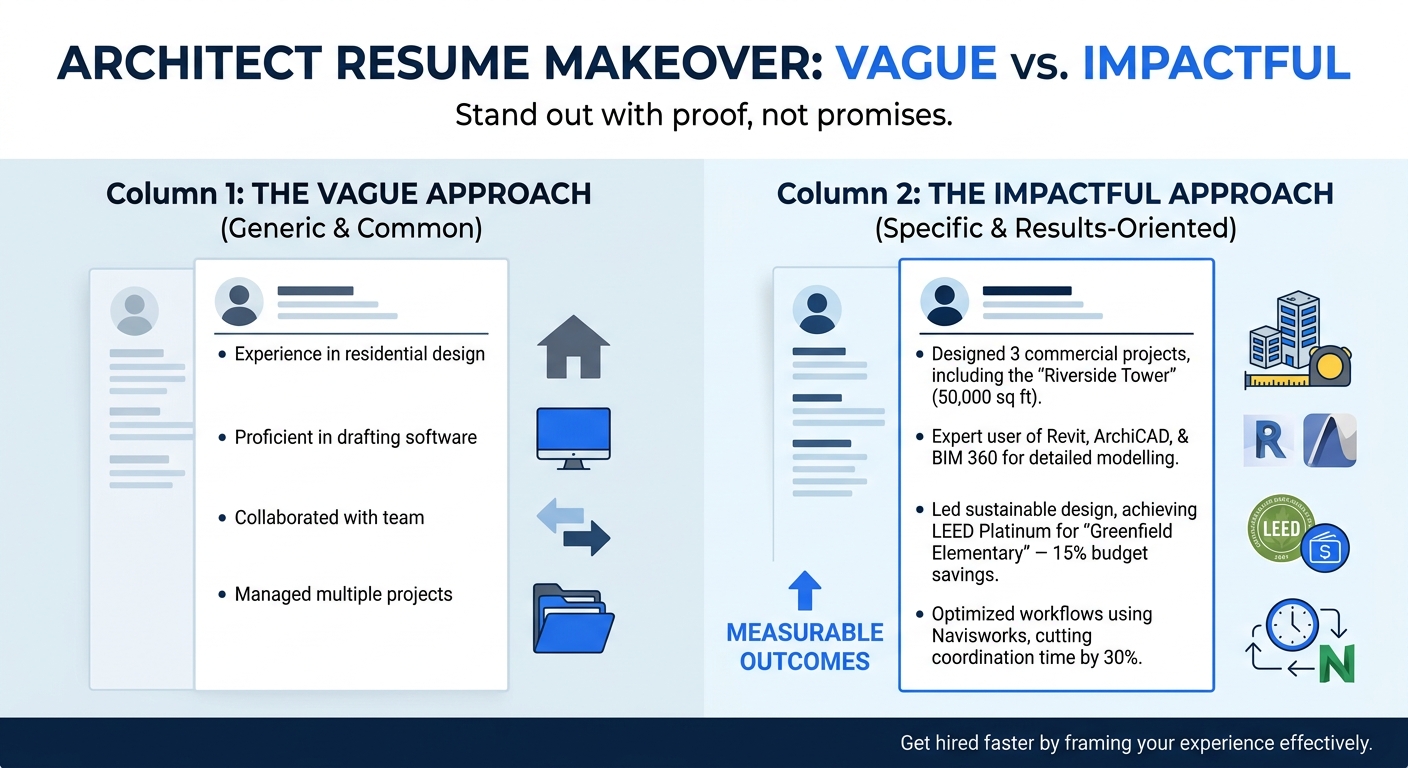
The architecture resume that works in 2026 looks different from the one most architects are sending. Resume Worded’s architecture examples emphasize bolstering bullet points with metrics: dollar value of project budgets, number of junior architects managed, percentage of building costs saved. Monster’s architecture resume guide recommends a dedicated “Project Highlights” section with three to five of your most impressive achievements described in bullet form.
That architect resume design focus matters because hiring managers are scanning for specifics, not generalities. They want to know: Can this person run a project at our scale? Do they have the technical tools we use? Have they worked on building types similar to ours?
A strong architecture portfolio strategy aligns your resume content with the evidence your portfolio will later provide. Think of the resume as the argument and the portfolio as the exhibit. If your resume claims you led schematic design for a 200-unit residential tower, the portfolio shows the drawings. But if the resume never makes that claim because you hid the project behind a vague bullet like “contributed to multi-family residential projects,” no one ever asks to see the exhibit.
Flagship Projects Belong on the Resume, Not Just in the Portfolio
One of the most common mistakes we see is architects treating flagship projects on resume as something too detailed or too boastful for a one-page document. They’ll mention a firm name and a date range, then save all project specifics for the portfolio. This is backwards.
Your resume should name two or three signature projects, include their scale (square footage, budget, unit count), and specify your role. “Led construction documentation for the 85,000 SF Meridian Office Campus ($14M budget, LEED Gold)” tells a hiring manager more in one bullet point than three pages of portfolio renders can communicate without context.
Resume Worded’s guidance is direct on this point: show recruiters a demonstrated history of interest and experience in architecture, and use metrics to prove impact. If you replace vague language with action-driven results, every bullet carries more weight.
BIM Tools Need Their Own Line
BIM proficiency is a gatekeeper skill in 2026 architecture hiring. Firms running Revit-based workflows will filter for candidates who list Revit explicitly. Those using Navisworks for clash detection or Dynamo for workflow automation need to see those terms spelled out. A resume that mentions “proficiency in BIM software” without naming specific tools fails the specificity test and often fails the ATS keyword scan too.
Tip: List your BIM tools in a dedicated “Technical Skills” line near the top of your resume, using full product names: Revit Architecture, Navisworks, AutoCAD, Dynamo, Rhino, Grasshopper. Do not use logos, icons, or progress bars. ATS can’t parse images.
The data on BIM tools resume placement backs this up. One case study from ResumeWorded noted that a BIM specialist who listed specific tools alongside measurable outcomes (“contributed to a 35% boost in client approvals” and “saved 5 hours per week on project planning”) received significantly more responses than candidates with identical experience who listed tools generically.
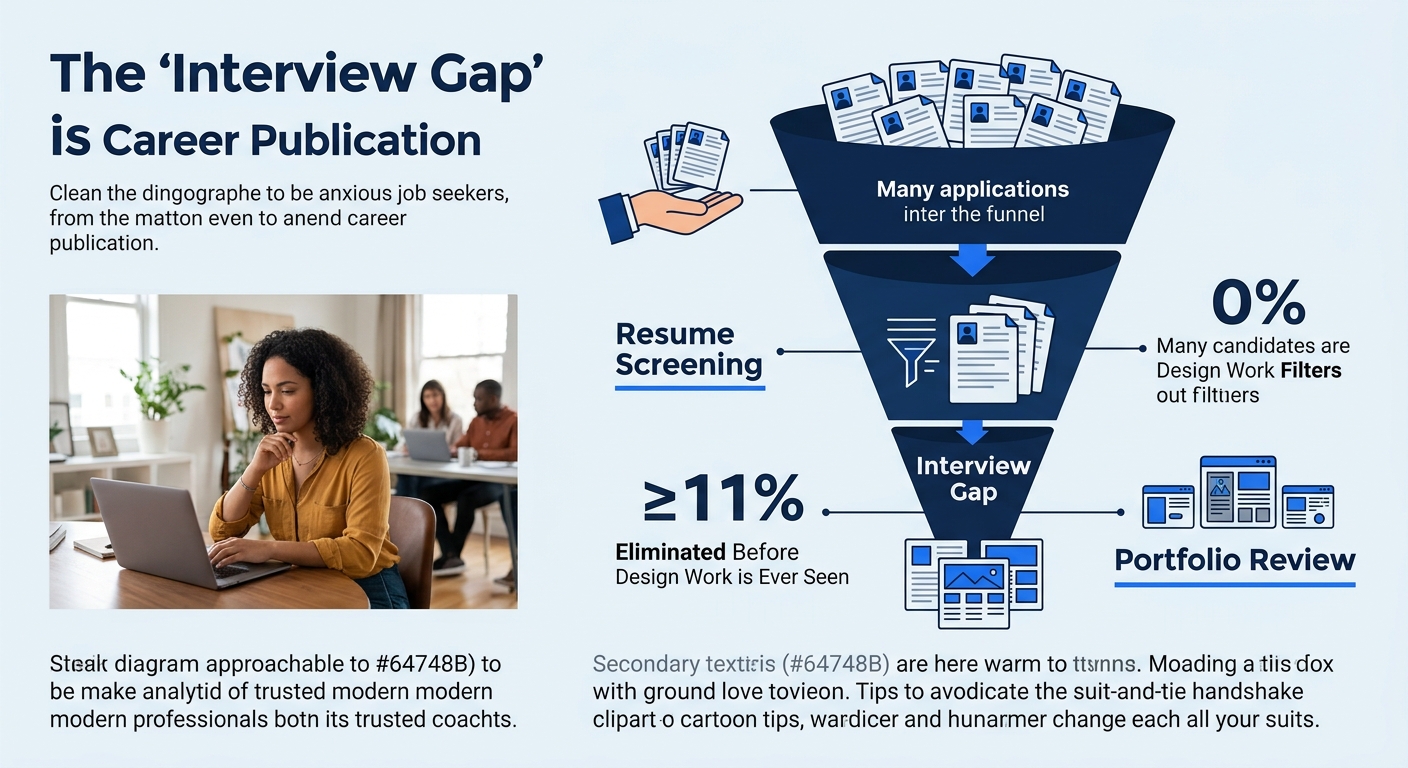
The Interview Gap Nobody Talks About
There’s a secondary problem that compounds the resume weakness. Multiple architects with three to five years of experience have reported on professional forums that even when they brought portfolios to interviews, the portfolios were barely looked at. Interviews at many firms are conversational, not portfolio-review sessions. The interviewer wants to know how you think, how you communicate, and whether you’d fit the team.
This means the resume does double duty. It’s the document that gets you into the room, and it’s often the only written record the interviewer references during the conversation. If your resume is thin on specifics, the interviewer has no prompts to ask you about. They default to generic questions, you give generic answers, and nobody ever discovers that you single-handedly managed the BIM coordination for a 300,000 SF healthcare project.
Architecture firms themselves contribute to this problem. As DAVRON has documented, many firms write vague job descriptions that don’t clearly define whether they need technical project leadership, client-facing project management, or a combination. When the job posting is unclear, architects don’t know which projects or skills to emphasize, so they emphasize nothing strongly.
If you’re struggling with what hiring managers actually notice in those first seconds of review, the answer for architects is the same as for every other field, just more acute: they notice specificity and they skip past generality.
Closing the Gap Between Documents
The fix isn’t complicated, but it requires architects to rethink which document carries the narrative. Your portfolio should remain a carefully curated showcase of your design thinking and process. Architizer’s career guide recommends customizing your portfolio’s theme for different firm types, building a case for mutual fit from both angles. For senior architects, Archipro’s hiring guide notes that portfolios should highlight complex problem-solving and direct client experience.
But your resume needs to carry the story of that work in compressed, scannable form. Think of it as the table of contents for your career. Each entry should give a hiring manager enough information to either advance your application or ask the right follow-up questions in an interview.
A few structural changes that make a measurable difference:
- Add a “Project Highlights” section below your summary, listing three to five signature projects with name, type, scale, budget, and your specific role. This is where your flagship projects on resume live.
- Lead bullets with outcomes, not responsibilities. “Reduced RFI volume by 40% through clash detection in Navisworks” beats “responsible for clash detection” every time.
- Match your resume’s project emphasis to the firm you’re applying to. If they specialize in healthcare, foreground your healthcare work. The portfolio strategy from Architizer (customize your theme per firm) applies equally to resume tailoring.
- Give BIM tools prime real estate. A dedicated technical skills line, placed in the top third of the page, ensures both ATS systems and human readers see your toolset immediately. The approach we outlined for making the most of white space on your resume applies here: a clean, scannable layout beats a cramped one.
And if you’re changing directions within architecture, say moving from residential to commercial, or from design to project management, the same principles that guide any career pivot resume apply. Lead with transferable outcomes, not with job titles.
Where This Lands Now
Architecture hiring still values design ability above almost everything else. That hasn’t changed, and the portfolio remains the primary evidence of that ability for design-focused roles. What has changed is the sequencing. The resume is now the first filter, and for a growing number of positions (project management, technical coordination, BIM leadership), it may be the primary document throughout the entire process.
Architects who treat the resume as an administrative formality, a required attachment they fill out in 20 minutes before returning to portfolio refinements, are systematically hiding their strongest qualifications from the people making hiring decisions. The anxiety flows in the wrong direction. The portfolio will speak for itself once someone opens it. The resume is what earns that opening.
If your callbacks have stalled and you’re about to start another portfolio redesign, stop and read your resume out loud instead. If it sounds like it could belong to any architect at your experience level, that’s the problem. Your best work is in there somewhere, waiting to be named, measured, and made visible to the people who need to see it.