

 4.9
4.9 4.5
4.5VirtualVocations released a comprehensive interview preparation guide on April 28, 2026, detailing tactical responses candidates can deploy when they encounter questions they cannot immediately answer, according to the remote job board’s blog. The guide frames unexpected questions as deliberate employer tests of problem-solving ability rather than knowledge gaps requiring apology.
The publication arrives as hiring managers increasingly structure interviews around behavioral scenarios and hypothetical challenges designed to assess real-time thinking, particularly for remote positions where independent problem-solving carries higher weight. VirtualVocations positions the guidance as a response to candidate anxiety over perfect-answer expectations that the firm says rarely match actual employer priorities.
Stalling Tactics Presented as Professional Communication
The guide outlines five specific techniques candidates can use to create thinking time without appearing unprepared, according to the publication. The first technique involves repeating or reframing the interviewer’s question before answering, which VirtualVocations describes as both a comprehension check and a moment to organize thoughts. The firm provides sample phrases including “That’s a great question about managing deadlines in remote teams” and “If I understand correctly, you’re asking about my approach to client communication.”
Asking for clarification appears as the second tactic, with VirtualVocations suggesting questions such as “Could you clarify what aspect of the project you’d like me to focus on?” The guide frames this as ensuring answer alignment with interviewer intent rather than dodging the question. The firm cautions against overusing the technique within a single interview session.
Physical pauses through water sips constitute the third approach, particularly for virtual interviews where candidates can position a glass within arm’s reach without appearing staged. Transition statements such as “That’s an interesting question” form the fourth category, giving candidates brief processing time while signaling thoughtful engagement.
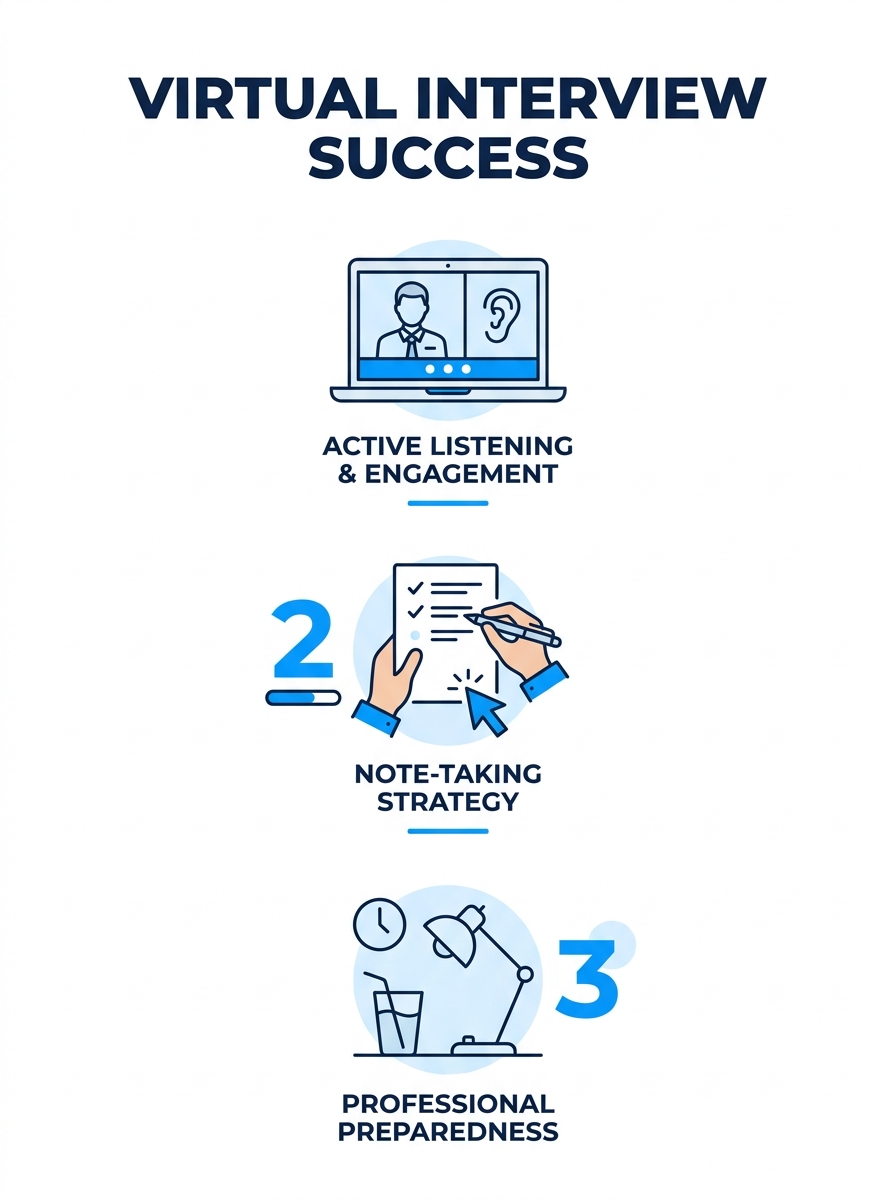
The fifth technique involves explicit requests for thinking time, which VirtualVocations frames as acceptable for complex scenario questions. The guide suggests phrasing such as “That’s a thoughtful question—can I take a moment to think it through?” while noting that most interviewers respond favorably to candidates who prioritize quality over speed in responses.
Thought Process Demonstration Over Perfect Answers
VirtualVocations emphasizes showing analytical reasoning when complete answers remain unclear, a strategy the guide describes as “thinking out loud.” The publication suggests candidates verbalize their approach to unfamiliar problems by stating which factors they would evaluate first, what information they would gather, or which stakeholders they would consult. This technique applies particularly to hypothetical scenarios or technical challenges outside a candidate’s direct experience.
The guide distinguishes between admitting knowledge gaps and demonstrating problem-solving frameworks. VirtualVocations recommends acknowledging unfamiliarity with specific tools or processes while pivoting to comparable experience, using phrases such as “I haven’t worked with that exact platform, but I’ve handled similar workflows in previous roles.” The firm positions this as honesty combined with transferable skill demonstration rather than evasion.
Research on interview effectiveness supports prioritizing communication process over perfect recall. First-question storytelling has shown measurable advantages over credential recitation in initial interview exchanges, suggesting that how candidates structure responses carries weight independent of answer content.
Preparation Framework Beyond Stalling Techniques
The April 28 publication pairs tactical response strategies with preparation recommendations, noting that stalling techniques serve as backup rather than primary strategy. VirtualVocations advises candidates to research common industry interview questions, prepare specific examples from work history, and practice articulating thought processes before interview dates. The guide suggests candidates prepare three to five detailed scenarios demonstrating problem-solving, collaboration, and independent judgment that can adapt to multiple question types.
For remote positions specifically, the publication recommends candidates prepare examples showing self-directed work management, asynchronous communication clarity, and technical troubleshooting without immediate support. These scenarios align with employer priorities VirtualVocations identifies for distributed teams where hiring managers assess candidate ability to function independently across time zones and communication platforms.
The guide estimates that candidates typically need six to eight hours of interview preparation for mid-level positions, including question research, example selection, and practice delivery. This timeline excludes role-specific technical preparation or portfolio assembly.
Why This Matters Now
Interview pressure creates a binary thinking trap where candidates believe they must either produce perfect answers immediately or fail the evaluation entirely. The VirtualVocations guide dismantles that framework by reframing unexpected questions as communication assessments rather than knowledge tests. For nervous job seekers who catastrophize single difficult questions, this shift in perspective reduces anxiety that can cascade through entire interview sessions.
The tactical stalling techniques serve a practical function beyond buying thinking time—they demonstrate the same workplace communication skills hiring managers evaluate in behavioral questions. A candidate who pauses to clarify a vague question before answering shows the same stakeholder-management instinct required in client meetings or cross-functional projects. Someone who verbalizes their reasoning process for an unfamiliar scenario demonstrates the transparency remote teams need when collaborating asynchronously across different schedules.
The publication’s timing reflects sustained job market uncertainty following recent tech sector layoffs and economic volatility, conditions that amplify candidate interview anxiety while simultaneously increasing competition for available positions. Candidates who master tactical response frameworks gain measurable advantages in markets where multiple qualified applicants compete for single openings and slight performance differences during interview rounds determine final selections.