
 4.9
4.9 4.5
4.5Ten companies entered a cohort program documented by Forbes in March 2026, and every single one started the same way: by tearing apart their own job descriptions. They stripped degree requirements, deleted years-of-experience thresholds, and replaced both with lists of specific, testable skills. The participants later reported that hands-on exercises (physically rewriting real job postings and practicing structured interviews) built confidence “far more than discussing the theory of skills-first hiring.” One company in the cohort made five skills-first hires within months of completing the program.
This matters for you because it signals a concrete shift in how employers evaluate candidates. Skills-first hiring places primary emphasis on skills as the determinant of qualification for a role, according to Opportunity@Work. And when the employer side of the equation changes, the resume you send has to change too.
If your job titles don’t reflect the work you actually do, or the work you want to do next, the skills-based resume format exists precisely for this moment.
The Job Description Rewrite That Started Everything
The Forbes cohort didn’t begin with resumes. It began with employers admitting their own job postings were broken.
Think about what a traditional job posting looks like: “Requires 7+ years in project management. Bachelor’s degree required. MBA preferred.” These requirements screen for credentials, not capability. The cohort participants rewrote postings to say things like “Can manage cross-functional timelines across three or more teams” or “Demonstrates proficiency in stakeholder communication during high-pressure deliverables.”
The shift matters. When an employer writes “7+ years in project management,” your resume needs to show seven years with “Project Manager” in the title. When they write “manages cross-functional timelines,” your resume needs to show you’ve done that work, regardless of what your title was.
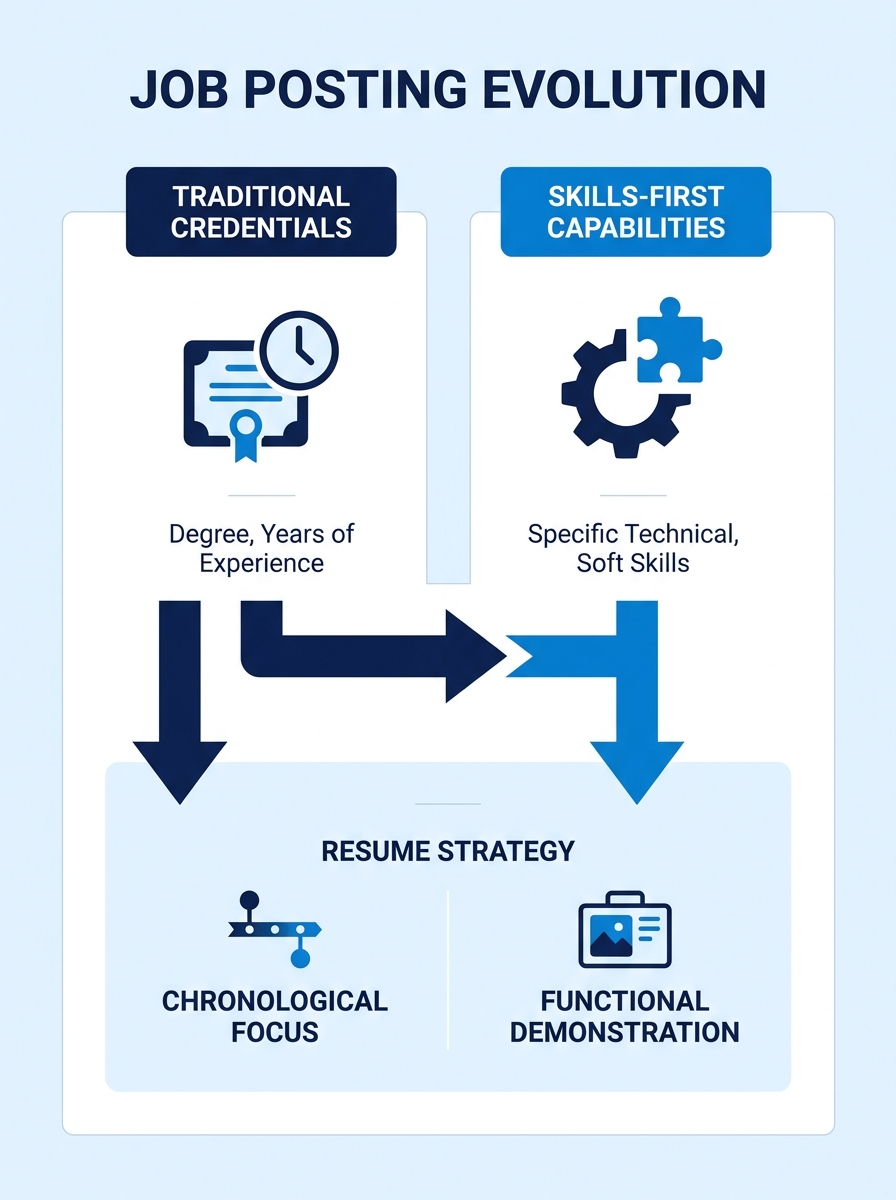
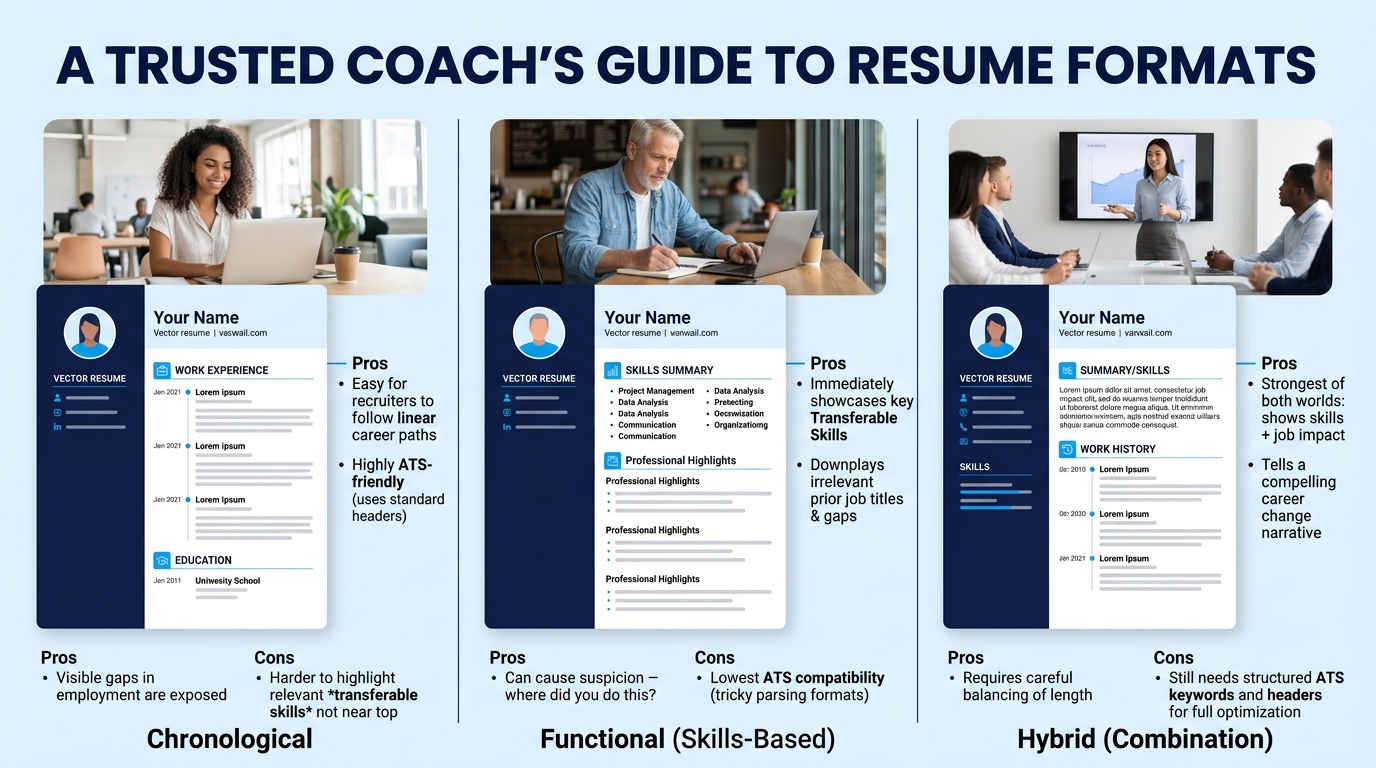
This is why the skills-based resume format has gained traction in skills-first hiring 2026. The format leads with categorized skill groups and supporting evidence rather than a reverse-chronological list of employers and titles. A chronological resume focuses on your job titles and professional trajectory over time; in the functional format, skills and competencies come first, followed by a condensed employment section.
And here’s the key insight for career changers: when the job posting itself has been rewritten around skills, a skills-first resume is the natural response. You’re matching the language the employer already chose.
How Transferable Skills Hide Inside Ordinary Work
The hardest part of building a skills-based resume isn’t formatting. It’s the identification step. Most people undercount their transferable skills because the skills feel too ordinary to mention.
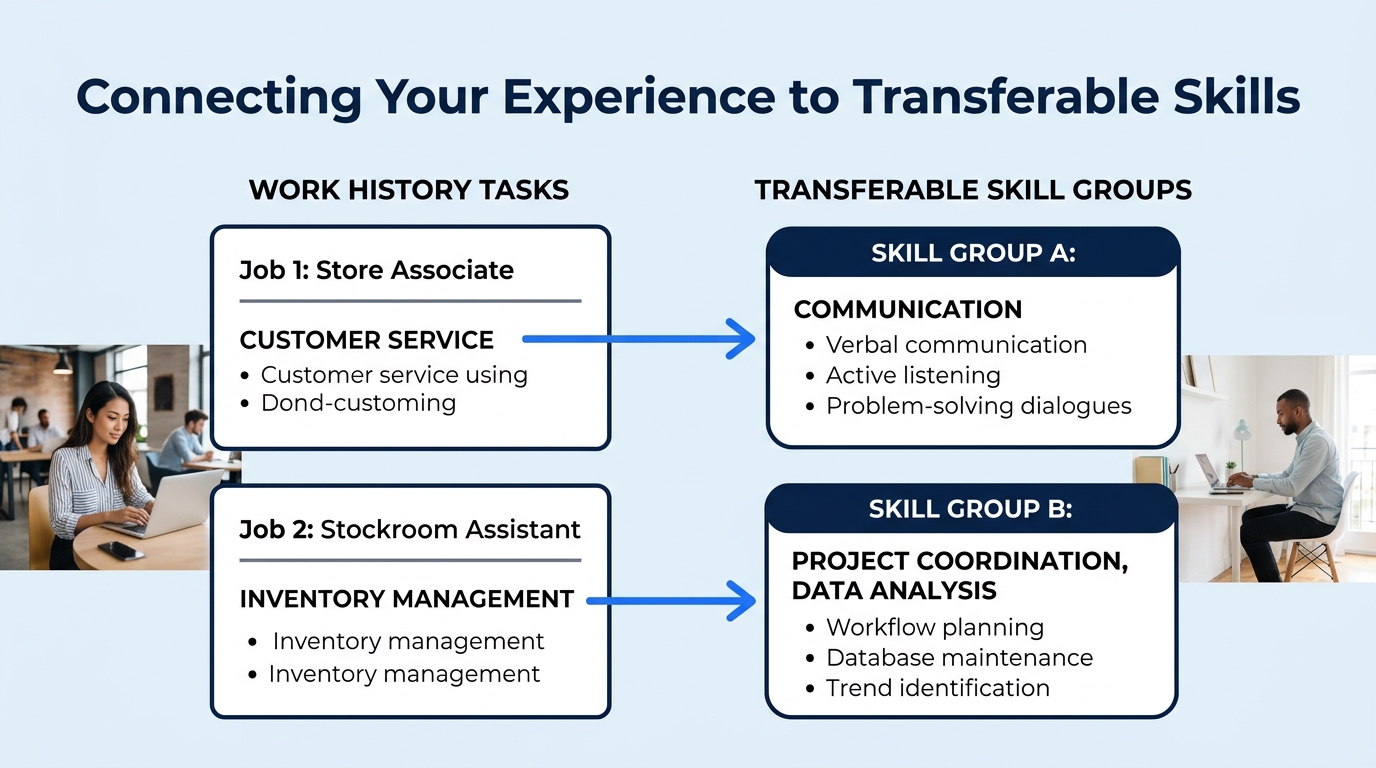
Purdue University’s OWL writing lab makes this point with a deceptively simple example: if you talked to customers while working at McDonald’s and investigated communication patterns in a psychology course, you’ve demonstrated communication skills. The specific context doesn’t matter as much as the underlying capability.
This is where transferable skills identification gets practical. iHire’s career change research notes that recognizing these assets “shifts your focus from what you lack (experience in the new field) to what you bring (proven abilities that drive results).” They also acknowledge the emotional barrier: when you’ve been in the same role for years, you might take certain abilities for granted because they feel like second nature.
So how do you actually surface these skills? The Reddit career guidance community offers a blunt but effective method: start by listing every skill you can think of, then match them against job descriptions in your target field. Highlight the overlaps. Those overlaps become the architecture of your resume.
Here’s a concrete process:
- Pull five job postings for roles you want.
- Copy every skill or capability mentioned in each posting into a single document.
- Circle every skill you’ve actually used, even if the context was completely different from the target industry.
- Group the circled skills into three or four categories (communication, technical proficiency, project execution, analysis, or whatever fits your background).
- Under each category, write two to three bullet points describing when and how you used that skill, with measurable outcomes wherever possible.
This is essentially resume builder skills extraction done manually. If you’ve explored how AI tools can help rewrite resume content, the same principle applies here: you’re pulling raw material from your experience and reorganizing it around what the employer actually needs.
The Before-and-After Reframe
Let me walk through what this looks like on paper.
Imagine someone who spent four years as a restaurant general manager and wants to move into operations management at a logistics company. Their chronological resume leads with:
General Manager, Rosario’s Italian Kitchen, 2022–2026
- Managed daily restaurant operations including staffing, inventory, and customer service
- Supervised a team of 22 employees across front-of-house and kitchen
- Handled vendor relationships and supply ordering
Every bullet is accurate. And every bullet screams “restaurant,” which is the one industry this person is trying to leave.
Now here’s the same experience restructured into a career transition resume structure:
Operations & Workforce Management
- Directed daily operations for a $1.8M-revenue business, maintaining profit margins within 2% of annual targets
- Built and managed weekly schedules for a 22-person team across two departments, reducing overtime costs by 15% through shift optimization
- Negotiated contracts with 11 vendors, cutting supply costs by 8% year-over-year while maintaining quality benchmarks
Stakeholder Communication & Problem Resolution
- Resolved an average of 6 escalated customer issues per week, maintaining a 4.7/5 satisfaction rating across review platforms
- Presented monthly P&L summaries and operational reports to ownership group
- Trained 40+ new hires using a standardized onboarding process that reduced 90-day turnover by 22%
The restaurant is still there. It appears in a brief employment history section at the bottom. But the reader’s first impression is of someone who manages operations, controls costs, leads teams, and communicates with stakeholders. The framing converts vague experience into measurable impact statements that translate across industries.
When the employer side of the equation changes—when postings lead with skills instead of credentials—the resume you send has to change too.
Notice what happened to the job title. It disappeared from the spotlight. The title “General Manager” at a restaurant carries a specific connotation that limits how a hiring manager imagines you. The skills categories carry no such limitation.
This approach pairs well with stronger action verbs throughout your bullets. “Managed daily restaurant operations” becomes “directed daily operations for a $1.8M-revenue business.” Same experience, completely different signal.
The Structural Tradeoffs Worth Understanding
The skills-based resume format has real advantages for career changers, but it also has tradeoffs that deserve honest consideration before you commit to it.
The biggest advantage: it lets you control the narrative. Instead of the reader scanning your titles and making assumptions, you decide which skills they encounter first. For anyone whose titles undersell their actual capabilities, this control is valuable.
The biggest risk: some recruiters and applicant tracking systems still expect chronological formatting. A fully functional resume with no dates, no titles, and no employment context can raise questions. Did this person work somewhere? When? The gap in context creates suspicion rather than curiosity.
The best approach for most career changers is a hybrid. Lead with a summary statement and a skills section organized by capability area, each with concrete, quantified accomplishments. Then include a brief employment history with titles, companies, and dates. This gives you the narrative control of a skills-first layout and the structural familiarity that ATS systems and traditional recruiters expect.
Tip: Your skills summary section should be tailored to every application. Create a master list of all your skills, then cross-reference it against each job description. The overlap between your master list and the posting’s requirements becomes your skills section for that specific application.
If you’re navigating a full career pivot with templates and coaching guidance, the hybrid format is almost always the safest bet. It signals confidence in your skills without hiding your work history.
What the Forbes Cohort Revealed About the Candidate Pool
The ten companies in the Forbes cohort discovered something that should reassure every career changer reading this: when they removed credential-based filters and evaluated candidates on demonstrated skills, they found qualified people they would have previously screened out.
Participants in the program cited job description templates, structured interview rubrics, and sample evaluation questions as the most valuable tools. The emphasis on practice over theory meant these companies went beyond agreeing that skills-first hiring was a good idea. They built the infrastructure to actually do it. And the fact that one company made five skills-first hires so quickly suggests the candidate pool was already there, waiting to be seen through a different lens.
This is the part that connects back to your resume. Skills-first hiring is real, it’s growing, and it changes what a “qualified candidate” looks like on paper. If you’ve spent years building capabilities inside a job title that doesn’t translate, the skills-based resume format gives you a way to present those capabilities in the language employers are increasingly using.
The work isn’t easy. Transferable skills identification requires honest self-assessment, and the rewriting process takes time. You might look at your experience and struggle to see the transferable value because, as the research from iHire puts it, those abilities feel like second nature. But the companies on the other side of the hiring table are actively learning to look past titles and credentials. Your resume should meet them where they’re headed.