
 4.9
4.9 4.5
4.5The job market in 2026 is smarter, faster, and more competitive than ever. Companies are using AI to screen applications, hiring across time zones, and prioritizing impact over tenure. That means your resume writing can’t just list what you’ve done — it has to clearly communicate your value.
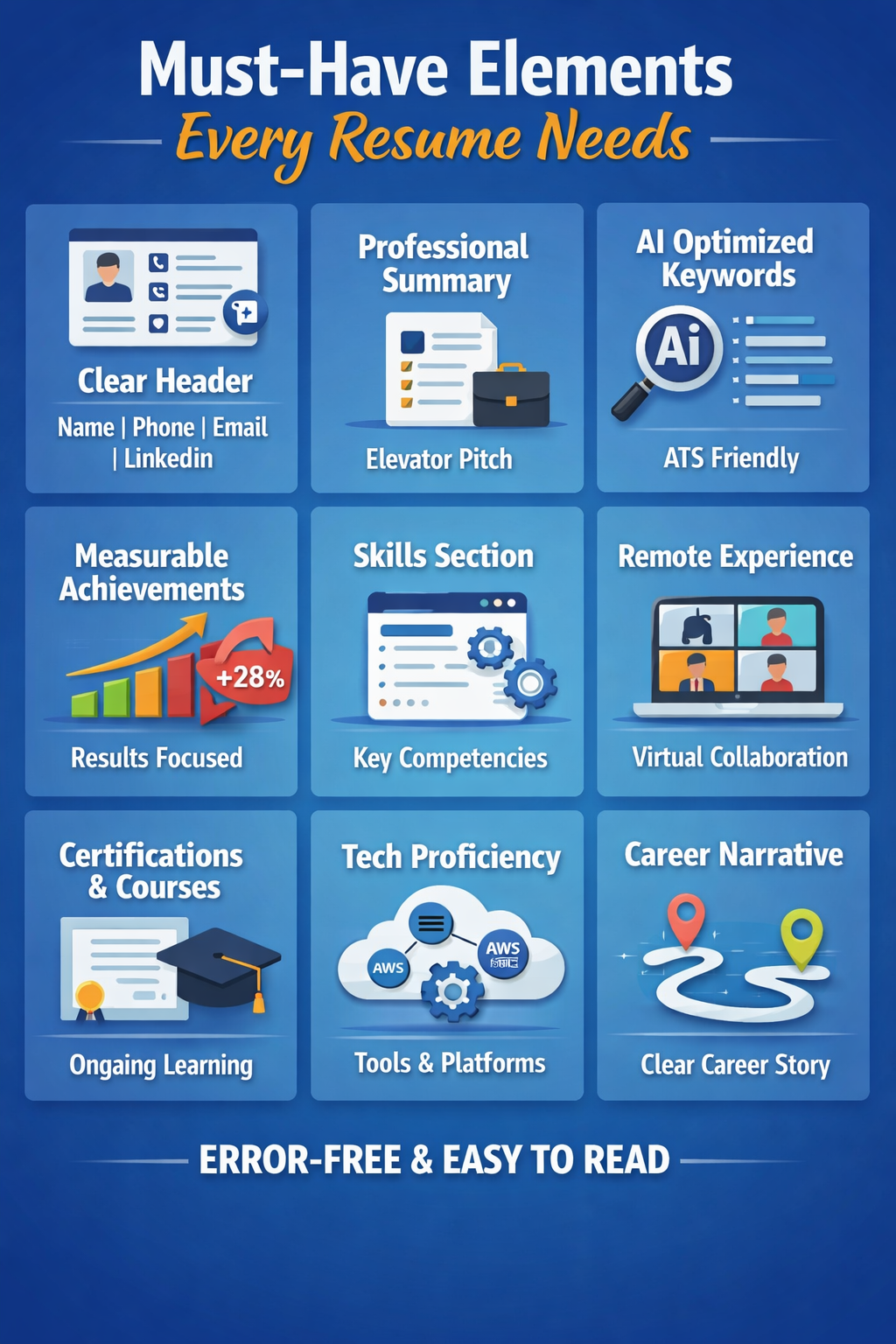
If you’re refreshing your resume this year, here are the 15 essential elements you need — and why they matter more than ever.
1. A Clear, Modern Header
Your resume header sets the tone. It should feel polished and professional within seconds.
Include your full name (slightly larger than the rest of the text), phone number, professional email, LinkedIn profile, and portfolio if relevant. In 2026, there’s no need for a full mailing address — city and state are enough.
Make sure your email sounds professional. If you’re still using something you created in high school, it’s time for an upgrade. This small detail signals maturity and attention to detail.
2. A Strong Professional Summary
The old-school objective statement (“Seeking a position where I can grow…”) no longer works. Employers already know you’re seeking a position — you applied.
Instead, open with a 3–4 line professional summary that answers:
- Who are you professionally?
- What’s your expertise?
- What measurable value do you bring?
For example:
“Data-driven marketing strategist with 6+ years of experience scaling B2B SaaS brands. Specializes in demand generation and lifecycle campaigns that drive revenue growth.”
Short. Clear. Impactful.
3. Keywords Optimized for AI Screening
Today, your resume is read by software before it’s read by a human.
Applicant Tracking Systems (ATS) scan for keywords pulled from the job description. If the role emphasizes “budget forecasting” and you wrote “financial planning,” you may not get credit — even if you’ve done the work.
Carefully study the job posting. Mirror important terminology naturally throughout your resume. This isn’t about stuffing keywords — it’s about alignment.
Think of it as speaking the employer’s language.
4. Measurable Achievements (Not Just Duties)
Hiring managers don’t just want to know what you were responsible for. They want to know what changed because you were there.
Compare these two bullets:
- Managed customer support team
- Led a 12-person support team and reduced ticket resolution time by 35%
The second one shows impact. Whenever possible, quantify:
- Revenue increases
- Cost reductions
- Efficiency improvements
- Growth percentages
- Engagement rates
Numbers make your contributions real and credible.
5. A Skills Section That’s Strategic
Your skills section should be intentional, not a long list of vague abilities.
Focus on:
- Technical tools
- Industry-specific knowledge
- Software proficiency
- Certifications
In 2026, simply listing “Microsoft Office” won’t impress anyone. Instead, be specific:
- Advanced Excel (pivot tables, financial modeling)
- Python for data analysis
- CRM automation (HubSpot, Salesforce)
Your skills should reinforce the story your experience tells.
6. Proof of Adaptability
The workplace is evolving constantly. AI tools, automation, shifting markets — adaptability is no longer optional.
Use your resume to show moments where you:
- Learned new systems quickly
- Stepped into a new role during change
- Took on cross-functional responsibilities
- Led initiatives outside your job description
Employers are hiring for resilience and growth mindset as much as they are for technical ability.
7. Remote & Digital Collaboration Experience
Even companies with offices now operate in hybrid environments. Demonstrating that you can thrive in digital spaces gives you an edge.
Mention experience with:
- Distributed teams
- Collaboration tools (Slack, Teams, Asana, Notion)
- Virtual presentations
- Managing projects across time zones
If you’ve successfully worked remotely, say so. It signals independence, discipline, and strong communication skills.
8. A Results-Driven Work History
Your experience section should be easy to skim but powerful in content.
For each role, include:
- Job title
- Company name
- Dates (month and year)
- 3–5 bullet points focused on results
Avoid long paragraphs. Hiring managers often scan resumes in under 10 seconds before deciding whether to read deeper. Structure helps them find what matters quickly.
9. Relevant Certifications or Micro-Credentials
Learning doesn’t stop after college — and employers love to see proof of continuous growth.
If you’ve completed:
- Industry certifications
- Online programs
- Leadership training
- Specialized workshops
Include them.
Micro-credentials are especially valued in 2026 because they show you’re proactive and committed to staying current in your field.
10. A Tech Stack (If Applicable)
If you work in tech, marketing, finance, operations, or design, a clearly defined tech stack can instantly boost your credibility.
For example:
Marketing Tech Stack:
- Google Analytics 4
- Meta Ads Manager
- HubSpot
- SEMrush
Engineering Stack:
- Python
- React
- AWS
- Docker
This makes it easy for hiring managers to quickly assess fit.
11. A Clean, Readable Layout
Design communicates professionalism before a single word is read.
Keep your layout:
- Simple
- Well-spaced
- Consistent
- Easy to scan
Avoid excessive graphics, icons, or complicated templates that may confuse ATS systems. Clean formatting wins in 2026.
If someone has to “work” to read your resume, it’s too busy.
12. Personal Branding Consistency
Recruiters almost always check LinkedIn.
Make sure:
- Job titles match
- Dates align
- Achievements don’t contradict
- Your messaging feels cohesive
Your resume and online presence should tell the same story. Consistency builds trust.
13. Soft Skills — Backed by Evidence
Soft skills still matter — communication, leadership, collaboration — but they need proof.
Instead of listing:
- Strong communicator
- Team player
Show it through experience:
- Delivered weekly stakeholder presentations
- Facilitated cross-department workshops
- Mentored 5 junior team members
Evidence is more persuasive than adjectives.
14. A Clear Career Narrative
Even if you’ve changed industries or roles, your resume should feel intentional.
Help employers understand:
- Why you pivoted
- How each role built transferable skills
- Where you’re headed next
When your career story makes sense, hiring managers feel more confident investing in you.
15. Zero Errors
Attention to detail matters more than ever.
Typos, inconsistent formatting, or grammatical mistakes suggest carelessness — even if you’re highly qualified.
Before sending your resume:
- Run spell check
- Read it out loud
- Have someone else review it
- Check formatting consistency
In a competitive market, small errors can cost big opportunities.
Final Thoughts
Your resume isn’t just a summary of your work history. It’s your professional marketing document.
In 2026, the strongest resumes are:
- Clear
- Data-driven
- Aligned with job descriptions
- Designed for both AI and humans
Treat your resume like a strategic asset, not a last-minute requirement. When it clearly communicates your value, you don’t just apply for jobs — you position yourself for conversations that can change your career.