


 4.9
4.9 4.5
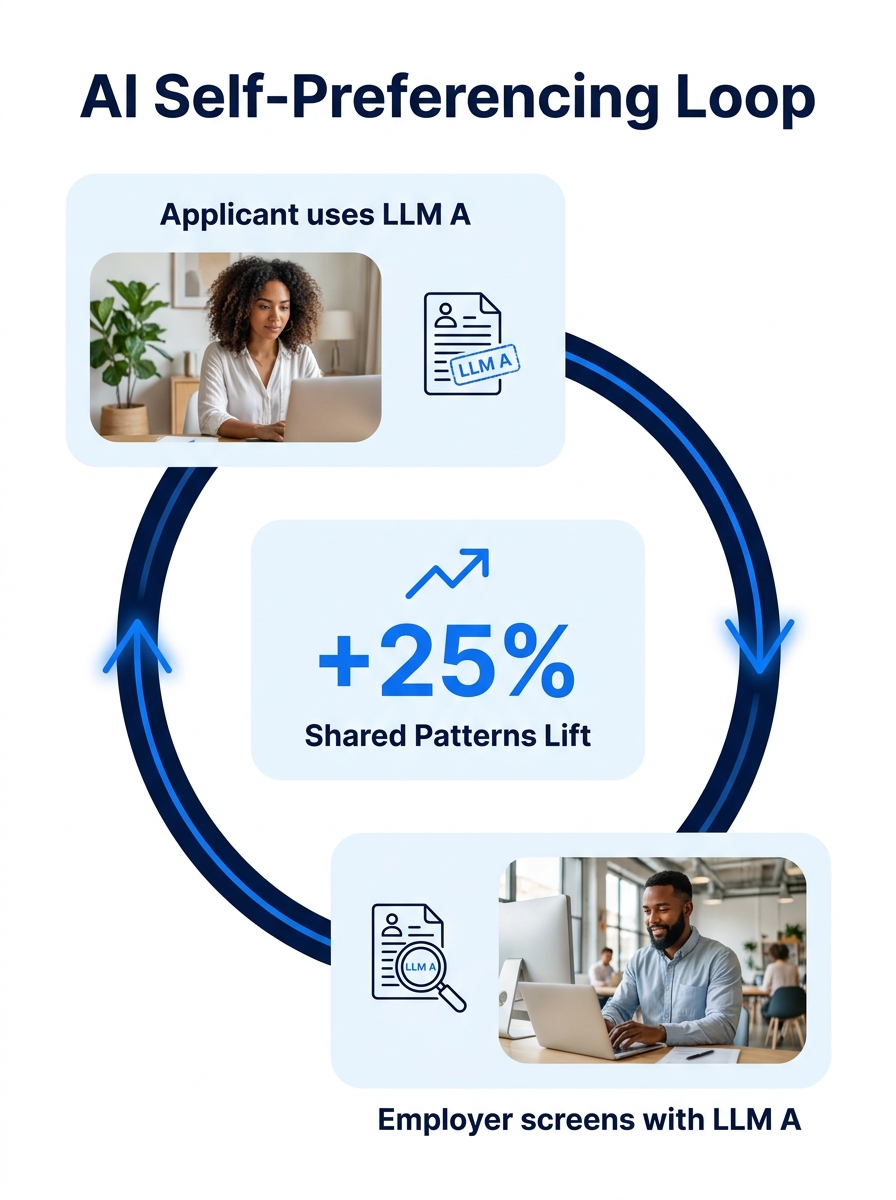
4.5Nvidia’s Chief Software Architect Jonathan Ross told attendees at the 2026 Sohn Investment Conference that résumés written by a specific AI model score higher when screened by that same model. The phenomenon, called AI self-preferencing, means the tools candidates use to write résumés and the tools employers use to screen them are now locked in a feedback loop that distorts algorithmic hiring fairness for everyone involved.
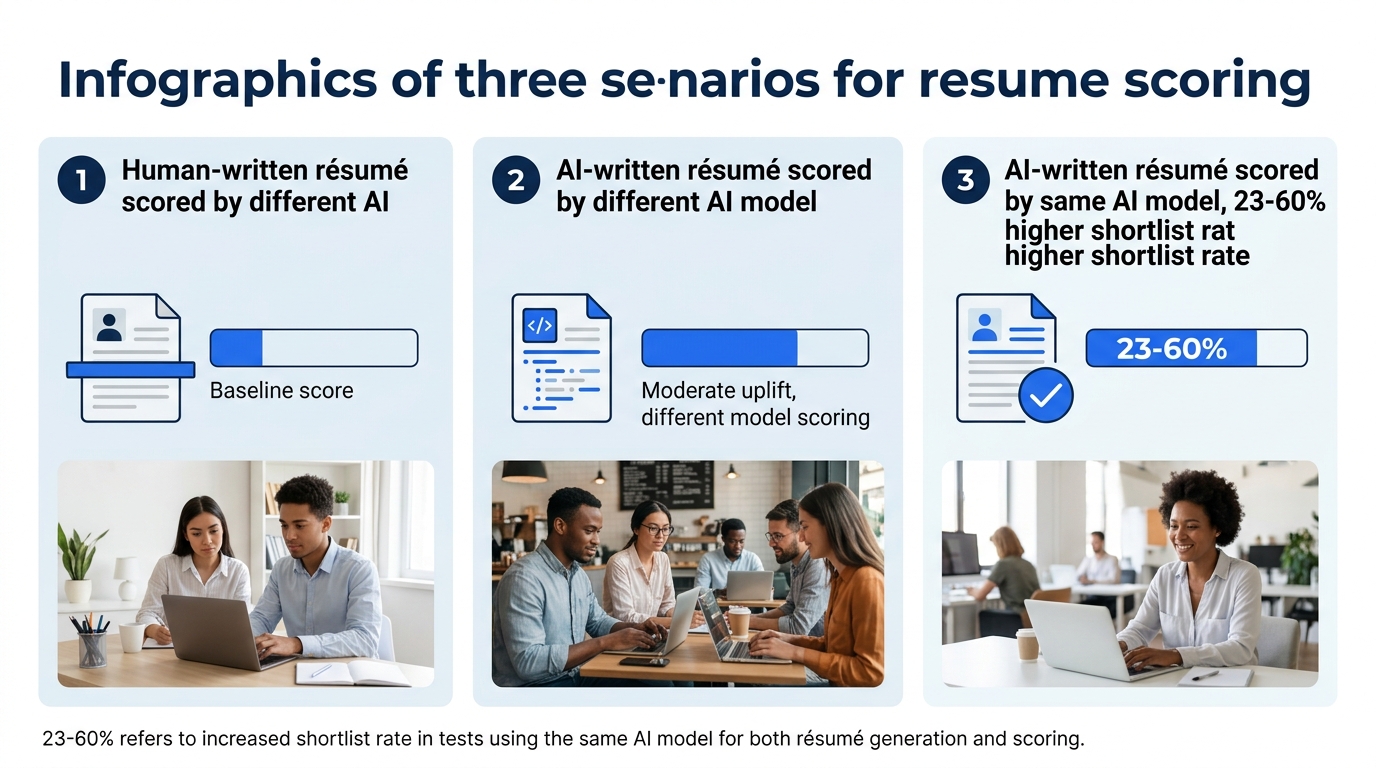
TL;DR: AI-generated résumés get preferentially ranked by screening systems built on the same underlying models, creating a loop where LLM resume optimization matters more than qualifications. A 2025 study found same-model candidates were 23% to 60% more likely to be shortlisted. AI resume bias is becoming structural, and both employers and applicants are caught in it.
The Self-Preferencing Mechanism
Why does an AI recruiter favor a résumé written by the same AI family? Because large language models trained on overlapping datasets produce text with shared statistical signatures in word choice, sentence rhythm, and semantic structure. When a screening LLM scores a document for “relevance” or “clarity,” it assigns higher confidence to patterns it already associates with high-quality output. Those patterns happen to be its own.
A late-2025 academic paper titled “AI Self-preferencing in Algorithmic Hiring,” published in the Proceedings of the AAAI/ACM Conference on AI, Ethics, and Society, tested over 2,200 résumés across 24 occupations. Candidates whose résumés were generated by the same model as the evaluator were 23% to 60% more likely to be shortlisted, even when qualifications were identical to human-written applications.
Ross’s advice was blunt: “You should build one résumé with Claude or Opus 4.7 and one with ChatGPT, and you’ll have the highest probability of being selected, basically.” That recommendation reveals how quickly AI resume builder manipulation has become a legitimate job-search tactic. The hiring pipeline now rewards candidates who correctly guess which model their target employer uses, rather than candidates with the strongest qualifications.
The ATS Gatekeeping Layer
Before any LLM-powered ranking system touches a résumé, the Applicant Tracking System acts as the first filter. An ATS stores, organizes, and manages job applications, scanning for keywords, formatting compliance, and structural markers. According to Forbes, a qualified candidate with a poorly formatted résumé or missing keywords never makes it past the algorithm, while a less qualified candidate who understands ATS rules can advance to human review.
A 2025 Resume.org survey of nearly 1,400 U.S. workers quantified the scale. 57% of companies use AI in hiring workflows. Of those, 79% use AI specifically to review résumés. And 74% allow AI systems to reject candidates without any human intervention at all. Run the math: roughly 33% of companies with AI hiring tools let algorithms make final rejection decisions with zero human oversight.
This is where the concern about AI sorting algorithms going beyond basic screening becomes concrete. The ATS layer filters on structure and keywords. The LLM layer then ranks whatever survives on semantic quality. Candidates who clear both gates aren’t necessarily more qualified. They’re more optimized. And the optimization itself requires understanding both layers, which creates an information asymmetry that disadvantages anyone who doesn’t know these systems exist.
How LLM-Optimized Résumés Converge
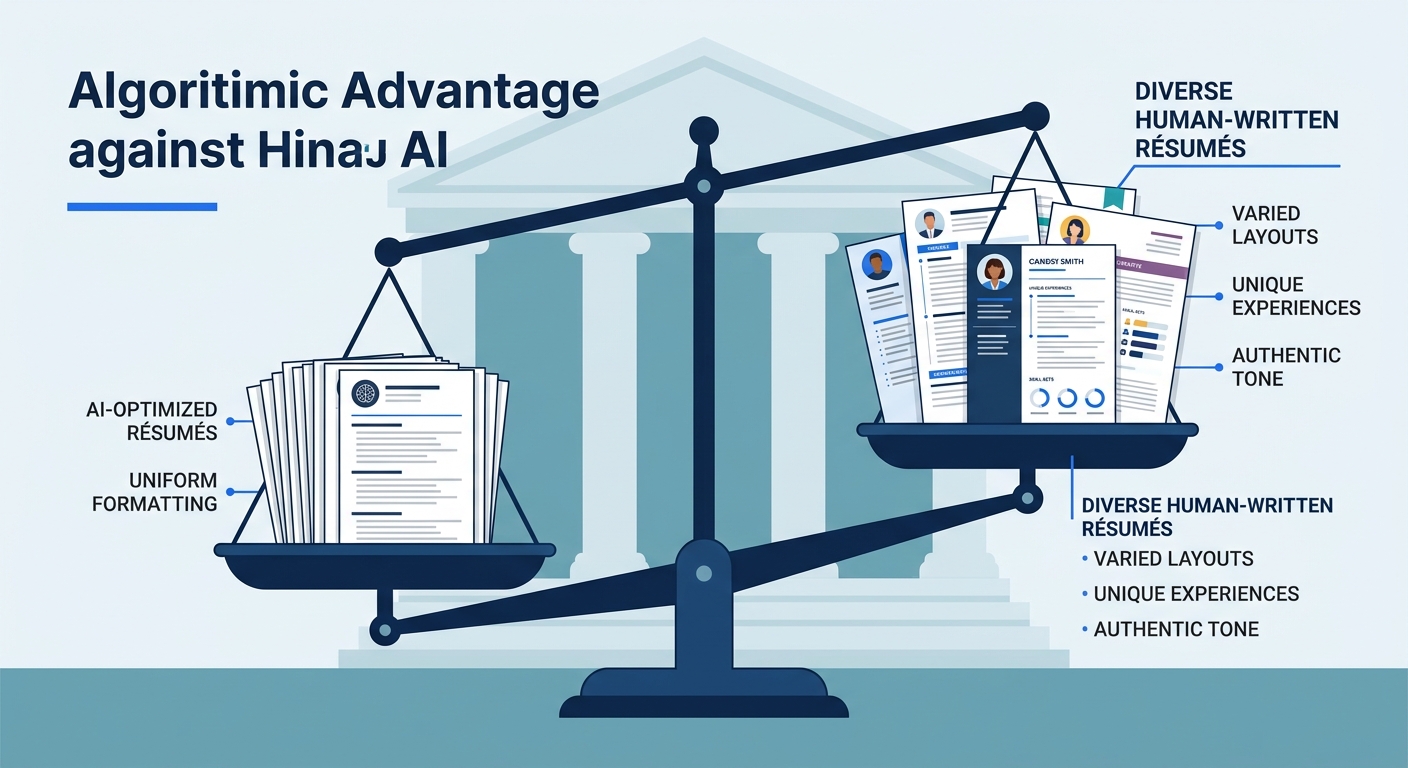
When thousands of applicants feed the same job description into the same AI tools, the outputs start to look identical. The same action verbs appear. The same bullet structures repeat. The same quantification patterns emerge. We’ve written about how one-click job matching erodes unique value, and the mechanism behind that erosion is straightforward: LLMs are probabilistic text generators that converge on high-probability token sequences. Given identical prompts (the same job listing), they produce near-identical outputs.
This convergence creates two problems at once. For applicants, LLM resume optimization without differentiation turns every résumé into a commodity. For employers, screening systems struggle to distinguish between 500 nearly identical documents.
A three-year study of a global consumer-goods firm, published in Harvard Business Review in December 2025, found that their algorithmic hiring system privileged a rigid definition of “fit” that sidelined managers’ local judgment. When every résumé looks the same to the algorithm, the algorithm defaults to whatever narrow criteria it was trained to weight most heavily. Research from Personnel Today confirms the downstream effect: AI in recruitment is causing employers to overlook strong candidates, reinforcing concerns that automated processes systematically miss people who would perform well in the role.
The Bias Amplification Layer
AI resume bias compounds across each stage of the pipeline. At the ATS level, keyword matching penalizes candidates who describe equivalent experience using different terminology. At the LLM ranking level, self-preferencing rewards applicants who happened to pick the right tool. And at the historical data level, models trained on past hiring decisions inherit every bias those decisions contained.
Amazon’s case remains the most cited example: the company scrapped its AI recruiting tool after discovering it penalized résumés containing the word “women’s,” because training data reflected a decade of predominantly male hiring patterns. But subtler forms of bias are harder to spot. In AI-driven ranking systems, a career gap reduces a candidate’s predicted “success probability,” indirectly disadvantaging caregivers. Educational pedigree weighted by degree prestige privileges candidates from wealthier socioeconomic backgrounds. ZIP code data, even when anonymized, can serve as a proxy for race.
Candidates can’t see the criteria, can’t appeal the decision, and often don’t even know AI was involved.
Only 26% of applicants trust AI to evaluate them fairly, according to Gartner research. That trust gap reflects a real asymmetry. For job seekers navigating this landscape, understanding the gap between ATS optimization and what human hiring managers actually want is essential. A résumé that scores well with the algorithm and reads well to a person requires different strategies than one optimized purely for machines.
Legal Pressure on Algorithmic Hiring Fairness
Regulation is catching up to the technology. New York City’s Local Law 144 requires annual bias audits and candidate notification when AI plays a role in hiring decisions. California, Illinois, Texas, and Colorado now mandate disclosure of AI use, bias testing, and alternative evaluation methods for candidates uncomfortable with automated systems. The EU AI Act, effective August 2026, classifies AI hiring tools as high-risk, requiring transparency, human oversight, and compliance with fairness standards.
The legal stakes are significant. The Mobley v. Workday case has become an active ADEA (Age Discrimination in Employment Act) collective action covering up to 1.1 billion applications. The American Bar Association has highlighted growing concern about algorithmic bias in recruitment, noting that employers must carefully examine all applicable federal, state, and local laws along with EEOC guidelines. Nature’s Humanities and Social Sciences Communications published research confirming that algorithmic systems require regular audits to prevent unintended discrimination.
These regulatory developments shift responsibility squarely onto employers. Companies using AI screening tools are increasingly liable for the outcomes those tools produce, whether they understand the underlying mechanisms or not. For displaced engineers and other candidates already dealing with a tighter market and AI-driven layoffs, the combination of opaque screening and growing legal scrutiny makes the hiring landscape feel adversarial from both sides.
Warning: If you’ve applied to 50+ jobs and received only automated rejections within minutes, the pattern is consistent with fully automated screening. Document timestamps and employer details, particularly if you’re over 40 or belong to a protected class.
Where the Model Breaks
The self-preferencing loop has a ceiling, and the system’s failures reveal its limits. When 74% of AI-using companies let algorithms reject without human review, and 57% of all companies use AI in hiring, roughly 1 in 3 job applications at these organizations faces a fully automated rejection gate. That creates a growing population of qualified candidates who never reach a human decision-maker, which is exactly the scenario that triggers both regulatory enforcement and employer backlash.
The mechanism also breaks when it encounters candidates whose experience doesn’t fit standard templates. Military veterans, career changers, and people re-entering the workforce after caregiving all present résumé patterns that LLM-trained scoring systems haven’t been optimized for. The tighter market facing the class of 2026 amplifies this problem, as entry-level candidates with limited work history generate thinner résumés that give algorithms less signal to work with.
And the convergence problem creates its own correction. As more hiring managers report receiving hundreds of identical-sounding applications, companies are adding structured interviews and calibration steps designed to detect whether a candidate’s actual abilities match their algorithmically polished résumé. Unilever, which reduced time-to-hire by 90% and recruiter review time by 75% with AI tools, has supplemented its system with additional human checkpoints precisely because pure automation produced too many false positives. The optimization arms race between AI resume builder manipulation and AI screening is producing diminishing returns on both sides. Candidates spend more time gaming systems. Employers spend more money auditing them. The mechanism functions within a narrow band of usefulness, and past that band, it undermines the very efficiency it was built to create.