

 4.9
4.9 4.5
4.5Replacing passive phrases like “responsible for” with direct action verbs for resumes increases interview callback rates by up to 140%, according to StylingCV’s 2026 recruiter analysis. The fix is mechanical: every bullet starts with a verb showing ownership, paired with a measurable result. Fewer than half of resumes follow this pattern.
TL;DR: Passive voice resume mistakes drain your bullets of energy and cost you callbacks. An action verb audit—checking each bullet for a strong leading verb, eliminating “responsible for” and “assisted with,” and pairing verbs with metrics—is the single highest-return edit you can make. The research backs a specific formula: verb first, context second, number last.
How Passive Language Drains Resume Bullet Point Strength
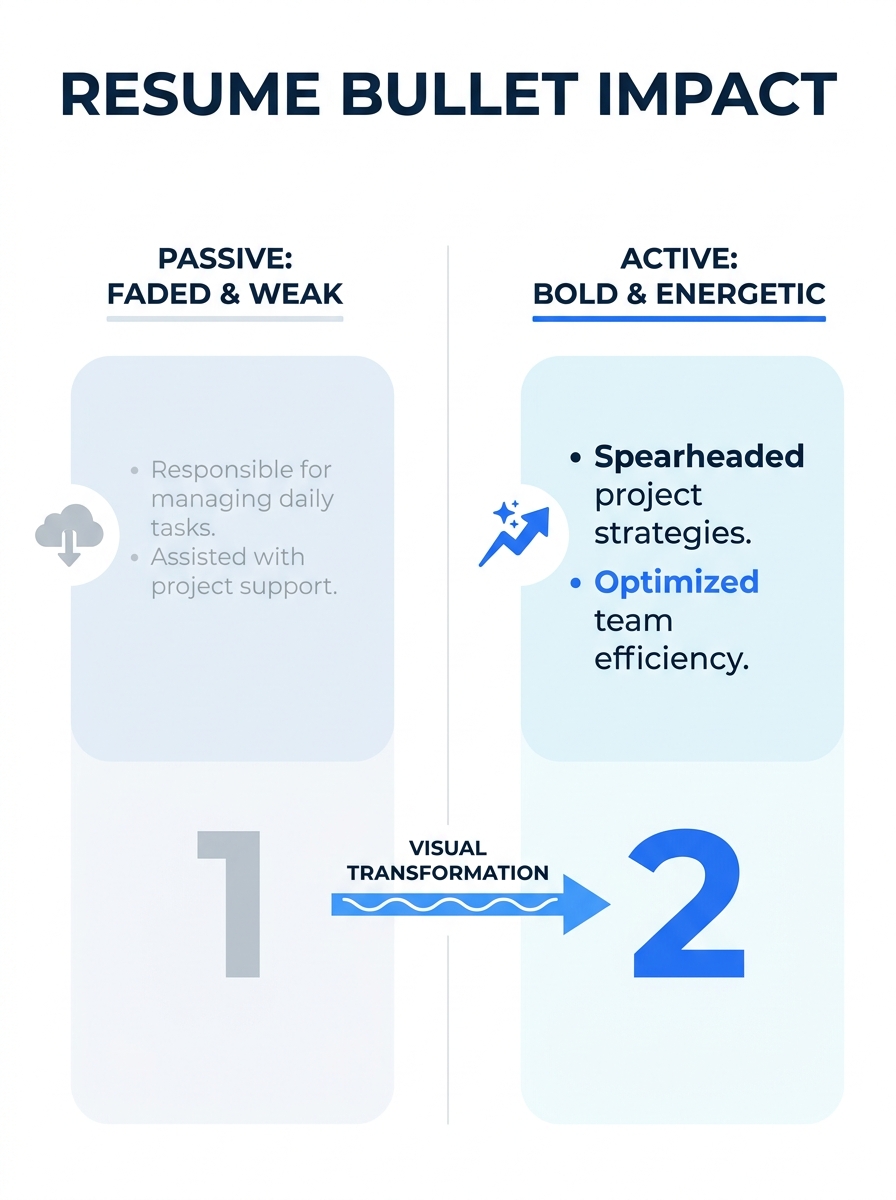
Hiring managers spend an average of 6 to 7.4 seconds scanning a resume. In that window, passive constructions like “was responsible for overseeing” or “projects were completed under my supervision” force the reader to work backward to figure out who did what. The subject disappears. Your agency vanishes.
MIT’s Career Advising & Professional Development department frames the problem bluntly: passive voice “obscures accountability” and makes phrasing “clunky,” which is “overall frowned upon by savvy prospective employers,” according to their resume writing guidance. The distinction matters at scale. When a recruiter reviews 200+ resumes per open position, the ones written in active voice register as more confident, more specific, and more worth reading.
And the problem compounds with ATS software. Modern applicant tracking systems now parse verb-outcome structures when ranking candidates. A bullet that reads “Reduced server downtime by 42% through automated monitoring scripts” gives the algorithm three extraction points: the action (reduced), the metric (42%), and the method (automated monitoring). A passive version—”Server downtime was reduced through the implementation of monitoring”—buries the verb and strips the candidate’s name from the achievement. If you’re already thinking about how ATS and AI filters screen your resume, verb choice is where that optimization actually starts.
Five Phrases Hiring Managers Flag Immediately
Some passive constructions are worse than others. These five appear in resume after resume, and each one signals the same thing: the candidate is describing a job description, not an achievement.
“Responsible for” tops the list. ResumeVera’s 2026 analysis calls it “bureaucratic filler” that buries contributions and reduces keyword density. Writing “Responsible for managing client accounts” tells a reader what your job title implied. Writing “Managed 34 client accounts totaling $1.8M in annual revenue” tells them what you actually accomplished.
“Assisted with” and “helped in” rank second and third. Both erase your contribution by attributing the work to someone else. Even if your role was genuinely supportive, reframing the bullet to name your specific contribution—”Coordinated logistics for 12 product launches across 3 regions”—gives the hiring manager something concrete.
“Was involved in” is the vaguest of all. Involved how? As the lead? As a participant? As someone CC’d on emails? This phrase communicates nothing about scope, scale, or impact-driven resume language.
“Duties included” rounds out the list. Columbia Career Education’s bullet-writing guide states directly: “Use varied, strong action verbs to grab the reader’s attention and make your resume stand out.” Listing duties grabs nobody’s attention. Duties describe a role. Achievements describe you.
| Passive Phrase | Why It Fails | Active Replacement Example |
|---|---|---|
| Responsible for managing | Describes job title, not achievement | Managed 34 accounts totaling $1.8M revenue |
| Assisted with outreach | Erases your specific contribution | Coordinated outreach to 200+ prospects weekly |
| Was involved in launch | Vague scope, no measurable result | Led product launch generating $420K in Q1 sales |
| Duties included reporting | Lists obligations, not accomplishments | Built automated reporting dashboard saving 6 hrs/week |
| Helped improve process | Hides your role in the outcome | Redesigned onboarding workflow, cutting ramp time by 30% |
The Verb-First, Metric-Last Rewrite Formula
Harvard’s Mignone Center for Career Success published a list of 45 rare action verbs specifically chosen because they’re underused and precise. Their guidance emphasizes that “the right resume action verbs will be doing a lot of the heavy lifting” on your resume—and that this lifting happens subconsciously for the reader. They feel the confidence without being able to pinpoint why.
The rewrite formula that produces the strongest resume bullet point strength follows a three-part structure the research calls CAR: Challenge, Action, Result. Resumly’s career content team documents this pattern with a concrete example: “Challenge: Entering a new Latin American market. Action: Conducted market research and led negotiations in Spanish. Result: Secured a $2.3M distribution agreement, increasing regional sales by 27% within the first year.”
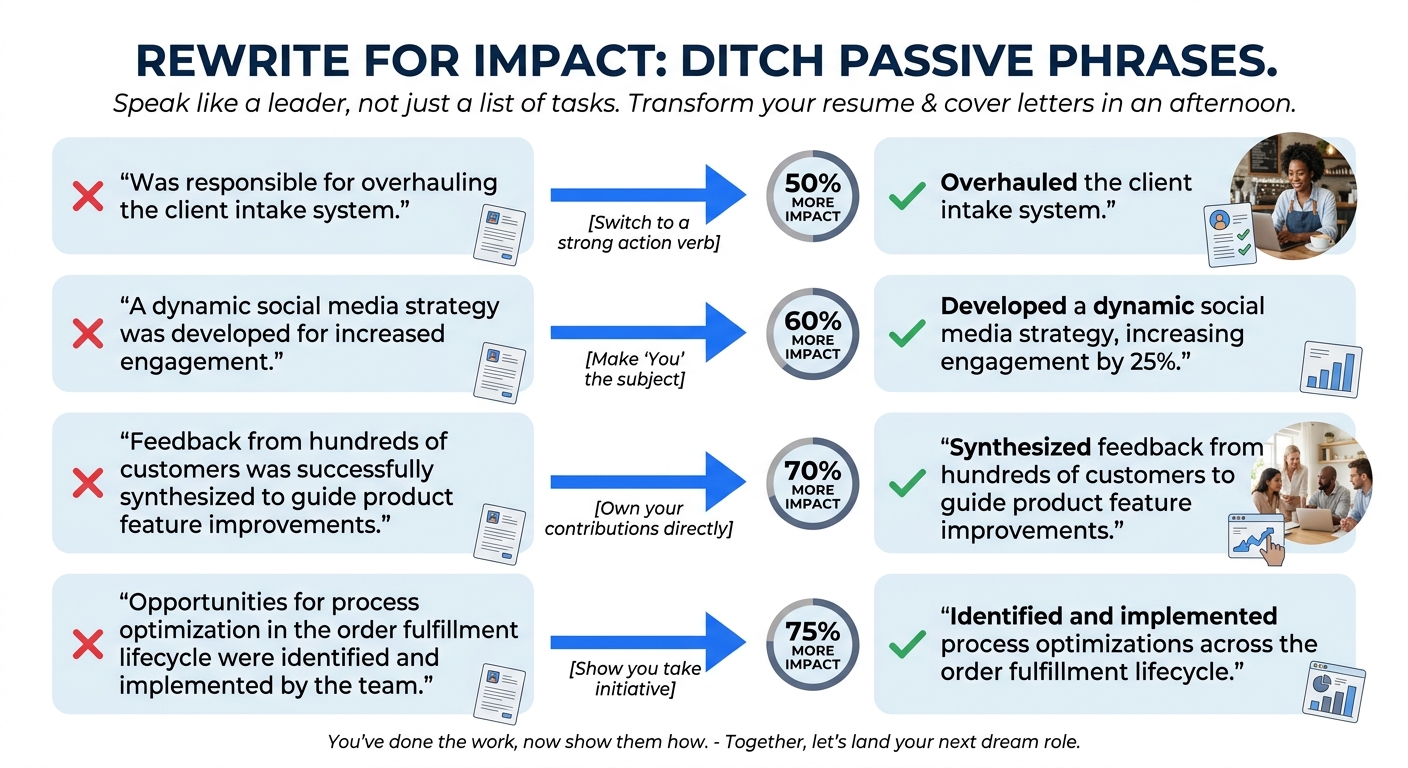
You don’t need to write each bullet as a three-sentence paragraph. The compressed version works for most resume contexts. The formula is: Action Verb + Specific Task + Measurable Result. “Optimized SQL queries, reducing average report load time from 12 seconds to 1.4 seconds.” That’s one sentence, three pieces of information, zero passivity.
The formula that produces the strongest bullets is simple: Action Verb + Specific Task + Measurable Result. One sentence, three pieces of information, zero passivity.
Indeed.com’s power words guide reinforces this with a direct comparison. Instead of “Prospect for new business opportunities by making cold calls and following up on leads,” their recommended rewrite reads: “Aggressively prospect for new business by completing 50+ cold calls a day and pursuing leads to ensure pipeline sufficiency.” The difference is the specificity of the number. “50+ cold calls a day” transforms a generic responsibility into a quantified achievement that hiring managers understand.
You should aim for at least 3 to 4 different verb categories across your resume to demonstrate range. Leadership verbs (directed, mentored, supervised), creation verbs (designed, built, launched), optimization verbs (redesigned, consolidated, automated), and results verbs (increased, reduced, generated) each signal different capabilities. Using “managed” six times across six bullets tells a recruiter you know one word.
Running Your Own 20-Minute Verb Audit
The audit itself takes less time than most people spend debating font choices. You need your current resume, a highlighter (physical or digital), and a willingness to be honest about how many of your bullets start with dead-weight phrases.
Step 1: Highlight every first word of every bullet point. If more than 30% of your bullets start with the same verb, you have a repetition problem. If any start with “responsible,” “assisted,” “helped,” “involved,” or “duties,” mark those for immediate rewriting. This alone usually flags 40% to 60% of bullets on the average resume.
Step 2: Check each bullet for a number. Resumes that pair strong verbs with quantified results perform measurably better in both ATS ranking and human review. The Resumly team documents cases where adding a single metric—”$180K additional revenue over 9 months”—transformed an otherwise generic bullet into one that signaled real business impact. If a bullet has no number, ask yourself: how many? How much? How fast? By what percentage?
Step 3: Run your draft through a grammar checker. LinkedIn’s career advice community recommends tools like Grammarly, Hemingway, or ProWritingAid to detect passive voice automatically. These tools flag passive constructions you might miss on your own, especially subtle ones like “was selected to” or “has been recognized for.” And if you’re concerned about AI tools homogenizing your language, the customization trap with one-click matching tools is worth understanding before you rely on any single platform’s suggestions.
Tip: After rewriting your bullets, read them out loud. If you stumble or lose your place mid-sentence, the bullet is too long or too convoluted. The best bullets read cleanly in a single breath—12 to 18 words is the sweet spot for both readability and ATS parsing.
Step 4: Verify verb accuracy. Every verb on your resume has to be defensible in an interview. If you wrote “directed” but you actually “contributed to,” a skilled interviewer will find the gap in about 90 seconds. Impact-driven resume language works because it’s precise, and precision means choosing the verb that matches your actual level of responsibility. As SimplyHired’s career advice column notes, “using the passive voice isn’t inherently awful”—sometimes a supporting role is exactly what you performed, and an honest, active description of that support (“coordinated,” “compiled,” “prepared”) is stronger than an inflated claim you can’t back up.

This process works regardless of your career stage. Whether you’re a new graduate navigating a tight entry-level market or a senior professional tackling the buzzword problem in executive summaries, the audit catches the same passive patterns.
What The Numbers Still Can’t Answer
The 140% callback improvement is compelling, but it comes with caveats the studies don’t fully address. That figure measures resumes holistically—verb choice, formatting, keyword density, and quantified achievements all changed simultaneously. Isolating how much of the lift comes from action verbs alone versus the metrics they’re paired with is difficult with current data.
There’s also the question of industry variation. A 2026 dataset from Jobscan cataloging 500+ resume action verbs acknowledges that verb effectiveness varies by field. “Engineered” and “deployed” carry weight in technical roles. “Negotiated” and “closed” perform better in sales. But the optimal verb list for, say, nonprofit program management or academic research administration hasn’t been studied with the same rigor.
And passive voice has its rare legitimate uses. A career changer who needs to de-emphasize a previous employer’s name might deliberately write “was selected for a cross-departmental task force” to keep the focus on the selection rather than the selecting entity. These edge cases are real, but they apply to maybe 5% of your bullets, not 50%.
What the data does tell us clearly: starting every bullet with a strong, accurate action verb and ending with a number is the single most reliable way to improve how your resume reads to both humans and machines. The rest—font, layout, summary versus objective—matters less than most people think. Your verbs carry your story. Make them do the work.