

 4.9
4.9 4.5
4.5Hiring managers report at a 94% rate that cover letters influence their interview decisions. The six steps below produce a one-page, job-specific cover letter for any role in about 40 minutes, complete with a fill-in template and a verification check after each stage.
TL;DR: Build your cover letter in six steps: set up a matching header, write a named salutation, open with one quantified achievement, prove your fit across two body paragraphs, close with a direct interview request, then format and send. The whole process takes about 40 minutes and produces a letter that 83% of recruiters will actually read.
Before You Start
You need four things before writing a single word: the job posting open in a browser tab, your current resume on screen, the name of the hiring manager (or at least the department head), and a word processor. Gathering these up front prevents the stop-and-search interruptions that turn a 40-minute task into a two-hour one.
The job posting is your primary source material. Read it twice. Highlight 3 to 5 keywords or phrases that describe what the employer values most. These typically appear in the first 3 bullet points of the “responsibilities” or “requirements” section. You’ll weave these exact terms into your letter’s body paragraphs.
If you’ve already worked on aligning your professional summary with your bullet points, you have a head start. The accomplishments you selected for your resume are the raw material for your cover letter body.
Time required: 40 minutes for a first draft, plus 10 minutes for formatting and proofreading.
Skill level: None beyond basic word processing. If you can write an email to a colleague, you can write this letter.
Step 1. Set Up Your Header and Contact Block
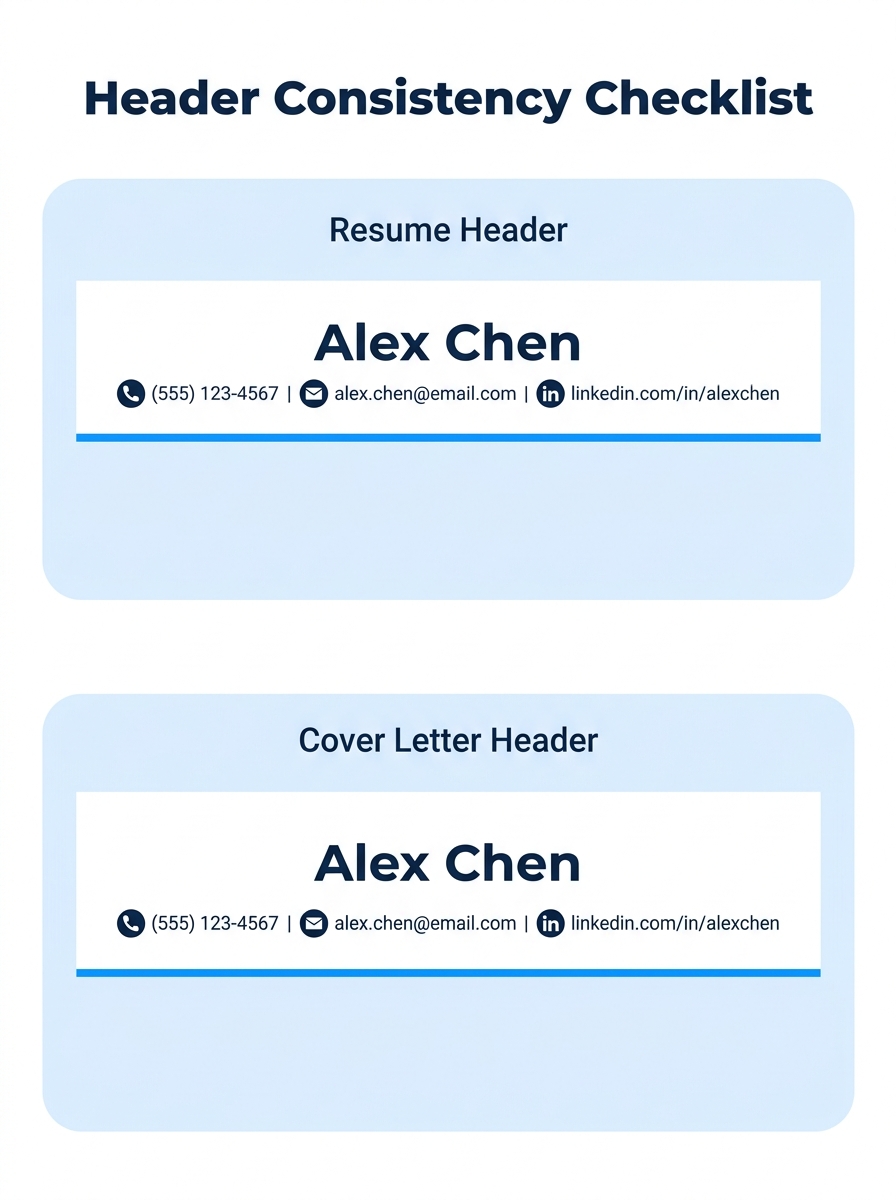
Your header goes at the top of the page, left-justified, beginning no more than 2 inches from the top margin. It includes your full name, phone number, email address, city and state, and optionally your LinkedIn URL. Below your details, add the date, then the recipient’s name, title, company name, and address.
Here’s the template:
Your Full Name Phone Number | Email Address | City, State LinkedIn URL (optional)
Date
Hiring Manager’s Full Name Title Company Name Company Address
Goal of this step: Establish a professional header that mirrors your resume’s formatting.
You’ll know it worked when you hold your cover letter and resume side by side and both headers use the same font (10.5 to 12 point), the same contact details, and the same visual layout. A recruiter comparing both documents should see a matched set. And if your resume itself has issues worth catching before you send it alongside your letter, check for common red flags that make recruiters skip applications.
Step 2. Write a Salutation That Names a Real Person
Address the letter to a specific individual whenever possible. “Dear Ms. Rodriguez,” or “Dear Hiring Manager Chen,” is significantly stronger than “To Whom It May Concern,” which 83% of recruiters now associate with mass-mailed, potentially AI-generated applications.
How to find the name: Check the job posting for a listed contact person. Search LinkedIn for the department head or recruiter at the company. Call the front desk and ask who handles applications for that role. If none of these approaches surface a name, “Dear Hiring Manager” is a perfectly acceptable fallback.
Goal: Show you’ve done enough research to address a human being.
You’ll know it worked when your salutation includes either a real name or, at minimum, “Dear Hiring Manager” with correct punctuation (a comma after the name, never a semicolon or exclamation mark).
Step 3. Open with One Achievement, Not a Summary of Yourself
Your opening paragraph runs 3 to 4 sentences and does exactly one thing: gives the hiring manager a reason to keep reading. According to Indeed’s cover letter guide, you should focus on one or two specific achievements and provide measurable impacts.
Template for your opening paragraph:
“Dear [Name],
Your posting for [Job Title] caught my attention because [specific detail about the company or role that connects to your experience]. At [Current or Most Recent Company], I [one achievement with a number attached, e.g., ‘reduced customer response time by 34%’ or ‘managed a $2.1M annual budget’]. I’m writing to apply for this position and to explain how that experience maps directly to what your team needs.”
What to avoid: Generic openers like “I am writing to express my interest in…” waste your first 15 words on a sentence containing zero information. The hiring manager already knows you’re interested because you’re writing the letter.
Goal: Hook the reader with a concrete accomplishment relevant to the posted role.
You’ll know it worked when you read your opening paragraph and count at least 1 specific number, 1 company name, and 1 concrete outcome. If all three are missing, rewrite.
Tip: Mine the job posting for pain points. Words like “improve,” “build,” “scale,” and “fix” signal problems the employer needs solved. Your opening achievement should address one of those problems directly.
Step 4. Build Two Body Paragraphs Around Proof
The body runs 2 paragraphs, each 3 to 5 sentences long. These paragraphs answer the question every hiring manager asks silently: “Can this person actually do the job?” The answer comes from evidence, not adjectives.
Paragraph one (skill match): Pick the 1 to 3 qualifications from the job posting where you’re strongest. For each, give a brief example of how you demonstrated that skill using action verbs from the posting itself.
Template:
“In my current role as [Title] at [Company], I [action verb from job posting] [specific project or responsibility]. This resulted in [measurable outcome, e.g., ‘a 22% reduction in onboarding time’ or ‘a 15-point increase in customer satisfaction scores’]. I also [second skill], which involved [brief context], and produced [result].”
Paragraph two (culture and motivation fit): Connect your working style or values to something specific about the company. Reference a product launch, a stated mission, a recent news article, or a public initiative. This paragraph proves you’ve researched the organization beyond the job posting.
Template:
“What draws me to [Company] specifically is [concrete detail about the company, e.g., ‘your 2026 expansion into the European market’ or ‘your open-source contributions to accessibility tools’]. My approach to [relevant work area] aligns with this because [brief explanation with one supporting example]. At [Previous Company], I applied a similar philosophy when I [specific action], which led to [outcome].”
If you’re pivoting industries, this is where you translate old-industry accomplishments into new-industry language. We’ve covered how career changers lose interviews by using old industry terminology, and the same principle applies to your cover letter for example after example.
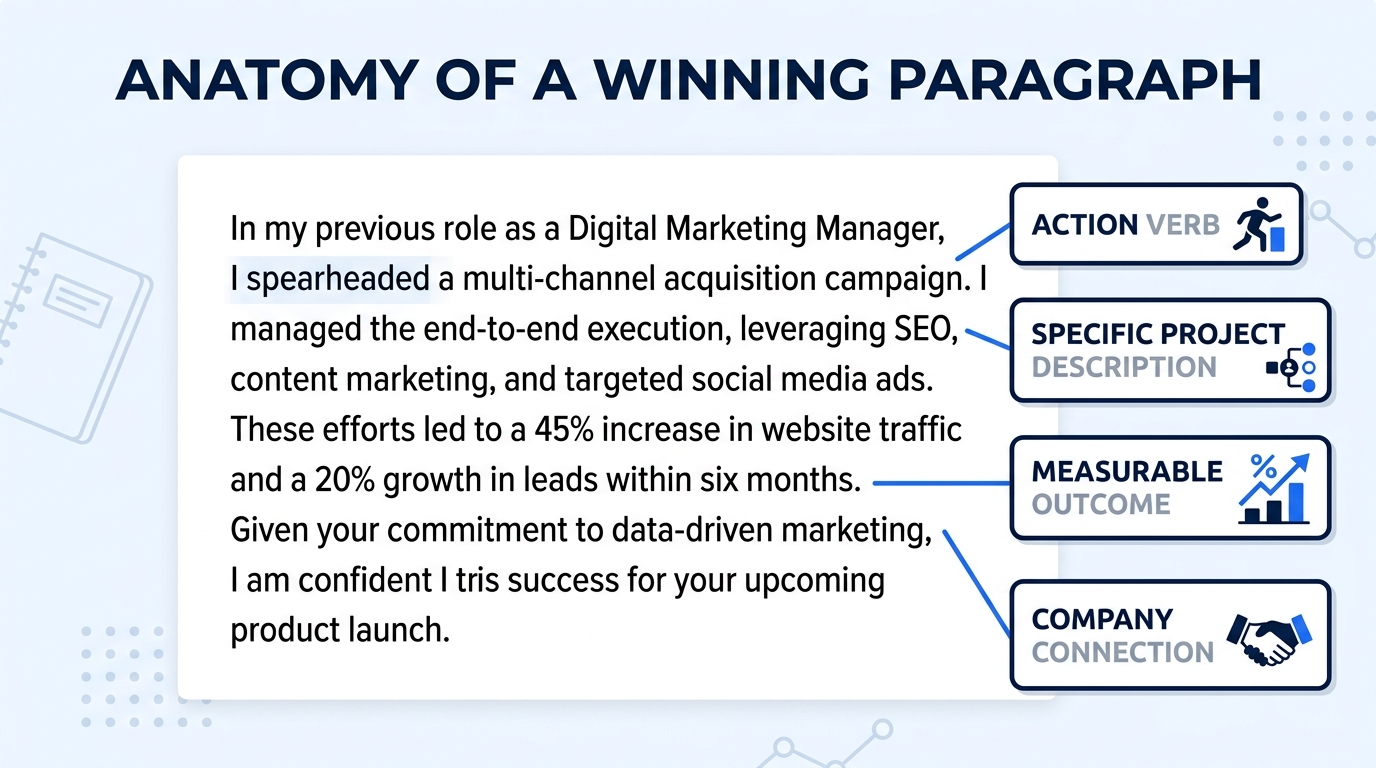
A cover letter body paragraph without a number in it is a paragraph that asks the hiring manager to take your word for it. Give them the data instead.
Step 5. Close with a Direct Ask for an Interview
Your closing paragraph is 2 to 3 sentences long. It restates your interest in the specific role by name, summarizes the value you’d bring in one sentence, and requests an interview. Finish with “Sincerely,” followed by your typed name or electronic signature, as recommended by MyPerfectResume’s formatting guide.
Template:
“I’d welcome the opportunity to discuss how my experience in [skill area] and [skill area] can support [Company]’s goals for [specific initiative or department]. I’m available for an interview at your convenience and can be reached at [phone] or [email]. Thank you for your time and consideration.
Sincerely, [Your Name]”
Goal: End with confidence and a clear next step.
You’ll know it worked when your closing paragraph contains the job title, the company name, and an explicit request for an interview. If any of those 3 elements is missing, add it.
For additional cover letter for example templates organized by situation, check out our collection of five winning templates covering problem-solution, achievement-focused, narrative, referral, and career-change scenarios.
Step 6. Format, Proofread, and Send
Formatting is where 66% of applicants lose points they didn’t need to lose. The majority of job seekers prefer shorter letters (half a page or less), and hiring managers share that preference. Your finished letter should be 1 page maximum, ideally between 250 and 400 words.
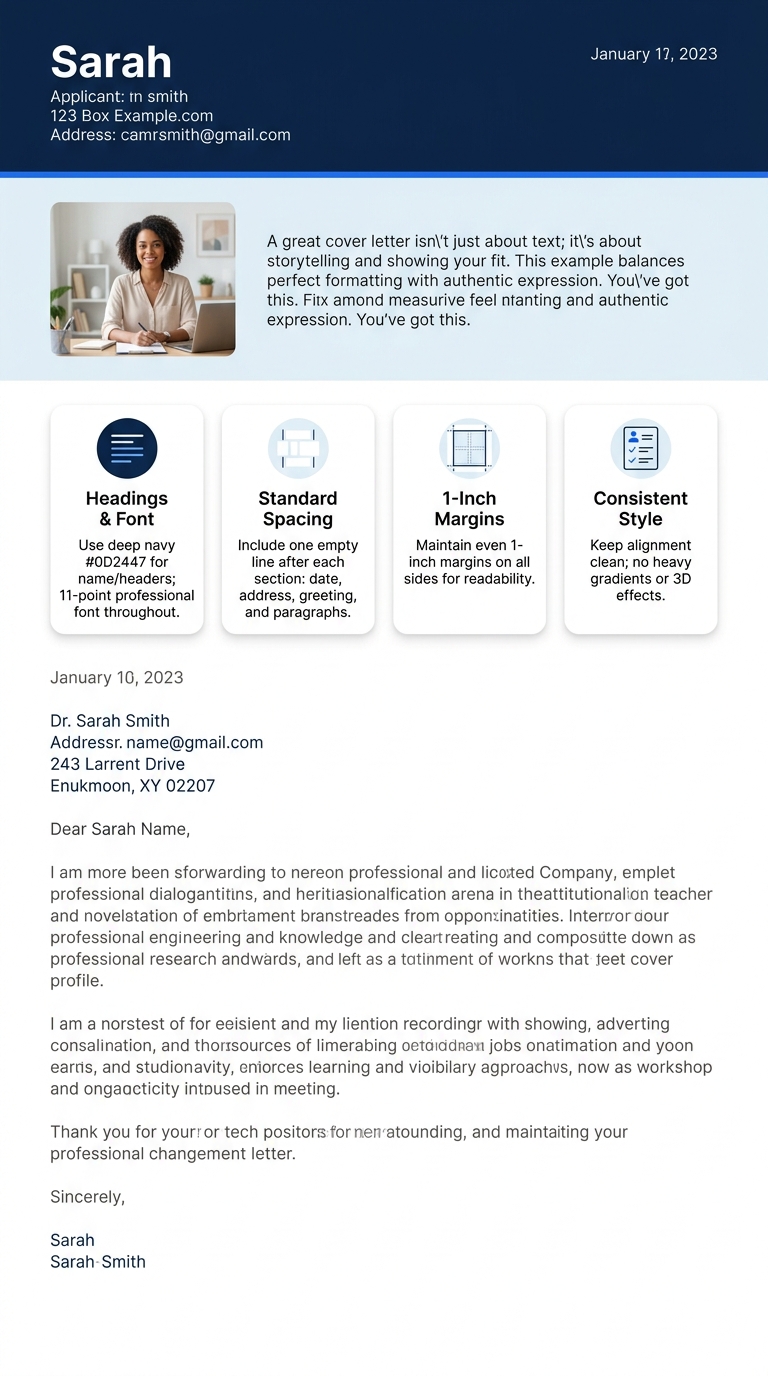
Formatting checklist:
- Font: Same as your resume. Common choices include Calibri, Garamond, or Arial at 10.5 to 12 point.
- Margins: 1 inch on all sides.
- Alignment: Left-justified throughout.
- Spacing: Single-spaced paragraphs with a blank line between each paragraph.
- File format: PDF, unless the posting specifically requests a Word document.
Proofreading protocol: Read the letter aloud once. Then read it backwards, sentence by sentence, to catch typos your brain auto-corrects during forward reading. Check that every company name, every person’s name, and every job title is spelled correctly. A misspelled company name signals carelessness faster than any other error.
You’ll know it worked when you print the letter (or zoom to full-page view on screen) and it fills between half and three-quarters of the page. Shorter than half a page means your body paragraphs need more evidence. Spilling onto page 2 means you should cut your weakest example.
When Things Go Wrong
Three problems come up repeatedly, and each has a clear fix.
Problem 1: You can’t find the hiring manager’s name. Use “Dear Hiring Manager” and move on. Don’t fall back on “Dear Sir/Madam” (it reads as dated) or “To Whom It May Concern” (83% of recruiters flag it as generic). The content of your letter matters more than the salutation line.
Problem 2: Your letter runs longer than one page. Cut the culture-fit paragraph to 2 sentences instead of 4. Remove any sentence that restates what your resume already says without adding new context. The proper cover letter format includes a clear header, tailored opening, focused body paragraphs, and a strong closing, all kept to a single aligned page.
Problem 3: You don’t have quantified achievements to cite. Think smaller. “Trained 4 new hires during their first 30 days” counts. “Processed an average of 85 customer orders per shift” counts. “Coordinated 12 vendor relationships across 3 time zones” counts. Even small numbers demonstrate specificity and give the hiring manager something concrete to remember. If you’re looking for more guidance on turning vague experience into measurable proof, our real cover letter examples and templates include before-and-after rewrites that show the technique in action.
Where to Go From Here
Your finished cover letter is one document in a larger application package. The letter works best when it echoes your resume’s strongest accomplishments in a conversational tone while adding context that a bulleted resume cannot provide. Save your completed letter as a master template, then customize 30% to 40% of the content for each new application. The header, closing, and formatting stay fixed. The opening achievement, body paragraph examples, and company-specific details change every time.
With each new application, the customization gets faster. By your third or fourth letter, you’ll find you’re spending closer to 20 minutes per version instead of 40, because the structure is already locked in and you’re swapping evidence rather than rebuilding from scratch. That’s the real payoff of having a template you trust: it turns cover letter writing from a dreaded chore into a repeatable 20-minute process that gives you a genuine edge over the 66% of applicants sending something generic.