

 4.9
4.9 4.5
4.5Career changers describe valuable experience accurately but lose interview opportunities because they frame that experience in their old industry’s terminology, leaving hiring managers unable to connect prior accomplishments to open roles, according to a July 14 analysis by Dr. Cheryl Robinson published on Forbes. Robinson identified the disconnect as a “transferable-skills trap” that prevents experienced professionals from translating two decades of communication and efficiency expertise into interviews, even when 51% of U.S. employees were actively job-hunting or watching for opportunities in late 2025, Gallup reported in March 2026.
TL;DR: Career changers describe skills in old industry language, preventing hiring systems from recognizing abilities under unfamiliar job titles, according to Forbes contributor Dr. Cheryl Robinson’s July 14 analysis.
The mismatch costs qualified candidates interviews because applicant tracking systems and hiring managers evaluate résumés against new-industry vocabulary while career changers continue using the descriptive frameworks from their previous sectors, Robinson wrote. A marketing director pivoting into healthcare may frame budget management and team-building accomplishments using retail or consumer-goods terminology that fails to signal understanding of patient privacy regulations or reimbursement models, she noted.
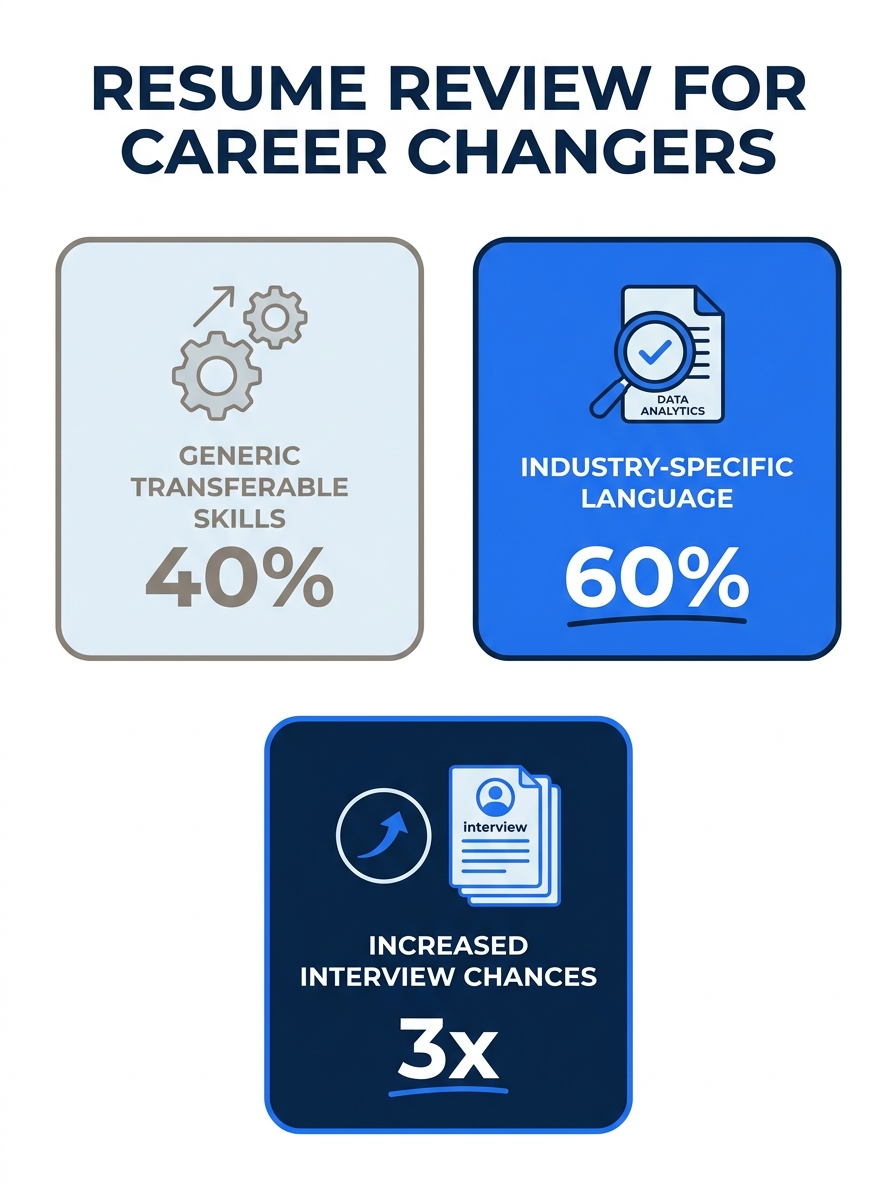
Generic Skill Claims Fail as Employers Demand Industry-Specific Evidence
Skills-first hiring is gaining traction—the World Economic Forum’s January 2025 “Future of Jobs Report” found employers expect 39% of workers’ core skills to change by 2030—but listing “leadership,” “communication,” and “problem-solving” without context does not demonstrate how those abilities would produce results in a different role, according to Robinson. The report also identified skills gaps as a major barrier to business transformation.
“Adaptability is easy to claim,” Robinson wrote. “A stronger candidate shows when it was tested, what they did and what changed as a result.” Hiring managers need evidence that a career changer understands the new industry’s regulations, customer base, technology, and operating norms before trusting them with senior responsibilities, she added.
Experience May Transfer at Lower Level as Candidates Learn New Industry Norms
Career changers who assume 15 or 20 years of workforce experience should qualify them for equally senior positions in a new field often encounter resistance from employers who value their judgment but question whether they know the industry well enough to lead immediately, Robinson wrote. A lower title, smaller salary, or narrower scope may prove temporary if the position provides the industry knowledge and credibility needed for the next advancement.
“You are not starting over, but you are learning a new industry and its way of operating,” she stated. Recognizing that learning curve signals to employers that candidates understand the complexity of the career pivot. Employment gap stigma has similarly faded, but job seekers still benefit from addressing transitions directly rather than leaving hiring managers to interpret career changes on their own.
Hiring Managers Question Whether Overqualified Candidates Will Stay
Employers may hesitate not because a midcareer candidate cannot perform the work but because they wonder whether the salary will satisfy that person or whether the candidate will leave once a more senior position becomes available, according to Robinson. She advised addressing that concern directly by explaining why the change makes sense now, what attracts the candidate to the work, and how the position fits longer-term career direction.
“Avoid framing the role as an escape from burnout or a temporary bridge,” Robinson wrote. “Show that you understand what the job involves and have chosen it deliberately.” Transferable skills demonstrate capability, but a clear career-change story demonstrates commitment, she added.
Résumés Must Answer Three Questions to Reduce Employer Risk
Robinson recommended career-change résumés answer three questions quickly: What can you already do? How does it connect to this position? What evidence reduces the employer’s risk? She advised shifting emphasis from duties to evidence by matching skills to new job requirements, using challenge-action-result statements, and providing tangible proof of accomplishments.
Career changers can strengthen applications by rewriting bullet points to mirror the language in target job descriptions, quantifying outcomes wherever possible, and including recent evidence such as volunteer work, freelance projects, or certifications that demonstrate readiness for the new field, Robinson wrote. Generic claims about leadership or communication fail where specific examples—”reduced customer complaint resolution time by 32% by implementing new CRM workflow”—show transferable abilities applied to measurable results.
Robinson’s guidance aligns with advice that resume red flags often stem from misalignment between claims and evidence, causing recruiters to skip applications from otherwise qualified candidates.
What This Means for Job Seekers
Career changers who frame prior experience using their old industry’s vocabulary forfeit interview opportunities even when their core abilities—project management, stakeholder communication, process improvement—directly address hiring manager needs. The fix requires translating every résumé bullet point into the target industry’s language and supporting each claim with concrete evidence, preferably quantified.
If you are pivoting after 15 years in one field, expect to accept a temporary step down in title or scope while you gain industry-specific credibility. Employers value adaptability but need proof you understand the new sector’s operating norms, not just assurances that you learn quickly. Address any perception that you are overqualified by explaining in cover letters and interviews why this specific role advances your deliberate career direction rather than serving as an escape route.
Review job descriptions in your target field and rewrite your résumé to mirror the exact terminology, technical requirements, and outcome measures those employers use. Skills transfer when you prove they transfer—and proof begins with speaking the industry’s language.