

 4.9
4.9 4.5
4.5Indeed organizes its cover letter template library by job title because the body paragraphs that convince a hiring manager in healthcare look nothing like ones written for construction or tech. The five fill-in templates below follow that same industry-specific logic. Six steps, roughly 35 minutes, and you’ll have a customized, ready-to-send letter for any role.
TL;DR: Pick one of five industry-matched templates, replace each bracketed placeholder with job-specific details and a quantified achievement, then format and file-name the document correctly. The whole process takes about 35 minutes and produces a half-page letter that 94% of hiring managers say will influence their interview decision.
Before You Start
You need four things ready before touching a template. Skipping any of them adds time mid-draft and produces vague, generic language.
What to have on hand:
- The job posting itself, open in a separate tab. You’ll pull keywords directly from it.
- Your resume, finalized and up to date. The cover letter shouldn’t repeat your resume, but it does need to reference the same job titles, dates, and company names.
- One quantified achievement relevant to the role. A percentage, dollar figure, or count. (“Reduced onboarding time by 40%,” “managed a $2.1M renovation budget,” “grew email subscribers from 800 to 12,000.”) If you haven’t identified your quantifiable results yet, do that first.
- The hiring manager’s name, if possible. MIT’s career advising office recommends addressing the letter directly to the hiring manager by name; if you can’t find it, “Dear Hiring Manager” works, according to MIT’s guidance.
Time required: 30-40 minutes for your first letter using these templates. Subsequent letters for similar roles take 15-20 minutes because you’re only swapping the company-specific details.
Knowledge level: No prior cover letter experience needed. If you’ve written one before and it felt generic, that’s fine, these templates force specificity at every bracket.
Step 1: Choose the Template That Matches Your Industry
The goal here is to select the right skeleton before you write a single word. Each example for cover letter below emphasizes different strengths because different industries care about different proof points. Indeed’s library confirms this split: construction and trades cover letters highlight safety awareness and equipment operation, while corporate letters emphasize leadership and process improvement.
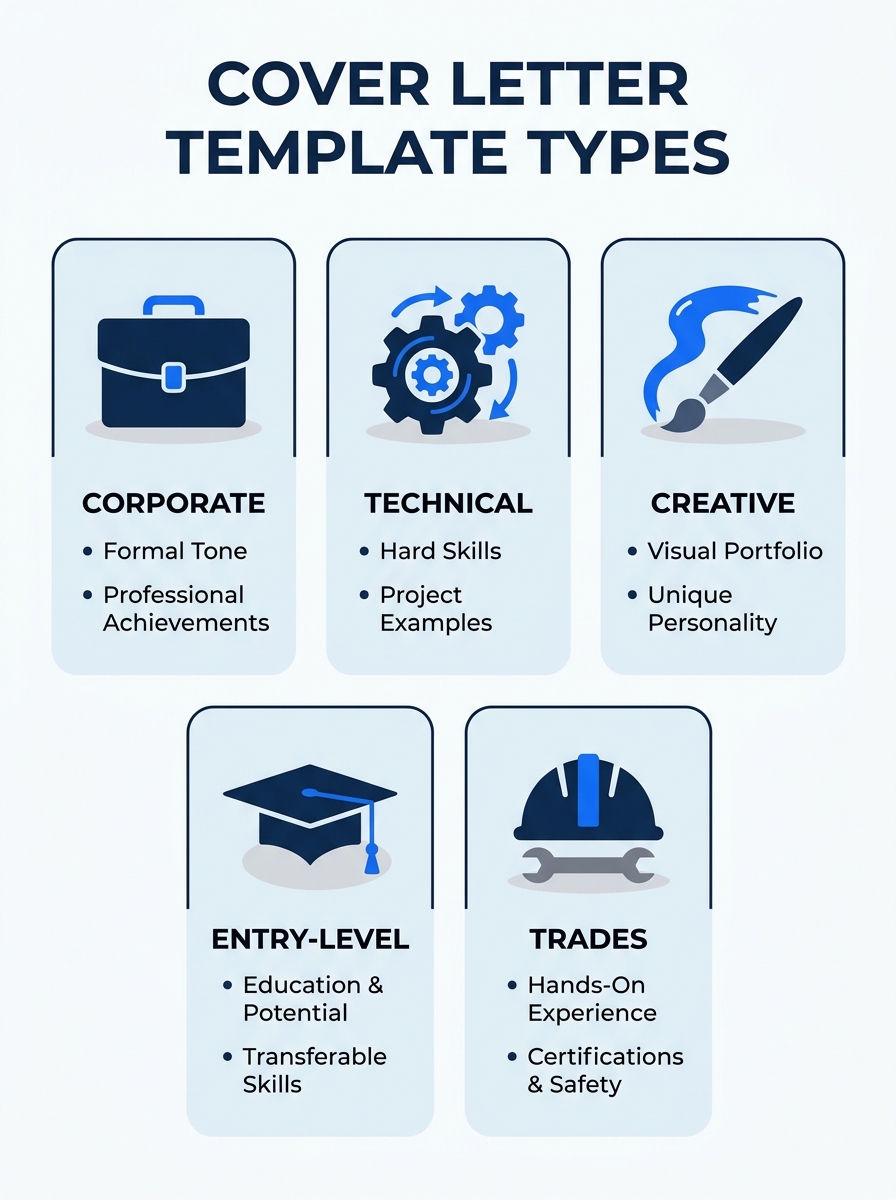
Here’s how the five templates break down:
| Template | Best For | Key Body Emphasis | Default Tone |
|---|---|---|---|
| Corporate | Finance, consulting, management | Leadership results, team size, revenue impact | Formal |
| Technical | Engineering, IT, data science | Tools used, system-level metrics, problem-solving | Direct |
| Creative | Marketing, design, writing, media | Campaign results, portfolio highlights, brand voice | Conversational |
| Entry-Level | First job, internship, career switch | Transferable skills, coursework, volunteer results | Enthusiastic |
| Trades/Operations | Construction, manufacturing, logistics | Safety record, certifications, equipment proficiency | Practical |
Pick the one closest to your target role. If you’re switching industries, say, moving from military logistics into corporate supply chain, choose the template that matches where you’re going, then pull achievements from where you’ve been. We covered how to translate experience across industries in a separate guide if that crossover feels tricky.
You’ll know you picked the right template when the “Key Body Emphasis” column describes the type of proof you actually have. If you’re a project manager applying to a tech company but your strongest achievement is a leadership result, the Corporate template will serve you better than the Technical one.
Step 2: Fill In the Header and Greeting
The goal is a clean, professional header block that mirrors your resume’s contact formatting. The University of Michigan Career Center specifies that cover letter layout should be “left justified, beginning no more than 2 inches from the top.” Here’s the exact format:
[Your Full Name] [Street Address or City, State] [Phone Number] | [Email Address]
[Date]
[Hiring Manager’s Name] [Their Title] [Company Name] [City, State]
Dear [Mr./Ms. Last Name or “Hiring Manager”],
Two details people get wrong here. First, the date: write it out (July 16, 2026), don’t abbreviate (7/16/26). Second, if the job posting includes a reference number or requisition code, add it to your greeting line or first sentence. MIT’s career advising team flags this explicitly, including the code helps HR track your application accurately.
You’ll know it worked when your header fits in roughly 6-8 lines and visually matches the header style on your resume (same font, same contact order).
Step 3: Write the Opening Paragraph
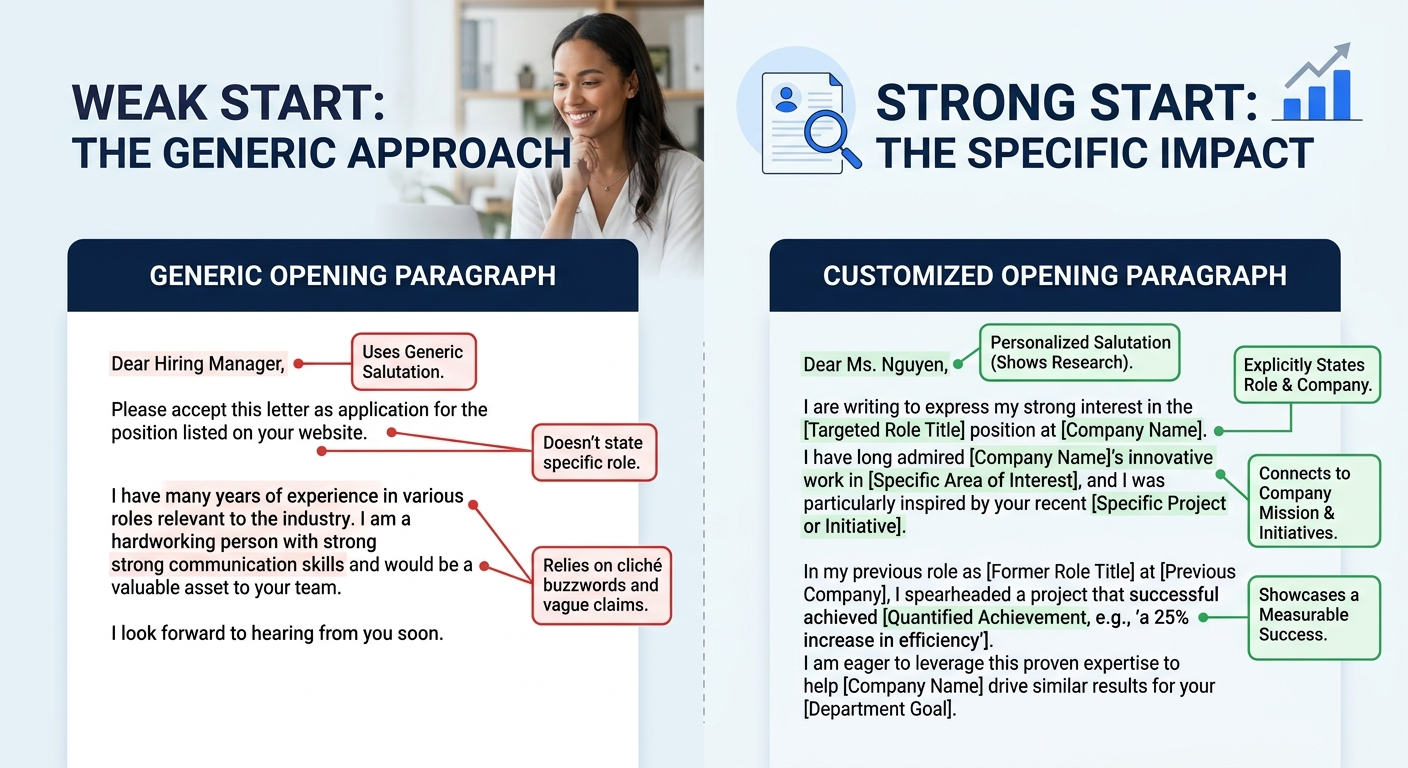
The goal of paragraph one is a single thing: make the hiring manager keep reading. You do that by naming the exact role, showing you know something specific about the company, and connecting it to your background in 2-3 sentences.
Here’s the fill-in structure that works across all five templates:
“I’m writing to apply for [Job Title] at [Company Name]. [One sentence about a specific company initiative, product, recent news item, or value that genuinely interests you]. With [X years/months] of experience in [relevant field], I’ve [one-line preview of your strongest relevant result].”
A filled-in example for the Corporate template:
“I’m writing to apply for the Operations Manager position at Meridian Healthcare. Your expansion into outpatient clinics across three new states signals exactly the kind of scaling challenge I’ve spent the last six years managing. With a background in multi-site operations, I’ve reduced facility launch timelines by 30% while keeping budgets within 5% of projections.”
And a filled-in example for the Entry-Level template:
“I’m writing to apply for the Marketing Coordinator role at Bellweather Creative. Your recent rebrand of the Luma skincare line caught my attention because it mirrors the positioning work I led as brand director for my university’s student-run agency. Over two semesters, our team grew that agency’s client base from 4 to 11 local businesses.”
You’ll know it worked when your opening paragraph names the company, names the role, and includes one specific number. If any of those three elements are missing, revise before moving on.
Step 4: Build the Body Around One Achievement
This is where most cover letters collapse into resume summaries. The body paragraph has one job: prove you can do the work by showing you’ve already done something similar.
Indeed’s writing guide is direct on this point: “Focus on one or two [experiences] and provide specific details about your success, including measurable impacts you made.” The word “measurable” is doing all the work in that sentence. 83% of recruiters say cover letters matter for hiring decisions, but the letters that actually move the needle contain numbers.
Here’s the fill-in structure:
“At [Previous/Current Company], I [specific action verb] [what you did] for/with [who or what system]. This resulted in [quantified outcome, percentage, dollar amount, time saved, count]. [One sentence connecting this result to a need mentioned in the job posting].”
A filled-in Technical template example:
“At Crestview Engineering, I redesigned the automated testing pipeline for our payments integration, reducing failed deployments from 12 per quarter to 2. That 83% reduction freed up approximately 60 engineering hours monthly. Your posting mentions a need for someone comfortable owning CI/CD reliability, and this is where I’ve built the most transferable depth.”
Tip: Pull the exact phrasing from the job posting into your connecting sentence. If they say “own CI/CD reliability,” use those words. Indeed’s guidance confirms: “Pay close attention to keywords listed in the job description and include ones that apply to you in the body of your cover letter.” This is how you pass both human and automated screening.
For the Trades/Operations template, the body emphasis shifts. Instead of revenue or software metrics, highlight safety records, equipment certifications, or project completion rates:
“Over three years at Markham Construction, I operated excavators and skid-steers across 14 commercial site-prep projects with zero recordable safety incidents. I also hold current OSHA-30 and confined-space certifications. Your posting emphasizes a clean safety record and multi-equipment proficiency, which matches my background directly.”
You’ll know it worked when your body paragraph contains at least one hard number and at least one phrase pulled verbatim from the job posting.
Step 5: Write the Closing Paragraph and Signature
The goal is simple: tell them what you want to happen next and make it easy for them to say yes.
“I’d welcome the opportunity to discuss how my experience with [relevant skill/project area] could contribute to [Company Name]’s [specific goal or team]. I’m available at [phone number] or [email] and happy to meet at your convenience. Thank you for your time and consideration.”
Sincerely, [Your Full Name]
Two things to avoid in the closing. Don’t write “I look forward to hearing from you”, it’s passive and assumes they’ll act. Write “I’d welcome the opportunity to discuss” because it’s forward-leaning without being pushy. And don’t introduce new achievements here. The closing is for logistics, not persuasion. That work happened in Steps 3 and 4.
You’ll know it worked when your closing is 2-3 sentences, includes your contact info, and names one specific thing you’d discuss in the interview.
The body paragraph has one job: prove you can do the work by showing you’ve already done something similar, with a number attached.
Step 6: Format, Name the File, and Send
The goal is to get the formatting right so none of your content work is undermined by a sloppy presentation. 66% of job seekers say they want cover letters at half a page or less, and hiring managers agree, shorter documents get read more carefully.
Formatting checklist:
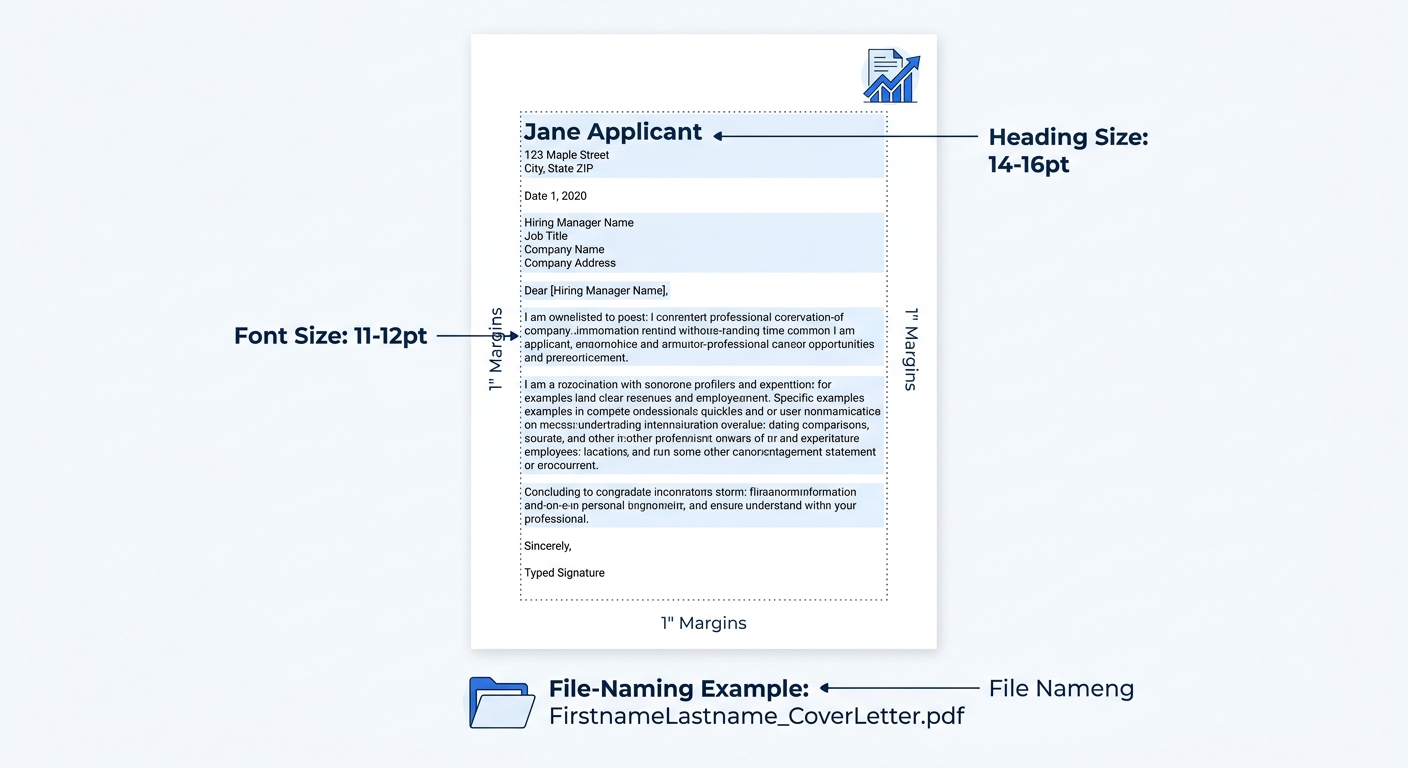
- Font: Match your resume. Standard choices are Calibri, Garamond, or Arial at 10.5-12pt.
- Margins: 1 inch on all sides. The University of Michigan’s Career Center recommends left-justified alignment throughout.
- Length: Aim for 250-400 words total. Your letter should fill roughly half to two-thirds of a single page. If it’s spilling onto page two, cut the body paragraph by removing the weakest sentence.
- File format: PDF unless the posting specifically requests .doc or .docx.
- File name: Indeed recommends the format FirstName-LastName-Cover-Letter (e.g., Jade-Young-Cover-Letter.pdf). Don’t name it “cover letter.pdf” or “document1.pdf”, recruiters download dozens of files a day and need to find yours.
If you’re submitting via email rather than an applicant portal, the University of Michigan Career Center advises using the body of the email as your cover letter, starting with a professional greeting. Attach the PDF as a backup.
You’ll know it worked when your final document is one page, under 400 words, saved as a PDF with your name in the file title.
When Things Go Wrong
Three problems come up repeatedly. Recognizing them early saves you from sending a letter that hurts more than it helps.
Problem 1: The letter reads like a second resume. You’ll notice this when every sentence starts with “I” and lists a duty rather than describing a result. Fix it by going back to Step 4 and rewriting the body paragraph around a single achievement with a measurable outcome. If you’re struggling with resume red flags that bleed into cover letters, address those first.
Problem 2: You can’t find the hiring manager’s name. Check the company’s team page, LinkedIn, or the department’s staff directory. If none of those work, “Dear Hiring Manager” is fine. Don’t guess at a name, getting it wrong is worse than using the generic greeting.
Problem 3: The letter runs over one page. This almost always means you’re covering too many achievements. Cut back to one. The cover letter is a highlight reel of your single most relevant result, not a career summary. If you have strong results across different areas, save the rest for the interview.
Where to Go From Here
You now have a template selected, filled in, formatted, and named correctly. The next step is adapting the process for speed. Once you’ve written your first letter using these steps, build a “base letter” for your target industry and keep it as a working document. Each new application should require changing only the company name, the role title, the company-specific sentence in paragraph one, and the connecting sentence in the body.
If your resume needs the same level of specificity you’ve put into this cover letter, our complete cover letter template guide walks through additional formatting variations. And for roles where your background doesn’t map cleanly to the posting, the industry language translation guide helps you reframe experience without misrepresenting it.
The difference between a cover letter that gets read and one that gets skimmed comes down to how many brackets you replaced with real, specific, numbered details. Every “[insert achievement here]” that stays generic is a missed opportunity to show the hiring manager you’ve done the work, both on the letter and in your career.