
 4.9
4.9 4.5
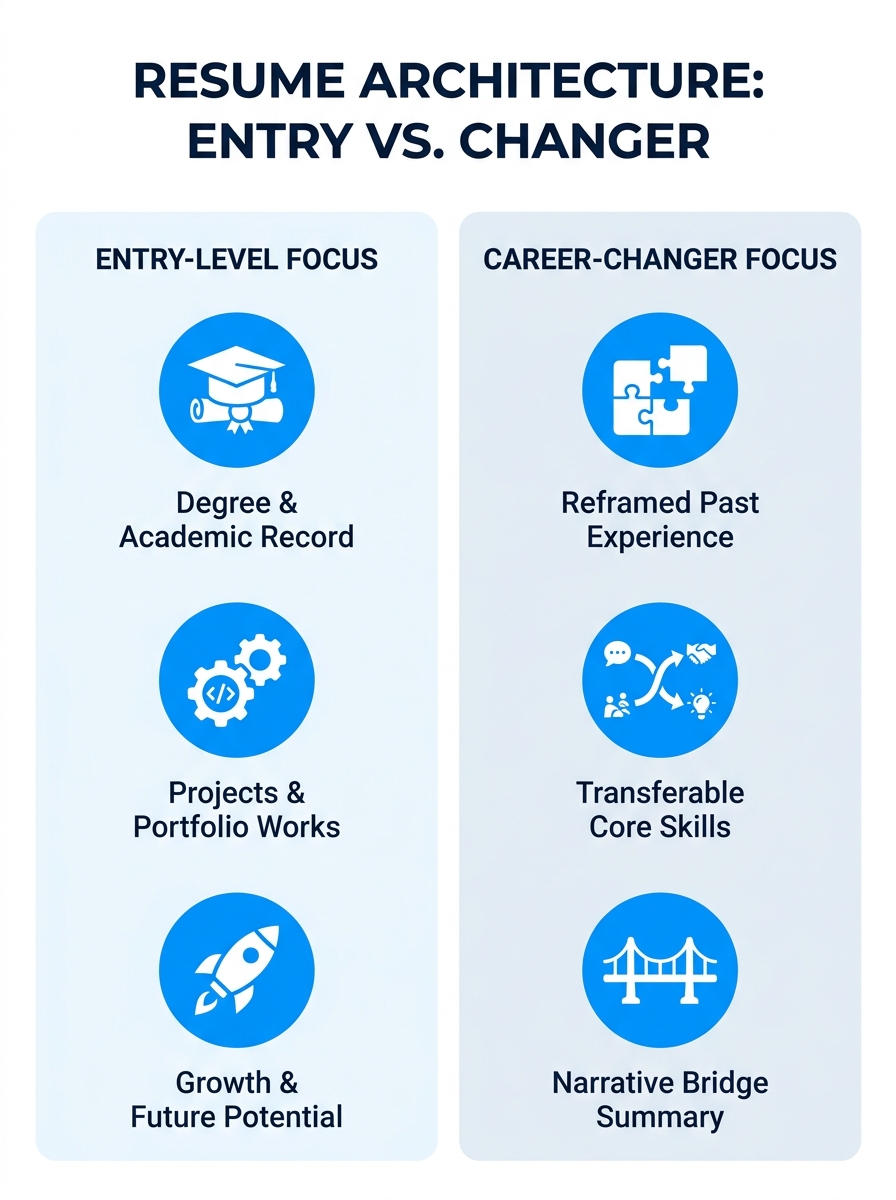
4.5Entry-level resumes and career-changer resumes look like they’re solving the same problem: a gap between what you’ve done and what the job requires. That shared surface hides completely different engineering underneath. The entry-level resume is a proof-of-potential document. It argues that a thin work history still maps to readiness. The career-changer resume is a translation document. It argues that a thick work history in Field A actually prepares you for Field B. Confusing the two, which most generic resume advice does, produces a document that convinces nobody.
This article breaks down the mechanics of each resume type, layer by layer: format, summary, keywords, experience bullets, and skills placement. If you understand why each piece works differently by career stage, you’ll make better decisions than someone blindly copying an entry-level resume template or a career changer resume strategy guide.
The Two Problems That Look Identical But Aren’t
An entry-level candidate walks into a job application with, realistically, 0-2 years of relevant work. Maybe an internship. Maybe a capstone project. The resume’s job is to convince a hiring manager that this person can become effective quickly, despite limited professional evidence.
A career changer walks in with 5, 10, sometimes 20 years of work experience. The resume’s job is completely different: it needs to convince a hiring manager that experience in an unrelated field is still relevant experience, properly reframed.
Here’s where the confusion starts. Both candidates lack direct job-title match. Both will probably get scored lower by an ATS on “years of relevant experience.” Both feel insecure about what they’re putting on paper. So they tend to reach for the same generic advice: “focus on transferable skills,” “tailor to the job description,” “use action verbs.”
That advice is technically correct and practically useless without understanding which resume architecture makes it work. As ResuFit’s career-level guide puts it, entry-level candidates need to emphasize education and potential, while experienced professionals must showcase strategic leadership and organizational impact. The career changer sits awkwardly between those two poles, and the resume needs to reflect that tension.
Format and Page Length Pull in Different Directions
Entry-level candidates: one page, chronological format, no exceptions. Forbes’s 2026 resume format guide states it plainly: if you’re a graduate or entry-level professional, one page will suffice. You don’t have enough content to justify two pages, and trying to fill that space leads to padding, which recruiters spot immediately.
The chronological format works here because you want your timeline front and center. Your education is recent and relevant. Your internship or part-time role is recent and relevant. Chronological order tells that story efficiently.
Career changers need a hybrid (combination) format. Pure chronological order works against you when your most recent job title is “Classroom Teacher” and you’re applying for a UX Research position. A hybrid format lets you lead with a skills summary and a curated skills section, then list your work history below in chronological order. You’re giving the reader a lens through which to interpret your experience before they encounter it.
Page length for career changers depends on total experience. If you’ve got under 10 years, stick to one page. If you’re in the 10-to-25-year range, two pages give you room to properly translate your background without cramming. The key insight about the resume format for job transitions is that you need enough space to build a narrative bridge between your old career and your new target, and that bridge takes up real estate that entry-level candidates simply don’t need.
If you’re weighing different template options for ATS compatibility, our breakdown of templates that actually pass ATS screening covers the formatting details that matter regardless of career stage: single-column layouts, .docx file format, and avoiding tables or graphics that confuse parsing software.
How the Summary Section Does Opposite Jobs
The professional summary is where the two resume types diverge most dramatically.
For entry-level candidates, the summary should be 2-3 sentences maximum. It states your degree, your target role, and one or two specific skills or experiences that make you a credible applicant. That’s it. You don’t have a career narrative to tell yet, and pretending you do sounds hollow. A new graduate applying for a financial analyst role might write: “Finance graduate from [University] with internship experience in equity research and financial modeling. Proficient in Excel, Python, and Bloomberg Terminal. Seeking an analyst role where I can apply quantitative analysis to portfolio management.”
For career changers, the summary does much heavier work. It’s your thesis statement. This is where you explicitly connect your past career to your target role and explain why the transition makes sense. Wharton’s career change resume guide advises connecting your work experience back to the skills listed in your skills summary section, and the summary is where that connection gets established first.
A teacher moving into UX research might write: “Former high school science teacher with 8 years of experience designing curriculum around student behavior data, conducting qualitative assessments, and iterating on instructional methods based on measured outcomes. Completed Google UX Design Certificate and led two pro-bono research studies for nonprofit clients. Transitioning into UX research to apply deep experience in user behavior analysis and mixed-methods evaluation.”
That summary is longer. It has to be. The career changer’s summary is doing the cognitive work that the entry-level candidate’s job title and degree already do automatically.
The career changer’s summary is doing the cognitive work that the entry-level candidate’s job title and degree already do automatically.
ATS Keywords Land Differently at Each Stage
Both resume types need keywords. The mechanics of ATS optimization by career stage are where things get interesting.
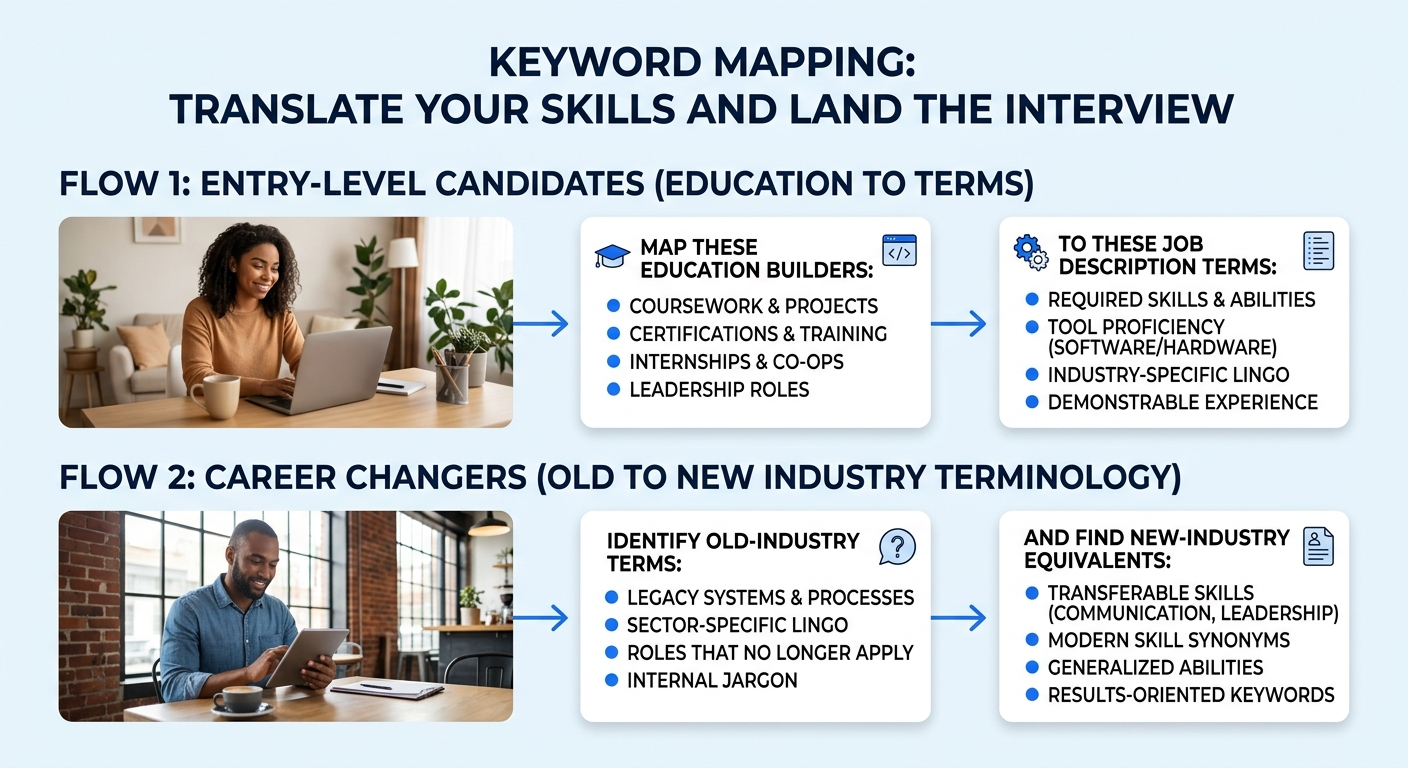
Entry-level candidates have a narrower keyword pool to draw from. You probably haven’t used the professional terminology of your target field in a paid work context. Your keywords will come from coursework, certifications, tools you’ve learned, and the language of the job description itself. Aim for 15-25 relevant keywords, which is the range that current ATS systems expect without triggering keyword-stuffing detection. For entry-level applicants, those keywords will cluster heavily in your skills section and education section rather than in your experience bullets.
Career changers face a vocabulary translation problem. You might have done project management for years, but if your old industry called it “program coordination” and your new industry calls it “project management,” the ATS won’t make that connection for you. You need to manually translate your old-field vocabulary into new-field vocabulary throughout the resume. This is where studying the job description becomes critical: you’re looking for the exact terminology the target role uses, then checking whether you’ve done equivalent work under a different name.
Both candidate types benefit from understanding how AI-driven screening tools evaluate resumes differently than human readers. The ATS cares about keyword presence and formatting parsability. The human reader who sees your resume after it passes the ATS cares about narrative coherence. Your resume needs to satisfy both audiences, and the balance point shifts depending on your experience level.
Experience Bullets Need Different Math
The quantification question trips up both groups, but for different reasons.
Entry-level candidates often feel like they have nothing to quantify. You ran the social media for a campus club. You completed a data analysis project in a class. These feel small. But recruiters aren’t comparing you to someone with 15 years of experience; they’re comparing you to other entry-level candidates. If you grew the club’s Instagram followers by 40% or your analysis project covered 10,000 data points, that’s worth stating. The specifics matter more than the scale. Our guide to converting vague experience into measurable impact bullets walks through the exact framework for doing this, and it applies to internships and academic projects as well as full-time roles.
Career changers have plenty to quantify but need to choose what to quantify strategically. A teacher who managed a $50,000 department budget should absolutely list that number if they’re targeting an operations role. A teacher who improved standardized test scores by 15% should highlight that if they’re targeting a data-driven marketing role. The principle from Enhancv’s career change research holds: quantify past achievements even if they’re from a different field, but choose the metrics that map to your target role’s priorities.
The difference in bullet construction comes down to emphasis. Entry-level bullets tend to follow a pattern of “Did X using Y, resulting in Z” where X is relatively simple and Z is a modest but real outcome. Career-changer bullets follow a pattern of “Applied [transferable skill] to [old-field context], achieving [result that maps to new-field priorities].” The career changer’s bullet has an extra translation layer built into it.
Skills Sections Carry Different Weight
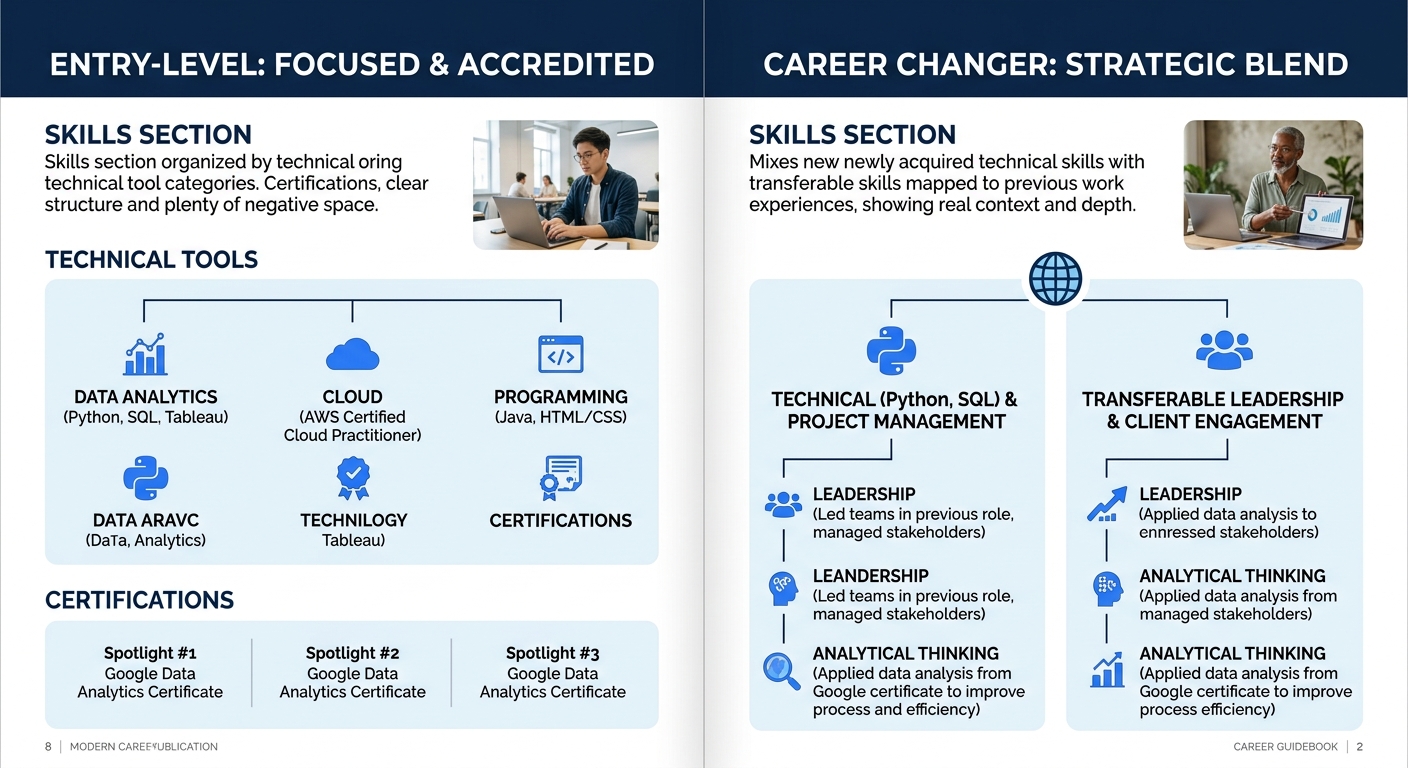
On an entry-level resume, the skills section is one of the strongest sections you have. It’s where you prove you know the tools and technical competencies the job requires, since your work history can’t demonstrate that depth yet. Put it near the top, right after your summary. List hard skills (software, programming languages, certifications) and organize them into logical groups. This section is doing much of your keyword heavy-lifting for ATS purposes.
On a career-changer resume, the skills section serves a different function. It acts as a decoder ring for the rest of the document. When a hiring manager sees “8 years in education” in your work history, they need the skills section to tell them what those 8 years mean in their language. This is where understanding the skills-based resume approach becomes valuable for career changers specifically. You’re reframing your experience through the skills the new employer actually cares about.
A practical difference: entry-level candidates should lean heavily on technical and tool-based skills because those are objectively verifiable. Career changers should blend technical skills (including any new certifications or coursework) with clearly labeled transferable skills that connect to their previous work.
Where Both Strategies Break Down
Neither the entry-level architecture nor the career-changer architecture is bulletproof, and knowing the failure points helps you compensate.
The entry-level resume breaks down when the candidate has zero relevant experience, not even tangential internships, volunteer work, or academic projects. At that point, the one-page chronological format becomes a document that’s mostly white space and a list of retail or food service jobs. If that’s your situation, you need to build relevant experience before the resume can do its job. Online certifications, freelance projects, or volunteer work in your target field will give you something real to put on paper. If you’re a recent graduate navigating this exact gap, the priority is creating resume-worthy experiences, not perfecting the formatting of experiences you don’t have.
The career-changer resume breaks down when the candidate tries to hide their previous career instead of translating it. Gaps in employment look suspicious. Vague descriptions of your old role look evasive. The whole strategy depends on owning your background and making a convincing case for why it prepared you. If you find yourself deleting entire jobs from your work history to make the resume “look right,” you’ve crossed from strategic editing into dishonesty, and interviewers will find the gap anyway.
Both resume types also share a common failure point around AI tools. Using AI to rewrite your resume can help with phrasing and keyword optimization, but it can also flatten your voice into generic corporate language that experienced recruiters recognize instantly. The line between helpful AI assistance and AI rewriting that actively hurts your chances is thinner than most candidates realize, and it’s especially dangerous for career changers whose resumes depend on a specific, personal narrative about why they’re making this transition.
The mechanism underneath all of this is straightforward: resume building for different experience levels requires different architectural decisions because the document is answering a different question in each case. “Can this person learn to do this job?” requires different evidence than “Has this person already been doing this job under a different name?” When you understand which question your resume needs to answer, the tactical choices about format, summary, keywords, bullet construction, and skills placement all follow logically from that single distinction.