
 4.9
4.9 4.5
4.5Deepak Malhotra’s 15 rules for negotiating job offers, published in Harvard Business Review, have one conspicuous gap: none of the 15 address what to do with your resume after the offer arrives. The rules cover anchoring, likeability, signaling enthusiasm, and knowing what matters to the other side. All of that advice targets the window between receiving an offer and accepting it. But the data from career-change research tells us something the negotiation literature largely ignores: your resume needs a second life after the ink dries. The way you present your professional story in week one, month one, and quarter one at a new job shapes everything from project assignments to your next raise. Post-offer negotiation and resume repositioning are two sides of the same coin, and treating them as separate problems leaves real money and career momentum on the table.
Employers Expect You to Negotiate (The Research Is Unambiguous)
Robert Half’s hiring research states it plainly: employers often expect candidates to discuss compensation after receiving a job offer. USC’s Career Center echoes this, calling negotiation “standard in the job search process; it is expected.” And Harvard’s Program on Negotiation emphasizes that justification helps shift the conversation from personal desire to objective reasoning, making it easier for the employer to say yes.
So why do so many people skip the salary negotiation strategy entirely? Often because they feel like the hard part is over. They got the offer. The relief is enormous. The instinct to protect the win by not rocking the boat is strong. But that instinct costs real compensation. And it also means your resume freezes in place at exactly the moment it should be evolving.
Your Resume Is a Negotiation Document (Before You Accept)
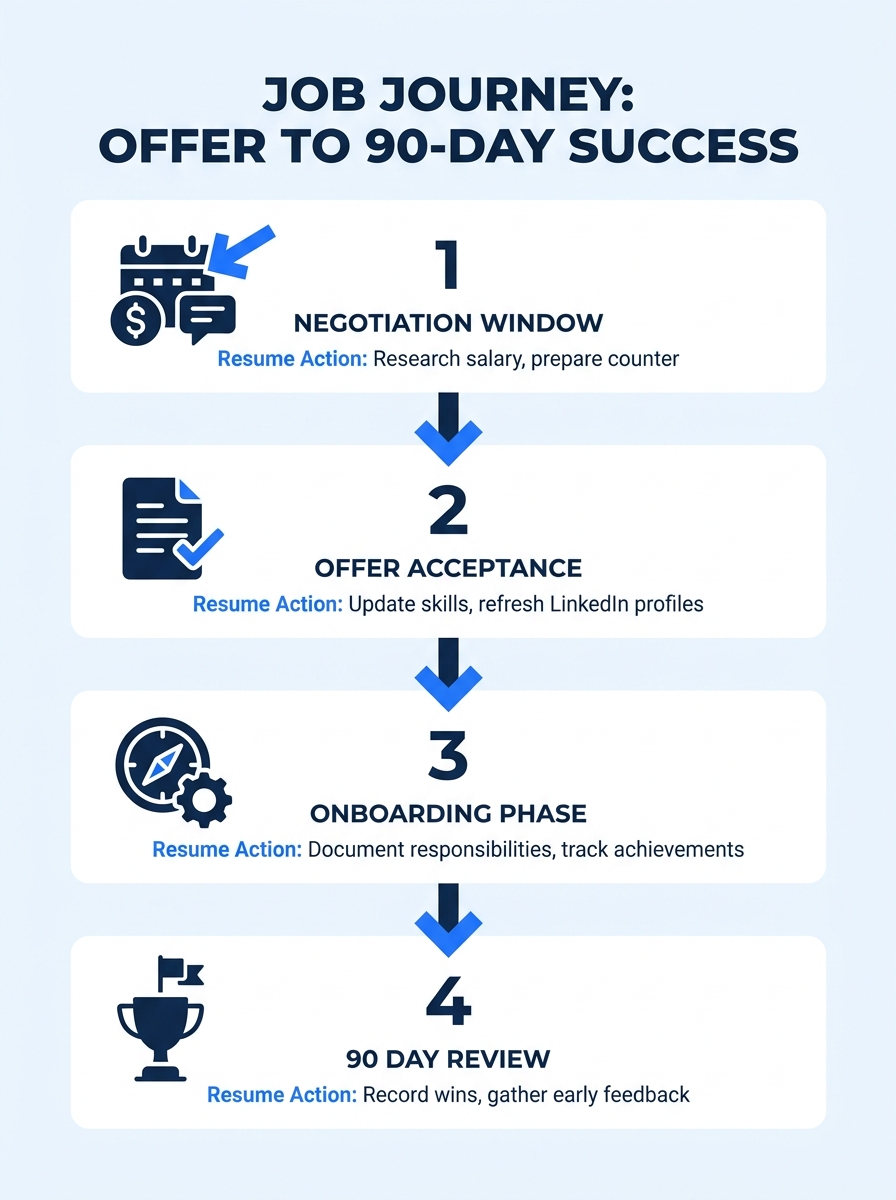
Before we talk about the post-acceptance pivot, let’s address what your resume should be doing during the negotiation itself. If you’re countering on salary, title, or scope, your resume is the evidence file. Every quantified achievement on that document is a data point supporting your counter-offer.
Here’s where many people stumble: the resume they used to land the interview was optimized for getting through ATS filters and catching a recruiter’s eye. That’s a different goal than justifying a $12,000 salary bump. For negotiation purposes, you need to know exactly which bullets on your resume map to the value the employer is paying for.
Pull up the job description. Read through it line by line. Now look at your resume and identify which accomplishments directly address those requirements. If you wrote that you “increased client retention by 23% over two quarters,” and the new role is heavily focused on account management, that bullet is your negotiation anchor. It proves you’ve delivered measurable results in the exact area they’re hiring for.
This process of converting vague experience into measurable impact is the foundation of any serious job offer counter-tactics strategy. Without specific numbers, you’re asking the employer to trust your general competence. With specific numbers, you’re giving them a business case they can bring to the budget holder.
The Verbal Advantage
Indeed’s career guidance notes that while it’s acceptable to negotiate over email, verbal exchanges are significantly more effective. Phone calls, video calls, and in-person conversations let you read tone, express gratitude naturally, and adjust your approach in real time. Email flattens all of that into a static message that the hiring manager can easily forward to someone who doesn’t have context for your tone.
When you do negotiate verbally, have your resume open in front of you. Not to read from it, but to reference specific accomplishments when the hiring manager asks why you believe the role warrants higher compensation. “I noticed the role emphasizes supply chain optimization, and in my current position I reduced procurement cycle time by 18 days” is the kind of specific, evidence-backed statement that moves the conversation forward.
The Pivot: What Happens to Your Resume After You Accept
This is the part almost nobody talks about. You’ve negotiated. You’ve accepted. You start the job. And your resume sits in a drawer (or more likely, unchanged on your laptop) for the next two years.
That’s a mistake for three reasons.
First, your resume controls your internal narrative. In large organizations, your resume or an internal profile often gets passed to project leads, cross-functional team managers, and mentors during onboarding. The version of you that document presents determines which opportunities come your way in the first 90 days.
Second, early resume repositioning protects your negotiation gains. If you negotiated a higher salary based on specific capabilities, your resume should reflect those capabilities prominently. When your first performance review arrives, your manager will be evaluating whether you’re delivering on the value proposition that justified your compensation.
Third, updating your resume while the job is fresh keeps your career narrative coherent. If you’re making a career pivot, the story of why you moved and what you bring needs to be sharp and current. Waiting until you need your resume again (because you’re unhappy, or restructuring hits) means reconstructing that story from faded memory.
The Four-Step Post-Acceptance Repositioning Framework
Step 1: Audit 10-20 Job Descriptions in Your New Field
Career change resume guidance from ResumeAdapter recommends reading through 10-20 job descriptions for roles you want and creating a list of recurring keywords, required competencies, and preferred experience. This advice is typically aimed at people applying for jobs. But it’s equally valuable after you’ve already landed one.
Why? Because those job descriptions tell you what your industry values right now. They reveal the language your new colleagues and managers use. And they show you where the field is headed, which helps you position your existing experience in terms that resonate.
If you’ve pivoted careers using resume templates and coaching, you’ve probably done a version of this exercise already. The post-acceptance version is more targeted: you’re not trying to get hired anymore, you’re trying to be understood and valued inside the organization you’ve joined.
Step 2: Rewrite Your Summary as a Transition Narrative
ResumeAdapter’s 2026 career change guide makes an important point: use your resume summary to frame your transition as intentional and explain how your background adds unique value. The word “intentional” does a lot of heavy lifting here. It signals that your career move was a deliberate strategy, not a reaction to circumstances.
A before/after example helps illustrate this:
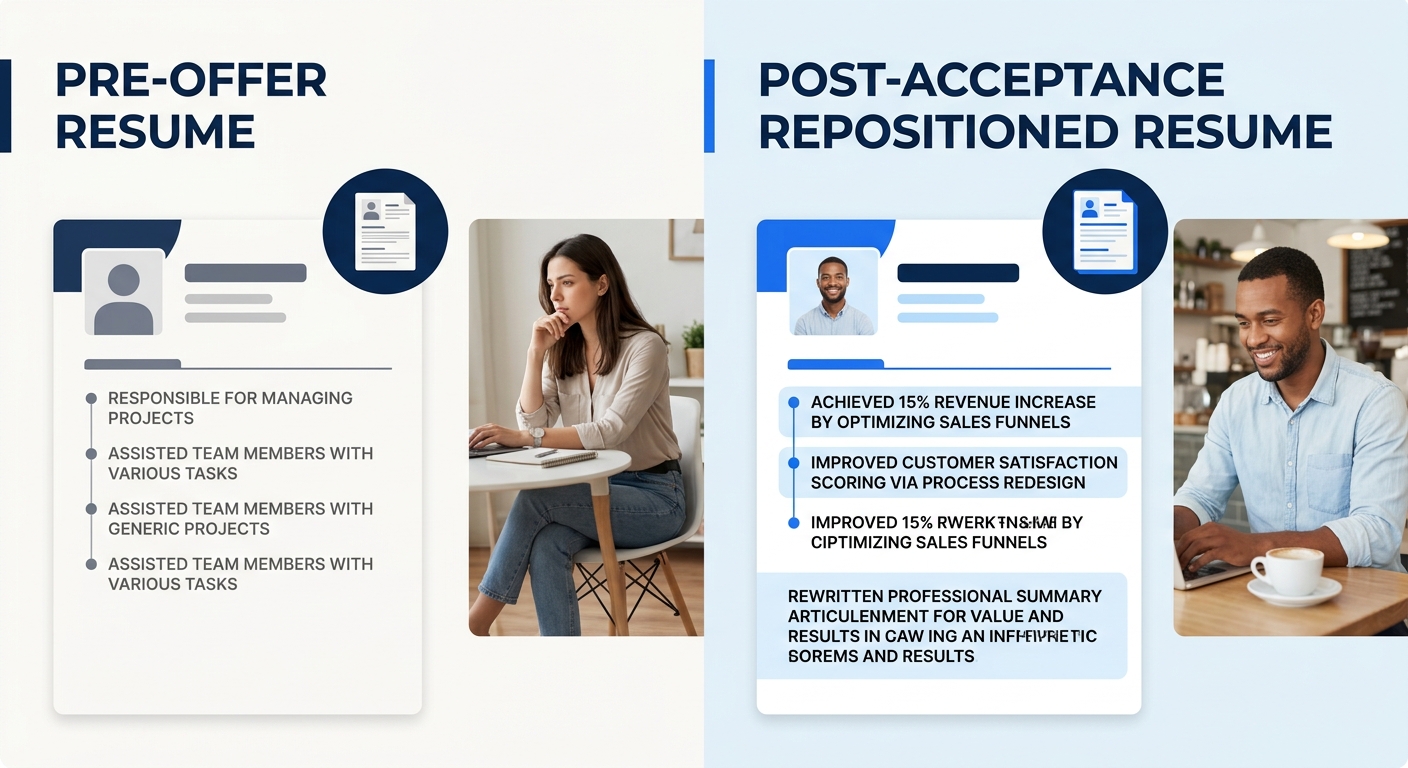
Before (generic): “Experienced marketing professional seeking new opportunities in data analytics.”
After (repositioned): “Marketing strategist with 6 years of campaign performance analysis, transitioning into a dedicated analytics role to apply predictive modeling skills developed through $2.3M in A/B-tested ad spend.”
The second version explains the pivot, quantifies the relevant experience, and connects the old career to the new one through a specific skill. Anyone reading it understands what you bring and why you’re here.
This kind of reframing experience when job titles don’t match your value is the core skill of resume repositioning. And doing it within the first few weeks of a new job means your internal profiles, your LinkedIn headline, and any introductory materials all tell the same focused story.
Step 3: Rebuild Your Bullets Around Transferable Outcomes
Every bullet point on your resume should now be evaluated through one filter: does this make sense to someone in my new industry?
If you spent five years in hospitality and now work in corporate operations, “managed front-desk team of 12 across three shifts” needs to become “oversaw 12-person operations team with 24/7 coverage, maintaining 97% customer satisfaction scores.” Same experience, different framing. The second version translates into corporate language without fabricating anything.
Tip: When rewriting bullets for a new industry, steal vocabulary directly from the job descriptions you audited in Step 1. If your new field says “stakeholder management,” don’t write “working with clients.” Match the terminology your new colleagues actually use.
This is also a good time to remove bullets that served you well in your job search but won’t matter internally. That ATS-optimized keyword stuffing that helped you get past automated screening can come out in favor of clearer, more specific impact statements.
Step 4: Align Your LinkedIn Profile Within 30 Days
Your LinkedIn profile is the public-facing version of your resume repositioning. When new colleagues, clients, and partners look you up (and they will, especially in the first month), they should see a profile that matches your new role’s narrative. If your LinkedIn still reads like someone looking for a job in your old field, it creates dissonance that undermines the internal positioning work you’ve done.
We’ve covered specific LinkedIn tweaks that increase engagement elsewhere, but the post-acceptance context adds urgency. Your new employer’s clients, your new team members, and your new manager are all forming impressions right now. A stale profile works against you.
Resume repositioning after acceptance isn’t vanity maintenance. It’s the difference between being assigned to the project that accelerates your career and being slotted into whatever’s left.

The Salary Renegotiation Point Most People Miss
Here’s where the post-offer negotiation framework connects back to compensation. Stanford Graduate School of Business research on career pivots emphasizes three keys: be realistic, patient, and willing to work incredibly hard. That patience factor matters because the first salary negotiation at the offer stage is rarely the last one.
Many companies conduct compensation reviews at 6 months, 12 months, or at the end of a probationary period. Your repositioned resume becomes the document that supports your case in those conversations. If you’ve spent six months building a track record of quantified results in your new role, and your resume already frames those results clearly, you walk into that review with a prepared case instead of scrambling to remember what you accomplished.
The Wake Forest School of Professional Studies recommends researching the salary range for your desired position and comparing it to your current income as a foundational step. Doing this research again at the 6-month mark, with updated market data, gives you a factual basis for any adjustment conversation. Salary negotiation strategy works best as an ongoing practice, not a one-time event.
Questions The Numbers Still Can’t Answer
The research on post-offer negotiation is clear on several points: employers expect it, verbal conversations outperform email, and justification grounded in objective reasoning gets better results than emotional appeals. The career-change data is equally clear: framing your transition as intentional, quantifying transferable outcomes, and matching industry vocabulary all improve how you’re perceived.
What the data can’t tell you is how your specific manager will respond to seeing a repositioned resume during onboarding, or whether your company’s culture treats internal career narratives as fluid or fixed. Some organizations encourage employees to update internal profiles quarterly. Others barely look at them after hiring.
The safest assumption is that your professional story is always being evaluated by someone, whether through a formal review, a casual LinkedIn check, or a project assignment meeting where your name comes up and someone pulls your file. If that story is stale, generic, or misaligned with the role you’re actually performing, it works against you in ways you’ll never see directly.
The framework outlined here gives you a structured way to keep that story current. But the timing, the tone, and the degree of repositioning that makes sense for your situation requires the kind of judgment that no dataset can provide. Pay attention to how your new organization communicates value, watch which colleagues get tapped for high-visibility projects, and update your documents accordingly. The resume you used to get hired did its job. The one you build after accepting does a different, longer-lasting job entirely.