

 4.9
4.9 4.5
4.5Three paths sit in front of every senior software engineer who feels stuck: polish the resume, build a promotion packet on your own, or hire a career coach. Each costs different amounts of time and money. Each solves a fundamentally different problem. And picking the wrong one can waste months of effort on a symptom while the actual disease spreads.
The typical software engineer career progression runs from junior to mid-level to senior, and then the road splits. As one widely cited industry resource puts it, the IC track is for engineers who want to stay close to the code, lead through technical excellence, and solve deep systems problems. The management track trades depth for breadth: people leadership, org design, roadmap ownership. And the “I don’t know what I want” track — the one nobody talks about — is where most of the misery lives.
That IC vs management decision is where career confusion concentrates, and it’s where the three approaches diverge most sharply. Here’s what each one actually delivers and where each one falls short.
Resume Optimization Fixes Your Document, Not Your Direction
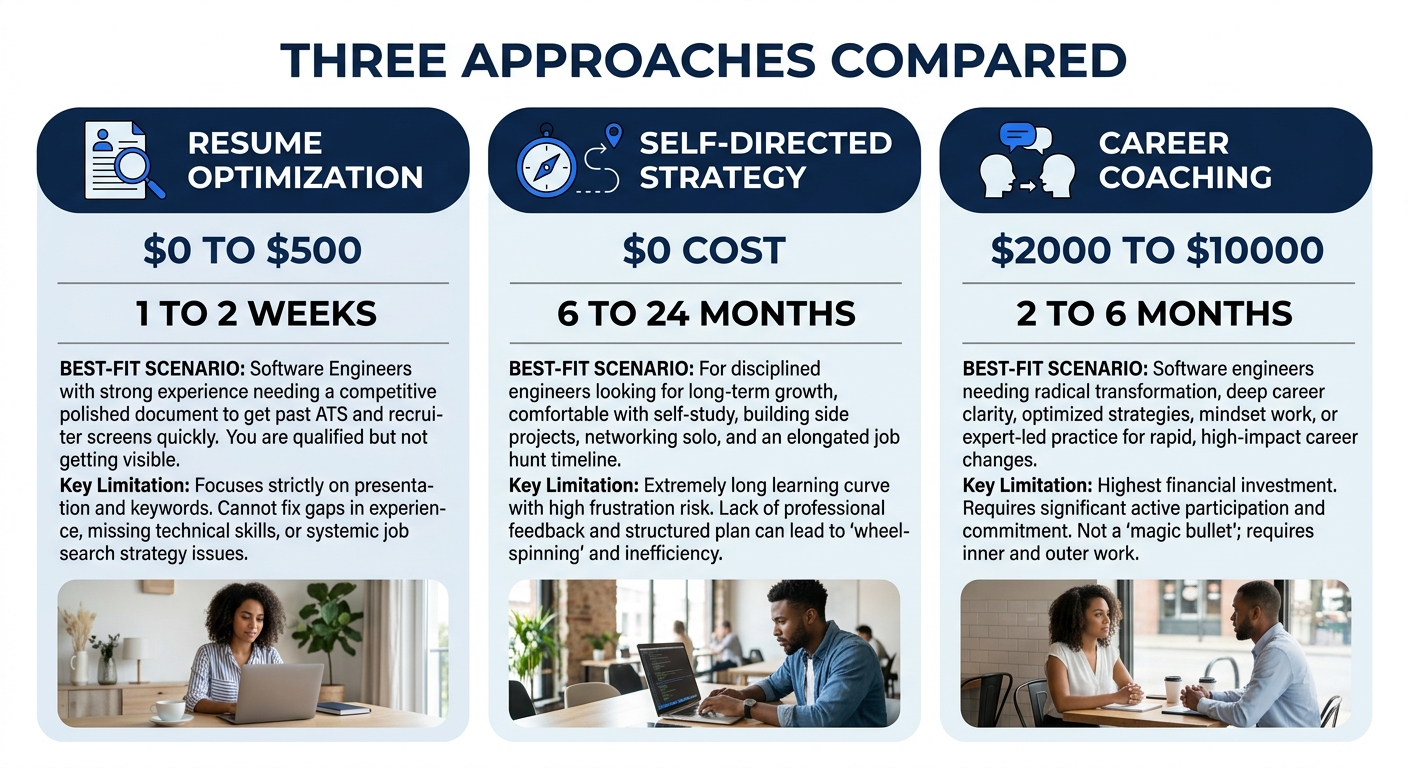
Resume work is the most accessible intervention. You can start tonight, for free, with a blank document and a job description. And for many engineers, it’s the right move, if the core problem is that your experience doesn’t translate onto paper.
The pattern we see constantly: an engineer with impressive work ships a resume full of vague bullets like “Built microservices with Spring Boot” or “Worked on the payments team.” These say nothing about impact. Converting those into measurable outcomes like “Reduced API latency by 40% across 150K daily requests by redesigning the caching layer” genuinely moves the needle on callbacks. We’ve written extensively about converting vague accomplishments into measurable outcomes, and the framework works.
But here’s where resume optimization hits its ceiling: it can only represent decisions you’ve already made. If you’re a senior engineer unsure whether to pursue staff engineer or pivot into engineering management, no amount of resume polish will resolve that ambiguity. You’ll end up with a beautifully formatted document that targets the wrong role.
When Resume Work Is the Right Call
You know what you want to do next. You can name the title, the type of company, and roughly the scope of the role. Your problem is translation: getting what’s in your head onto paper in a way that hiring managers and ATS systems can parse. If that’s you, start with strong action verbs and power language and build from there.
When It Falls Short
You’ve been updating your resume for six months. You’re applying broadly. You’re getting some interviews but nothing feels right, or you keep getting offers you don’t want to accept. The document is fine. The direction is unclear.
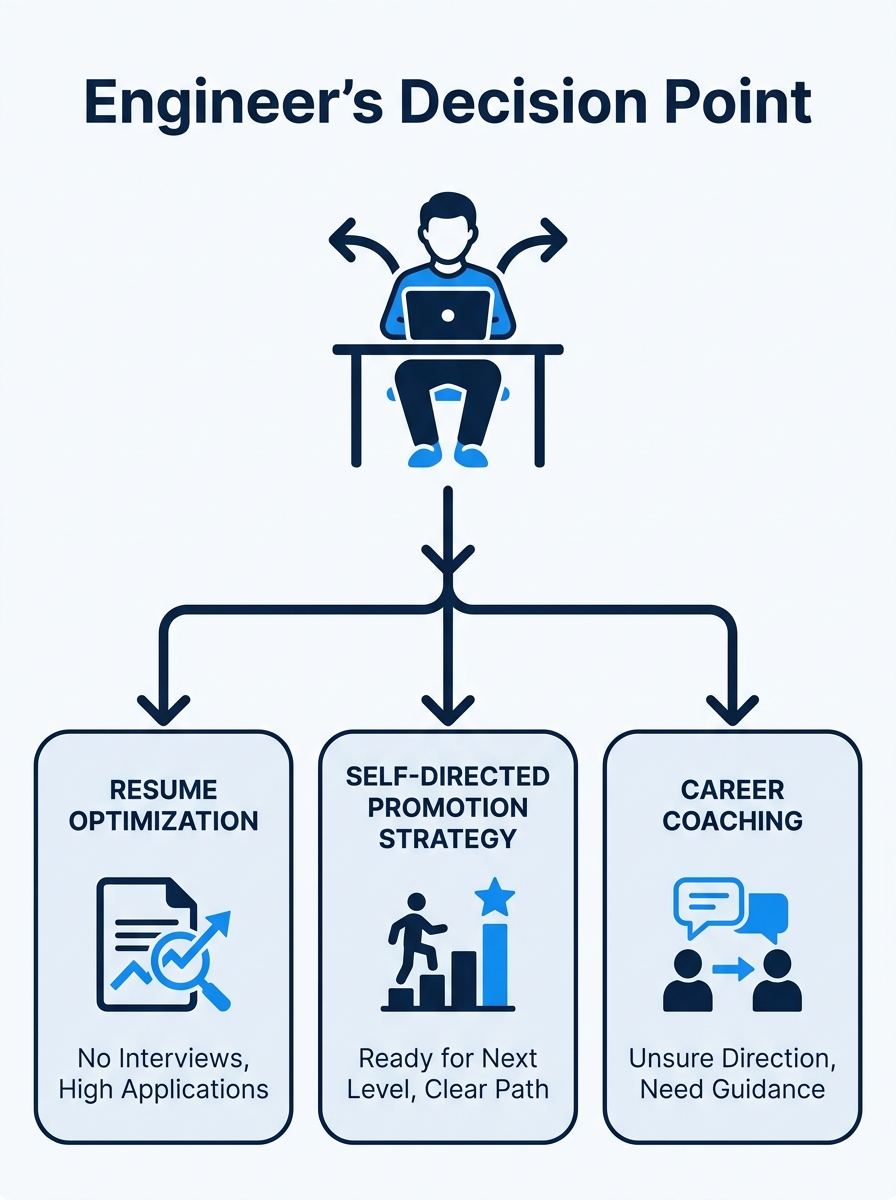
The Self-Directed Promotion Packet
This approach assumes you’ve already decided where you’re going. You want staff engineer, or you want to move into management at your current company, and you’re willing to do the strategic work yourself.
The promotion packet, a document tracking your accomplishments, impact areas, and evidence of operating at the next level, has become standard advice in big tech. Will Larson’s Staff Engineer guide recommends using it to steer yourself toward demonstrating promotion criteria over time, especially when your manager changes. And manager changes are common. Without a written record of your trajectory, a new skip-level or direct manager may reset the clock on your promotion timeline.
The self-directed approach also involves what multiple staff engineers describe as the most underrated career move: a frank conversation with your manager about performance and trajectory. One staff engineer’s account describes telling their manager, plainly, “My rough plan is to exceed expectations this cycle and to get promoted next cycle.” That kind of directness forces alignment. Or it reveals misalignment, which is equally valuable information.
The Strengths of Going Solo
Cost: essentially zero. Timeline: you control it. And the process itself builds skills you’ll need at the next level, including self-advocacy, strategic thinking, and organizational awareness. Engineers who successfully navigate to staff through self-directed effort often arrive with stronger political instincts than those who were coached through it. There’s something to be said for learning to read an organization by actually reading it, rather than having someone interpret it for you.
The Tradeoffs
You’re working without a mirror. Engineers are notoriously bad at assessing their own communication gaps, blind spots in stakeholder management, and the invisible criteria their promotion committee actually weighs. You can build a pristine promotion packet and still get passed over because you never realized that your VP cares more about cross-team influence than technical depth.
The other risk is that the self-directed path assumes your goal is correct. If you’ve decided “staff engineer” is the answer without examining why you want it, you might spend two years executing a plan that leads somewhere you don’t actually want to be. Reaching staff engineer career clarity requires understanding what the role demands day-to-day, and for many engineers, the reality (more documents, more meetings, more alignment work, less coding) comes as a genuine surprise.
If you’ve decided “staff engineer” is the answer without examining why you want it, you might spend two years executing a plan that leads somewhere you don’t actually want to be.
What Career Coaching Actually Does (and Doesn’t Do)
Career coaching for developers has a reputation problem. Engineers tend to be skeptical of anything that sounds soft, and the coaching industry hasn’t helped by wrapping its services in vague language about “unlocking potential.” So let’s be specific about what coaching addresses.
A good technical career coach helps across three domains: career strategy (promotions, compensation, job search), leadership development (stakeholder management, communication), and the clarity work that the other two approaches skip entirely.
Nicholas Zakas, creator of ESLint and a well-known engineering leader, describes the moment that reshaped his understanding of senior technical careers. Someone told him what it took to reach principal engineer: “At a certain point, you stop being judged on your technical skills and start being judged on how you work with people.” That transition catches many engineers off guard. Coaching helps you prepare for it before you’re already in the role and struggling.
What Coaching Solves That the Other Two Don’t
The IC vs management decision is the obvious one. A coach can help you audit your actual preferences: not what sounds prestigious, not what your peer group is doing, but what kind of work energizes you on a Tuesday afternoon when nobody’s watching. That audit is hard to do alone because you’re inside your own biases.
Coaching also addresses what you might call the “narrative gap.” Your resume lists what you did, but a coach helps you understand, and articulate, why it mattered and where it points. Engineers who’ve gone through coaching during career transitions frequently report that the biggest value had nothing to do with interview prep or resume tweaks. It was realizing they’d been aiming at the wrong target.
For engineers weighing a career pivot with strategic coaching, the coaching component typically surfaces questions that templates can’t answer. Do you actually want to manage people, or do you want the salary bump that comes with management? Are you drawn to the staff engineer title, or to the type of work staff engineers do? Those are different things, and confusing them leads to years of misaligned effort.
What Coaching Doesn’t Solve
Coaching won’t write your resume for you. It won’t fix a bad interview if you haven’t practiced. And it can’t compensate for a genuine skills gap. If you need to learn system design at scale, you need to study system design at scale. Expecting a coach to substitute for technical growth leads to disappointment on both sides.
Coaching also varies wildly in quality. Programs range from engineering-specific services with genuine technical credibility to generic life coaches who’ve rebranded for the tech market. Some services, like OACO, claim 325+ engineering leaders coached with custom “Promotion Playbooks.” Others pair you with mentors through platforms like MentorCruise, where you can find coaches specifically credentialed in software engineering. The gap between the best and worst coaching is enormous, so vetting matters more here than in almost any other professional service.
Tip: When evaluating a career coach, ask for specifics: What percentage of their clients are engineers? Can they explain the difference between L5 and L7 expectations at a big tech company? If they can’t speak your technical language, they probably can’t help you navigate your technical career strategy.
How To Choose Between These Three
The right approach depends on which problem you actually have. Here’s the honest breakdown.
Your direction is clear and your resume is weak. You know you want to stay IC and target staff-level roles at mid-size companies. You know you want to move into engineering management at a FAANG. Whatever the specifics, the destination is locked in and your resume doesn’t reflect it. Go with resume optimization. It’s the cheapest, fastest path, and the ROI shows up within weeks. An engineer who can articulate measurable impact in every bullet will outperform one with a vague resume and a coach on speed dial.
Your direction is clear and your company has a defined ladder. You want staff engineer at your current employer. The promotion criteria exist in writing, or can be extracted from your manager. You’re a self-starter who’s comfortable with ambiguity and good at soliciting feedback from peers and leadership. Build the promotion packet. Do the self-directed work. The engineers who succeed with this approach tend to build lasting career muscles that serve them for decades.
Your direction is unclear, or you keep pursuing goals that feel hollow when you achieve them. You got the senior title and felt nothing. You’re toggling between “maybe management” and “maybe staff IC” every few weeks. You’re applying to jobs but can’t explain what you actually want from your next role beyond “more money” or “better culture.” This is where coaching earns its cost. The clarity problem sits upstream of everything else, and solving it makes every subsequent move, the resume, the promotion packet, the interviews, dramatically more effective.
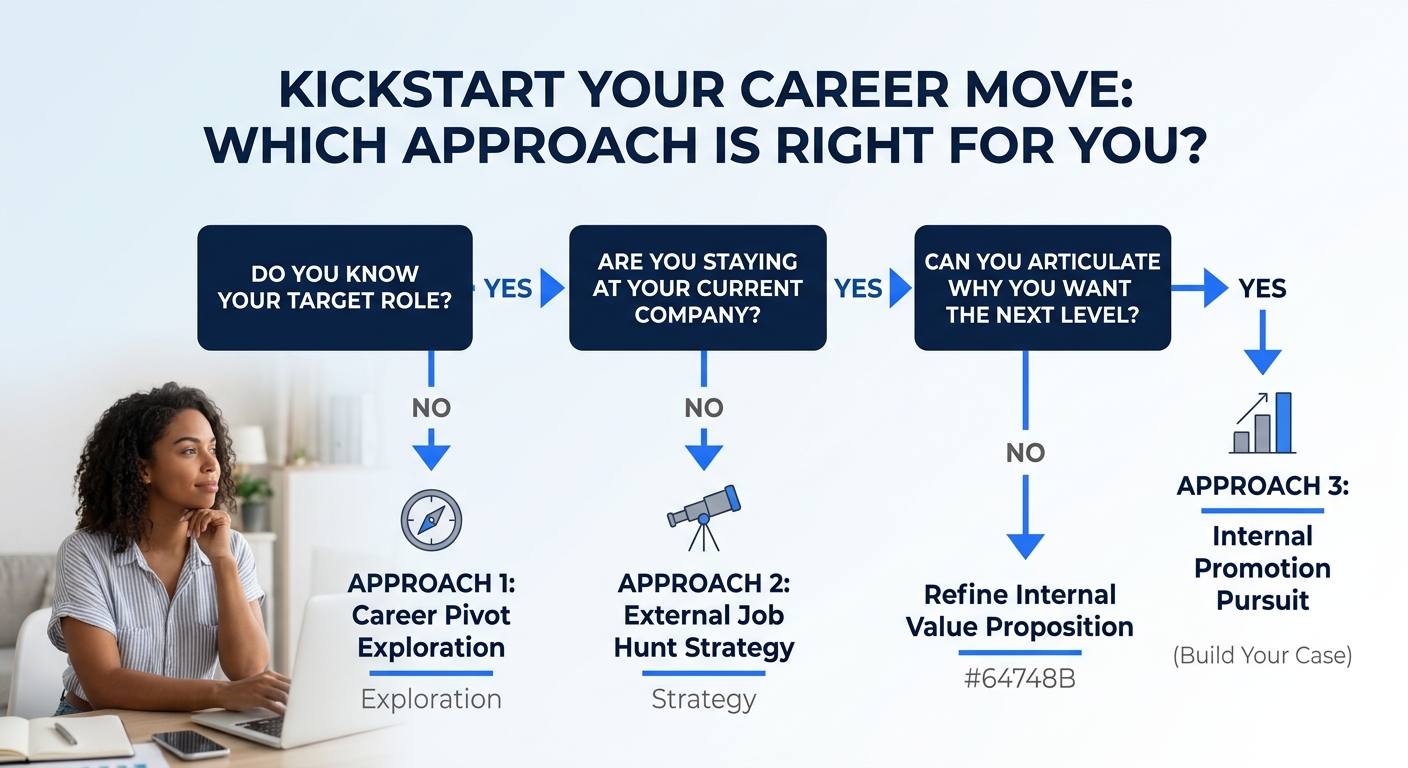
Many engineers end up using all three at different stages of their software engineer career progression. A coach helps you find direction at 28, self-directed promotion strategy gets you to staff at 33, and sharp resume work lands you the next external role at 37. These aren’t competing philosophies. They’re tools with different applications, and treating a direction problem as a resume problem (or vice versa) is how engineers spend years feeling productive about their careers while going nowhere in particular.
The engineers who navigate this best tend to be honest about which problem they’re actually facing. Rewriting your bullets for the fourth time when you don’t know what role you’re targeting is procrastination dressed up as productivity. And hiring a coach when all you need is better resume language is spending $5,000 to fix a $50 problem. Match the tool to the problem, and the problem gets solved.