
 4.9
4.9 4.5
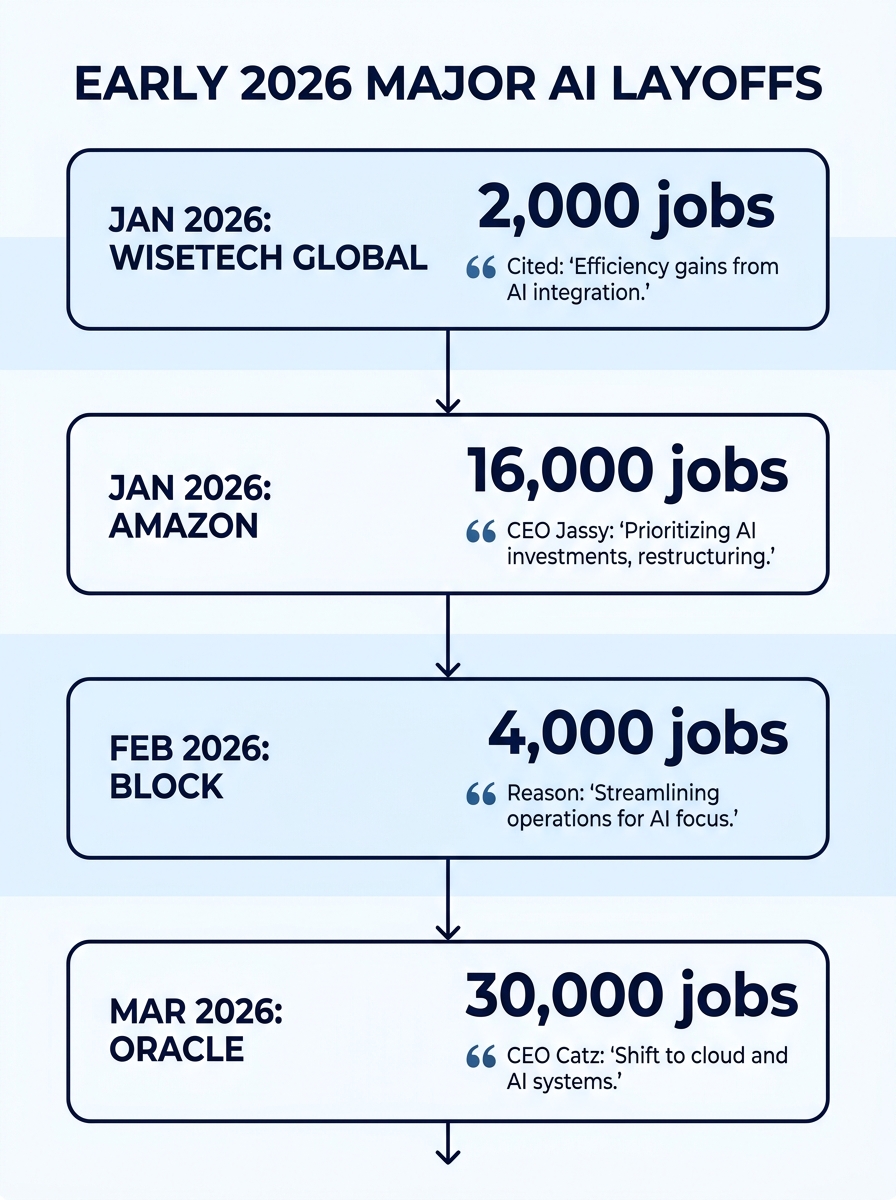
4.5Wisetech Global, a logistics software company based in Sydney, eliminated 2,000 positions in early 2026. That’s 30% of its entire workforce. CEO Zubin Appoo didn’t blame market headwinds or a bad quarter. He said something more jarring: “The era of manually writing code as the core act of engineering is over.” A single sentence reduced thousands of careers to a before-and-after line on a timeline. And Wisetech’s move, while dramatic, fits a much larger pattern of tech industry job displacement that’s reshaping what a technical resume even needs to look like. This article dissects Wisetech’s case and walks through exactly how to rebuild a resume after tech layoffs driven by AI restructuring.
Zubin Appoo Said the Quiet Part Out Loud
Most CEOs announcing layoffs point to restructuring, efficiency, or shifting priorities. Appoo chose a different framing. He declared an entire category of work obsolete. The implication for Wisetech’s engineers was clear: the company didn’t think their core skill, writing code by hand, would matter in the same way going forward.
This wasn’t a vague gesture toward future automation. Wisetech actively replaced manual QA and code-generation workflows with AI tooling and restructured teams around smaller groups of engineers who could direct AI-assisted development. The people who got cut weren’t underperformers. Many had years of experience in supply chain logistics software, a niche domain. But their resumes described work that Appoo had publicly said the company no longer valued.
That framing matters because it tells you something about how the hiring side of the tech market is shifting. As HBR reported in January 2026, companies are laying off workers based on AI’s potential, not its proven performance. The actual productivity gains from AI remain debated. But leadership teams are making staffing decisions as if those gains are already locked in. When you’re repositioning a technical resume in 2026, you’re writing for hiring managers who live in that gap between promise and reality.
100,000 Workers, 155 Events, One Quarter
Wisetech didn’t act alone. As of late April 2026, over 100,443 tech workers have been affected across 155 separate layoff events, according to the SkillSyncer Layoffs Tracker. Amazon cut 16,000 corporate roles citing AI-driven operational efficiencies. Block eliminated 4,000 positions. Oracle is reportedly planning reductions affecting up to 30,000 employees globally.
Goldman Sachs research published in early 2026 projects that generative AI could ultimately affect 300 million full-time jobs worldwide, with roughly two-thirds of current occupations exposed to some degree of AI automation. And Challenger, Gray & Christmas estimates that 23% of Q1 2026 tech layoffs were directly attributed to AI implementation. The roles hit hardest include customer support, quality assurance, content moderation, and middle management.
But here’s the thing CNN Business reported that deserves a closer read: there’s still no solid evidence AI is meaningfully replacing workers at scale. The white-collar “bloodbath” predicted by tech executives hasn’t materialized in aggregate employment data. Unemployment remains relatively low. What’s happening is more targeted and structural. Companies are using AI as a reason to flatten org charts, reduce headcount in specific functions, and reallocate budgets toward AI infrastructure. If you were in one of those specific functions, the macro data is cold comfort. Your resume needs to address a very particular challenge: proving that your skills compound with AI rather than compete against it.
Companies are laying off workers based on AI’s potential, not its proven performance. When you rebuild your resume, you’re writing for hiring managers who live in that gap between promise and reality.
Why the Standard Technical Resume Fails This Filter
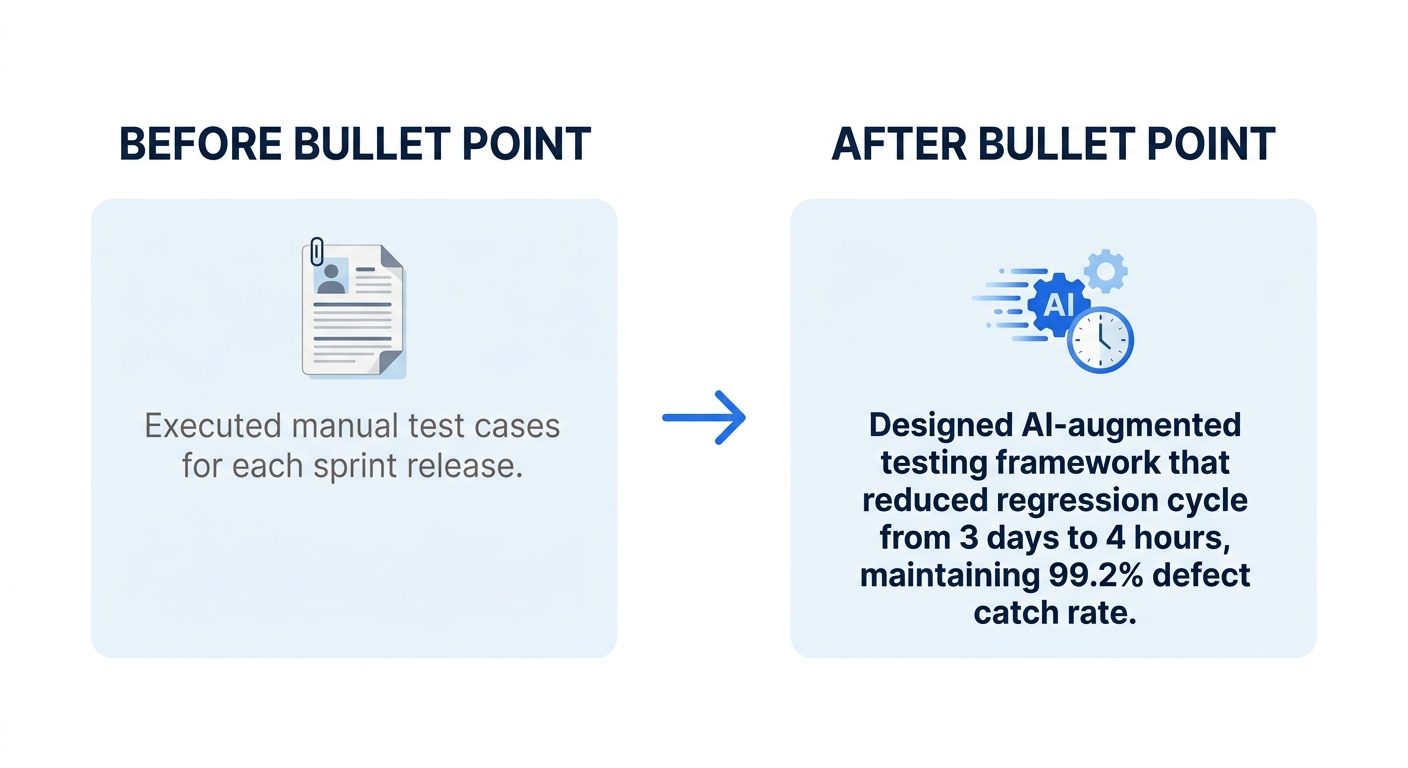
Consider what a typical QA engineer’s resume looked like before Wisetech’s cuts. It might list responsibilities like “developed and executed manual test cases,” “performed regression testing across builds,” or “documented bugs in Jira.” Solid descriptions. Accurate. And now, to a hiring manager evaluating a candidate for an AI-augmented team, they read like a list of tasks a testing copilot handles in minutes.
The problem with a resume after tech layoffs like Wisetech’s is twofold. First, the skills section may emphasize exactly the activities the employer automated away. Second, the chronological format spotlights a gap if you’ve been out for a few months during the search. Indeed’s career advice recommends considering a functional resume format after a layoff, which organizes experience by skill category rather than timeline. This can help when you need to downplay a gap and emphasize transferable strengths.
If your resume feels stuck in old patterns, it’s worth reading through common signs your resume isn’t performing and comparing against what’s actually getting past screeners right now. The AI-driven screening tools most companies use in 2026 parse for specific keywords, measurable outcomes, and evidence of collaboration with automated tools. Understanding how AI-powered resume screening works gives you a real edge in knowing what to include and what to cut.
Your transferable skills are genuinely valuable here. As Enhancv’s guide on handling layoffs points out, the technical knowledge and people skills you’ve accumulated don’t vanish because a company restructured. They’re a foundation recruiters want to see, especially when framed around judgment, context, and outcomes rather than task execution.
Rebuilding Around Judgment, Context, and Cross-Functional Impact
So what does a repositioned technical resume actually look like after a career pivot after company restructuring? The Wisetech case gives us a clear lens, because the CEO defined exactly what the company no longer wanted (manual code writing) and implied what it still did want (engineers who could direct, evaluate, and improve AI-generated output).
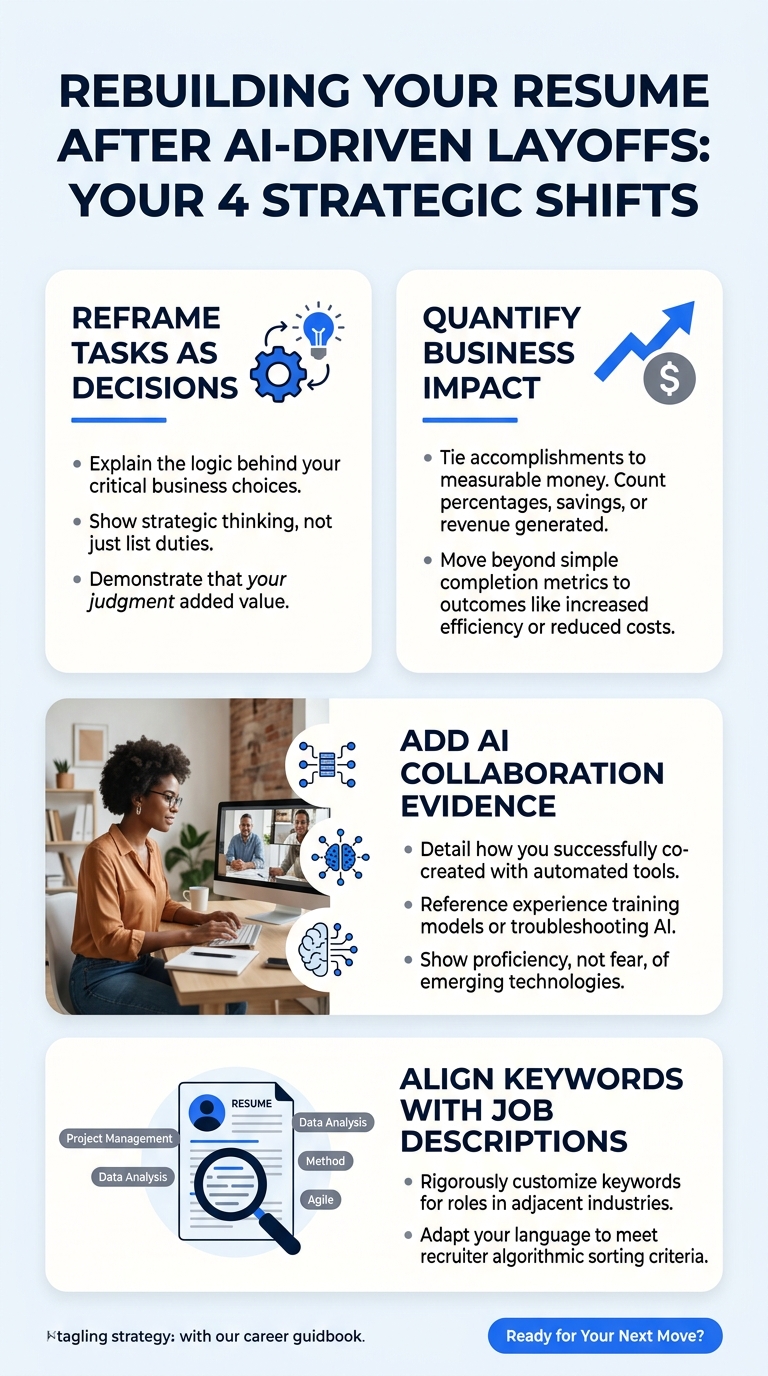
Here’s a practical framework for rewriting your resume around AI-resistant skills:
Reframe every bullet as a decision, not a task
Instead of “wrote unit tests for payment processing module,” try “identified critical failure modes in payment processing logic and designed test coverage strategy that caught 14 production-blocking defects before release.” The second version shows judgment. It positions you as someone who understands what to test and why, which is the part AI still can’t do well. Using strong action verbs at the start of each bullet reinforces this shift toward agency and decision-making.
Quantify your impact in business terms
Hiring managers scanning for AI-resistant skills on a resume look for evidence that you drove outcomes tied to revenue, cost savings, or customer retention. “Reduced onboarding time by 30% using AI-driven training modules” tells a much better story than “helped with onboarding.” If you reduced cycle time, increased coverage, improved retention, or saved the company money, say so with numbers.
Add an AI collaboration section
This is new territory for most resumes, but it matters. If you’ve used GitHub Copilot, ChatGPT for code review, AI-powered testing frameworks, or any other AI tooling, create a dedicated subsection under your skills or within your experience bullets. Be specific: name the tools, describe the workflow, and quantify the result. Anthropic’s own engineering team has written about designing technical evaluations that account for AI assistance, which signals that companies expect candidates to be fluent with these tools.
Consider adjacent industries
Tech industry job displacement doesn’t mean your skills only work in tech. Supply chain logistics, healthcare IT, fintech, and manufacturing all need people who understand software systems. If you’re exploring a broader career pivot, resources like our guide to resume strategies for career changers walk through how to reposition experience for a different sector without starting from zero.
Tip: When tailoring your resume for a specific role, pull keywords directly from the job description and weave them into your experience bullets. This applies to both ATS optimization and the human reviewer who reads your resume afterward. Our [tips for making resumes ATS-friendly](/blog/ways-to-make-resume-ats-friendly) cover the mechanics in detail.
And don’t neglect your LinkedIn profile during this process. The data shows that recruiters increasingly cross-reference resumes with LinkedIn before making interview decisions, and a few targeted profile updates can significantly increase your visibility to the right people.
The Wisetech Playbook, Generalized
Wisetech’s layoffs are a case study in how quickly the rules of employability can shift. One CEO statement reframed an entire skill category, and 2,000 people had to figure out what their experience was worth on the other side of that statement. The answer, it turns out, is that the experience is still worth plenty. The packaging just needs to change.
If you’re rebuilding your resume after an AI-driven layoff, the core principle from this case is straightforward: stop describing what you did and start describing the decisions you made, the context you understood, and the outcomes you produced. AI can write code, run tests, and generate reports. It can’t explain why a particular architectural choice was the right one for a specific business context, or how you navigated a cross-team dependency that threatened a launch date. Those are the stories your resume needs to tell.
The broader job market data supports this approach. Even as overall tech postings have declined by 8% year over year, AI and machine learning engineering roles have increased by 34%. Companies are hiring differently, and the professionals who land those roles will be the ones whose resumes reflect an understanding of where human judgment fits in an AI-augmented workflow. If you want structured support through this process, working with professional career coaches who specialize in tech transitions can help you identify your strongest positioning angles and practice articulating them in interviews.
Wisetech’s displaced engineers aren’t a cautionary tale about obsolescence. They’re the first large cohort forced to answer a question the rest of the industry will face soon: when the CEO says your core task is automated, what’s left on your resume? The answer is everything you brought to the work that the task description never captured. Get that onto the page, and you’ll be in a stronger position than your resume has ever put you in before. For more guidance on navigating this landscape, browse our career guides for updated strategies tailored to the realities of the current market.