

 4.9
4.9 4.5
4.5Paste three different job descriptions into a modern resume builder and the AI will produce bullet points that sound nearly identical for all three. Auditing those suggestions before accepting them, using a consistent set of checks, separates applications that earn callbacks from ones that disappear into the pile.
TL;DR: AI resume builders generate plausible-sounding bullets that lack specificity and personal voice. Run every suggestion through six checks: read it aloud, insert real metrics, test for uniqueness, treat keywords selectively, break tonal uniformity, and verify factual claims about your role.
An estimated 27% of resumes now contain AI-generated content, according to a 2026 industry audit. The grammar is clean. The formatting passes ATS scanners. The keywords align with the job posting. But hiring managers are catching on. Samuel Johns, senior career counselor at CV Genius, has stated that “hiring managers seek insight into a candidate’s passions and cultural fit,” qualities that AI-generated bullets consistently fail to convey. Recruiters already spend roughly 11 seconds scanning each resume before making a decision, and if your bullet points read like everyone else’s AI output, those 11 seconds work against you.
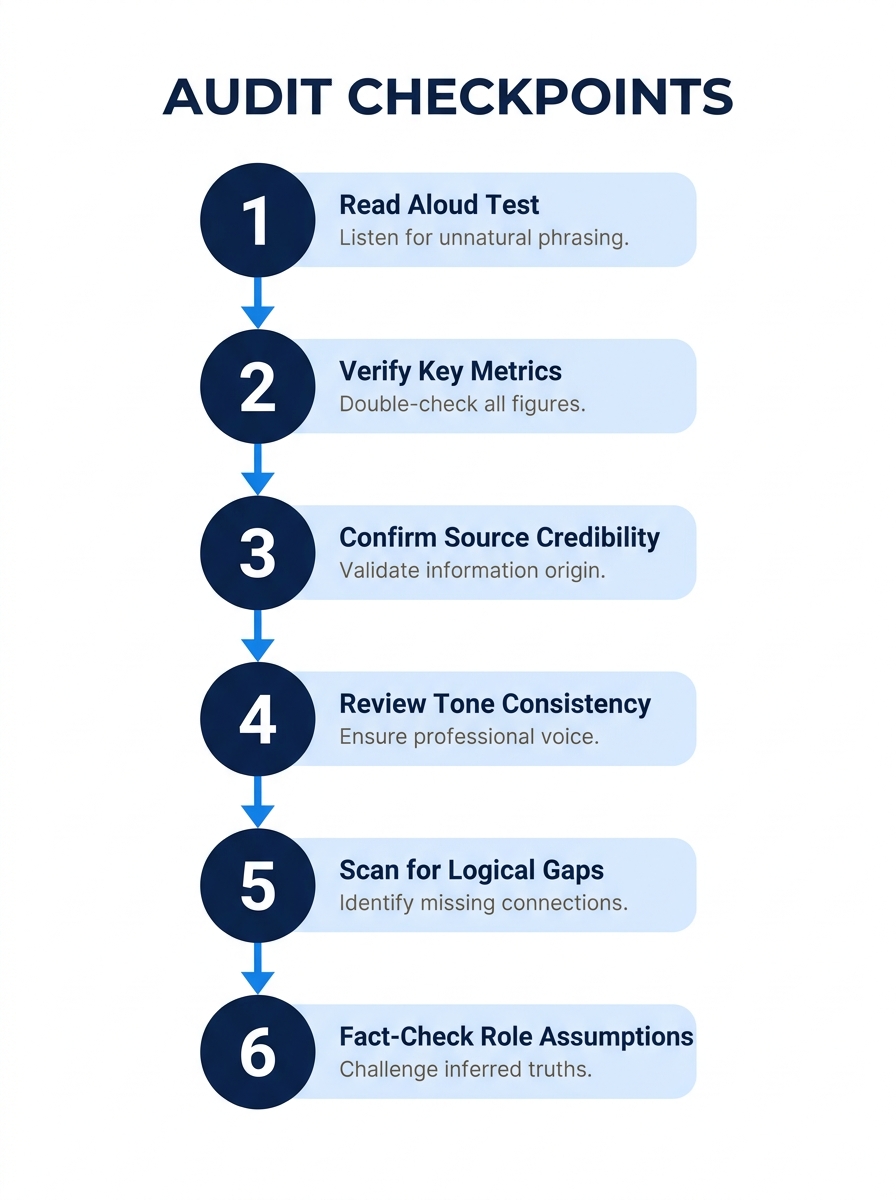
The six rules below form an AI resume suggestions audit you can run on any builder’s output. Each takes under five minutes. Together, they turn generic AI drafts into something that sounds like a specific human with specific accomplishments.
Read every suggestion out loud before you accept it
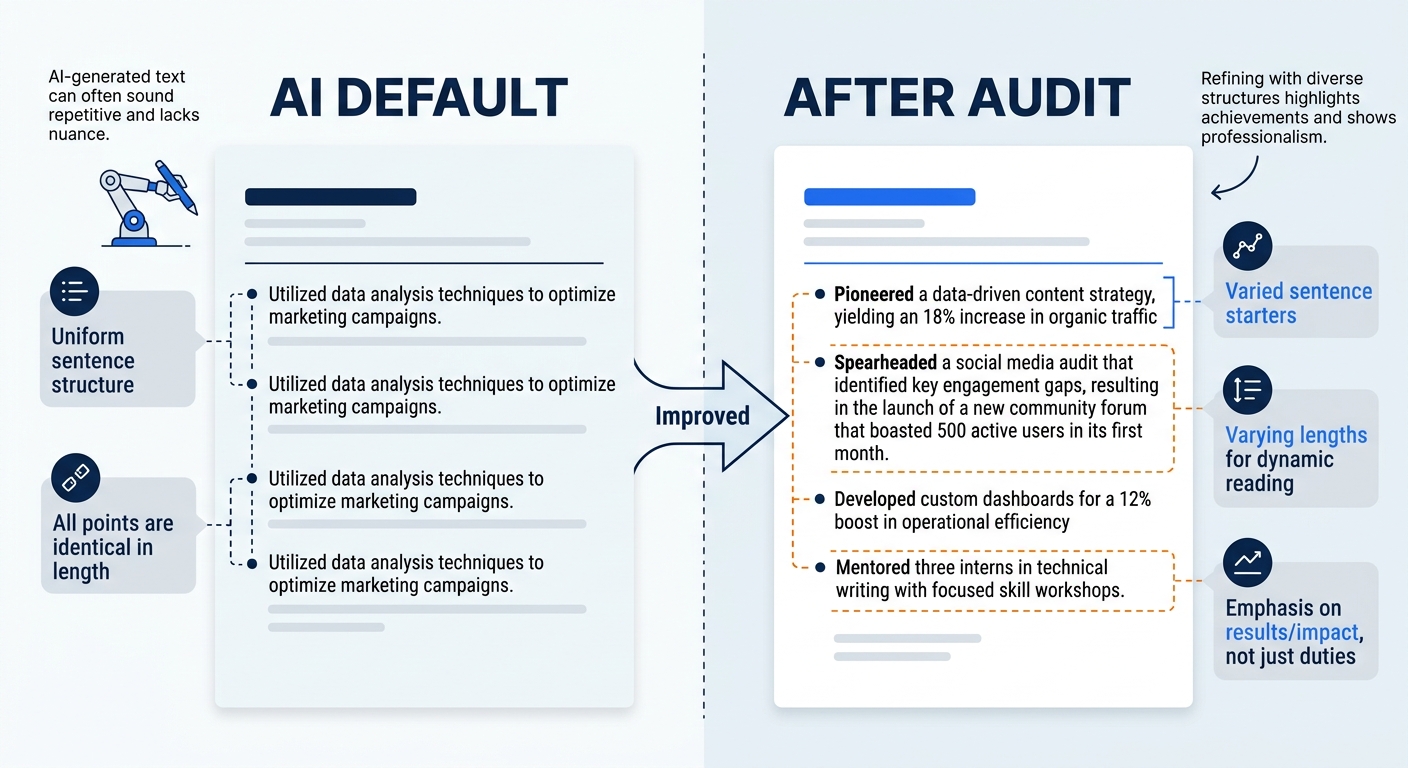
This rule catches the single most common AI tell: sentences that look professional on screen but sound robotic when spoken. AI-generated bullets tend toward uniform sentence length (averaging 18 to 22 words per bullet), identical parallel structures, and a formal register that no person actually uses when describing their work.
The read-aloud test exposes three specific problems. First, you’ll hear when the AI has strung together buzzwords without saying anything concrete. “Drove cross-functional alignment to optimize stakeholder outcomes” means nothing to a hiring manager’s ear. Second, you’ll notice rhythmic monotony, where every bullet follows the same verb-noun-prepositional-phrase cadence. Third, you’ll catch phrases you would never say in a real conversation about your job. If you wouldn’t describe your work that way to a former colleague over coffee, the bullet needs rewriting.
Resumly’s Buzzword Detector tool, part of their free resume audit suite, flags overused corporate language automatically. Running your AI-generated draft through it before the read-aloud test gives you a concrete list of words to replace. Their ATS Resume Checker and Readability Test add 2 additional layers, evaluating keyword density and sentence complexity on numerical scales rather than subjective judgment.
Replace every vague impact claim with your actual numbers
AI builders excel at generating bullet structures: action verb, responsibility description, implied outcome. They fail at the one thing that makes a bullet memorable, which is quantified proof. As ResuFit’s editorial team has written, AI tools “generate tailored bullets from your actual experience and the target job description,” but “the bullet points describing your experience should always be authentically” yours, grounded in real results you can defend.
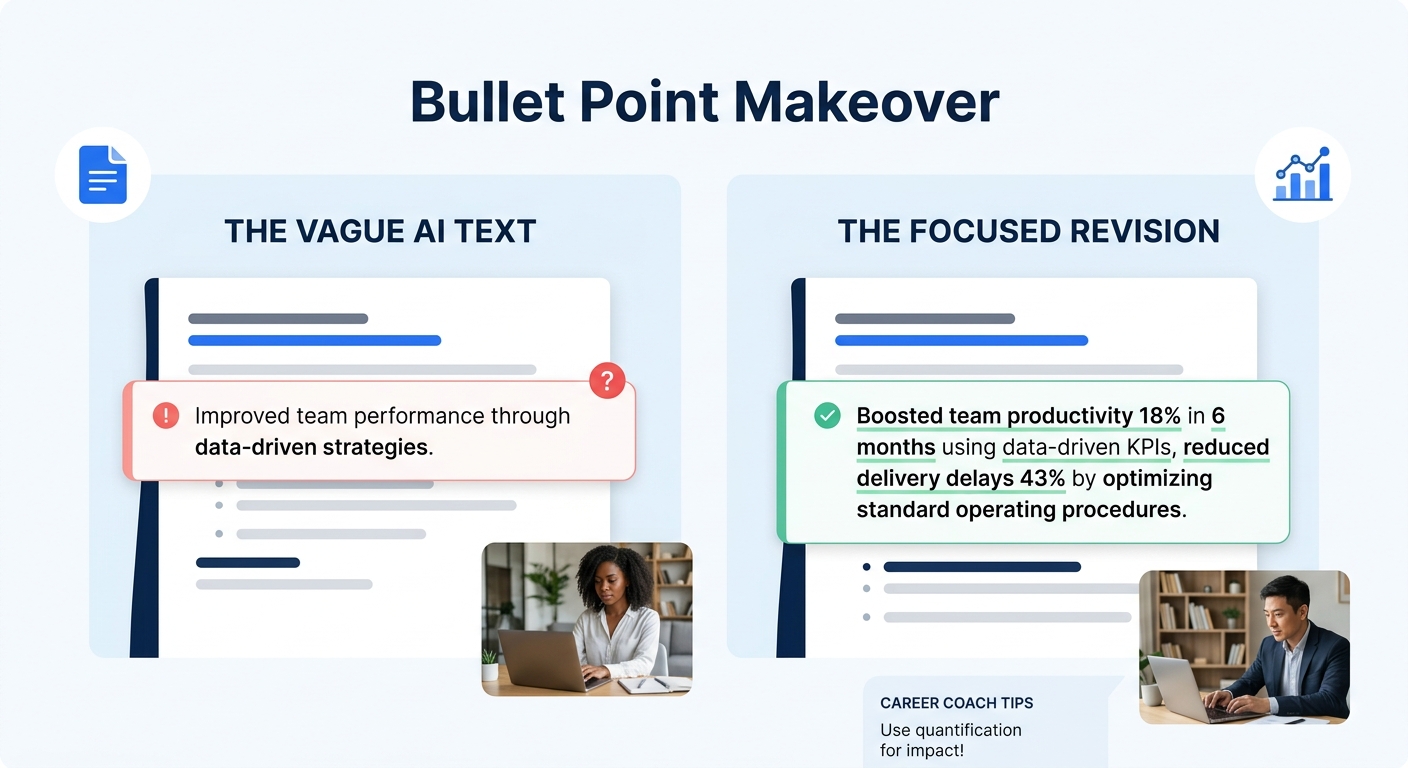
Resumes with specific metrics are 68% more likely to result in job offers within 90 days. That gap exists because numbers answer the recruiter’s implicit question: “How much?” An AI might suggest “Improved customer retention through targeted outreach.” The audited version reads “Increased customer retention from 72% to 89% over 6 months by redesigning the onboarding email sequence, generating $140K in preserved annual revenue.” Same structure. Completely different impact.
ApplyBuddy’s AI resume rater evaluates content strength across 3 sub-dimensions: clarity, impact, and quantified achievements. ATS compatibility gets scored separately on formatting, keywords, and parseability. Notice that “quantified achievements” is its own scoring axis, weighted independently from the other 5 evaluation criteria. AI tools that score your resume know numbers matter. The irony is that the same category of tool often generates bullets without any numbers at all.
Apply the “who else could claim this” test to every bullet
If you swap your name for any other professional in your field and the bullet still works, the bullet is too generic. This test is the fastest way to identify where your resume builder customization strategy has failed you. AI tools pull from pattern libraries trained on thousands of resumes, so they naturally converge on the median description of any role.
The test works like this: read each bullet and ask whether a competitor for the same job could paste it onto their resume without changing a word. “Managed a team of 8 engineers and delivered 3 product releases ahead of schedule, reducing QA cycle time by 34%” passes the test because those numbers and team sizes belong to you. “Led engineering team to deliver projects on time” fails, because anyone with the same title could write that sentence.
A Brookings study that analyzed 554 resumes for screening bias augmented each with different names to measure how AI screening tools treated identical content. The finding matters here for a different reason: if identical content appears across hundreds of resumes (because the same AI builder generated similar bullets for similar roles), screening algorithms have nothing to differentiate you on except formatting and keyword density. Your unique accomplishments are the only reliable differentiator, and we explored this dynamic in depth when covering how AI resumes end up gaming AI recruiters.
Treat keyword suggestions as ingredients, not a recipe
Every major resume builder now offers keyword matching. You paste a job description, and the tool highlights which terms your resume is missing. Enhancv checks for formatting, relevant keywords, grammar and spelling errors, and content relevance across 4 distinct evaluation axes. AIApply provides a thorough evaluation of content, structure, and layout with suggested improvement steps. These features are genuinely useful. The danger is following them too literally.
The customization trap with one-click job matching destroys your unique value proposition when you stuff every suggested keyword into your bullets regardless of whether they represent real experience. A smarter resume builder customization strategy treats the keyword list as a menu: pick the 8 to 12 terms that genuinely describe your skills, weave them into bullets where they fit naturally, and skip the rest.
Warning: When an AI tool suggests adding a keyword you’ve never actually worked with, do not add it. Recruiters verify claims during interviews, and a keyword that doesn’t match your real experience creates a credibility gap that’s worse than a missing keyword.
Resumly’s contextual embedding analysis can detect subtle bias in language choices, including age-related phrasing like “recent graduate” used in roles that aren’t entry-level. This same technology identifies when keyword insertion creates awkward or misleading phrasing. Running a bias and readability check after keyword insertion catches problems that the keyword-matching tool itself won’t flag, because the matching tool’s job is to maximize overlap with the job posting, not to evaluate whether the result sounds authentic.
Break the tone uniformity that AI defaults to
Pull up any AI-generated resume and read 5 consecutive bullets. They share an identical emotional register: confident, vaguely aspirational, relentlessly positive. Real professional experience includes problem-solving under pressure, inherited messes that you cleaned up, constraints you worked around. AI flattens all of that into the same polished surface.
The action verb audit approach addresses part of this problem by replacing passive constructions with specific, energetic verbs. Swapping “responsible for” with direct action verbs increases interview callback rates by up to 140%, according to StylingCV’s 2026 recruiter analysis. But authenticity in AI-generated bullets requires going deeper than verb choice. It requires sentence variety: mixing a 7-word bullet (“Cut server costs 40% in Q3”) with a 20-word one that explains context. It means occasionally starting a bullet with the result instead of the action, or naming the constraint before the solution.
The Reddit resume community has debated bullet structure extensively, with popular formats including “action verb + task/project + outcome” and “action verb + measurable outcome + task/project.” Both work well in practice. The uniformity problem emerges when AI picks one format and applies it to every single line. Your audit should check whether your resume uses at least 2 to 3 different structural patterns across its bullet points. Variety in structure signals a human author, and the research on readability in AI-enhanced bullet points confirms that structural monotony hurts both ATS parsing and human comprehension.
Fact-check every assumption the AI makes about your role
AI resume tools hallucinate. They infer job responsibilities from your title, fill in scope based on industry averages, and occasionally fabricate metrics you never provided. This is the highest-stakes failure mode in any AI resume draft because a single inaccurate claim, discovered during a reference check or a pointed interview question, can cost you the offer.
Your fact-check should cover 5 specific items: employment dates (AI sometimes rounds or adjusts gaps), job titles (tools may “upgrade” titles to match the target posting), company names (especially after mergers or rebrands), team sizes or budget figures the AI inserted without your input, and technology or tool names you didn’t mention. Enhancv’s resume checker evaluates consistency across details and flags mismatches, but no automated tool catches every error. You need to read the final document against your actual employment history, line by line.
The best AI resume suggestion is one you’ve verified, personalized, and would confidently defend in an interview.
This rule applies with special force to summary sections. AI summary generators ask for your desired role and experience level, then produce a polished paragraph. The output typically overstates scope (“extensive experience leading global teams”) or uses vague qualifiers (“proven track record of success”) that you can’t back up with specifics. Career summaries outperform objectives for experienced professionals, producing up to 340% more interview callbacks, but only when the content is accurate. If your career summary doesn’t match what a career coach would say about you, the disconnect will surface the moment someone asks you to elaborate.
When these rules break down
These 6 audit checks assume you’re starting from an AI draft and refining toward authenticity. That workflow makes sense for experienced professionals who have real accomplishments to draw from and need help with personalizing template recommendations. The calculus changes in a few situations.
If you’re writing your first resume with no professional experience, AI suggestions serve a different purpose: they teach you what professional language sounds like and what bullet structure hiring managers expect. The “who else could claim this” test is less useful here because you’re building foundational skills, not differentiating deep expertise. Focus on rules 1, 4, and 6 (read aloud, selective keywords, fact-checking) and worry less about uniqueness until you have accomplishments worth being unique about.
If you’re applying to 50 or more positions in a compressed search, full audits on every version aren’t realistic. Prioritize rules 2 and 6 (real numbers and fact-checking) as non-negotiable, and batch the remaining checks by job category rather than individual posting.
And if the AI builder’s suggestion is genuinely better than what you would have written on your own, accept it. The goal of any AI resume suggestions audit is a document that represents your best professional self, not one that avoids AI assistance on principle. Sometimes the machine drafts a cleaner sentence than you would have. Keep it, verify it matches your real experience, and move on to the next bullet.