


 4.9
4.9 4.5
4.5IT resume writer J.M. Auron published guidance July 11 recommending that most technology professionals use reverse chronological resume formats rather than functional or combination structures, citing recruiter expectations, applicant tracking system compatibility issues, and the importance of career progression visibility in technical hiring, according to a post on Quantum Tech Resumes.
TL;DR: IT resume writer with 15 years of experience advises against functional and combination resume formats for tech professionals, citing ATS parsing problems and recruiter suspicion, while recommending reverse chronological structure for clarity and compatibility.
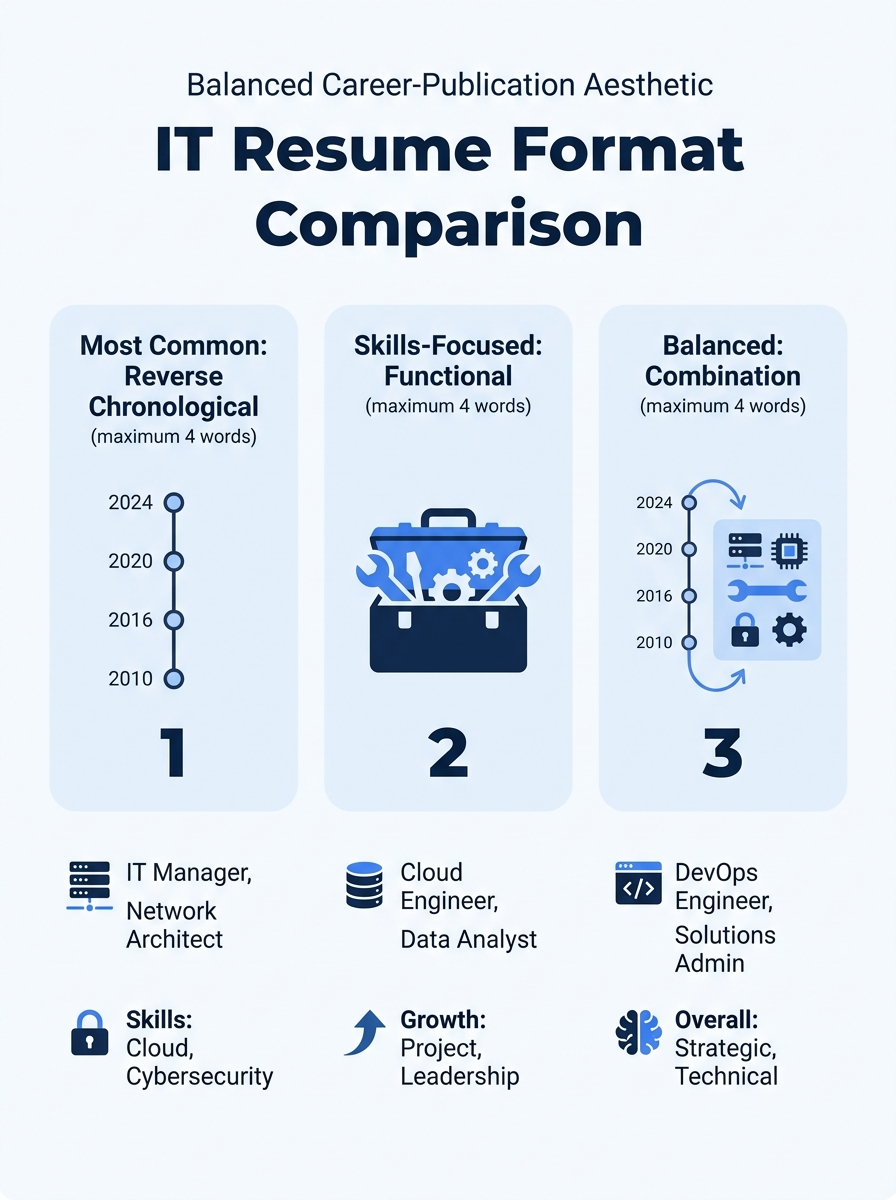
Auron, who holds the Academy Certified Resume Writer credential and spent 15 years writing IT resumes plus prior headhunting experience, evaluated three resume format categories—reverse chronological, functional, and combination—and concluded that reverse chronological serves IT job seekers best in the majority of search scenarios.
Functional Resumes Signal Problems to Tech Recruiters
The functional resume format groups accomplishments by skill category before presenting chronological work history, a structure intended to minimize visibility of employment gaps or career pivots. Auron stated that technology hiring managers recognize the format as a red flag. “The format signals, almost universally, that there’s something in the chronology the candidate doesn’t want you to find quickly,” Auron wrote in the July 11 post. “That suspicion is often enough to move a resume to the bottom of the pile—or out of it entirely.”
Applicant tracking systems present a second obstacle. ATS platforms parse resumes around chronological data fields—employer names, job titles, employment dates, and responsibilities—and functional resumes that minimize or bury that structure can produce mangled candidate profiles visible to recruiters, Auron noted. The writer added that technology recruiters specifically need chronological context: where candidates gained AWS experience, at what company scale, and how recently, rather than skill lists alone.
Auron recommended functional resumes only as a last resort for candidates whose reverse chronological format “genuinely cannot support your goals,” a scenario the writer described as rare in IT careers.
Combination Format Creates Navigation Problems
Combination resumes pair skills sections with scaled-down chronological employment listings, an approach Auron described as producing “the drawbacks of both formats and the benefits of neither.” The writer cited two specific problems: recruiters skip the skills section, fail to locate required information in the abbreviated chronological section, then navigate back to skills and attempt to match them to employers—a process Auron characterized as “too time-consuming and frustrating” unless the role is highly specialized with few applicants.
Redundancy compounds the navigation issue. “Given the nature of the approach, it’s almost impossible not to repeat similar skills and accomplishments in both sections,” Auron wrote. “That takes up valuable space, and it’s tedious to read.”
Reverse Chronological Meets Recruiter Expectations
The reverse chronological format lists employment history from most recent backward, presenting responsibilities and accomplishments under each position. Auron cited three advantages: clarity of career phase visibility, contextual framing for accomplishments, and alignment with recruiter scanning habits. “Recruiters and hiring managers are used to seeing them and reading them—so scanning for relevant information is quicker and easier,” the writer stated.
The post noted that reverse chronological resumes still require strong execution—accomplishment focus rather than duty lists, strategic positioning of strongest material, and readability—to succeed in competitive IT hiring. Auron’s guidance aligns with best resume builders that default to chronological templates for technology roles.
Context and Outlook
The recommendation against functional and combination formats reflects broader hiring market mechanics where ATS parsing accuracy and recruiter time constraints favor standardized document structures. Technology hiring managers reviewing dozens of applications per open role typically spend 30 seconds on initial resume scans, according to Auron’s estimate, making format familiarity a functional advantage for candidates.
The advice carries particular weight for mid-career IT professionals navigating resume red flags that block applications, where format choice can either mitigate or boost screening concerns. While employment gap stigma has decreased in 2026 hiring markets, functional resume adoption still signals evasion to technical recruiters accustomed to parsing career arcs through infrastructure migrations, platform upgrades, and team scaling patterns visible only in chronological context.
Auron’s 15-year IT resume writing practice provides specialized insight into technology hiring norms that differ from generalist career guidance. The post did not address hybrid remote workers, contract-heavy career paths, or open-source contributors whose work history may not fit traditional employment chronology—scenarios where format adaptation may still serve candidates despite the general recommendation.