
 4.9
4.9 4.5
4.5Ninety-four percent of hiring managers say cover letters influence their interview decisions, yet most applicants submit the same recycled paragraph across every application. This guide walks you through writing a targeted cover letter in under 45 minutes, with a letter cover example at each step and three template formats ready to customize.
TL;DR: Build your cover letter in five steps: research the role, write a role-specific opening, construct a problem-solution body with quantified results, close with a confident call to action, and format the document to match your resume. Budget 30-45 minutes per application.
Before You Start
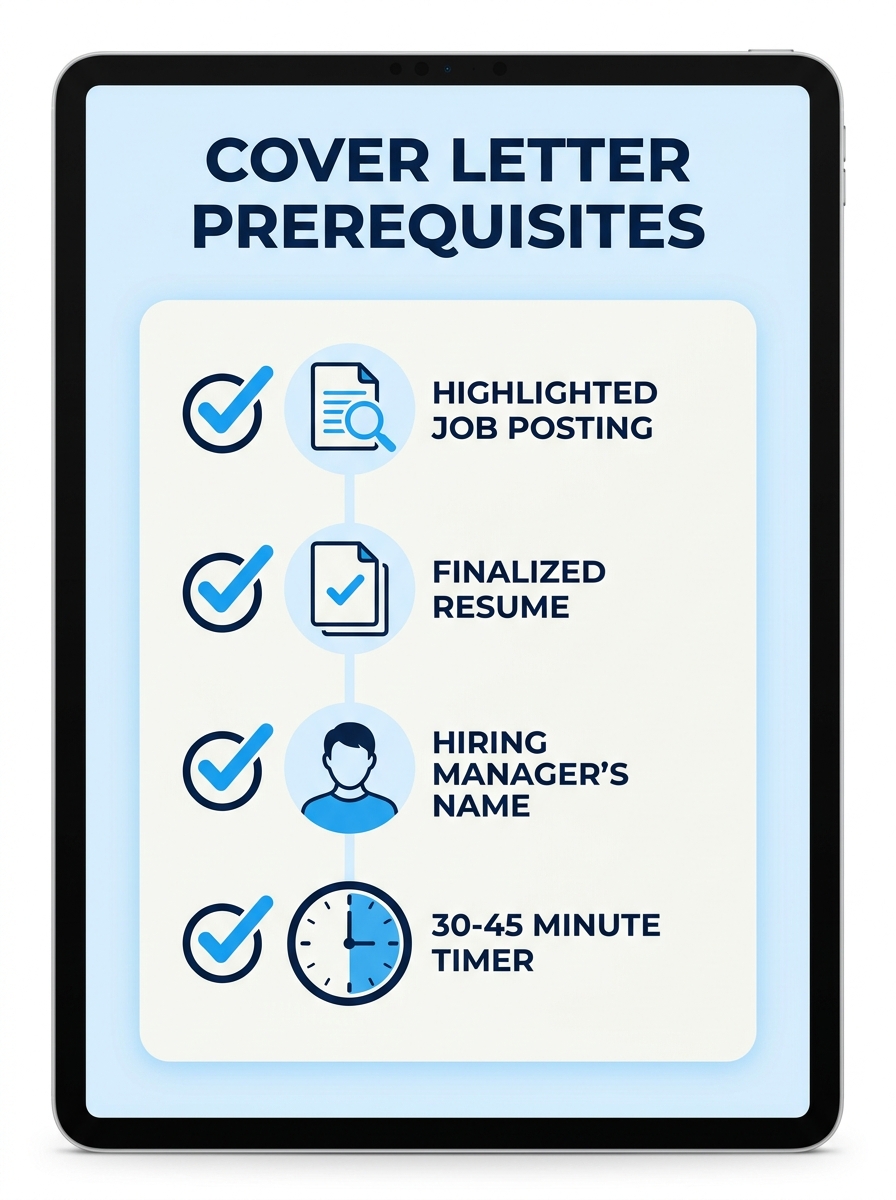
Four things you need before writing a single line of your cover letter:
- A specific job posting open in front of you. Generic cover letters fail because they aren’t written for anyone in particular. Pull up the full job description, highlight 3-5 key requirements, and note the exact job title.
- Your resume, finalized. Your cover letter and resume work as a pair. If you’re still editing your resume, finish that first. You can find guidance on aligning your professional summary with your bullet points before moving forward.
- The hiring manager’s name (if possible). The University of Michigan Career Center advises candidates to “find the name of the person you want to read the letter,” noting that it “demonstrates a higher level of investment and enthusiasm for the position.” Check the company’s team page, LinkedIn, or the job posting itself. If you can’t find a name, use a title like Hiring Manager, Internship Coordinator, or Human Resources Director.
- 30-45 minutes of uninterrupted time. A strong cover letter for one application takes about this long. Trying to batch-write five at once leads to the generic templates hiring managers discard.
Step 1: Research the Company and Identify Their Pain Point
The goal of this step is to find one specific challenge the company faces that your skills can address. This is where most cover letters fail before a word gets written, because writers skip the research and jump straight to talking about themselves.
Read the job description line by line. Look for repeated phrases, bolded requirements, or language that signals urgency (“immediately,” “critical need,” “high-priority”). Then spend 5-10 minutes scanning the company’s recent news, press releases, or LinkedIn page.
You’re looking for a gap between where the company is and where it wants to be. A marketing coordinator posting that mentions “scaling social presence across three new platforms” tells you the team is stretched thin. A software developer role emphasizing “reducing deployment time” tells you their release cycle is slow.
Write down one sentence summarizing their problem. Something like: “The marketing team needs to expand to TikTok, YouTube Shorts, and Threads without adding headcount.” This sentence won’t appear in your cover letter, but it anchors every paragraph you write.
You’ll know it worked when you can explain, in one sentence, what the company needs and why they posted this role.
Step 2: Write Your Opening Paragraph
The goal here is to introduce yourself, name the exact role, and signal that you understand what the company needs. Your opening paragraph should run 3-4 sentences, and the University of Cincinnati’s cover letter guide recommends that you “introduce yourself, state the position you’re applying for and mention how you found the job listing” through a job board, company website, or personal referral.
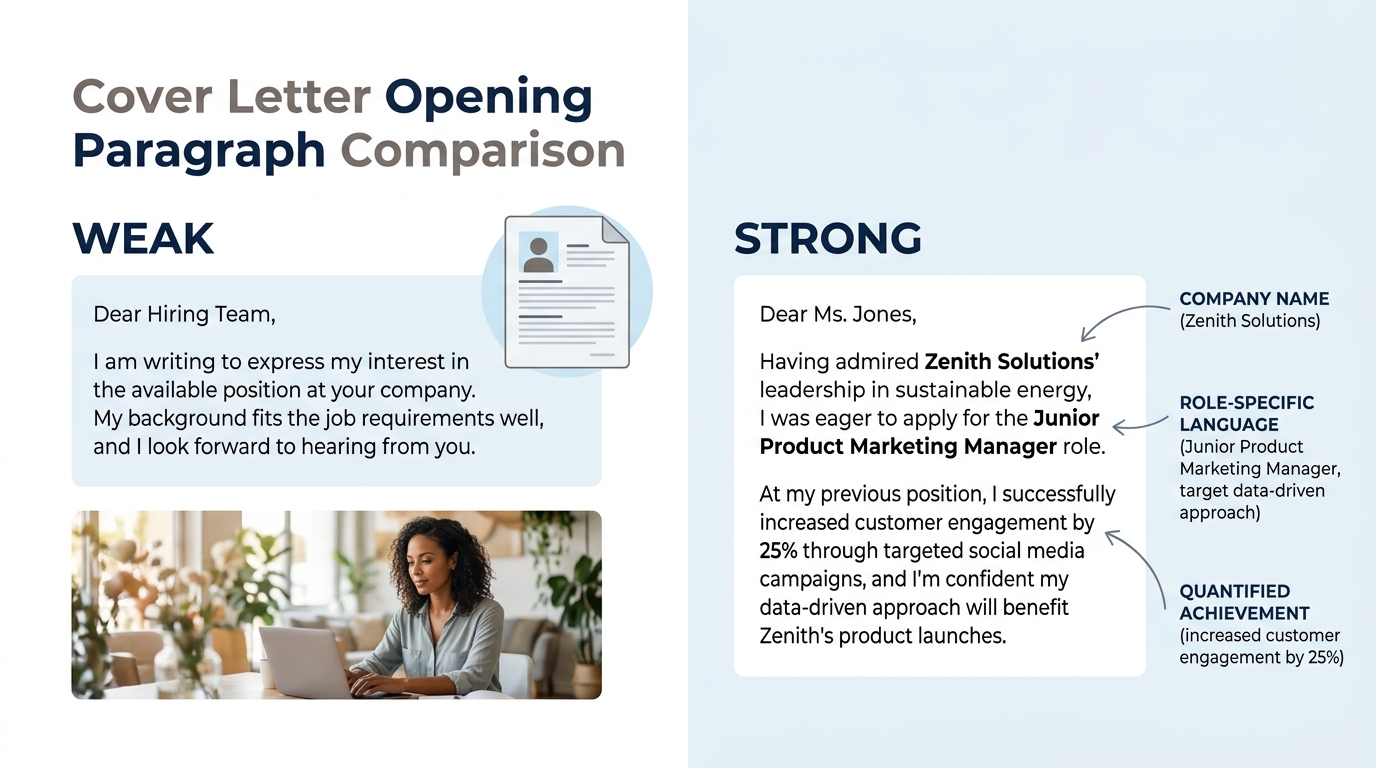
That’s the framework. Here’s a letter cover example showing the difference between a weak and strong opening:
Weak opening: “I am writing to express my interest in the Marketing Coordinator position at your company. I believe my skills and experience make me a strong candidate for this role.”
Strong opening: “When I saw the Marketing Coordinator posting on LinkedIn for Greenfield Labs, I recognized the challenge immediately: scaling a social media presence across three new platforms while maintaining brand consistency. Over the past two years at Relay Digital, I’ve launched and managed content strategies across TikTok and YouTube Shorts, growing combined engagement by 35%.”
The weak version could apply to any company for any role. Swap “Marketing Coordinator” for “Project Manager” and nothing changes. The strong version names the company, references the specific challenge from Step 1, and drops in a quantified result (35% engagement growth). Princeton’s Career Development Center reinforces this approach, advising applicants to “craft your letter in your own voice” and “match the tone of the job description and organization.”
Tip: If someone referred you to the role, mention their name in the opening sentence. Referral hires get prioritized at many companies, and dropping a name immediately separates your application from the anonymous pile.
You’ll know it worked when your opening paragraph names the company, the role, and at least one specific detail from the job posting.
Step 3: Build the Body With Problem-Solution Paragraphs
Each body paragraph follows a three-part structure: name a challenge from the job description, describe how you’ve solved something similar, and back it up with a measurable result. This problem-solution format works because it mirrors how hiring managers evaluate candidates. They have a problem (the open role), and they’re scanning for someone who already solves that type of problem.
Here’s a letter cover example of a well-built body paragraph:
“Your posting mentions reducing client onboarding time as a priority for the operations team. At Bridgepoint Solutions, I redesigned the onboarding workflow for mid-market accounts, cutting average setup time from 14 days to 6 and reducing integration errors by 50%. I’d bring that same process-driven approach to the Operations Analyst role at Caldwell.”
Three things make this paragraph work: it references the job posting directly, it includes two specific metrics (14 days to 6, 50% reduction), and it connects back to the target role by name. Each body paragraph should run 3-5 sentences. Write two of these paragraphs for most applications. That keeps the letter under a full page, which matters: 66% of job seekers prefer cover letters of half a page or less, and hiring managers spending only 6-7 seconds on an initial scan won’t read past one page anyway.
One critical warning: don’t repeat your resume bullet points word for word. Your cover letter explains the why behind your experience. If your resume says “Managed a team of 8 engineers,” your cover letter should explain what that team accomplished and why it matters for this particular role. The resume states the what. The cover letter explains the why. If you’re finding that your cover letter and resume keep saying the same thing, you might want to check for common red flags that make recruiters skip applications.
You’ll know it worked when each body paragraph references the job posting and includes at least one quantified result.
Your cover letter explains the “why” behind your experience. Your resume states the “what.” They work as a pair, and they should never say the same thing twice.
Step 4: Close With Confidence and a Specific Next Step
Your closing paragraph does two things: thanks the hiring manager and states what you want to happen next. Microsoft’s cover letter format guide advises writers to “close the cover letter by thanking the hiring manager for reviewing your application and expressing interest in further discussion” with a confident and polite call to action.
Here’s what that looks like:
“Thank you for considering my application for the Operations Analyst role. I’d welcome the chance to discuss how my experience simplifying client onboarding at Bridgepoint could support Caldwell’s growth targets. I’m available for a conversation at your convenience and can be reached at [phone] or [email].”
Keep this to 2-3 sentences. End with a professional closing (“Sincerely,” “Best regards,” or “Respectfully”) followed by your full name. Don’t end with “I look forward to hearing from you” and nothing else. Give them a reason to reach out by mentioning a specific conversation topic, the way the example above references “simplifying client onboarding.”
You’ll know it worked when your closing names the role, suggests a topic for the next conversation, and includes your contact information.
Step 5: Format the Document to Match Your Resume
Your cover letter’s visual presentation signals professionalism before a single word gets read. Use the same font, font size (10-12pt), and margin width (1 inch on all sides) as your resume. The two documents should look like they came from the same person.
Keep total length between 250 and 400 words, which fills roughly half to three-quarters of a single page. Indeed’s formatting guide confirms that a cover letter should outline “why you are applying for a specific position, a brief overview of your professional background and what makes you uniquely qualified for the job,” all within that one page.
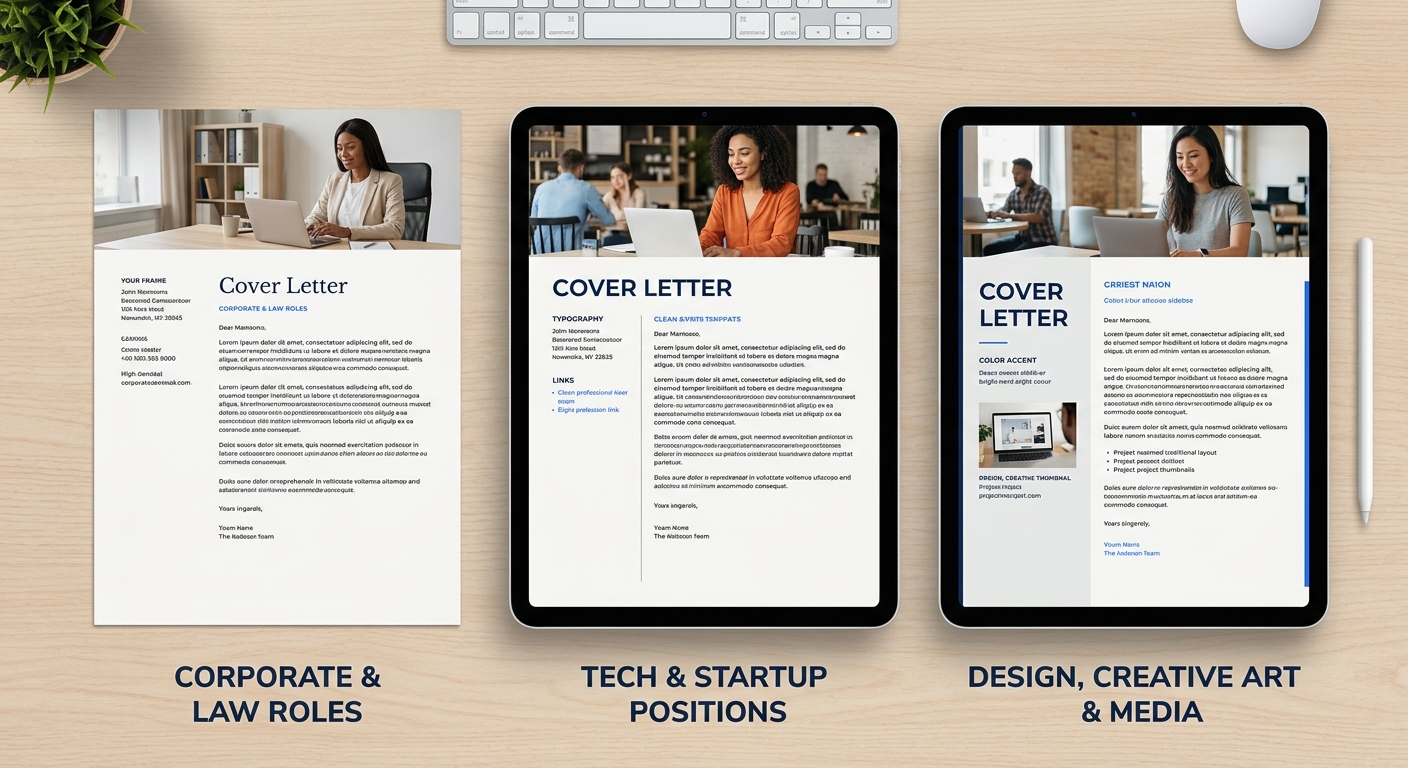
Three template formats cover the vast majority of applications:
| Template Style | Best For | Tone | Key Feature |
|---|---|---|---|
| Traditional | Finance, law, government, academia | Formal, conservative | Single-column layout, serif font, no color |
| Modern | Tech, marketing, startups | Professional but approachable | Sans-serif font, subtle color accent, clear spacing |
| Creative | Media, advertising, arts, brand roles | Personality-forward | Color blocks, custom typography, visual hierarchy |
Match your template to the industry and company culture. A creative template sent to a law firm reads as tone-deaf. A stiff traditional layout sent to a startup signals you didn’t research the company. Microsoft Word offers free cover letter templates across all three styles that you can customize directly for your next application.
Warning: If you’re using AI tools to draft your cover letter, be deliberate about it. Many hiring managers now flag applications that sound generically polished. The same principles behind [keeping your resume authentic when using AI](/blog/resume-authenticity-ai-assistance-human-voice) apply to cover letters: use the tool for structure, then rewrite in your own voice.
You’ll know it worked when your cover letter and resume share identical formatting, the document stays under one page, and the template matches the industry.
Common Problems and How to Fix Them
Your cover letter sounds generic. Read your opening paragraph and mentally swap the company name for a competitor’s name. If the paragraph still makes sense without any changes, it’s too generic. Go back to Step 1 and find a more specific pain point.
You can’t find the hiring manager’s name. Search LinkedIn for people with “Recruiter,” “Talent Acquisition,” or department-head titles at that company. If that fails, call the company’s main line and ask who’s handling the role. “Dear Hiring Manager” works as a fallback, but don’t use “To Whom It May Concern,” which reads as dated and detached.
Your cover letter runs longer than one page. Cut your body section to two paragraphs maximum. Remove any sentence that restates a resume bullet without adding new context. If you’re past 400 words, information is sneaking in that belongs on your resume, not your cover letter.
Where to Go From Here
A strong cover letter gets your resume read with attention instead of skimmed in 6 seconds. But the cover letter is one piece of a larger application strategy. If your resume has gaps, contradictions, or formatting problems, even the sharpest cover letter won’t carry the whole application. Browse more career guides on the ResumeWriting.net blog for resume construction walkthroughs, interview prep, and job search strategy. And if you want a second opinion on your entire application package, ResumeWriting.net offers tools and reviews to help you identify weak spots before a recruiter does.
The template and format choices matter. The research and specificity you bring to each application matter more. Spend the first 15 minutes of your 45-minute writing window on Step 1, identifying the company’s actual problem, and the remaining four steps will come together faster than you expect.