

 4.9
4.9 4.5
4.5Product manager Nazuk Jain published a job search strategy guide July 10 warning that generic ChatGPT-written resumes eliminate candidate differentiation and recommending that active job seekers submit at least five tailored applications daily within 24 hours of each posting, according to her Substack newsletter. The framework targets the July-to-October hiring window and prioritizes company career portals over LinkedIn’s “Easy Apply” function.
TL;DR: A product manager published a job search framework July 10 advising against AI-generated resume language and recommending five daily applications submitted within 24 hours of posting directly through company career sites.
Core Warning: Generic AI Language Eliminates Differentiation
Jain’s guide opens with a warning that copying ChatGPT output directly produces resume language indistinguishable from other candidates. The newsletter cites sample bullet points that “sound professional” but fail authenticity tests in interviews, including phrases such as “led cross-functional initiatives to drive 15% engagement growth” and “led data-driven strategies that increased operational efficiency by 22%.”
The author, who identifies as a non-native English speaker with Hindi as a first language, acknowledged AI’s utility for language polishing but distinguished between using tools for clarity versus delegating full resume construction. “Your resume should sound like proof,” the guide states, listing five proof points: completion of work, problem understanding, impact explanation, experience-to-role connection, and interview defensibility.
Jain reported that she and her husband both landed positions within 90 days using the strategy outlined in the framework, though she emphasized that individual results depend on market conditions, background, role type, timing, and network strength.
Application Volume Strategy Targets Five Daily Submissions
The framework sets a baseline of five “strong applications per day” for active job seekers, defining strength as applications tailored to specific roles and submitted within 24 hours of posting. The timing requirement aims to reach hiring managers before applicant pools grow large enough to trigger automated screening increases.
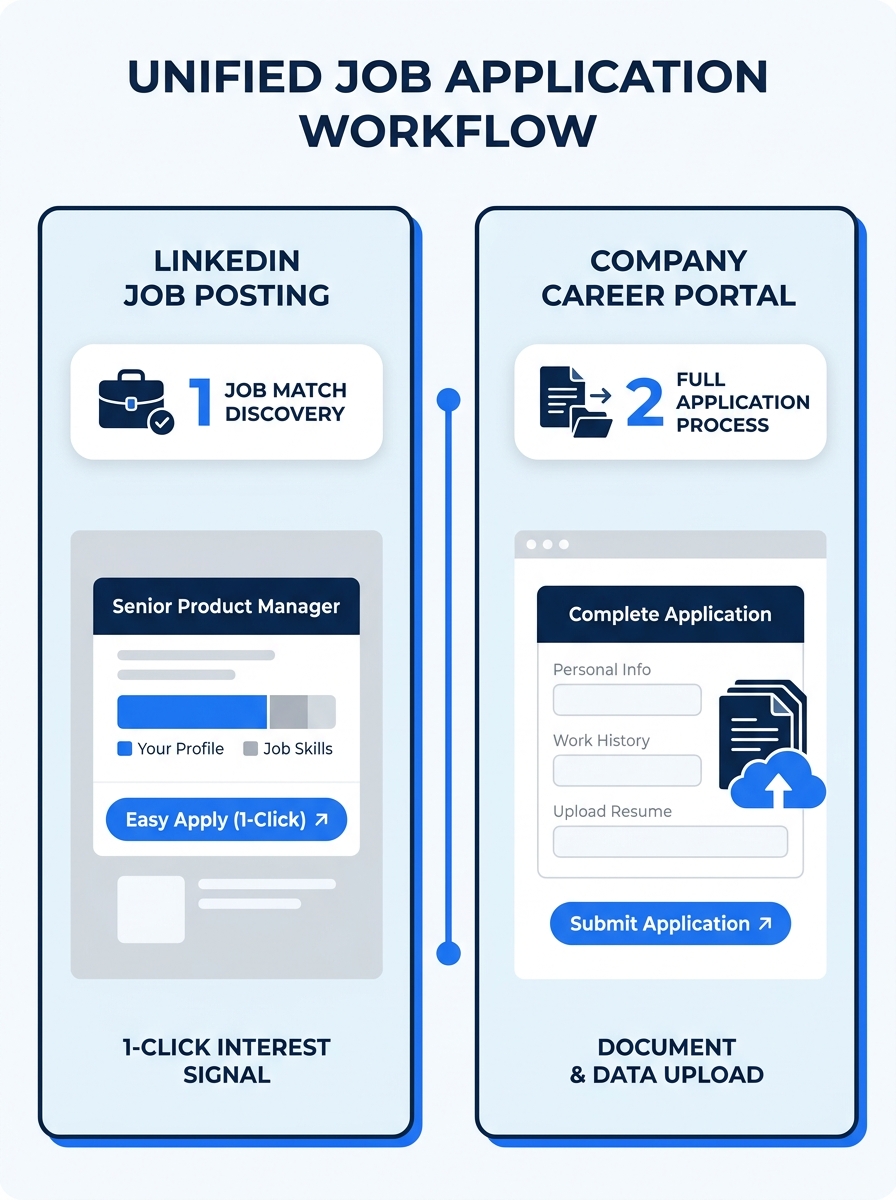
Jain’s volume recommendation assumes job seekers may create profiles on 100 or more company career portals during a three-month search cycle. “If you apply to Microsoft, create a profile on Microsoft’s career site,” the guide instructs, rejecting reliance on LinkedIn’s one-click application feature.
The strategy prioritizes direct company website applications over aggregator platforms, positioning LinkedIn as a discovery tool rather than a submission endpoint. According to the framework, candidates should use LinkedIn to identify new postings, locate employees for potential referrals, research hiring teams, and track recent role additions—then complete applications on company-owned systems. Job seekers facing AI-generated content flags on LinkedIn may find the company-direct approach sidesteps platform-level content detection entirely.
Platform Mix Emphasizes Greenhouse, Ashby, Built In SF
The published framework lists six platform types for daily monitoring: LinkedIn for discovery, company career pages for direct submission, Greenhouse job boards, Ashby Jobs, Built In SF for startup roles, and company-specific portals for priority targets. The guide does not include Indeed in its primary rotation despite mentioning it as a secondary resource.
Greenhouse and Ashby function as applicant tracking systems that host public-facing job boards aggregating openings across multiple employers. Built In SF focuses on technology and startup positions in the San Francisco market, though the platform has expanded to additional U.S. cities since launch.
Jain’s framework advises creating a “small system that you check every day” rather than monitoring dozens of platforms, emphasizing speed and specificity over breadth. The goal, according to the guide, is to “find the right job quickly, understand whether it fits, tailor your resume, and apply before the posting is flooded.”
Candidates uncertain whether to use professional resume writers or AI-assisted self-construction may find the framework’s emphasis on interview defensibility—”can you defend every word in an interview?”—clarifies the selection criterion.
July-to-October Window Targets Pre-Holiday Hiring Cycle
The strategy document identifies July through October as a critical four-month application window before November and December hiring slowdowns. “This is not the time to casually apply once in a while and hope something happens,” the framework states, urging immediate action for candidates in active search mode.
The seasonal advice aligns with corporate hiring patterns in which budget approvals and headcount planning typically conclude before calendar year-end holidays. Positions posted after mid-October face higher risk of requisition freezes or interview delays extending into January, according to the framework’s implicit logic.
Jain did not specify whether the 90-day timeline she and her husband experienced occurred during the July-October window or across a different seasonal period. The newsletter provided no comparison data on application success rates by month.
AI Tool Segmentation Assigns Roles to Claude, Codex, Perplexity
The framework mentions Claude, Codex, and Perplexity Computer as distinct tools within a job search workflow but does not detail specific use cases in the published excerpt. Jain’s reference to “prompts that worked for me” suggests the full course material includes task-specific prompt templates for each platform.
ChatGPT, Claude, and Perplexity function as conversational AI models capable of generating and refining resume language, though each employs different underlying models and interface designs. Codex typically refers to OpenAI’s code-generation model, which may serve specialized roles for technical resume optimization or portfolio construction in engineering searches.
The framework’s “anti-AI tactics” framing positions AI as a support tool requiring human oversight rather than a replacement for candidate voice. Job seekers exploring AI resume audit workflows may find Jain’s defensibility standard—whether each statement can be explained in interview context—provides a functional filter for AI-suggested revisions.
Reading Between the Lines
The published framework reflects a broader tension in 2026 job markets between AI accessibility and differentiation pressure. Jain’s warning that ChatGPT-generated language makes candidates “sound like everybody else” captures a core problem: as more applicants adopt identical tools with similar prompts, the output converges toward a generic professional register that hiring managers now recognize and discount.
Her five-applications-per-day baseline, combined with the 24-hour posting response requirement, implies a full-time commitment to search activity—a realistic demand for unemployed candidates but potentially unsustainable for passive seekers exploring opportunities while employed. The framework’s omission of network activation or referral generation beyond “prioritize referrals where you already have a real connection” may underweight relationship-building tactics that career coaches typically position as higher-yield than volume application alone.
The company-portal preference over LinkedIn Easy Apply addresses a documented ATS filtering problem but introduces friction that could reduce daily submission counts for candidates managing multiple search tracks. Job seekers will need to weigh submission speed against application quality and decide whether creating 100 career portal profiles delivers better outcomes than concentrating effort on fewer, deeply researched targets.