

 4.9
4.9 4.5
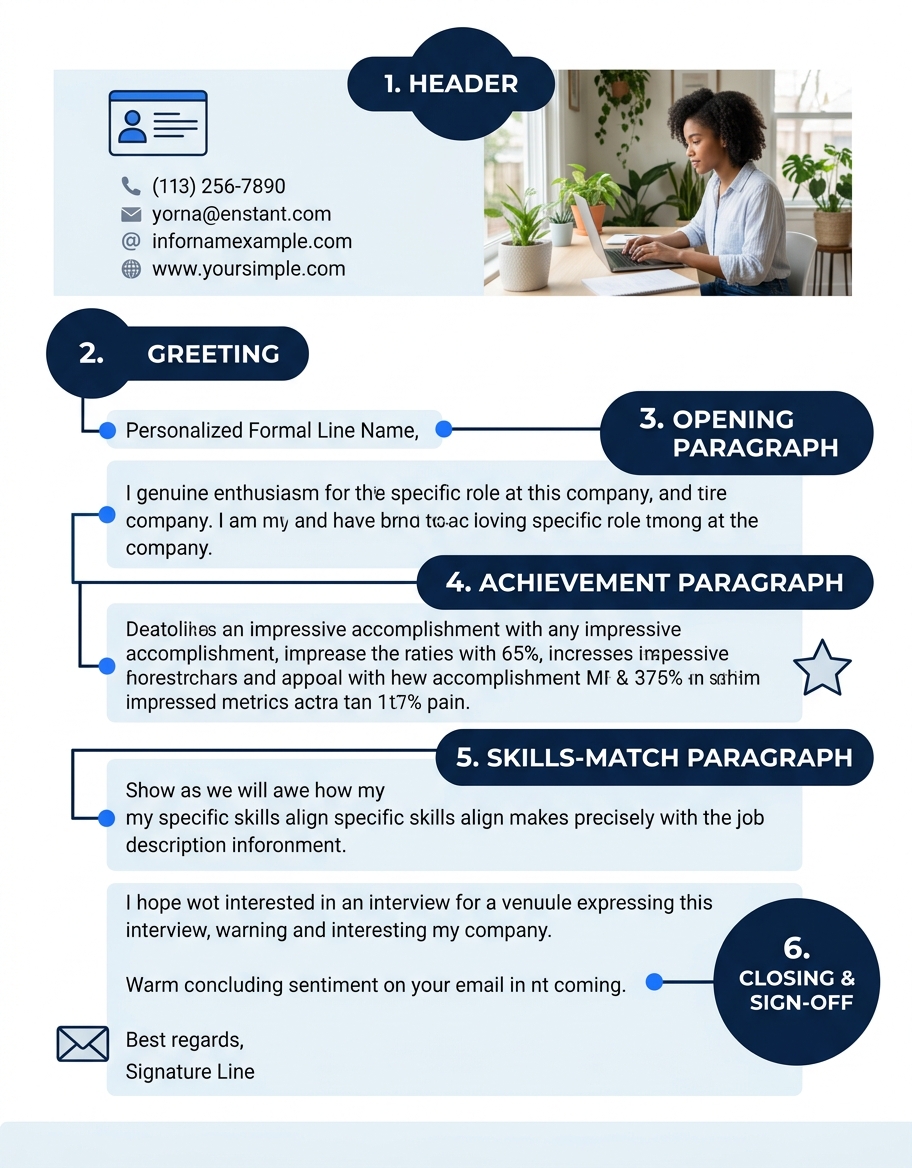
4.5This guide gives you a complete fill-in cover letter template and a 6-step process to customize it for any job posting. The whole thing takes about 35 minutes. By the end, you’ll have a one-page letter with a named recipient, a quantified achievement, and a clear closing request.
TL;DR: Use the fill-in template below as your starting skeleton, then follow the 6 steps to personalize each section. Every step has a checkable outcome. The process works for any industry or experience level.
Before You Start
You need four things ready before step 1:
- The job posting you’re applying to, open in a browser tab. You’ll pull keywords, the hiring manager’s name, and the job title directly from it.
- Your resume, finalized and saved. The cover letter should complement your resume, not repeat it. If you’re still revising, our guide on real cover letter templates includes formatting advice that applies to both documents.
- A word processor or template tool. Microsoft Word offers free cover letter templates that handle spacing and margins automatically. Canva’s cover letter library gives you more visual options if your industry rewards design.
- About 35 minutes of uninterrupted time. Rushing produces generic language, and generic language is the single biggest reason cover letters get skipped.
Knowledge level: You don’t need prior cover letter experience. If you’ve written a professional email, you have the writing skill this requires.
Step 1: Build Your Header With Complete Contact Information
The header sits at the top of your letter and includes 5 elements: your full name, phone number, email address, city and state, and optionally your LinkedIn URL. According to MIT’s career advising team, “A cover letter should be no longer than one page with a font size between 10-12 points.” Set your margins to 1 inch on all sides. Poor formatting alone can eliminate up to 50% of candidates when ATS software scans applications.
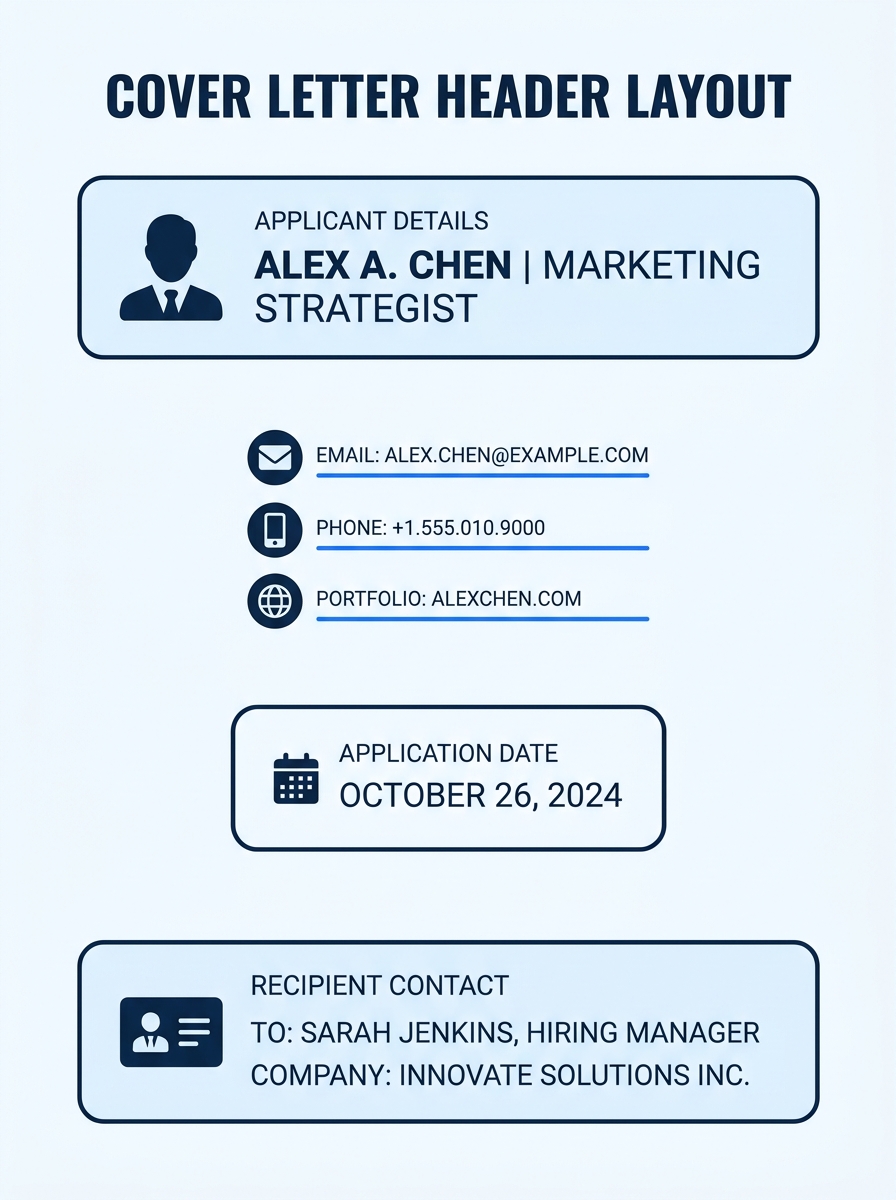
Here’s the template header:
[Your Full Name] [Phone Number] | [Email Address] [City, State] | [LinkedIn URL if relevant]
[Date]
[Hiring Manager’s Name] [Company Name] [Company Address]
You’ll know it worked when: your header takes up no more than 5-6 lines, uses the same font as your resume, and leaves the rest of the page for your 3-4 body paragraphs.
Step 2: Address the Hiring Manager by Name
Write “Dear [First Name Last Name],” and spend a few minutes finding the actual person. Check the job posting first. If it’s not listed there, search LinkedIn for the company name plus the department or job title. A hiring survey found that 26% of hiring managers consider a personalized greeting “highly impactful” in their evaluation. That’s a meaningful edge for 2 minutes of research.
If you genuinely cannot find a name after checking LinkedIn, the company website’s team page, and the job listing itself, write “Dear Hiring Manager.” Skip “To Whom It May Concern.” It reads as outdated and signals you didn’t look.
MIT’s career advising guidance also notes: if the role includes a reference number or code, include it in the first line of your letter so HR can accurately track your application.
You’ll know it worked when: your greeting uses a real person’s name (or “Dear Hiring Manager” as a last resort), and any reference codes from the posting appear in your opening line.
Step 3: Write a First Paragraph That Names the Job and Company
Your opening paragraph should run 2-3 sentences and accomplish 3 things: state the exact job title, name the company, and give one specific reason you’re interested. This paragraph carries weight because 41% of hiring managers consider the introduction and closing critical to their decision.
Template:
“I am writing to apply for the [Job Title] position at [Company Name]. With [X years/months] of experience in [relevant field], I am drawn to this role because [specific reason tied to the company’s mission, a recent project, or a value you share].”
Don’t waste this paragraph on autobiography. The hiring manager doesn’t need your career history here. They need to know you’ve read the posting and you’re applying with intention.
You’ll know it worked when: a stranger reading only this paragraph could tell exactly which job at which company you’re targeting, and your reason for interest references something specific about the organization rather than a generic phrase like “your reputable company.”
Step 4: Build the Body Around One or Two Quantified Achievements
This is the paragraph that separates strong letters from forgettable ones. Indeed’s career guidance is direct: “Focus on one or two and provide specific details about your success, including measurable impacts you made.” Don’t list 5 accomplishments with shallow detail. Pick 1-2 and give them room to breathe.
Template:
“In my current role as [Job Title] at [Company], I [specific achievement with a number]. For example, [second detail or supporting result]. These experiences have prepared me to [connect to a requirement from the job posting].”
Example with numbers:
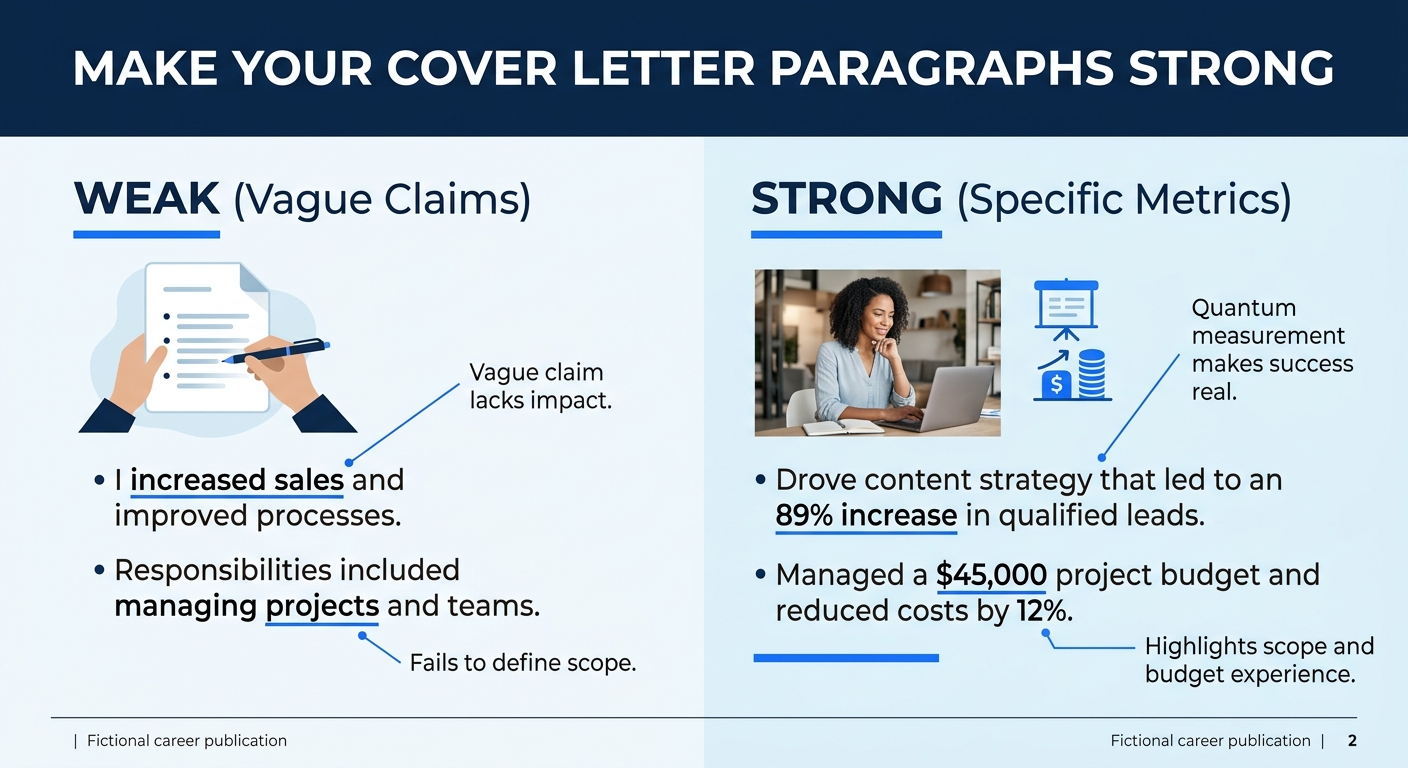
“As a Marketing Coordinator at Brevard Media, I redesigned our email nurture sequence and increased qualified leads by 89% over 6 months. I also managed a $45,000 quarterly ad budget while reducing cost-per-acquisition by 22%.”
The numbers matter here. “Increased leads” is vague. “Increased qualified leads by 89%” is concrete and memorable. Pay close attention to keywords in the job description and mirror them in this section. ATS systems scan for keyword matches, and hiring managers unconsciously look for language alignment between the posting and your letter.
Tip: If you’re struggling to quantify achievements, our walkthrough on [converting vague experience into measurable results](/blog/entry-level-developer-resume-quantification) covers the process for any field, not just technical roles.
Step 5: Connect Your Background to Their Requirements
The third body paragraph bridges what you’ve done to what they need. Pull 2-3 requirements directly from the job posting and show how your skills match each one. This is where you prove you’ve read the listing carefully enough to translate their needs into your experience.
Template:
“Your posting emphasizes [Requirement 1] and [Requirement 2]. In my work at [Company], I developed these skills by [specific example]. I’m particularly interested in [aspect of the role] because [genuine connection to your professional goals].”
Match the tone to the industry. Finance and legal roles expect formal, measured language. Creative and marketing positions give you more room for personality and warmth. A social media manager’s letter should sound different from a compliance analyst’s, and hiring managers notice when it doesn’t.
If you’re switching industries, frame your experience in the new field’s vocabulary. We covered how industry-specific language shapes hiring decisions in a separate piece, and the same principle applies to every example letter cover you write: use the words your target employer uses.
You’ll know it worked when: every skill you mention maps directly to something in the job posting, and you’ve used at least 3-4 keywords from the listing.
Step 6: Close With a Direct Request
Your final paragraph should be 2-3 sentences: express appreciation, restate your interest, and ask for something specific. Don’t trail off with “I hope to hear from you.” Ask for the interview.
Template:
“Thank you for considering my application. I would welcome the opportunity to discuss how my experience in [relevant field] aligns with the [Job Title] role. I am available for an interview at your convenience and can be reached at [phone number] or [email].”
Sign off with “Best regards,” “Sincerely,” or “Thank you,” followed by your full name. These closings are professional across every industry. Avoid “Cheers,” “Warmly,” or anything you wouldn’t say in a first business meeting.
You’ll know it worked when: your closing contains a specific ask (interview, conversation, phone call), includes your contact information one more time, and the entire letter fits on one page with readable spacing.
The resume says what you did. The cover letter says why it matters for this specific job.
When the Template Breaks Down
Three things commonly go wrong, and each has a clear fix.
Problem 1: The letter spills onto a second page. This happens when you try to cover too many achievements or when your header spacing is too generous. Cut back to 1-2 achievements. Tighten header spacing. Drop your font size to 10.5 points (anything below 10 becomes hard to read and risks ATS rejection). The University of Michigan’s career center is blunt: “Keep it short and sweet, do not exceed one page.”
Problem 2: You can’t find anything to quantify. Not every role produces revenue numbers, and that’s fine. Substitute with scope: team sizes you managed, number of projects completed per quarter, customer satisfaction scores, or process improvements measured in hours saved. Even “trained 12 new hires across 3 departments” lands stronger than “helped onboard new team members.” If you want a deeper framework for turning soft experience into hard numbers, the resume red flag audit covers common quantification gaps alongside other formatting issues.
Problem 3: The letter sounds identical to your resume. Your cover letter explains the context and motivation behind the bullet points on your resume. If you’re copying sentences straight from your resume into the letter, stop and rewrite. The resume states what you did. The letter explains why those accomplishments matter for this particular job at this particular company. Our walkthrough on complete cover letter templates shows this distinction with before-and-after examples.
Where to Go From Here
You now have a complete example letter cover template and a repeatable process for adapting it to any job posting. What comes next depends on where you are in your search.
If you’re applying to multiple roles this week, save your completed letter as a base version and duplicate it for each application. Swap out the company name, the hiring manager, the job title, and the achievement paragraph for each new role. Those 4 elements take about 10 minutes to customize once you’ve built the original. Your header format, closing structure, and general qualifications paragraph stay mostly stable across applications.
If you want to see how different industries and experience levels shape the letter’s tone and content, browse additional letter cover examples organized by job title to compare structures side by side. And if you’re still negotiating salary expectations as part of your search, the guidance from career coaches on anchoring to market rates is worth reading before you reach the offer stage.
One letter, customized properly for a specific role, beats 10 generic copies sent in bulk. The 35 minutes you spend now pay off when the phone rings.