
 4.9
4.9 4.5
4.5Hoku’s resume listed five years of supply chain management and program coordination. Every bullet point referenced logistics timelines, vendor negotiations, and operational efficiency metrics. The role she actually wanted, event planning and program development, shared almost none of those keywords. On paper, she looked like the wrong candidate entirely. Her pivot from one industry to another is one of the clearest documented examples of how a career transition resume, the right template structure, and targeted coaching can close what feels like an impossible gap.
This is the dissection of how she did it: which resume decisions worked, which coaching interventions mattered, and where the transferable skills positioning actually made hiring managers pay attention.
Supply Chain Professional, Event Planning Applicant
Hoku had spent years coordinating programs and managing supply chain workflows. According to her case study published by Career Bloom Coaching, she’d built deep expertise in program management, stakeholder communication, and cross-functional project execution. But her job titles said “supply chain.” Her employers were logistics companies. An ATS scanning her resume for “event coordination” or “venue management” would find nothing.
This is the core tension in any industry pivot strategy: your experience is genuinely relevant, but the language wrapping that experience belongs to a different world. A hiring manager scanning resumes for an event planning role doesn’t think “vendor negotiations = vendor management for event catering” unless someone explicitly draws that line.
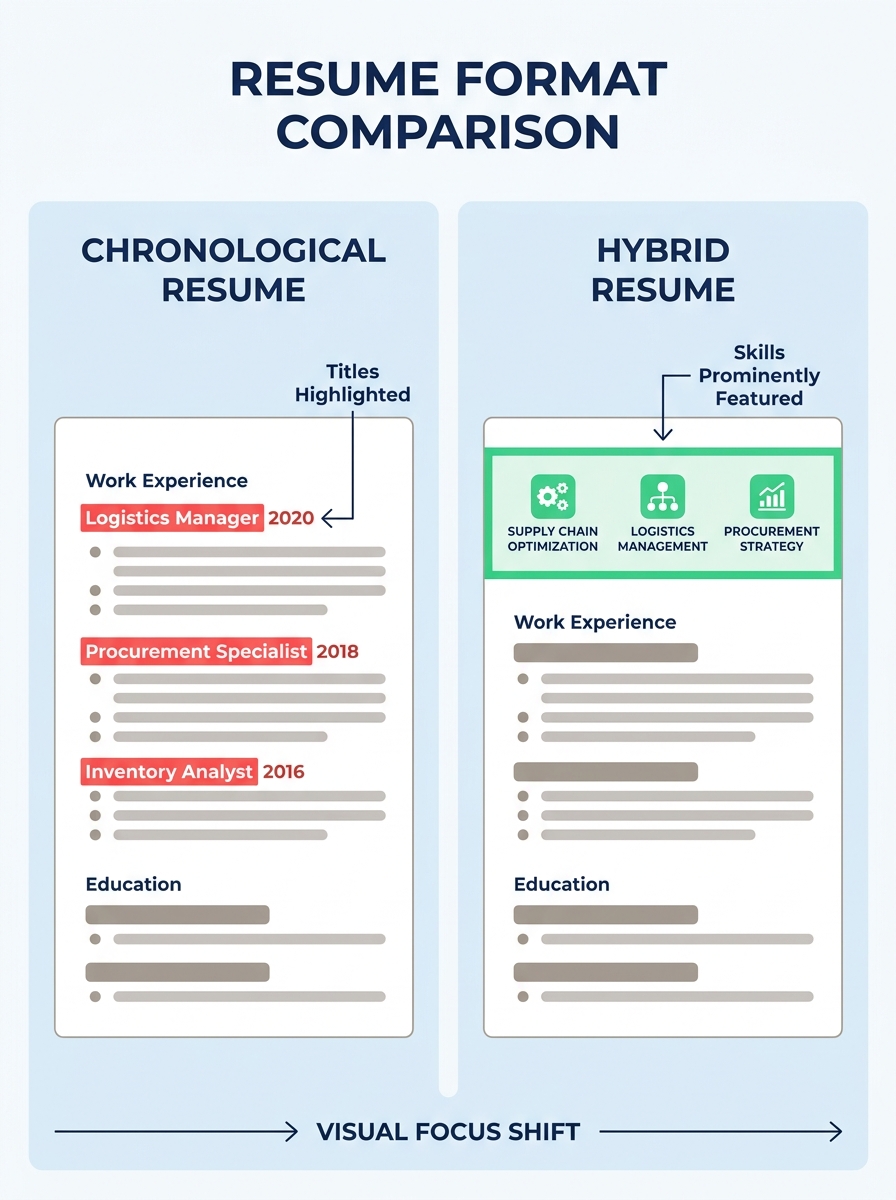
Hoku’s first challenge was structural. A traditional chronological resume, the default format most people use, would list her supply chain roles first, and a recruiter would stop reading within seconds. The format itself was actively working against her.
The Hybrid Resume That Bridged Two Industries
The resume format for new industries that career-change experts consistently recommend is the hybrid (or combination) resume. Jobscan’s career change guide describes it as the format that “highlights your skills and accomplishments while still detailing a chronological format of your career trajectory”. Wharton’s executive education team similarly advises leading with a skills-forward summary when the job titles on your resume don’t match your target role.
Here’s what the hybrid format actually looked like in practice, and why it worked for Hoku:
The summary section came first. Instead of jumping into her work history, Hoku’s revised resume opened with a professional summary that named the role she was pursuing and connected it to the transferable competencies she already had. Jobscan recommends structuring this in three parts: a brief description of who you are, what you value, and what you want to achieve, followed by your most significant recent experience.
Skills got their own prominent section. Rather than burying competencies inside bullet points under each job, her resume grouped relevant skills together: project management, stakeholder relations, budget oversight, timeline coordination, team leadership. Every one of those skills applied directly to event planning, even though she’d developed them in supply chain environments.
Work history still appeared, but lower on the page. The chronological section didn’t disappear. It moved down. This matters for ATS compliance, since many tracking systems still expect to see employer names, dates, and job titles. But by the time a human reader reached that section, the skills section had already established relevance.
If you’re working with templates, the ones that pass modern ATS filters are worth studying closely. We’ve broken down which resume templates actually clear ATS screening in a separate review. The key is choosing a template that allows you to lead with skills without stripping out the chronological data that automated systems need.
A hiring manager scanning resumes for an event planning role doesn’t think “vendor negotiations = vendor management for event catering” unless someone explicitly draws that line.
Mapping Transferable Skills Across the Gap
The skills section on Hoku’s resume didn’t appear out of thin air. She went through a deliberate process of transferable skills positioning: identifying which capabilities from her existing career translated directly to her target industry, and which ones needed reframing.
Here’s what that mapping actually looked like:
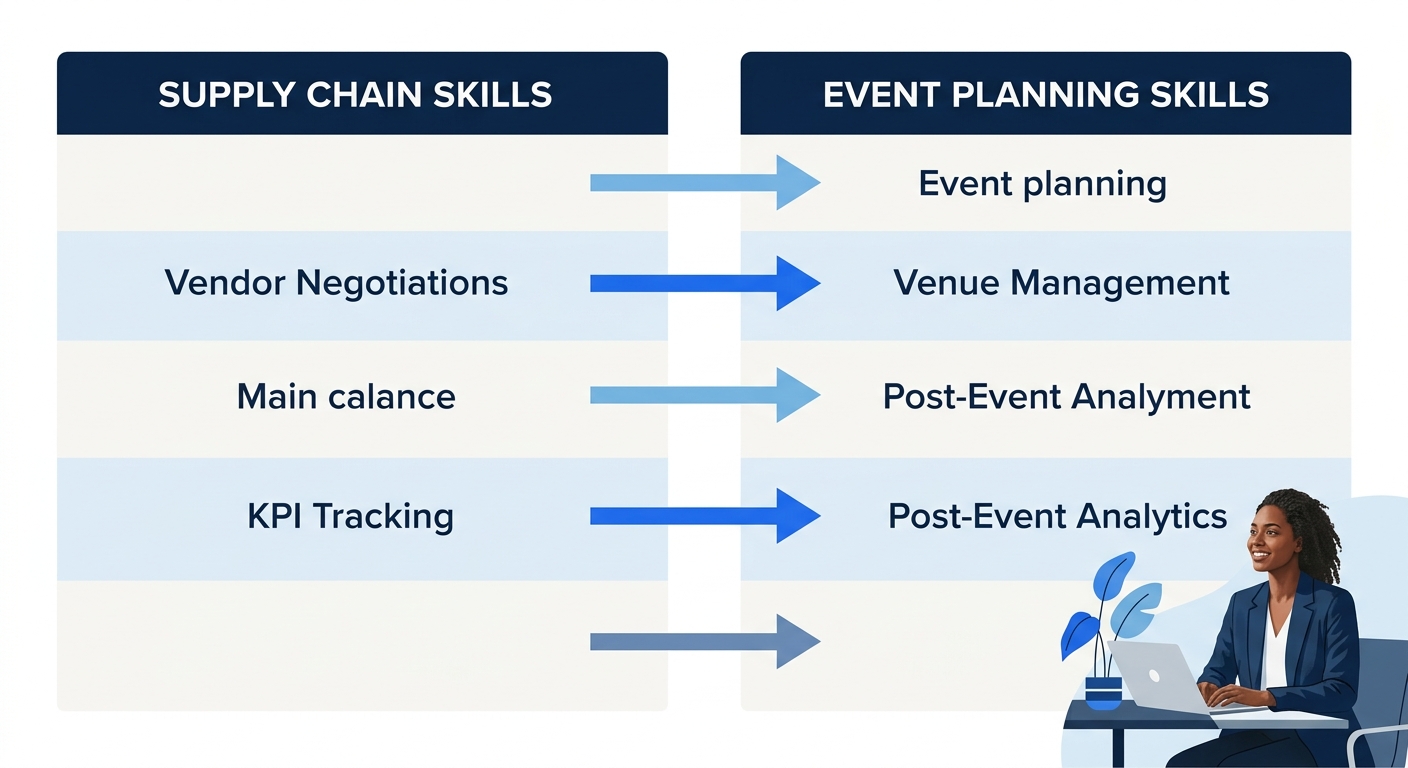
- Program management in supply chain → Program development in events. Same discipline (scoping, scheduling, coordinating stakeholders, managing budgets), different context.
- Vendor negotiations → Vendor and venue management. Negotiating contracts with shipping partners requires the same skills as negotiating with caterers or A/V companies.
- Cross-functional coordination → Event logistics coordination. Running a supply chain means constantly aligning teams that don’t report to you. So does running an event.
- Data reporting and KPI tracking → Post-event analytics and ROI measurement. The numbers change; the analytical muscle doesn’t.
CityU of Seattle’s transferable skills guide points out that a dedicated skills section is the most straightforward way to showcase these crossover capabilities. But Hoku went further than a simple list. She wrote bullet points under each previous role that reframed her accomplishments using the vocabulary of her target industry. “Coordinated vendor logistics for 12-region distribution network” became something closer to “Managed multi-vendor coordination across 12 operational regions, ensuring timeline adherence and stakeholder satisfaction.”
That reframing work is tedious, and it’s where many career changers stall. If you find yourself struggling with it, the principles behind replacing passive language with action-driven phrasing apply directly here. The goal isn’t to fabricate experience. It’s to describe real experience in language your target industry actually uses.
The Coaching Sessions That Sharpened the Pitch
Hoku didn’t do this alone. Career coaching for career changers played a documented role in her transition. Her coaching process included skill assessment, narrative development, and networking strategy, the three areas where most self-directed pivots break down.
Organizations like Pivot Journeys build their entire coaching model around this sequence. Their approach, grounded in design-thinking and strengths-based psychology, walks professionals through a structured process: clarifying career direction, mapping existing strengths to target roles, and building an action plan that includes resume revision, LinkedIn optimization, and interview preparation. The Pivot Method offers a similar structure with two 45-minute coaching sessions per month, email support between sessions, and access to digital resources including a Pivot Toolkit.
What’s notable about both programs is how much time they spend on narrative. The story you tell about why you’re changing careers and how your background makes you a stronger candidate matters as much as the resume itself.
For Hoku, the coaching helped in three specific ways:
- Clarifying which roles to target. She wasn’t applying to “event planning” generically. Coaching helped her identify that program development roles, specifically, were the strongest match for her existing skill set. That focus prevented the scattershot application approach that burns out most career changers.
- Building a networking strategy. Hoku used informational interviews and intentional LinkedIn outreach to connect with professionals already working in her target field. If you haven’t optimized your profile for this kind of outreach, the research on LinkedIn tweaks that increase interview requests is a useful companion resource.
- Rehearsing the career-change narrative. When you walk into an interview with a non-traditional background, you need a clear, confident answer to “Why are you switching industries?” Coaching gave Hoku the space to practice that answer until it felt natural rather than defensive. The research on storytelling approaches that outperform credential lists in interviews backs this up: hiring managers respond to narrative coherence, and a well-told pivot story can be more compelling than a linear career path.
We’ve reviewed career coaching services worth the investment in depth elsewhere on this site. The consistent finding is that coaching delivers the most value during transitions, precisely the moment when most people try to figure everything out on their own.
Tip: If you can’t afford full coaching, focus your budget on two things: a single session to nail your career-change narrative, and a professional resume review to catch language mismatches between your background and your target industry.
Two Offers and the Power to Choose
The outcome of Hoku’s pivot is the part that surprises people. She didn’t land one job in her new field. She received offers from both a dream job and a dream company, giving her the power to choose between them. That’s an uncommon career-changer outcome, and it’s worth examining why it happened.
Three factors converged. First, the hybrid resume format got her past the initial screening barrier. Without that structural change, her application likely would have been filtered out by ATS systems or dismissed by recruiters scanning for event-planning keywords. Second, the transferable skills positioning made her look like a strong candidate rather than a desperate one. She wasn’t saying “I’m willing to start over.” She was saying “I’ve already been doing this work, in a different context, for five years.” Third, coaching gave her a networking and interview strategy that multiplied the impact of the resume work.
The broader data supports this combination. Workers now average 12.4 jobs over their careers, which means industry pivots are increasingly common. About 35% of U.S. workers have considered a full career change. And 92% of executives say soft skills like communication, empathy, and strategic thinking carry significant weight in hiring decisions, exactly the kind of skills that transfer across industries.
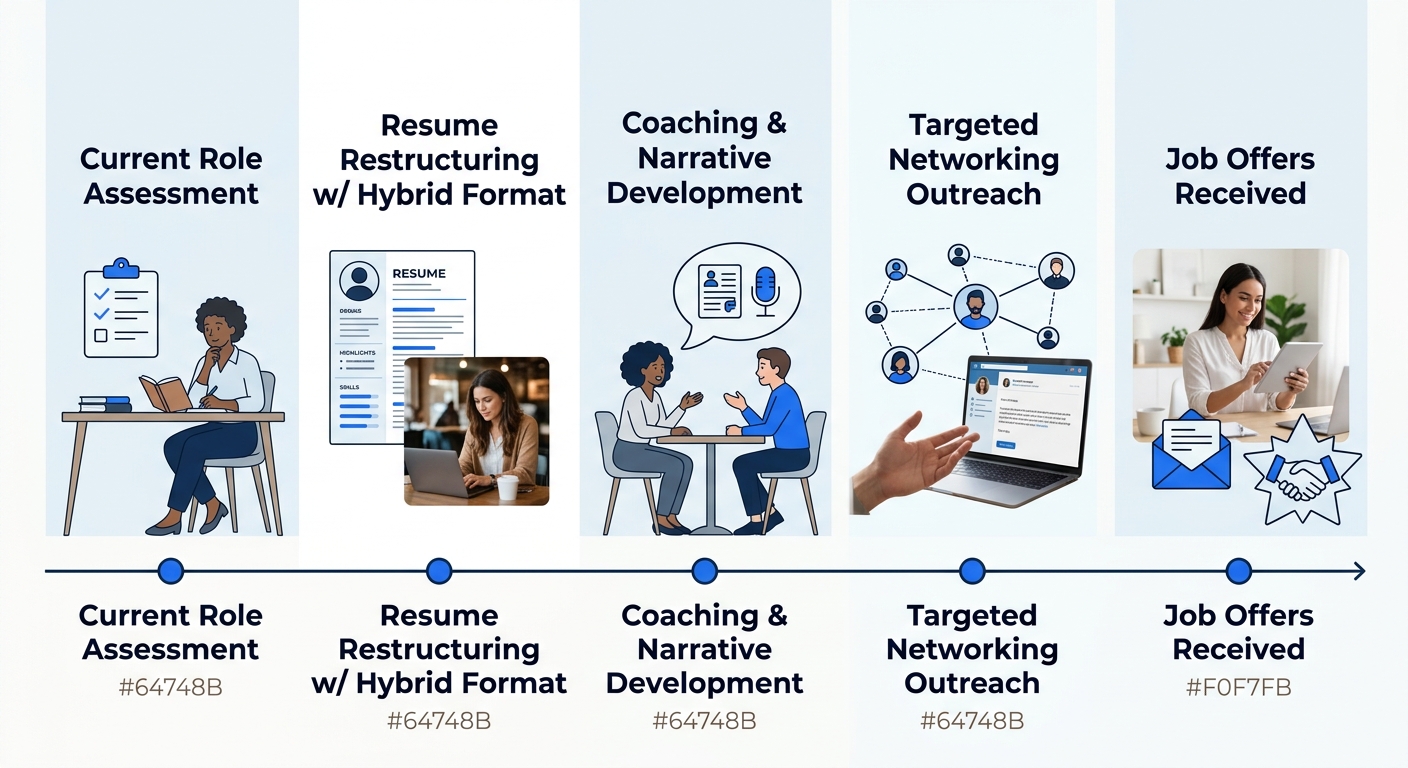
Hoku’s case isn’t a template you can copy line by line. Your industry, your skills, and your target role will demand different keyword choices, different narrative angles, different networking tactics. But the architecture of her pivot transfers to virtually any career transition resume project: hybrid format to get past automated filters, deliberate skill mapping to translate experience across industries, a coached narrative to answer the “why” question with confidence, and strategic networking to reach the humans behind the job postings. The people who treat an industry change as a translation problem, rather than a starting-over problem, are the ones who end up choosing between offers instead of waiting for callbacks.