
 4.9
4.9 4.5
4.5Candidates who tailor resumes to specific job postings see a 30% increase in callback rates, according to a Jobscan analysis cited by Resumly. That number has circulated since 2023 and raised an obvious follow-up: if tailoring works, can AI do the tailoring for you at scale? By April 2026, we have enough head-to-head tests between ChatGPT, Claude, and Gemini to answer that with data instead of hype.
A 3BOX AI comparison published April 20 tested all three models on the same resume against the same job descriptions. A Tom’s Guide experiment from August 2025, reaffirmed by SkillUpgradeHub in March 2026, ran a similar gauntlet. And a widely discussed Reddit thread on r/ClaudeAI captured something the formal tests missed: one user’s observation that Claude was the only model that flagged gaps in their experience rather than polishing over them.
The results across these tests point in a consistent direction. And they suggest that the best AI for resume writing depends heavily on what’s actually wrong with your resume in the first place.
What Each Model Does Well (And Where It Falls Apart)
ChatGPT (GPT-5.4 via ChatGPT Plus, $20/month)
ChatGPT is fast. Paste a job description and your current resume into the same prompt, and you’ll have a rewritten version in under 30 seconds. The output tends to be narrative-driven, with strong action verbs and polished phrasing. For someone whose resume reads flat or passive—the kind of document where every bullet starts with “responsible for”—ChatGPT will fix that surface-level problem quickly. If you’ve been working on replacing weak resume language with action-driven results, ChatGPT does this well out of the box.
The problem: ChatGPT invents metrics. Multiple testers flagged this across the April 2026 evaluations. It will add percentages, dollar figures, and team sizes that never existed in your original resume. One 3BOX AI tester found ChatGPT inserting “reduced processing time by 40%” when the original bullet said nothing about measurable outcomes. That’s a liability in an interview when someone asks you to walk through the specifics behind your numbers.
ChatGPT also tends to stuff keywords mechanically. The ATS will probably parse them fine, but a human recruiter reading the result may notice the same phrase appearing four times in eight bullet points.
Claude (Sonnet 4.6 / Opus 4.6, $20/month)
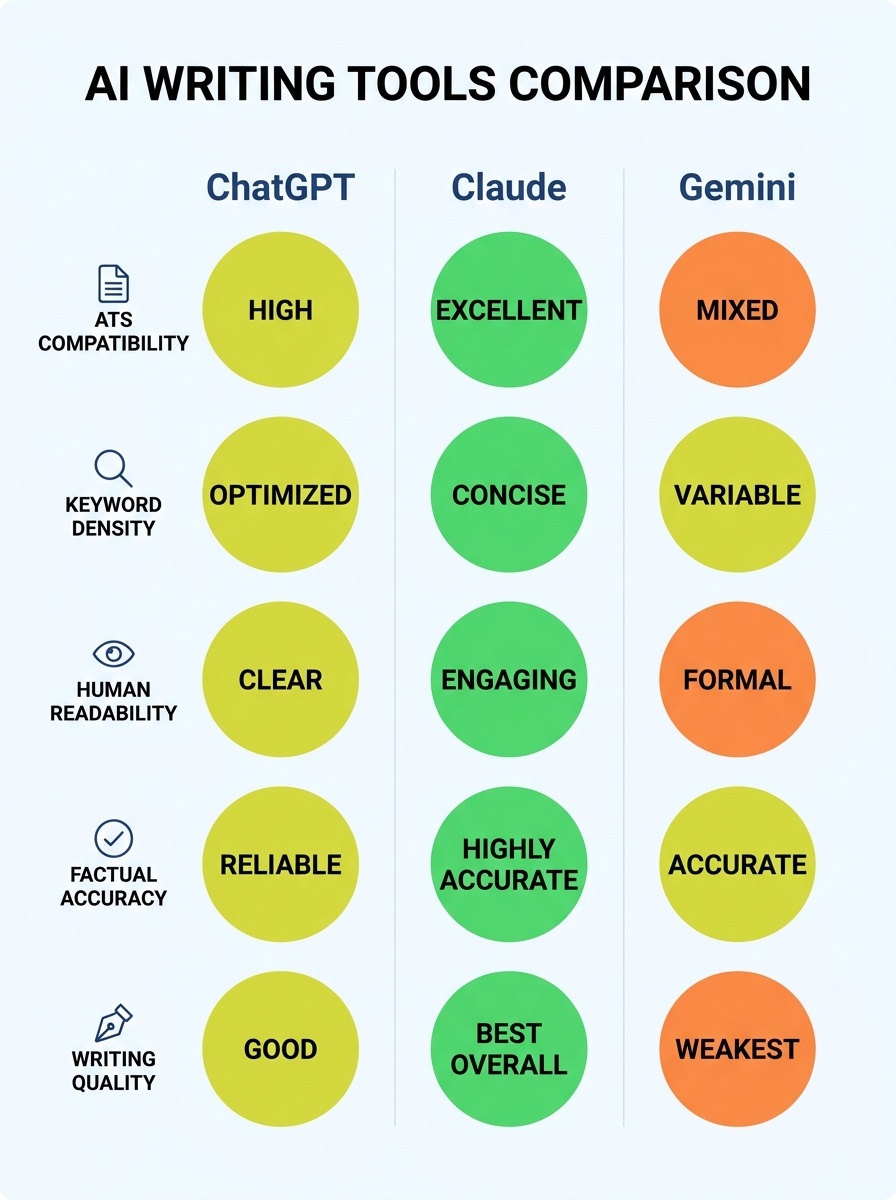
Claude consistently scored highest in the Tom’s Guide test for ATS optimization, keyword integration, and human readability. Those three criteria together determine whether your resume survives both the automated screen and the six-second human scan that hiring managers actually perform.
What sets Claude apart in any AI resume tools comparison 2026 is its approach to your content. As one Reddit user put it: “ChatGPT and Gemini treated my experience as facts to be polished. Claude treated them as claims to be examined.” That distinction matters enormously. Claude will tell you that your bullet points don’t support the seniority level you’re targeting, or that your experience section has a logical gap a hiring manager will catch.
In the UseResume.ai analysis from March 2026, Claude’s output “read as if written by someone already in the target role,” with keywords embedded contextually rather than inserted mechanically. For example, it reframed “user research” into “synthesizing data to develop recommendations,” which aligns with how senior-level job descriptions actually describe the work.
The downside: Claude sometimes under-indexes on keyword density. If you’re applying to a company running aggressive ATS filtering, you may need to manually add a few more keyword matches after Claude does its structural work. Understanding how modern ATS screening actually operates will help you fill those gaps yourself.
Gemini (Gemini Advanced / Gemini 3, $19.99/month)
Gemini’s unique advantage is live Google Search integration. It can pull in context about the company you’re applying to, including recent blog posts, press releases, and even hiring manager LinkedIn activity, then weave that context into your resume and cover letter. The 3BOX AI test found Gemini referencing a company’s 2025 data strategy pillar when tailoring a resume, something neither ChatGPT nor Claude could do without manual input.
But Gemini’s writing quality consistently ranks behind the other two in user preference surveys. A Reztune comparison noted that “in many head-to-head comparisons by users, Gemini is often ranked behind both Claude and ChatGPT for creative and professional writing tasks.” The output reads more robotic, with less natural sentence variation. For a resume, where every word needs to earn its place, that’s a real handicap.
Gemini is best used as a research tool before you write, not as the writer itself.
The Callback Data We Actually Have
No peer-reviewed study has tracked interview callbacks from resumes generated by each of these three specific models at scale. The 3X callback figure cited by Talent Anywhere applies to AI-enhanced resumes broadly, not to any single ChatGPT Claude Gemini resume workflow.
What we do have: the Tom’s Guide experiment, where a real job seeker submitted resumes generated by each model and tracked results. Claude’s version secured what evaluators called the highest “interview callback potential,” rated as “most effectively optimized” for both ATS scanning and human review. ChatGPT’s version scored well on narrative quality but lower on ATS compatibility. Gemini’s version had the strongest company-specific context but the weakest prose.
A resume is an argument. If your argument has weak points, the best thing an AI can do is tell you before an interviewer does.
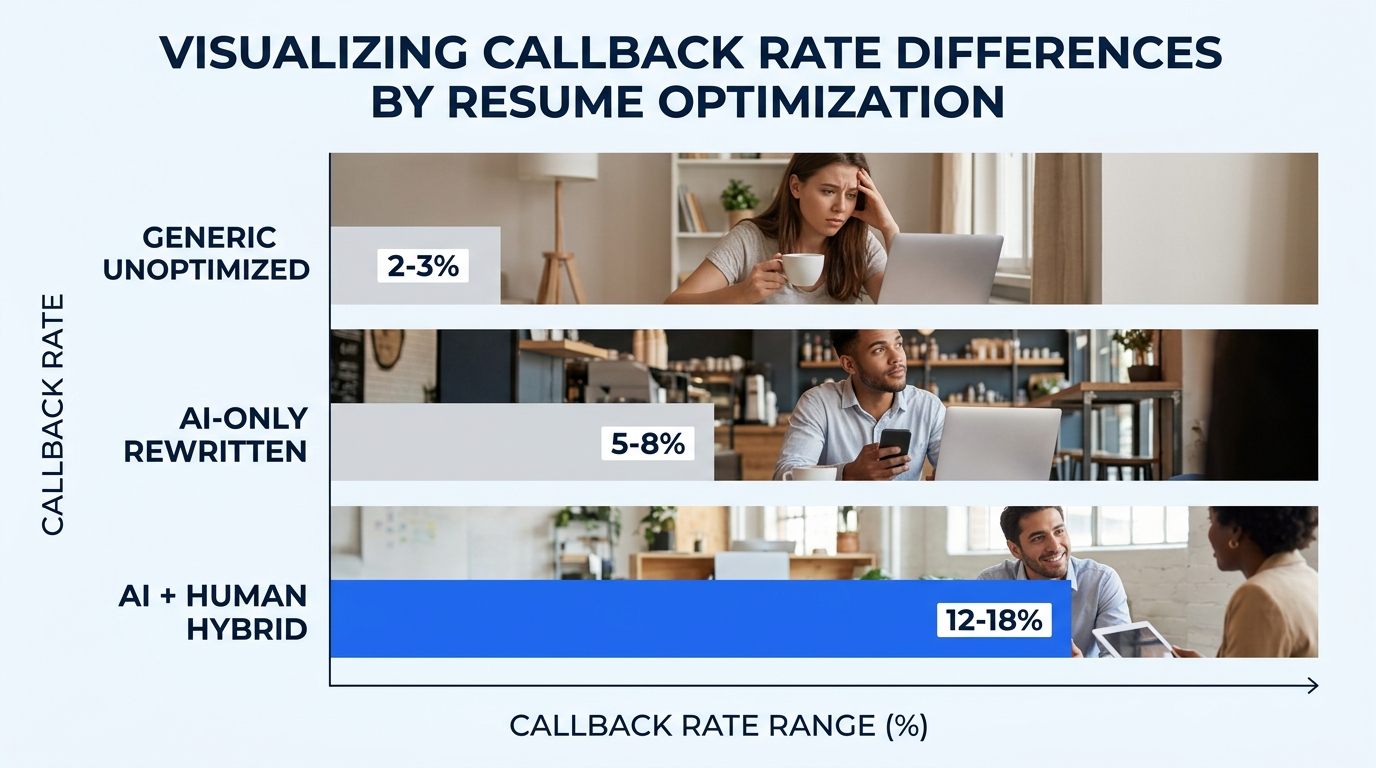
And there’s a sobering counterpoint. EarnBetter, a free AI resume rewriting tool, showed response rates of only 1–3% compared to human-assisted services like Scale.jobs, which reported 12–18% through a hybrid of AI tools and recruiter expertise. The gap between AI-only and AI-plus-human remains significant, which means AI-powered resume optimization works best as an accelerant for your own judgment, not a replacement for it.
How to Pick the Right Model for Your Situation
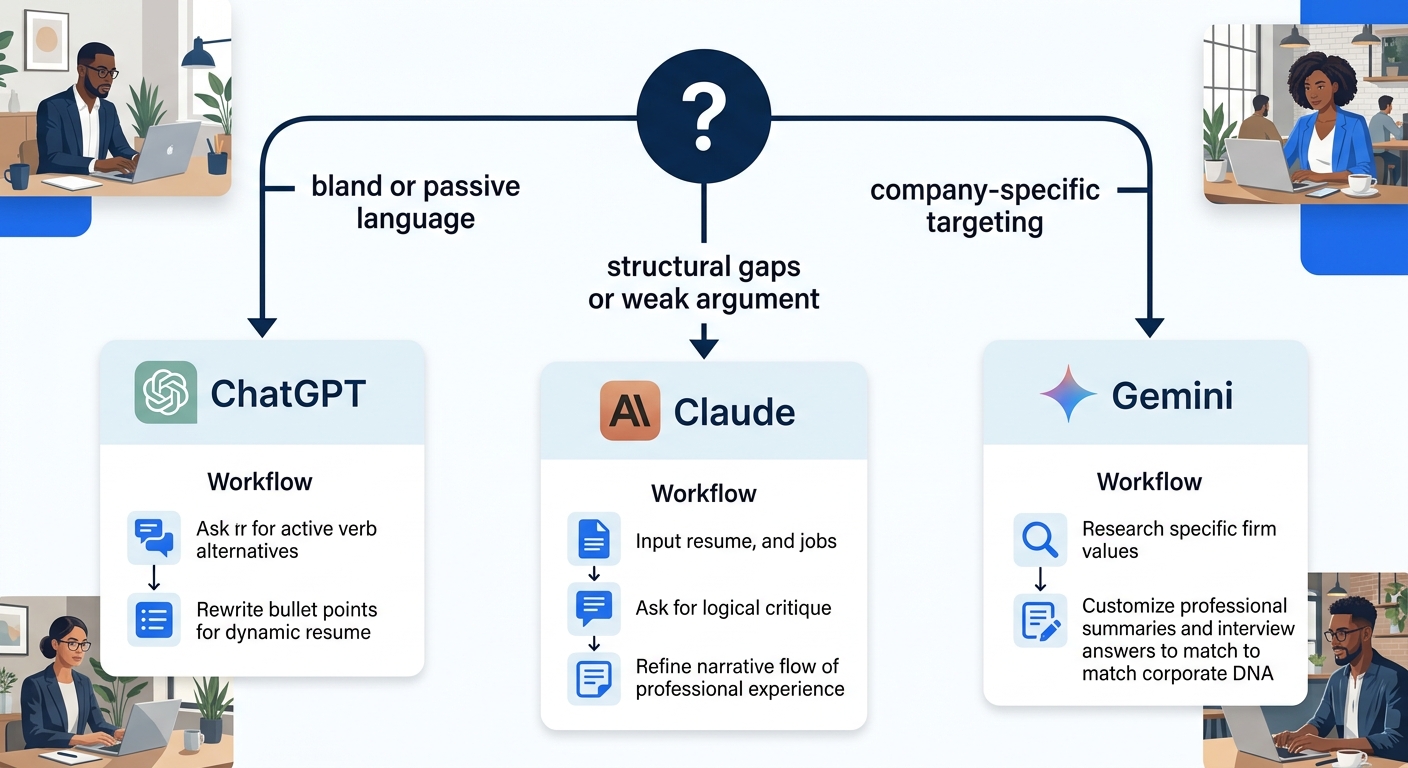
The resume rewriting AI tools debate doesn’t have a single winner because these tools solve different problems.
If your resume is bland and passive, ChatGPT will punch it up faster than the alternatives. Fact-check everything it adds. Every metric, every percentage, every claim about team size needs verification before you submit.
If your resume has structural weaknesses—you’re targeting a role above your current level, your career trajectory has gaps, or your bullet points don’t build a coherent case—Claude is the stronger choice. It will push back on weak claims rather than dressing them up. This is the closest any of these tools come to mimicking what a human career coach would do, and if you’re considering whether professional coaching is worth the investment, spending a month with Claude Pro at $20 is a reasonable first step.
If you’re doing targeted applications at specific companies and want company-specific language, use Gemini for research, then feed that research into Claude or ChatGPT for the actual writing.
Tip: All three models offer free tiers sufficient for a single resume rewrite. If you’re in active job search mode, Claude Pro at $20/month is probably the highest-ROI choice among the three for resume content specifically. Pair it with a tested ATS-compatible template separately, since [template formatting matters as much as the content layer](/blog/resume-templates-that-pass-ats).
What These Tests Leave Out
Every comparison cited here—3BOX AI, Tom’s Guide, Reztune, UseResume.ai—tests the models at a single point in time with a specific prompt. Prompt quality dramatically affects output quality. A vague instruction like “improve my resume” produces mediocre results from all three models. A detailed prompt that includes the job description, specifies the target seniority level, and asks the model to identify weaknesses before rewriting produces dramatically better output from every one of them.
The 30% callback improvement from tailoring? That number comes from the tailoring itself, not from any specific tool. You could achieve similar results with manual rewrites if you had the time and skill. What AI gives you is speed—the ability to tailor for each application without spending hours per version.
These models are also changing underneath us. The latest rounds of updates to both ChatGPT and Claude in April 2026 have narrowed gaps that existed even three months ago. Any snapshot comparison has a shelf life of maybe a quarter before the landscape shifts again.
Questions the Numbers Still Can’t Answer
The biggest unknown in any AI resume tools comparison 2026 is longitudinal. We know Claude produces the best-rated single resume in side-by-side tests. We know ChatGPT is fastest for bulk applications. We know Gemini brings the best company research. But nobody has yet tracked 500 job seekers across all three tools for six months and measured actual hire rates, controlling for industry, seniority level, and geographic market.
Until that study exists, the honest take is this: use whichever model matches your resume’s specific weakness, treat its output as a first draft, and do the verification work that AI output demands. The humans who report the strongest callback numbers are the ones who fact-check the metrics their AI suggests, adjust the tone for their specific industry, and pair the rewritten resume with a LinkedIn profile that converts views into actual conversations.
The tool gives you speed and a strong starting point. The judgment about what’s true, what’s relevant, and what will hold up under interview questioning still has to be yours.