


 4.9
4.9 4.5
4.5The average senior executive summary runs about 73 words, roughly 18 words longer than what junior professionals write. That extra space should be where decades of leadership experience crystallize into a specific, compelling case for your candidacy. Instead, the overwhelming pattern in senior executive resume writing is that candidates fill those 73 words with the same interchangeable phrases every other VP, SVP, and C-suite applicant already used. “Results-oriented leader.” “Proven track record.” “Seasoned executive with a strong background in operations.” The summary section is the most valuable real estate on your resume, and you’ve built a strip mall on beachfront property.
This matters because the executive summary is typically the only section a hiring committee reads in full before deciding whether to continue. When your summary sounds identical to the other 200 applicants, you’ve squandered the one section that was supposed to differentiate you. And at the senior level, differentiation is the entire game.
The Phrases That Signal “Skip This Candidate”
Career Impressions’ breakdown of common executive resume mistakes puts it bluntly: “You’re already losing your audience if your resume opens with a vague or generic statement that anyone else could also claim.” The firm specifically calls out “results-oriented leader” and “seasoned executive with a strong background in operations” as phrases that make senior candidates sound indistinguishable.
Here’s a partial list of the phrases we see constantly in executive summary resumes, along with why each one fails:
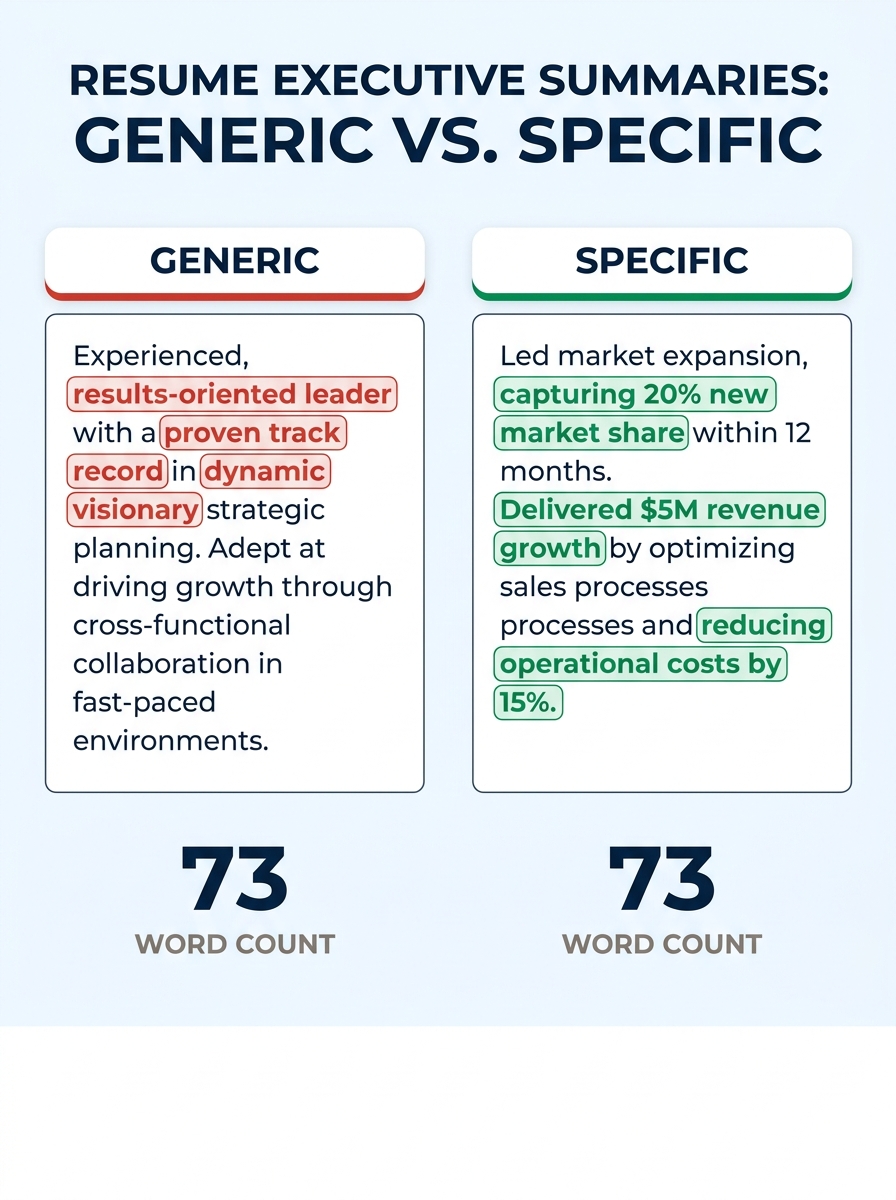
- “Results-oriented leader” — Every executive claims to be results-oriented. The word “results” without a specific result is an empty container.
- “Proven track record of success” — Proven how? Track record in what? Success measured by whom? This phrase does zero work.
- “Dynamic and visionary executive” — Two adjectives, no evidence. The reader has to take your word for it, and they won’t.
- “Passionate about driving growth” — Passion is demonstrated through accomplishments, not declared in a sentence.
- “Strong communicator with excellent interpersonal skills” — If you need to announce that you communicate well, the resume itself is failing to prove it.
- “Seasoned professional with 20+ years of experience” — They already know your experience level from your employment history. This wastes words on information available three inches lower on the page.
The pattern across all these phrases is the same: they describe a category of person rather than a specific person. Your executive summary should make it impossible to swap in someone else’s name without the whole thing falling apart. If another SVP of Operations could paste your summary onto their resume and it would still read fine, you’ve written a job description, not a personal positioning statement.
How C-Suite Career Branding Actually Works in a Summary
The shift executives need to make is from describing attributes to documenting outcomes. A good executive summary reads more like a brief financial report than a personality profile. Here’s what that looks like in practice.
Generic version: “Visionary technology executive with a proven track record of driving digital transformation and building high-performing teams across global enterprises.”
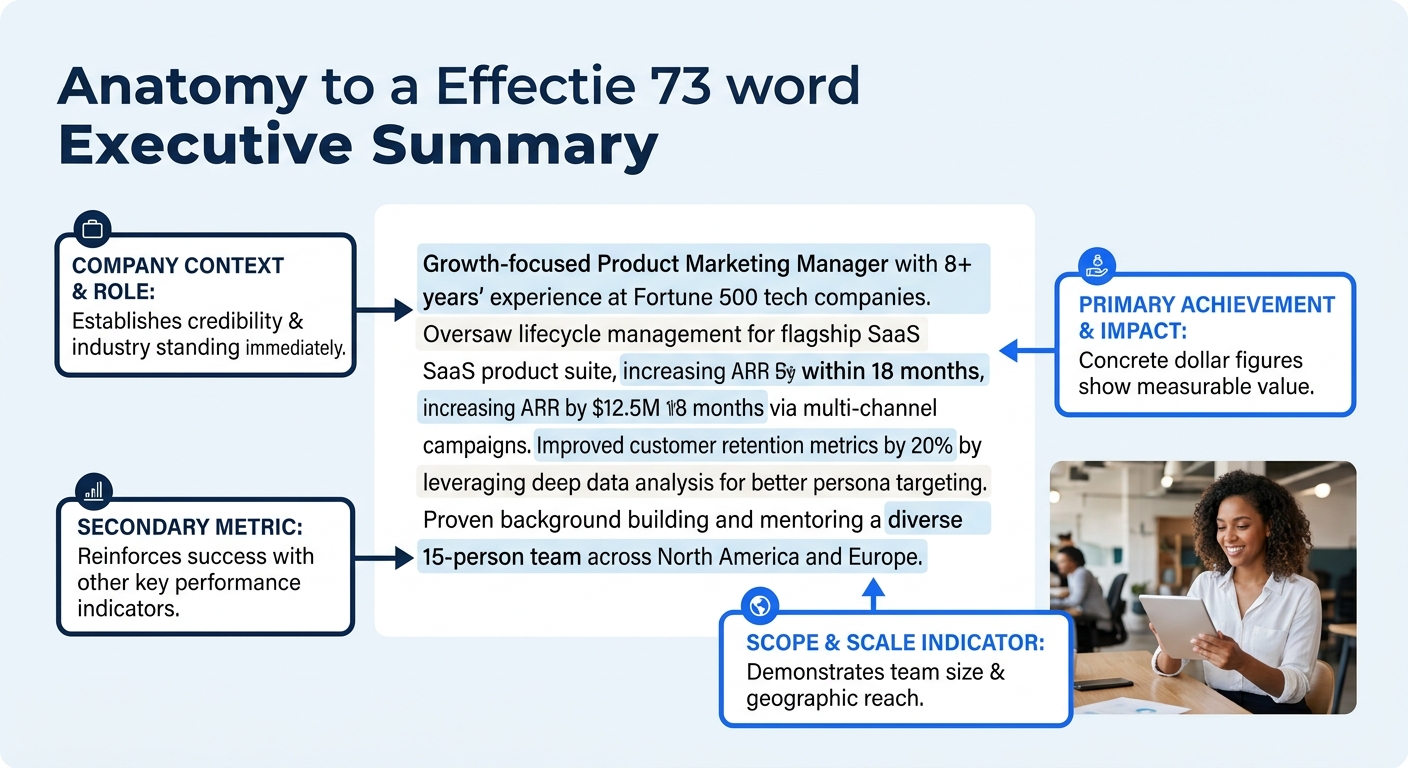
Specific version: “CTO who migrated a 14,000-employee organization from legacy on-premise infrastructure to hybrid cloud, cutting annual IT spend by $6.2M while reducing system downtime from 4.1% to 0.3% over 18 months. Built and scaled engineering teams across three continents.”
The second version is longer, yes. But every word carries information. The reader knows what kind of company you led technology for (large, global), what you specifically did (cloud migration), what it cost or saved ($6.2M), and what operational improvement resulted (downtime reduction). There’s no room for ambiguity and no need for buzzwords.
This kind of leadership resume positioning forces you to choose your most impressive accomplishment and lead with it. That’s uncomfortable for many executives who’ve held broad roles spanning strategy, operations, revenue, and culture. The instinct is to cover everything. Resist it. Your summary is an argument, not an inventory.
Tip: A practical test: read your executive summary aloud and ask yourself whether a board member who has never met you would know, from these 73 words alone, what specific problems you solve and how much money is involved. If the answer is no, rewrite it.
Work It Daily’s guidance on senior resumes reinforces this point: in director-level and above positions, designing and implementing strategic plans is what matters, and your summary needs to reflect that strategic scope. The summary shouldn’t read like a mid-career professional’s highlight reel. It should read like a board presentation’s opening slide.
The Tactical-to-Strategic Shift Most Senior Resumes Miss
One of the most telling problems in senior executive resume writing appears when a VP or C-suite leader writes a summary that describes what they did day-to-day rather than what they changed. CIO’s profile of resume modernization for executive IT leaders illustrates this well: a resume consultant specifically repositioned a client away from tactical descriptions toward “a technology and operations executive who helps drive growth, scale, and profitability into the business.”
That distinction between tactical and strategic is where most executive summaries collapse. Consider the difference:
Tactical framing: “Managed P&L responsibility for a $40M business unit and oversaw a team of 120 employees across four departments.”
Strategic framing: “Grew a $28M business unit to $40M in three years by repositioning the product line for enterprise buyers and restructuring the sales organization from geographic to vertical alignment.”
The tactical version describes a job. The strategic version describes a transformation. At the C-suite level, companies are hiring you to change something, and your summary needs to signal what kind of change you’re capable of producing.
This connects directly to how your resume performs once it reaches a human screener. Research shows that recruiters spend roughly 11 seconds scanning a resume before making an initial keep-or-reject decision. If your summary is packed with category descriptors like “strong leader” and “team builder,” a screener doesn’t absorb anything specific in those 11 seconds. Concrete numbers and named outcomes register faster than abstract adjectives because they give the brain something to anchor to.
Your summary shouldn’t read like a mid-career professional’s highlight reel. It should read like a board presentation’s opening slide.
Tailoring the Summary Without Starting From Scratch Each Time
One reasonable objection: if every executive summary needs to be specific, do you need to rewrite it for every application? The answer is mostly no, but with a critical caveat.
Your core summary should reflect your strongest, most transferable achievement. If you turned around a struggling division, led a company through an IPO, or built an organization from 50 to 500 people, that story works across most executive searches. What changes per application is usually one or two phrases that connect your experience to the target company’s situation.
For example, if your core achievement is a turnaround story but the target company is in growth mode rather than distress, you’d adjust the framing to emphasize the growth metrics within your turnaround rather than the distress you inherited. The bones stay the same. The emphasis shifts.
This approach to C-suite career branding avoids the trap of writing a completely generic summary that tries to be all things to all companies. If you’ve been reading about the widening gap between ATS optimization and human readability, you’ll recognize the parallel problem: executives often write summaries optimized for keyword matching that sound hollow to the actual human decision-maker. Your summary needs to serve both audiences, and specificity achieves that better than keyword stuffing.
And if you’re wondering whether the language in your bullet points carries the same risk as a buzzword-heavy summary, the research on converting vague accomplishments into measurable outcomes applies here too. The principles are the same whether you’re a director of engineering or a chief revenue officer: specific beats generic, numbers beat adjectives, and outcomes beat responsibilities.
Why Seniority Makes This Problem Worse, Not Better
You might think that at the senior level, your reputation and network would compensate for a weak resume. And in some cases they do. But executive searches increasingly involve multiple stakeholders reviewing resumes independently, including board members, search committee participants, and sometimes investors or advisors who don’t know you personally. Your resume has to work on its own, without your reputation entering the room first.
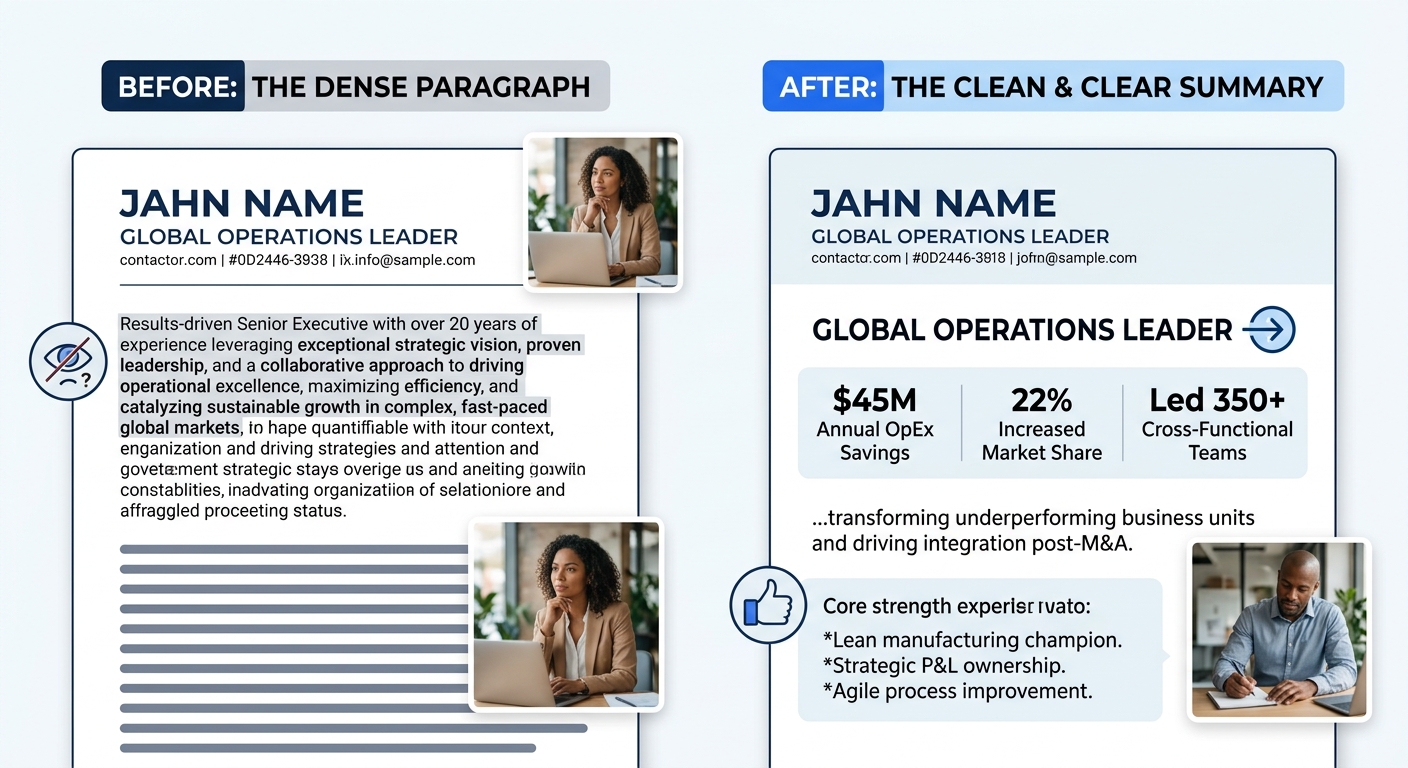
The irony is that junior candidates often have an easier time writing specific summaries because their accomplishments are contained and concrete. They shipped a feature, closed a deal, managed a project. Executives, whose work spans years and involves dozens of interconnected decisions, struggle to compress that complexity into 73 words. The temptation is to retreat into abstractions. “I’m a strategic leader who drives results.” That sentence could describe anyone from a franchise restaurant owner to a four-star general.
The fix is to think about your summary the way you’d think about pitching an investor. An investor doesn’t want to hear that you’re passionate and experienced. They want to know the revenue number, the margin improvement, the market share gain, or the cost structure you rebuilt. Your executive summary resume should deliver that same density of information.
If your online presence reinforces those same specifics, the effect compounds. We’ve covered how hiring managers routinely search candidates online before interviews, and an executive whose LinkedIn summary echoes the same buzzword-laden language as their resume creates a consistent but unflattering impression. When both your resume and your digital presence tell a vague story, evaluators fill in the blanks with skepticism.
What Still Isn’t Settled
Executive resume conventions are shifting, and a few questions don’t have clean answers yet. The 73-word average for senior summaries may itself be too short for certain industries where technical complexity or regulatory context demands more explanation. Whether summaries should include a branded tagline (“The CFO Who Builds Finance Teams That Scale”) or whether that reads as gimmicky remains a matter of debate among executive resume writers.
What is settled: generic language in the most prominent section of your resume costs you opportunities. Every search firm partner and internal recruiter we’ve spoken with confirms the same thing. When they see “results-oriented leader with a proven track record,” they don’t think less of you as a person. They just move on to the next resume, because yours didn’t give them a reason to stop. The executives who win the interview are the ones whose summaries read like the opening paragraph of a case study, where the scale of the problem and the specificity of the solution make it impossible to look away.