

 4.9
4.9 4.5
4.5Three cover letter formats cover every job type you’ll encounter: problem-solution, achievement-focused, and narrative. This tutorial walks you through picking the right one, writing it with industry-specific cover letter examples, and adapting it for roles from entry-level to C-suite in about 45 minutes.
TL;DR: Choose your format based on role type (problem-solution for mid-career, achievement-focused for technical and sales, narrative for creative and career-change), then build each section using the examples and verification checks below. Your finished letter should be one page, 250–400 words, addressed to a named person.
Before You Start
You need four things before writing a single word: the full job posting (not a summary), the company’s About page or mission statement, your current resume, and the hiring manager’s name. LinkedIn, the company’s team page, and even a quick phone call to the front desk can surface that name. MIT’s career advising office specifies that a cover letter should stay under one page with a 10-to-12-point font. The University of Michigan’s Career Center echoes this: “Keep it short and sweet, do not exceed one page.”
Time required: 45 minutes for your first letter. About 15 minutes to adapt it for each subsequent application.
Knowledge level: You should be able to identify 2–3 accomplishments from your work history and connect them to a job posting’s requirements. If you’re struggling with that connection, our guide on building real cover letter templates can help you find the right framing.
Tools: A word processor. Microsoft Word offers free cover letter templates if you want a formatted starting point, and Canva provides design-forward options. But the format matters far less than the words inside it.
Step 1: Pick the Format That Matches Your Role
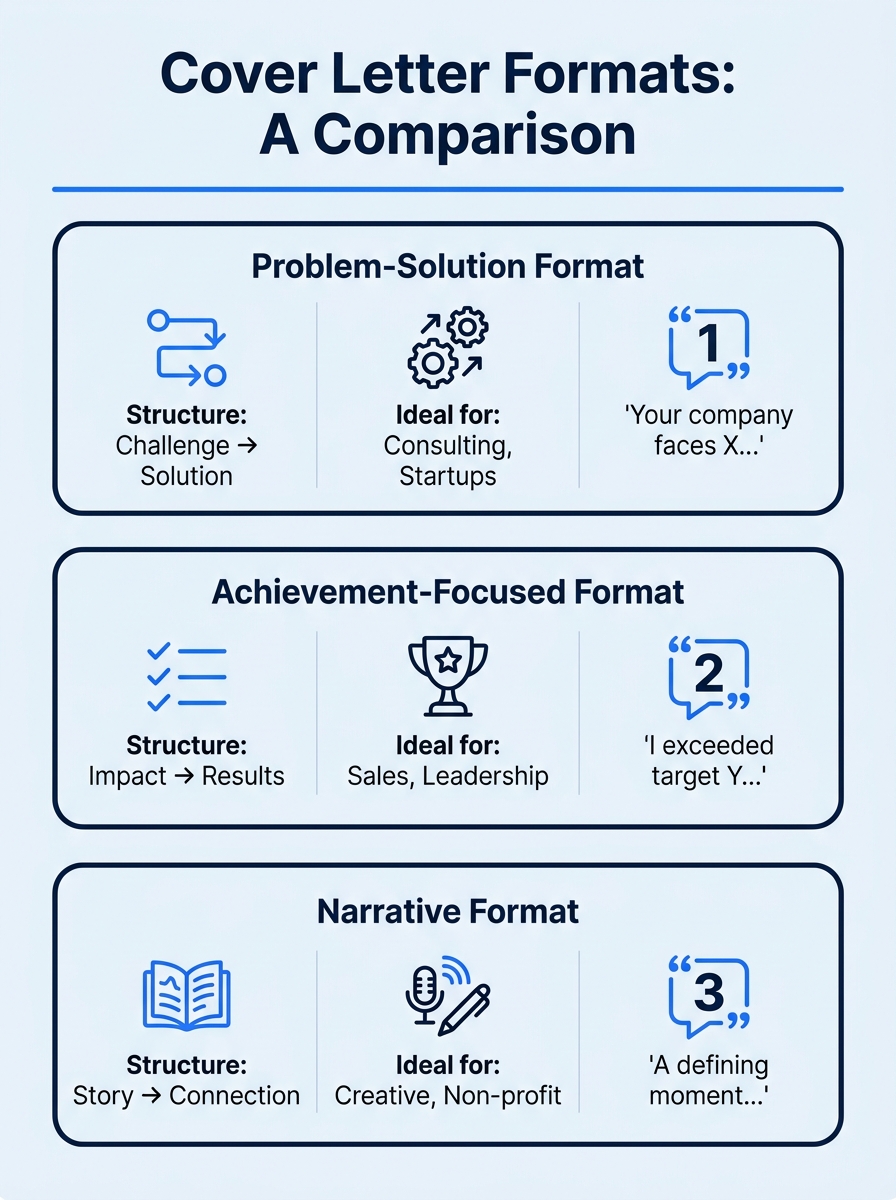
The format you choose determines how the hiring manager reads your qualifications. With 94% of hiring managers reporting that cover letters influence interview decisions and 83% calling them important to hiring choices, the wrong format buries your strongest material where nobody reads it. Here’s how the three formats break down:
| Format | Best For | Structure | Tone | Key Feature |
|---|---|---|---|---|
| Problem-Solution | Mid-career, management, operations | Identify company challenge → present yourself as the fix | Consultative, direct | Mirrors job description keywords like “improve,” “build,” “scale” |
| Achievement-Focused | Sales, engineering, technical, finance | 3–4 bullet-pointed results with numbers | Data-driven, confident | Proves impact with percentages and dollar figures |
| Narrative | Creative roles, career changers, nonprofits | Personal story → connection to mission → future contribution | Warm, authentic, specific | Creates emotional resonance a resume can’t deliver |
If you’re applying to a sales role where KPIs dominate the job posting, the achievement-focused format lets you lead with numbers. If you’re pivoting from teaching into corporate training, the narrative format gives you space to explain why that transition makes sense. And if you’re a project manager applying to a company that’s publicly struggling with delivery timelines, the problem-solution format positions you as the person who fixes that exact pain point.
Info: 66% of job seekers prefer their cover letter to be half a page or less. Hiring managers tend to agree. Regardless of format, aim for 250–400 words.
You’ll know this step worked when: you can point to 2–3 specific lines in the job posting that your chosen format directly addresses.
Step 2: Write Your Opening Paragraph
The opening paragraph determines whether anyone reads the rest. The Resume.io executive cover letter guide states that addressing your letter recipient by name is “practically a must” for executive candidates, but the same principle applies at every level. “Dear Hiring Manager” signals that you didn’t care enough to spend 90 seconds on LinkedIn.
Here are three opening paragraphs, one per format, that you can adapt:
Problem-Solution (Operations Manager applying to a logistics company):
“Your Q2 earnings call highlighted a 14% increase in last-mile delivery costs across the Midwest region. At [Previous Company], I reduced last-mile costs by 22% over 18 months by renegotiating carrier contracts and consolidating three distribution centers into two. I’d like to bring that same approach to [Company Name]’s logistics operations.”
Achievement-Focused (Sales Representative):
“In my two years as a sales representative at [Previous Company], I generated $1.2M in new account revenue, exceeded quarterly KPIs by around 40%, and expanded our client base by 87 accounts. I’m writing because [Company Name]’s expansion into the Southeast market aligns directly with the territory-building work I do best.”
Narrative (Career Changer moving from education to corporate L&D):
“After eight years teaching AP Chemistry to 150 students per year, I’ve designed more than 40 original curricula, tracked learning outcomes across 1,200 students, and consistently lifted pass rates by 15–20 percentage points. That work is instructional design. I’d like to do it full-time for [Company Name]’s growing learning and development team.”
Notice what each opening does: names a specific result, connects it to the target company, and explains why you’re writing. Zero space wasted on “I am writing to express my interest in the position of…”
If you’ve worked with our complete cover letter template before, you’ll recognize the Interest + Evidence + Fit framework embedded here. The opening paragraph should answer three questions: Why this company? Why this role? Why you?
You’ll know this step worked when: your opening contains at least one specific number and the company’s name appears in the first three sentences.
Step 3: Build Body Paragraphs Around Proof
Body paragraphs are where most cover letters collapse into vague responsibility lists. “I was responsible for managing a team” tells a hiring manager nothing. “I managed a 12-person team that delivered a $3.4M product launch 3 weeks ahead of schedule” tells them everything.
For achievement-focused formats, use 3–4 bullet points in the body. Each bullet follows this pattern: action verb + specific metric + context.
- Increased customer retention from 72% to 89% by redesigning the onboarding sequence
- Reduced average ticket resolution time by 35% across a 40-person support team
- Generated $840K in upsell revenue during Q3 by targeting existing accounts with usage data
For problem-solution formats, write two prose paragraphs. The first paragraph describes the problem you’ve solved before (with numbers). The second paragraph explains how that experience maps onto the company’s current challenge. Pull language directly from the job posting.
For narrative formats, the body is where your story earns its credibility. You’ve hooked them with your personal connection in the opening. Now prove you have the skills. Career changers should pay particular attention here because, as we’ve covered in our piece on why resumes often speak the wrong industry language, the bridge between your old role and your target role needs to be explicit.
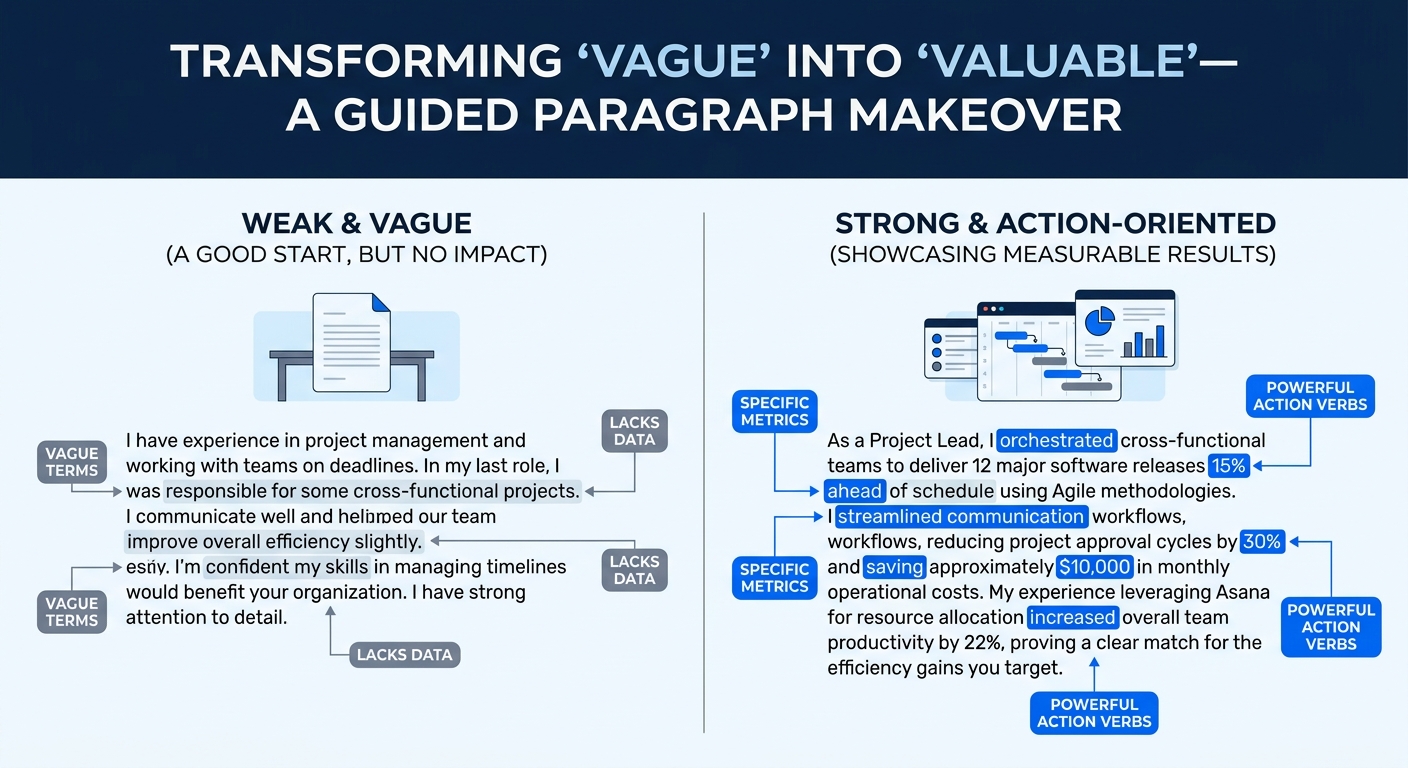
“I was responsible for managing a team” tells a hiring manager nothing. “I managed a 12-person team that delivered a $3.4M product launch 3 weeks ahead of schedule” tells them everything.
You’ll know this step worked when: every claim in your body paragraphs includes a number, a timeframe, or a named outcome.
Step 4: Adapt Tone and Detail to Your Industry
A cover letter for a pediatric nursing position reads differently from one for a fintech startup, even if both use the achievement-focused format. Here’s how to calibrate:
Healthcare and education: Lead with certifications, patient/student outcomes, and compliance awareness. Mention specific credentials (RN-BSN, state licensure numbers, FERPA training). Tone stays professional and empathetic.
Technology and engineering: Emphasize tools, systems, and scale. “Built a CI/CD pipeline serving 200 deployments per week” carries weight. Skip soft-skill adjectives and let the technical specifics speak. If you’re in tech, the reverse-chronological resume format guidance we’ve published carries over to cover letter structure, too: your most recent and relevant work goes first.
Sales and business development: Numbers dominate. Revenue generated, deals closed, territory size, quota attainment percentage. ResumeBuilder.com’s executive cover letter examples show phrases like “My ability to create strategic partnerships with enterprise customers and C-level executives would create immense value” working well at the senior level. At the mid-level, replace “immense value” with a dollar figure.
Creative and marketing: Show, don’t just tell. Link to a portfolio. Reference a specific campaign, publication, or project by name. If you increased social engagement by 87%, say that, but also name the platform and the content strategy that produced it.
Executive and C-suite: Indeed’s executive cover letter sample illustrates how senior candidates should frame vision alongside results. At this level, address the CEO or board chair by name. Skip “Dear Hiring Manager” entirely. Resume.io’s executive guide is clear that using the recipient’s name is “practically a must” for executive candidates, and a generic greeting can disqualify you before the first paragraph ends.
You’ll know this step worked when: someone from your target industry would read the letter and think you understand their day-to-day priorities.
Step 5: Write a Closing That Asks for Something Specific
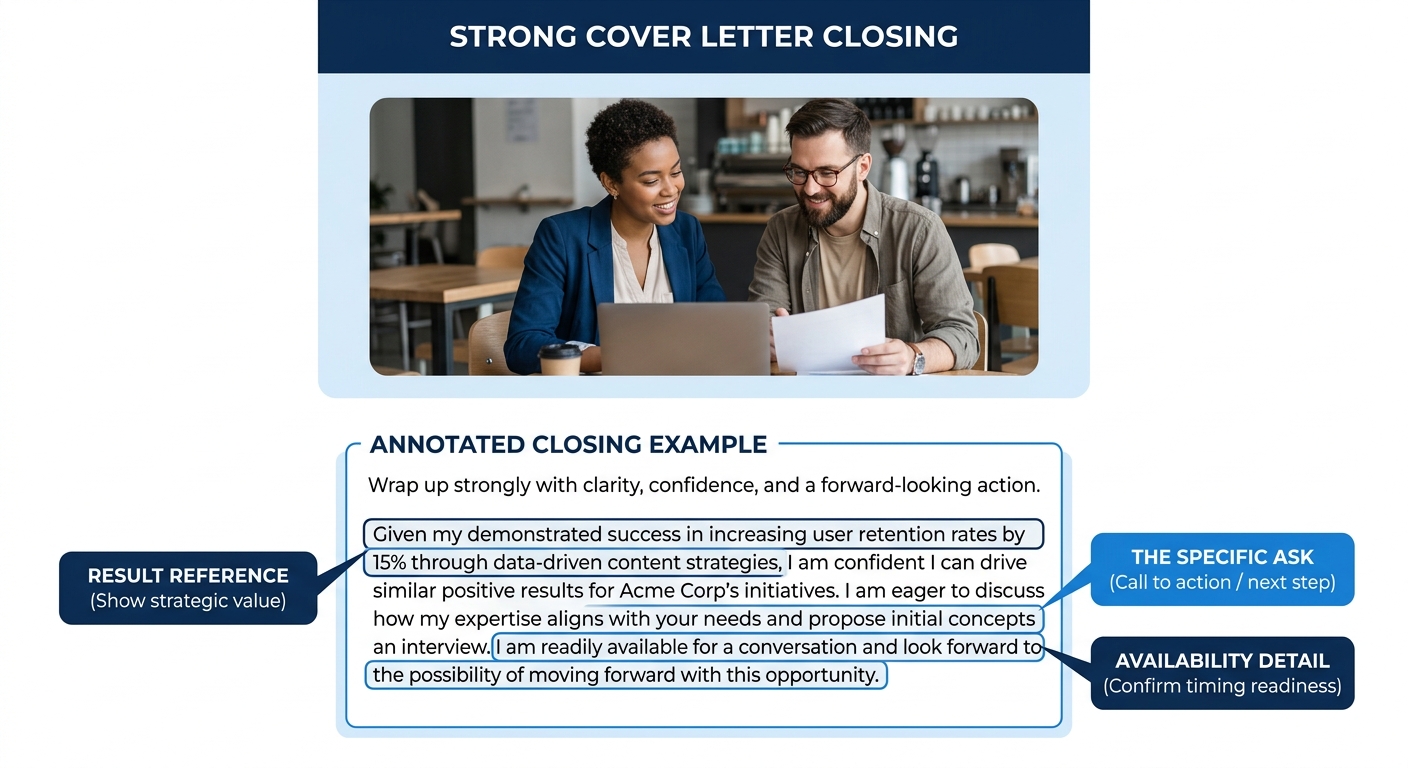
Don’t end with “Thank you for your time and consideration.” End with a specific ask and a specific offer. Compare:
Weak closing: “I look forward to hearing from you at your earliest convenience.”
Strong closing: “I’d welcome 20 minutes to walk through how I reduced onboarding time by 30% at [Previous Company] and how that approach could work for your Austin team. I’m available Tuesday through Thursday this week and can be reached at [phone] or [email].”
The strong version names a result, proposes a concrete time window, and makes it easy for the reader to say yes. It’s 47 words. Your closing should be 40–60 words maximum.
You’ll know this step worked when: your closing paragraph contains a specific time window and references at least one result from your body paragraphs.
When the Letter Isn’t Working
Three things go wrong most often, and each has a distinct symptom:
Problem: You’re getting zero responses across 10+ applications. The letter is probably too generic. Check whether you’ve changed the company name, the role title, and at least one body-paragraph detail for each application. A cover letter that could be sent to any company will be read by none of them. Run a quick test: delete the company name from your letter. If the letter still makes sense without it, you haven’t personalized enough.
Problem: You’re getting interviews but they feel off-target. Your cover letter is promising something your resume doesn’t support. Make sure every claim in the letter appears, with evidence, on your resume. If your letter mentions “leading cross-functional teams” but your resume shows only individual contributor roles, the interviewer will notice that gap in the first 5 minutes.
Problem: Your letter runs longer than one page. Cut the second-weakest body paragraph entirely. With 66% of applicants preferring letters under half a page, long letters work against you. If you still can’t fit, increase your font to 11 point (the MIT guideline ceiling is 12) and reduce your margins to 0.7 inches. If it still overflows, you’re trying to say too much.
Warning: Generic AI-generated cover letters are increasingly rejected by hiring managers. If you used a chatbot to draft your letter, spend 15 minutes rewriting every sentence in your own voice, adding specific numbers from your actual experience, and removing any phrasing that sounds like it came from a template.
Where to Go From Here
You now have a format-matched, industry-calibrated cover letter with a personalized opening, proof-driven body paragraphs, and a closing that asks for something concrete. The next step is pairing it with an equally strong resume. Our cover letter and template examples guide walks you through making sure both documents tell a consistent story, which matters because interviewers read them side-by-side more often than applicants realize.
Keep a “master” version of your cover letter for each format. When a new job posting appears, copy the master, swap in the company name and role-specific details, update one body paragraph to mirror the posting’s language, and adjust the closing ask. That adaptation process should take 10–15 minutes per application. If it’s taking longer, your master version needs more work. If it’s taking less, you’re probably not customizing enough.