



 4.9
4.9 4.5
4.5The PARW/CC’s Certified Professional Resume Writer exam grades candidates on five criteria: résumé structure, content strategy, writing quality, ATS compliance, and accomplishment presentation. None of those five criteria measure whether the finished document converts into interviews for the person who paid for it.
That disconnect sits at the center of an ongoing frustration for job seekers who spend $100 to $1,000 or more on professionally written résumés and still hear nothing back. The CPRW credential validates a writer’s craft. It does not validate the outcome a job seeker actually needs: getting into the interview room. Understanding exactly where the breakdown happens reveals why CPRW certification value gets questioned by the same people paying for it, and what the certification does and doesn’t protect you from when you’re spending real money during a stressful search.
The Five Criteria and the Missing Sixth
The CPRW exam, administered by the Professional Association of Résumé Writers & Career Coaches, tests whether a writer can produce a well-structured, professional-quality résumé on demand. Candidates submit sample work and are scored on document organization, strategic positioning of career accomplishments, clean writing, and whether the format will survive an applicant tracking system’s parsing process.
These are legitimate skills. A badly formatted résumé that chokes an ATS parser costs candidates interviews they should have gotten, and plenty of DIY résumés fail at this basic level. The gap between what ATS systems need and what hiring managers want to read is real, and a CPRW-credentialed writer should be able to navigate it.
But the exam’s scope ends at document quality. There’s no criterion for interview conversion rate, client satisfaction data, or post-delivery placement tracking. A writer who produces structurally perfect résumés that never generate callbacks can hold the same credential as one whose clients land interviews within weeks. The certification doesn’t distinguish between the two because it was never designed to.
One recruiter with 13 years of experience put it plainly on Reddit: “I think the certification does lend credibility to a writer but it is not necessary either.” That framing captures the credential’s actual function. It signals baseline competence to prospective clients shopping for a writer. It doesn’t signal anything about whether that writer’s output performs in a live job market.
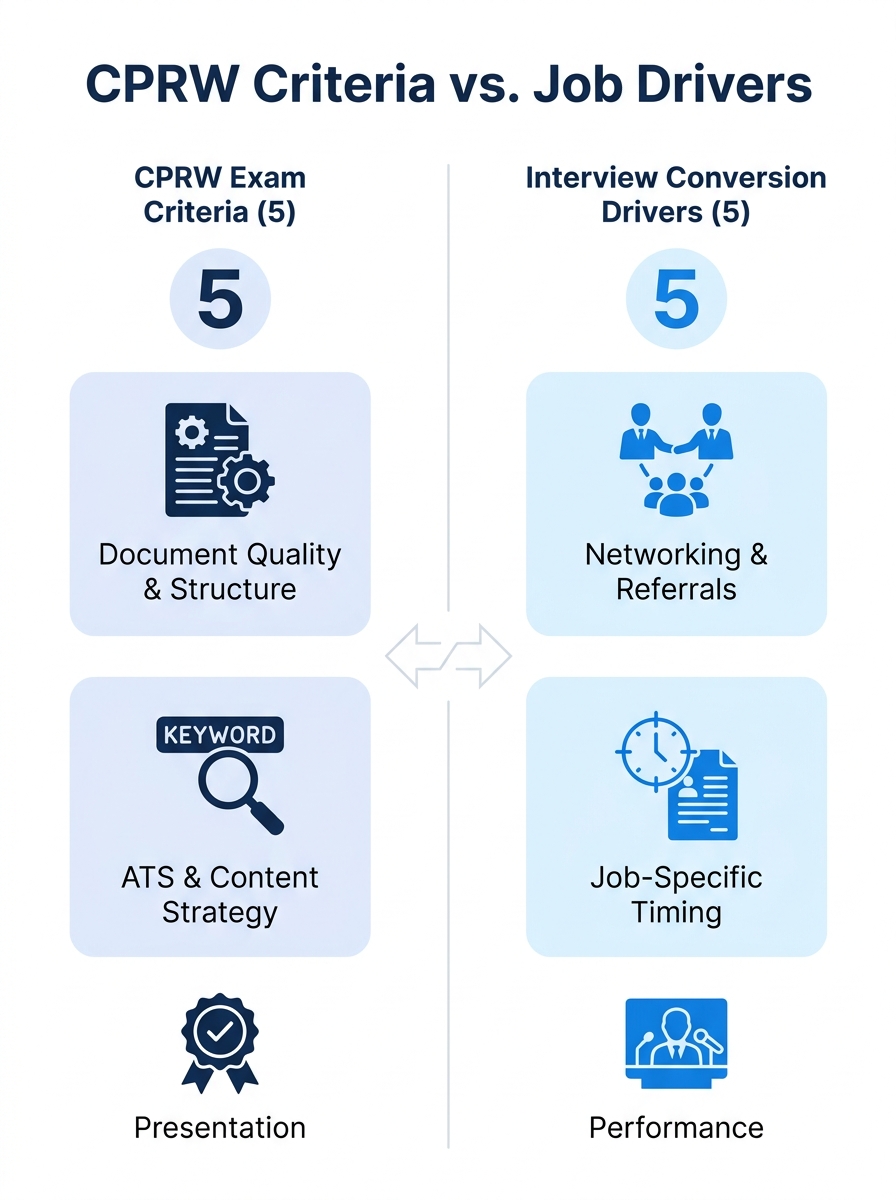
The missing sixth criterion is the one job seekers care about most: did the résumé work? And the reason it’s missing is structural. Interview conversion depends on variables no writer controls, including the applicant’s network, the local job market, how many people applied to the same role, and whether the hiring manager was having a good day. Certifying writers on outcomes would be like certifying surgeons on whether their patients later won marathons.
One Résumé for Every Job You’ll Never Tailor
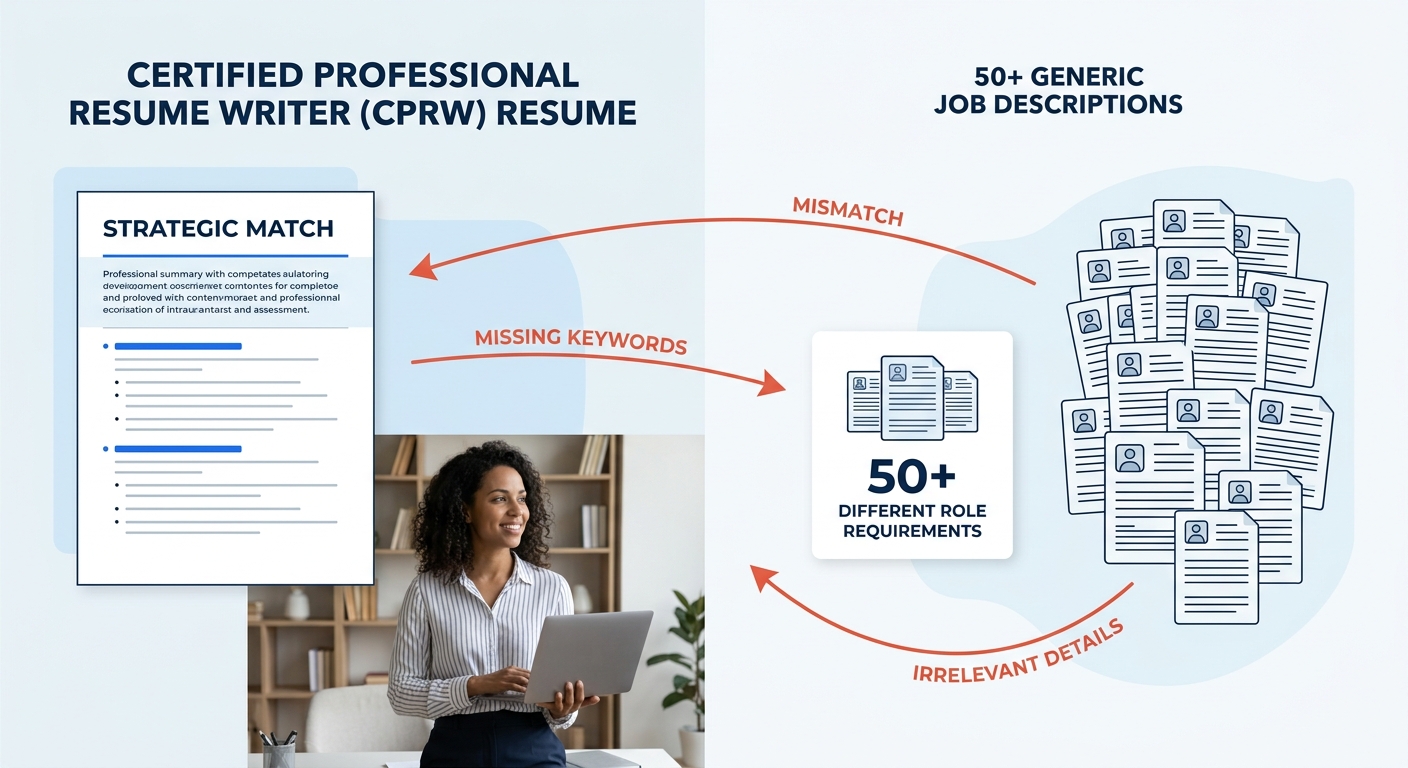
The economics of professional résumé writing create a second gap the CPRW credential doesn’t address. Jobscan’s analysis found that “the best way to increase your interview rate is to submit a resume that’s tailored for the job you’re applying for. So, if you apply for 50 jobs, you need 50 tailored resumes. But many resume writers only give you one resume for the cost of $100.”
That single deliverable is the standard model across the industry, whether the writer holds a CPRW or not. You pay $100 to $400 for a mid-career résumé (executive packages run $700 to $1,000+), and you receive one polished document. Some services include a round or two of revisions. Few include ongoing tailoring for each application.
The math is brutal. If you’re applying to 50 positions over a three-month search and each one ideally needs a customized version of your résumé, a single deliverable covers 2% of your applications. The other 98% go out either un-tailored or self-tailored by you, the person who paid a professional because you didn’t trust yourself to do it right.
This is where the customization trap in résumé builders meets the professional writing market head-on. The CPRW-written document is often beautiful, strategically organized, and ATS-friendly. And it sits unchanged in your Downloads folder while you fire it at 50 different job descriptions with 50 different keyword profiles.
Warning: Interview guarantee limitations are real: most résumé writing services explicitly state they do not guarantee interview results. The standard disclaimer notes that “hiring outcomes also depend on market conditions, networking, and interview performance.” If a service promises a specific number of interviews, read the fine print on refund conditions.
When you’re evaluating whether a professional resume writer is worth it, this delivery model is the first thing to interrogate. Ask how many tailored versions are included. Ask whether the writer offers a keyword-swapping guide you can use on your own. Ask what happens when application number 37 targets a slightly different role than the one the original résumé was built for. The answer to those questions matters more than whether the writer passed a certification exam.
The 68% Figure and Who Paid for It
The most commonly cited statistic in the résumé writing industry claims that “job seekers with professionally written resumes are 68% more likely to secure a job within 90 days.” That number appears on ResumeProfessionalWriters.com, which is itself a résumé writing service. Resume Optimizer Pro, reviewing the industry in 2026, flagged the obvious conflict: “That statistic comes from a service with an obvious interest in its interpretation, so treat it as directional.”
Directional is generous. The 68% figure has no published methodology behind it, no sample size disclosure, no control group comparison, and no independent replication. It circulates from service to service as received truth, each citation lending it borrowed credibility.
A more grounded resume writing service ROI calculation comes from Elite Resumes, which frames the value proposition around time-to-employment: “If you secure your next position within 6 months rather than 12 months as a result of investing $1,000 for a professional resume, the ROI based on an annual salary of $150,000 would be $74,000.” That math is transparent about its assumptions and conditional framing. The key word is “if.”
The 68% figure has no published methodology, no sample size, no control group, and no independent replication. It circulates from service to service as received truth.
The ROI question for a job seeker is whether the résumé itself shortened the search or whether something else did. A person who hires a professional writer during month three of an unsuccessful search and lands a job in month five might credit the résumé. They also ramped up their networking, adjusted their target roles, and got better at interviewing over those same months. Isolating the résumé’s contribution is genuinely difficult, and the industry’s most-cited numbers don’t try.
Scale.jobs notes that professional services “can significantly increase interview rates by addressing common resume pitfalls,” which is a measured claim. The pitfall-fixing function is where these services earn their keep. A CPRW writer who catches that your bullets are buried in passive language and restructures them around quantified accomplishments is doing real, measurable work. The question is whether that work, frozen in a single document, survives contact with a dynamic job market.
A Credential That Certifies Process, Not Results
The CPRW designation exists in a professional space where no outcome-based certification is possible. Résumé writing occupies a peculiar position: the product is deeply personal, the variables affecting its success are mostly outside the writer’s control, and the feedback loop between delivery and result is long and noisy. A writer who produces excellent work for a client with a thin network in a saturated market will see worse outcomes than a mediocre writer whose client has a warm referral waiting.
One certified writer at DesignResumes captured the self-referential logic of the credential clearly: “Don’t I know I write quality resumes? Of course I do. My clients are hired for great jobs! The resume writing certifications confirm my skills.” The certification confirms what the writer already believed. It doesn’t introduce new evidence about client outcomes.
This isn’t an argument that CPRW writers are bad or that the credential is meaningless. The exam’s five criteria represent real skills that produce real improvements in document quality. A résumé that survives ATS parsing, leads with measurable accomplishments, and presents a coherent career narrative is categorically better than one that doesn’t. And the alignment between your résumé and your broader career positioning matters enormously for converting interviews once you’re in front of a human.
The argument is narrower: the credential certifies a writer’s process and craft, and job seekers consistently mistake it for a certification of results. When they pay $400 and don’t get interviews, they blame the CPRW credential. The credential was never making the promise they thought it was.
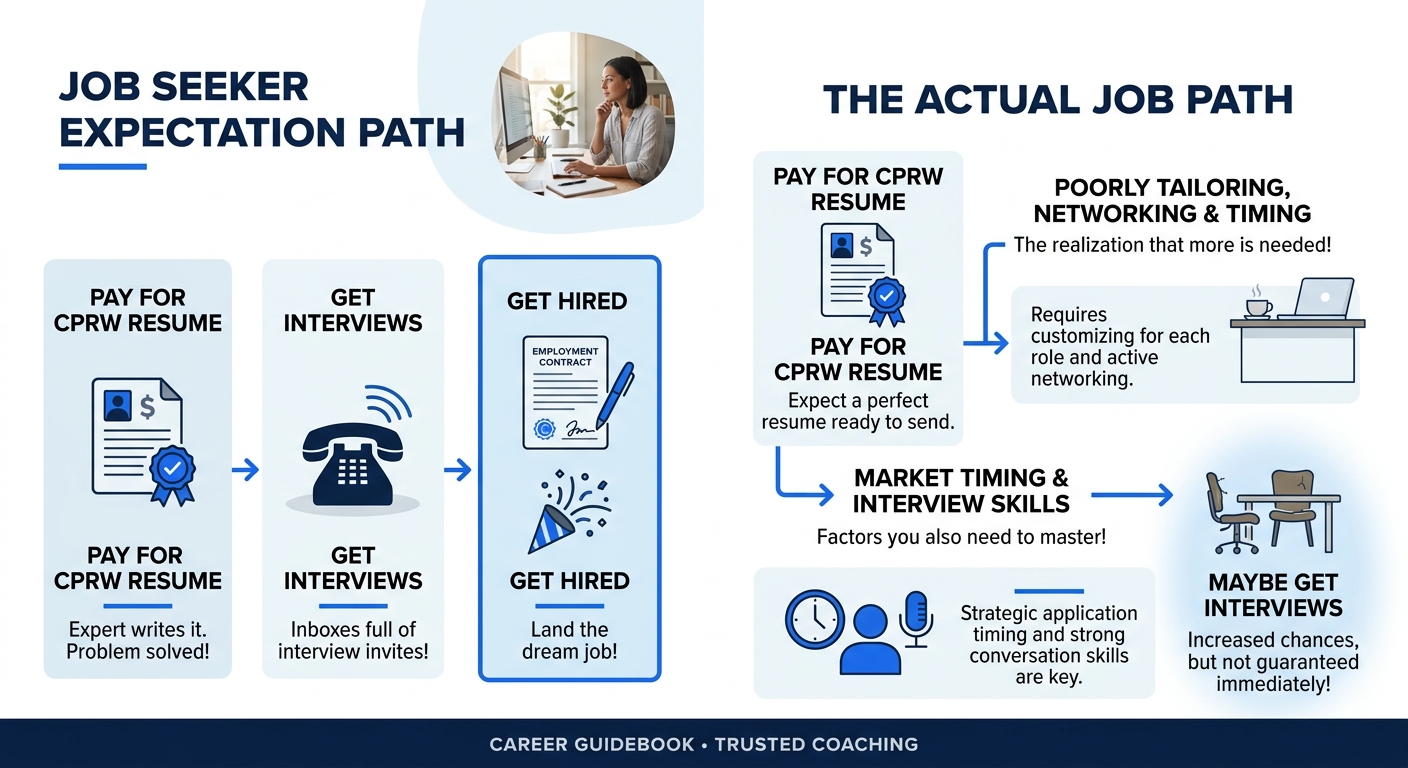
If you’re weighing whether to hire a CPRW-credentialed writer, the credential tells you the writer passed a skills test administered by the leading industry body. It tells you they understand formatting standards, ATS requirements, and accomplishment framing. It doesn’t tell you your phone will ring. The writers who are honest about this distinction tend to be the ones worth hiring, and the ones who understand how algorithmic screening adds another layer of complexity beyond what the exam covers are the ones keeping up with how hiring actually works right now.
The gap between certification and conversion isn’t a scandal. It’s a structural mismatch between what a professional credential can reasonably measure and what a desperate job seeker needs it to mean. Closing that gap requires the industry to get more honest about delivery models, the job seeker to take ownership of tailoring and networking after the résumé is delivered, and both parties to stop pretending a single polished document is the whole answer to a problem that has always been bigger than one page.