
 4.9
4.9 4.5
4.5Continuous learning entries strengthen a resume when they appear in the right section for your career stage and connect directly to a target role’s requirements. Place them in the wrong zone, and they signal padding or desperation to hiring managers who’ve screened thousands of applications.
TL;DR: Run every learning entry through a Relevance-Recency-Evidence test before adding it to your resume. Professionals should place education below experience, students should lead with it, and everyone should avoid dumping unfinished courses into their professional summary. Three to five high-quality entries outperform fifteen completion badges every time.
The Placement Rule Every Career Stage Gets Wrong
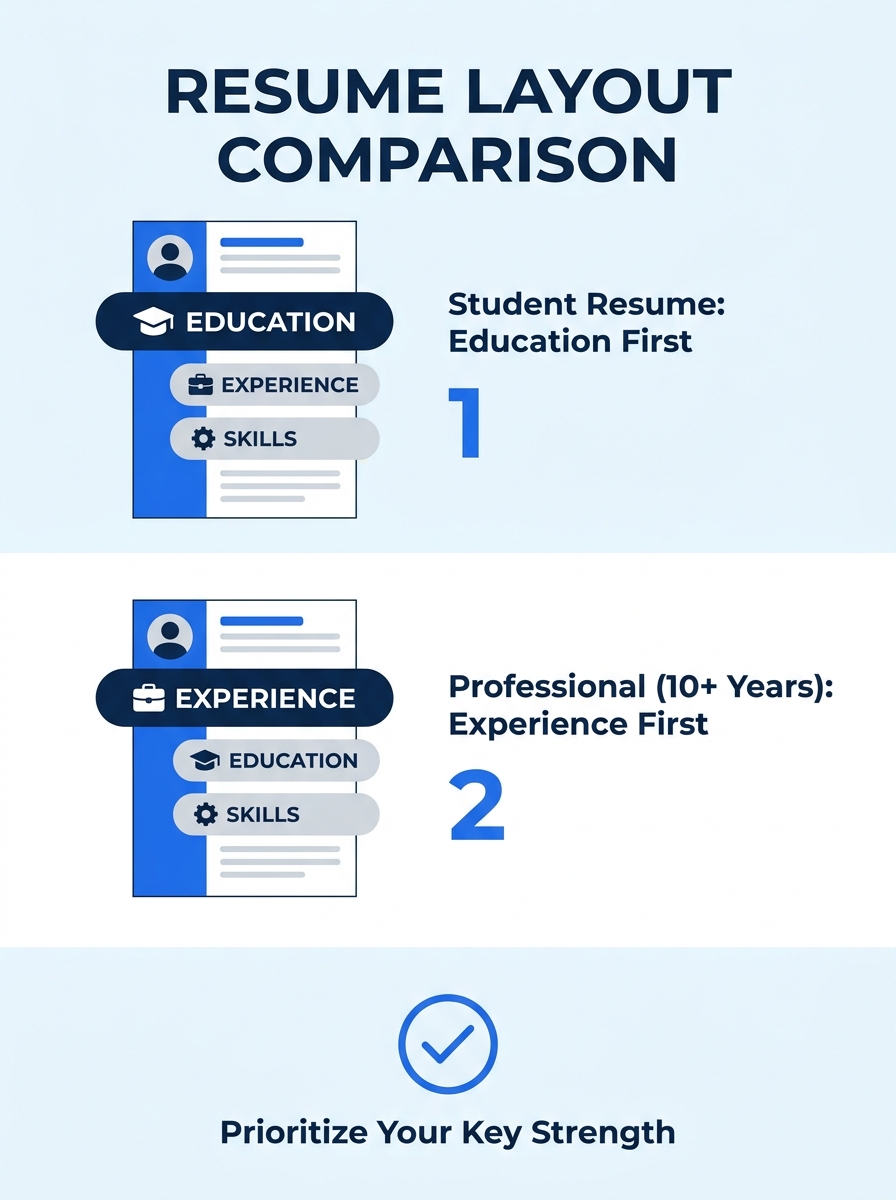
The Enhancv career team puts it plainly: place education strategically — top for students, below experience for professionals. That single guideline governs almost every continuous learning resume placement decision, and ignoring it is the most common mistake we see in resume reviews.
For someone with 8+ years of experience, a Google Data Analytics Certificate listed above their work history competes with their actual professional track record for the hiring manager’s attention. For a recent graduate pivoting into UX design, that same certificate near the top of the resume provides essential credibility that work experience can’t yet deliver.
The confusion happens when mid-career professionals treat their resume like a LinkedIn profile, where “always be learning” is rewarded socially. Resumes operate under different rules. Every line item competes for 6 seconds of scanning time, and an entry that doesn’t clearly serve the target role dilutes the ones that do. If your summary and your bullets already tell a story that doesn’t match your learning entries, you’re dealing with the kind of internal contradiction that tanks interview callbacks.
The Skills Audit Framework That Prevents Bad Placements
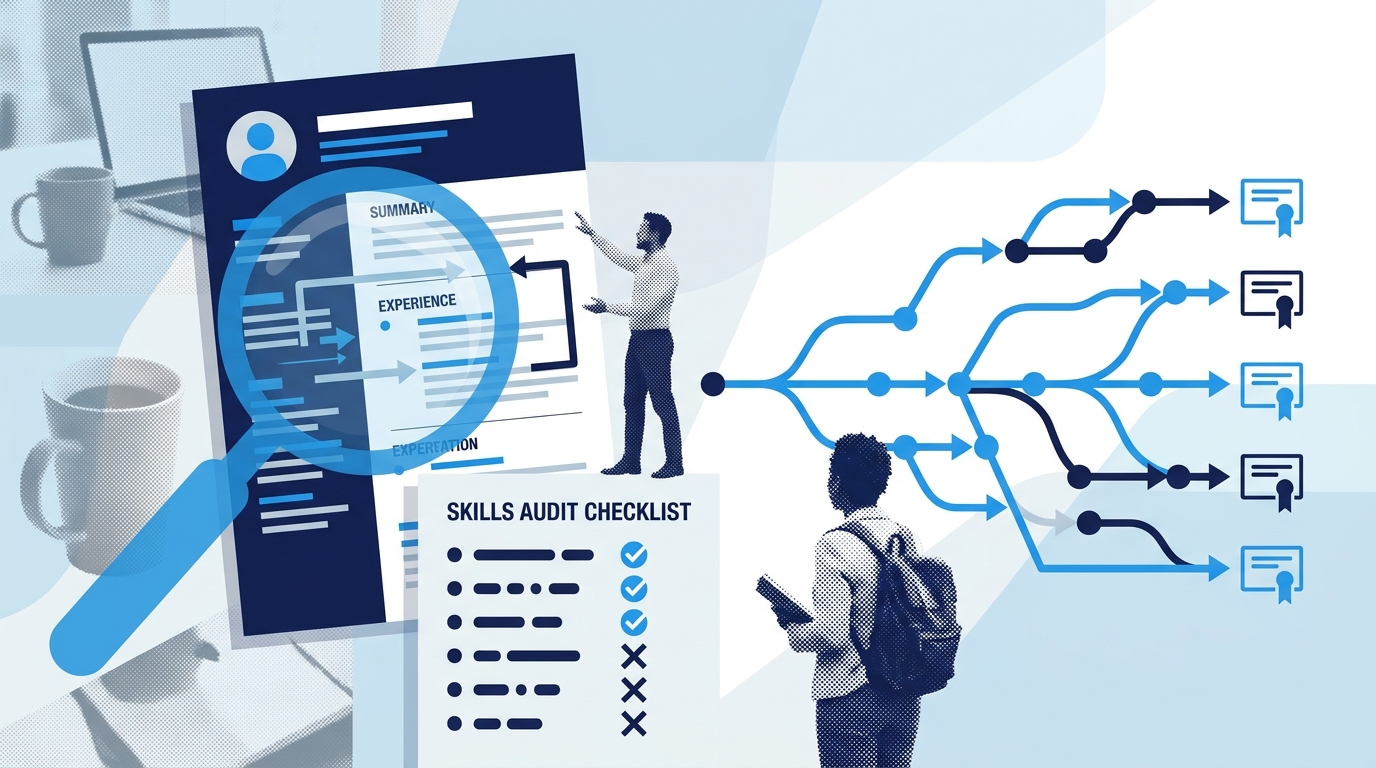
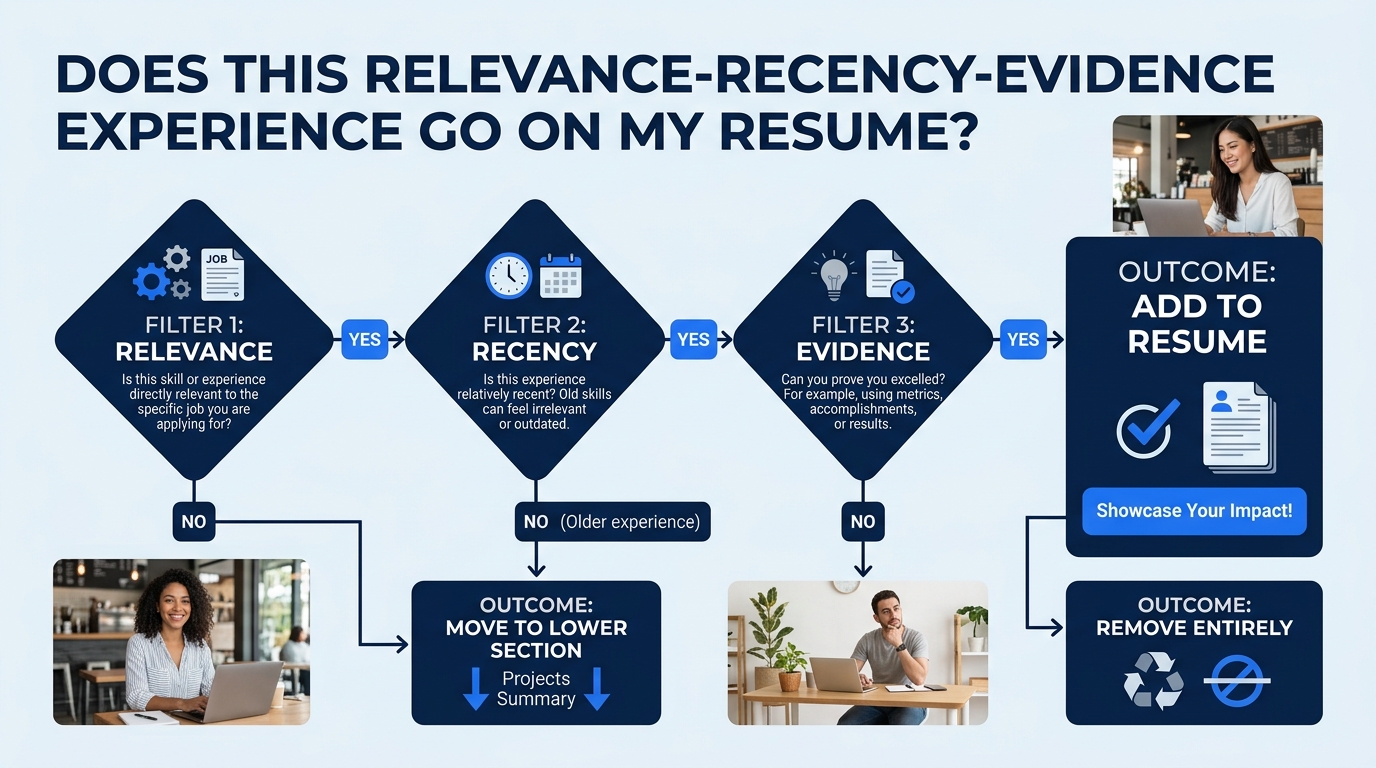
A career skills audit is a structured self-assessment that maps what you can actually do against what the job market currently values, according to career strategist Katharine Gallagher’s 60-minute checklist. Before you add any learning entry to your resume, run it through three filters. I call this the Relevance-Recency-Evidence test:
1. Relevance. Does the certificate, course, or workshop directly map to a skill listed in your target job description? Pull up 3-5 job postings you’d actually apply to. If your newly completed Python bootcamp doesn’t appear in any of them, it doesn’t belong on this version of your resume. Different target roles get different resume versions, and your learning entries should shift accordingly.
2. Recency. Was the learning completed within the last 18 months? Industry-specific certifications like AWS, PMP, and CPA have longer shelf lives, but a 2019 Coursera course on “Digital Marketing Fundamentals” reads as filler in 2026. Hiring managers know which certifications carry expiration dates, and they mentally apply that logic even to credentials that don’t technically expire.
3. Evidence. Can you point to a measurable outcome that resulted from this learning? LinkedIn’s talent acquisition guidance recommends that candidates emphasize quantifiable achievements that show how continuous learning contributed to success, using the STAR technique (Situation, Task, Action, Results). A Salesforce certification is good. A Salesforce certification plus “Rebuilt lead scoring model using Salesforce Einstein, increasing qualified pipeline by 34%” is the entry that actually moves your resume forward.
If a learning entry fails any of these 3 filters, it either needs to be moved to a lower-priority section, reworked with supporting evidence, or removed entirely.
The Four Zones Where Continuous Learning Works
ResumeSpice’s career strategists identify four resume zones where professional development entries belong: your summary, skills section, experience descriptions, and a dedicated professional development area. But each zone serves a different purpose, and stuffing the same entry into all four makes you look like you’re compensating for a thin work history.
Professional Summary
Use this zone only for learning that directly defines your professional identity. “PMP-certified project manager with 12 years in manufacturing operations” works because the certification is load-bearing. “Completed 6 Udemy courses in 2025” does not work because it describes activity, not identity. Reserve this space for 1 or 2 credentials maximum, and only the ones that a hiring manager would expect to see attached to your title.
Skills Section
List certified technical skills with their proficiency level here. The balance between confidence and authenticity matters because ATS systems parse this section heavily for keyword matches, and hiring managers use it to calibrate interview expectations. Claiming “Advanced” proficiency in a tool you completed a 4-hour course on will surface during the interview, and the trust damage lasts longer than the awkward silence.
Experience Bullets
This is the highest-impact zone for continuous learning resume placement. Instead of a standalone line item saying “Completed AWS Solutions Architect certification,” weave it into an accomplishment: “Redesigned cloud infrastructure after earning AWS Solutions Architect certification, reducing monthly hosting costs by $12,000.” The learning becomes evidence of impact, not a decoration hanging off the side of your work history.
Dedicated Professional Development Section
Reserve this for learning that doesn’t fit cleanly into experience bullets but still passes all 3 filters of the Relevance-Recency-Evidence test. Workshops, conferences, bootcamps, and ongoing certifications live here. Keep it to 3-5 entries maximum. More than that signals certificate collecting rather than skill building.
The learning becomes evidence of impact, not a decoration hanging off the side of your work history.
Three Placements That Actively Damage Professional Development Credibility
Knowing where continuous learning works is half the audit. The other half is recognizing the placements that make hiring managers skeptical.
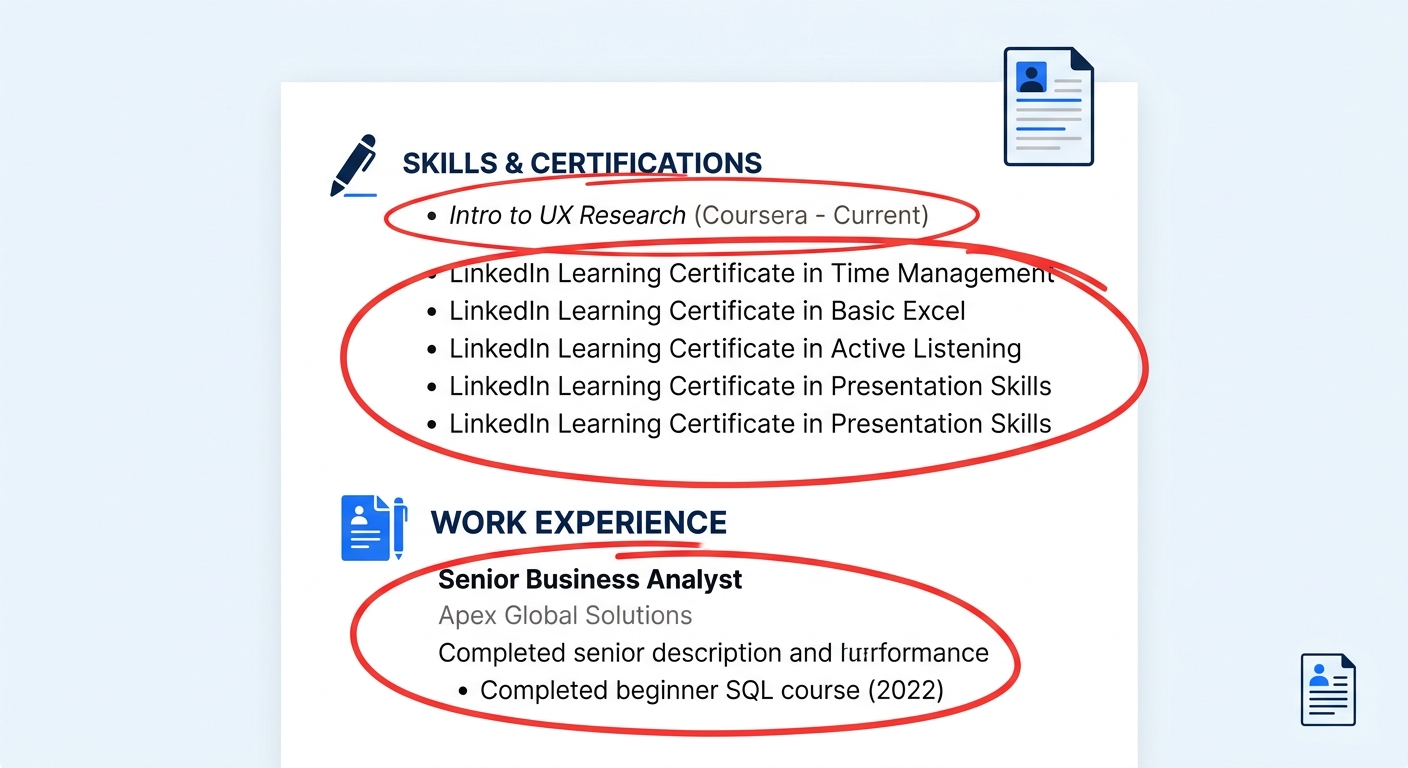
Unfinished courses listed as completed. Writing “Google UX Design Certificate” when you’ve finished 3 of 7 modules is misrepresentation. Some candidates add “(In Progress)” and think that fixes it, but an in-progress entry in your skills or summary section still implies competence you haven’t demonstrated. If you must list in-progress learning, confine it to the professional development section with an expected completion date and nowhere else.
Stacking low-effort certificates to fill space. Twelve LinkedIn Learning completions listed consecutively tell a story you don’t want told. The hiring manager’s internal monologue becomes: “This person spent a weekend clicking through videos and is presenting it as professional growth.” We’ve explored this same credibility dynamic in our guide to building resume impact without overstating your experience, and the principle holds here too. Two rigorous, industry-recognized certifications outweigh 15 video-course completion badges on every hiring manager’s mental scorecard.
Listing learning that contradicts your claimed experience level. If your resume positions you as a senior data analyst with 10 years of experience, an “Introduction to SQL” course completion undermines that positioning. A hiring manager will question whether you actually have the depth your experience section claims. Your learning entries should show growth at your current level, not remediation of basics you should already command. Walking this line between honesty and strategic positioning is the core challenge of maintaining resume authenticity balance.
Running Your Own 60-Minute Audit
The FutureLearn career development program defines a skills audit as a process for considering and recording the skills you’ve picked up and developed in your career so far. Here’s how to turn that into a practical resume review you can complete in a single sitting:
| Audit Step | Time | What You Produce |
|---|---|---|
| Inventory all learning entries | 15 min | Complete list in a separate doc |
| Filter through Relevance-Recency-Evidence | 15 min | Green / yellow / red ratings |
| Place green entries in the correct zone | 15 min | Updated resume draft |
| Stress-test the whole resume as a hiring manager | 15 min | Final version ready for applications |
Minutes 1-15: Inventory. Pull every learning entry currently on your resume into a separate document. Include certifications, courses, workshops, conferences, and any self-directed learning you’ve listed. Don’t edit yet. Collect everything in one place so you can see the full picture.
Minutes 16-30: Filter. Run each entry through the Relevance-Recency-Evidence test. Mark entries green (passes all 3 filters), yellow (passes 2 of 3), or red (fails 2 or more). Red entries come off the resume immediately. Yellow entries need reworking before they earn their place back.
Minutes 31-45: Place. For every green entry, decide which of the 4 zones it belongs in using the guidelines above. If an entry fits naturally into an experience bullet, put it there instead of the professional development section. Experience-integrated learning always carries more weight than a standalone line item because it demonstrates applied knowledge rather than theoretical exposure.
Minutes 46-60: Stress-test. Read your resume as if you’re the hiring manager filling this specific role. Does every learning entry reinforce the professional narrative, or does anything feel like padding? If you’ve already been auditing where your upskilling appears across sections, cross-reference those results to make sure nothing contradictory slipped through.
Tip: Set a calendar reminder to repeat this audit every 90 days. Your target roles shift, new certifications become industry standard, and older learning entries lose relevance faster than you’d expect.
What Hasn’t Been Settled
The relationship between continuous learning and resume credibility still has genuine unresolved tensions. ATS systems are getting better at parsing professional development sections, but there’s no industry-wide standard for how they weight a Coursera certificate versus a university-issued credential versus a vendor certification like AWS or Cisco. Hiring managers at different companies value these entries on entirely different scales, and the gap between what ATS screens rank highly and what a human interviewer cares about remains wide.
There’s also an open question about AI-verified skill badges. As more platforms offer automated competency scores and proctored assessments, resumes may shift toward including these machine-validated credentials alongside traditional certificates. Whether hiring managers will trust those signals is genuinely unclear, and early adoption carries both opportunity and risk.
The professionals who audit their resumes on a regular cycle, filter ruthlessly through the Relevance-Recency-Evidence framework, and place learning entries where they carry demonstrable weight will be well positioned regardless of how these tools evolve. The ones who keep adding every completion badge to a growing list at the bottom of page two will keep wondering why their applications disappear into the void.