


 4.9
4.9 4.5
4.5Hiring managers spend an average of 7.4 seconds scanning a resume, and eye-tracking research shows the first word of each bullet point receives the heaviest attention. That first word is almost always a verb. Which means every verb on your resume is functioning as a tiny audition: it either earns the recruiter’s next two seconds of reading, or it doesn’t. The University of Colorado Boulder’s career services team puts the stakes plainly: recruiters see “led,” “responsible for,” and “managed” so often that these words have essentially stopped communicating anything.
The six rules below form a line-by-line audit framework for your resume. Each targets a specific pattern that weakens your bullets, and each has a concrete fix. If you apply all six and your callback rate doesn’t change, the problem lives somewhere else on the page. But for most people, the verbs are where the damage hides.
Kill every “responsible for” on sight
“Responsible for” is the most common filler phrase on resumes, and it communicates exactly one thing: someone assigned you a task. It says nothing about whether you did it well, what changed because of your work, or what skills you brought. MIT’s career advising office recommends starting every bullet with an action verb that paints a picture for the reviewer and affirms your skills. “Responsible for” paints no picture at all.
Here’s how this plays out in practice:
Before: “Responsible for managing client accounts and ensuring satisfaction.” After: “Managed 14 client accounts with a 96% retention rate over two years.”
Before: “Responsible for training new team members.” After: “Trained 8 new hires, reducing average onboarding time from 6 weeks to 4.”
The phrase “responsible for” should appear zero times on your finished resume. Same goes for “duties included,” “was in charge of,” and “tasked with.” These are all passive scaffolding, the linguistic equivalent of leaving construction tape on a finished building. Strip them out, and the actual accomplishment underneath becomes visible.
If you’ve already worked through replacing weak resume language with action-driven results, this step will feel familiar. The difference here is scope. Don’t stop at the obvious offenders. Search for every instance where a bullet describes what your role was rather than what you did in it.
Match your verbs to the job posting’s exact language
This is where resume power words intersect with ATS strategy. Applicant tracking systems don’t score your resume based on how impressive your vocabulary is. They check whether your document contains the specific terms the employer flagged as important. If a job posting says “coordinate cross-functional teams” and your resume says “oversaw interdepartmental collaboration,” an ATS might not register the match at all.
The fix is straightforward: read the job posting before you submit, and mirror its verb choices where they honestly describe your experience. If the posting says “analyze,” use “analyzed.” If it says “develop,” use “developed.” This is about speaking the same professional language as the people who wrote the job description, not about copying their words wholesale.
A Reddit thread in r/QualityAssurance captured the reality well: ATS isn’t counting how many times you said “quality assurance.” It’s checking if you have the terms they’re searching for at all. The problem most applicants have is they describe their work in generic language when the job posting uses specific terms.
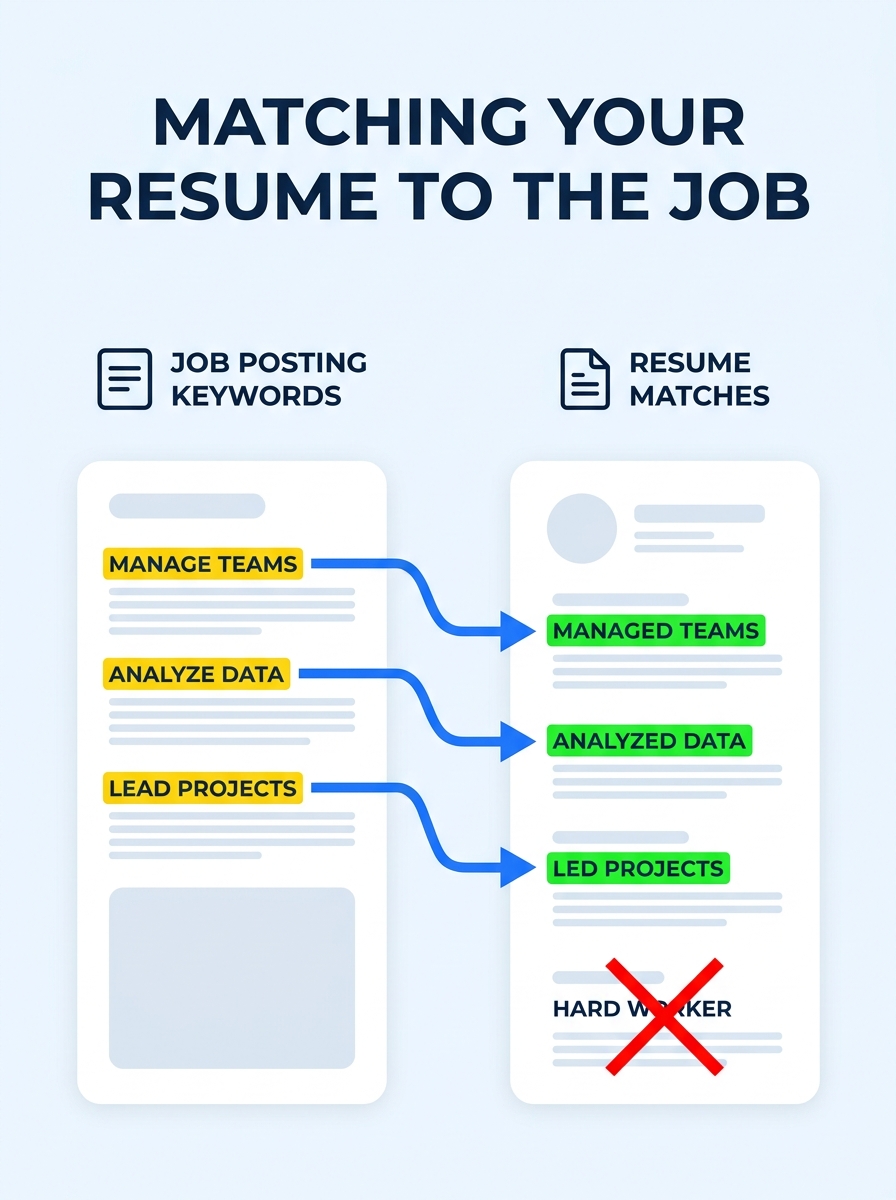
One practical pattern: before each application, highlight every verb and key phrase in the job posting. Then check your resume against that list. You don’t need to match every single one, but if you’re hitting fewer than half, your resume is speaking a different language than the one the employer is listening for.
Never repeat the same action verb twice on one page
Part of the recruiter fatigue problem is frequency across candidates, but a surprising amount of it comes from frequency within a single resume. If “managed” appears at the start of four different bullets, the reader starts to wonder whether you did anything besides manage things.
Variety signals range. A marketing professional who “designed campaigns,” “negotiated vendor contracts,” “analyzed conversion data,” and “presented quarterly results to the C-suite” sounds like someone with four distinct capabilities. The same person who “managed campaigns,” “managed vendor relationships,” “managed analytics,” and “managed quarterly presentations” sounds like someone reaching for the same word four times because nothing more specific came to mind.
Here’s a practical trick: after finishing a draft, use Ctrl+F to search each of your opening verbs. If any verb appears more than once in the first-word position of a bullet, replace one instance with a more precise alternative. “Managed a budget” becomes “Allocated a $2.4M annual budget.” “Managed a team” becomes “Directed a team of 9 engineers.” The replacement verb carries more information per syllable, which is the entire point of choosing action verbs for resumes carefully.
Pair every power verb with a measurable outcome
A strong verb without a result is a promise without evidence. “Optimized the sales pipeline” tells a recruiter you did something to the pipeline, but it doesn’t tell them whether it worked. “Optimized the sales pipeline, increasing qualified leads by 34% in Q3” tells them exactly how well and gives them a concrete reason to keep reading.
A strong verb without a result is a promise without evidence. “Optimized” means nothing until you say what changed.
Research confirms that action verbs perform best when paired with numbers. Words like “accelerated,” “reduced,” and “improved” carry weight because they imply a before-and-after comparison, and a number completes that comparison in the recruiter’s mind.
If your role didn’t produce easily quantifiable results, you still have options. You can reference scale (“Trained 40+ employees across 3 departments”), frequency (“Conducted weekly audits of 200+ inventory SKUs”), or scope (“Redesigned the onboarding process for all North American offices”). We wrote a full guide on writing resume bullets when you don’t have hard metrics that walks through this in detail. The key is that every bullet has three components: what you did (verb), what it involved (context), and what happened because of it (result).
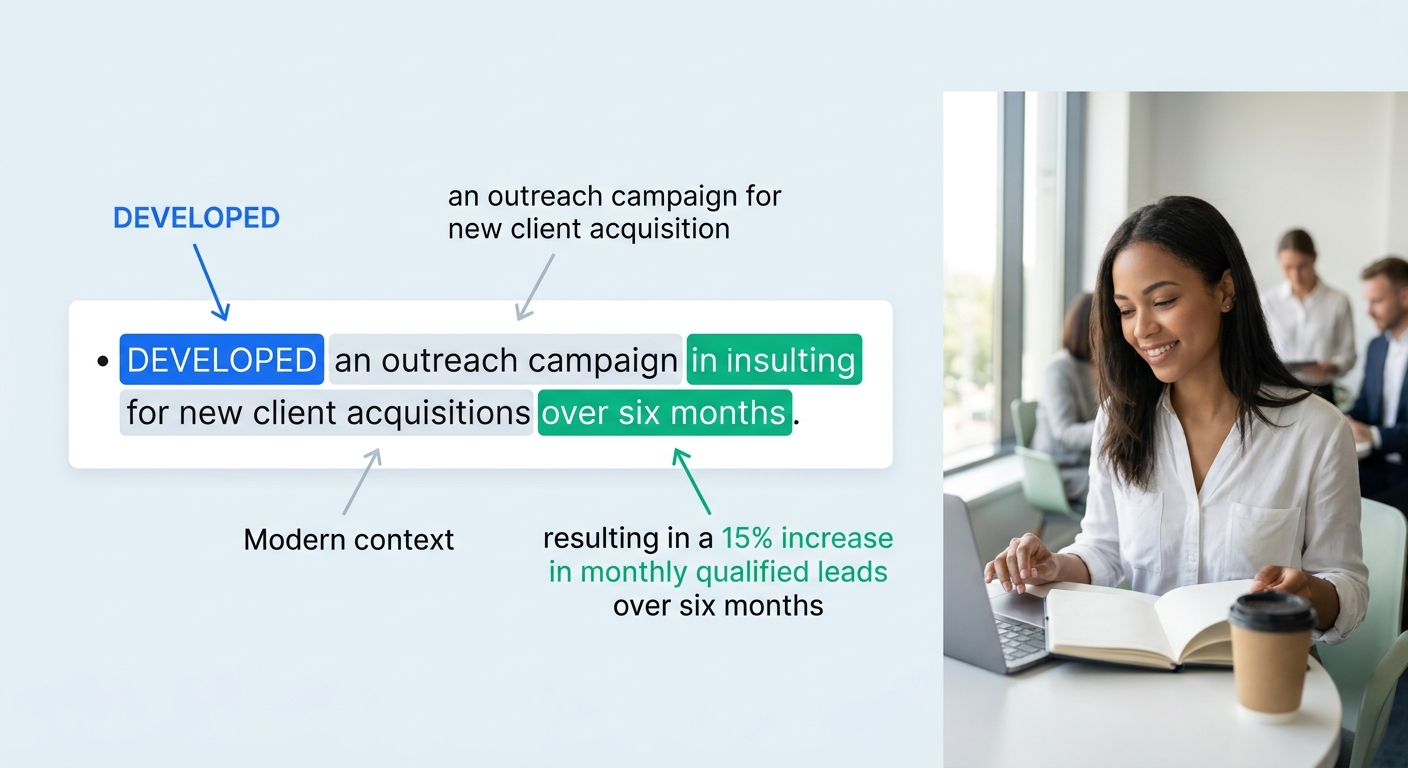
Missing any of those three parts weakens the bullet significantly. Two out of three is passable. All three together is what makes a recruiter slow down and actually read.
Read each bullet backward to catch hidden passive voice
Passive voice on a resume is sneaky. Sometimes it’s obvious (“was responsible for,” “was tasked with”), but sometimes it hides inside otherwise decent-sounding bullets. “New software was implemented to reduce processing time” sounds professional enough, yet it buries the most important information: you’re the one who implemented it.
MIT’s career advising team dedicates an entire resource to this topic and offers a memorable test: if you can add “by zombies” after the verb and the sentence still makes grammatical sense, it’s passive. “New software was implemented [by zombies] to reduce processing time.” Grammatically perfect, which means the sentence is passive and needs rewriting.
The backward-reading technique works because of how your brain processes familiar text. When you read forward, you auto-correct weak phrasing because you already know what you meant. Reading backward forces you to evaluate each phrase in isolation. You’ll catch “was developed,” “were coordinated,” and “had been established” much faster when they appear out of context.
Once you spot passive constructions, passive resume language fixes are usually simple mechanical swaps. Put yourself back into the subject position:
Before: “A new reporting system was developed that saved 10 hours per week.” After: “Developed a reporting system that saved 10 hours per week.”
Before: “Customer complaints were reduced by 25% through process improvements.” After: “Reduced customer complaints by 25% by redesigning the intake workflow.”
And if you’re concerned about how your overall resume communicates your story after all this editing, it’s worth checking whether an AI-polished draft might be smoothing out your personality in the process. Precision matters, but so does sounding like a human being.
Swap generic verbs for category-specific ones
“Helped,” “worked on,” “assisted with,” and “supported” are among the vaguest verbs in English. They describe participation without describing contribution. Every study of recruiter language patterns reaches the same conclusion: generic verbs get skipped because they create no mental image.
The fix is to categorize your experience and choose verbs native to that category:
- Leadership: directed, orchestrated, mentored, mobilized, championed
- Achievement: exceeded, delivered, surpassed, earned, captured
- Improvement: optimized, redesigned, overhauled, refined, modernized
- Analysis: evaluated, forecasted, benchmarked, audited, diagnosed
- Creation: built, authored, engineered, launched, prototyped
Each verb in those lists carries distinct connotations. “Orchestrated” implies coordination of many moving parts. “Diagnosed” implies investigative skill. “Prototyped” implies building something from scratch under uncertainty. These aren’t fancy synonyms from a thesaurus. They’re precision tools that tell a recruiter different things about what you actually contributed.
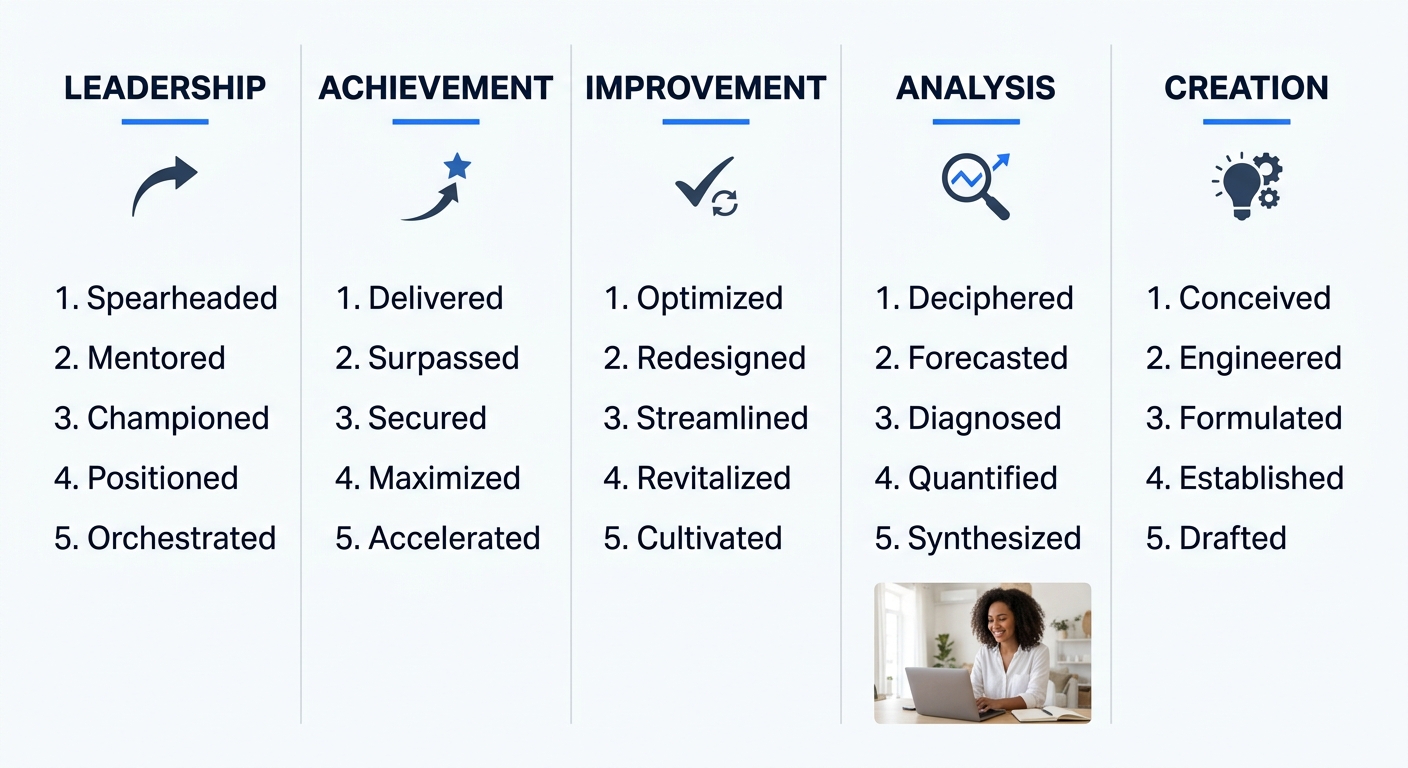
When running a full audit, tag each bullet by category. If most of your bullets fall under “Analysis” but you’re applying for a leadership position, you know exactly which verbs need to shift. The developer resume specificity formula covers a version of this principle for technical roles, but the category-matching logic applies to every industry.
Tip: Keep a personal verb bank organized by these five categories. When you sit down to tailor a resume for a new application, you’ll spend five minutes picking the right verbs instead of thirty minutes staring at a blank screen.
When these rules collide
Sometimes rule two (match the job posting) and rule three (don’t repeat verbs) will fight each other. If the posting uses “managed” three times, mirroring that verb in three bullets creates the exact repetition you’re trying to avoid. In that case, use the posting’s verb once in the bullet where it matters most, then find close synonyms an ATS would still recognize: “directed,” “oversaw,” “coordinated.”
Sometimes rule four (measurable outcomes) will conflict with honesty. If you genuinely can’t quantify a result, don’t invent a percentage. A specific-but-unquantified bullet like “Redesigned the employee onboarding workflow for all U.S. offices” beats a vaguely quantified “Improved processes by 20%” when that 20% is a guess. Recruiters can smell fabricated metrics, and the trust cost isn’t worth the precision theater.
And sometimes a bullet will resist all of these rules at once. The experience was collaborative, the outcome wasn’t measurable, the job posting doesn’t give you useful language cues, and every strong verb feels like overselling what happened. When that’s the situation, ask yourself a different question: does this bullet need to exist on your resume at all? A resume with 12 strong, well-crafted bullets beats one with 18 where six are filler. Cutting a weak line is itself a form of editing, and frequently the most effective one.
The common thread across all six rules is specificity. Vague verbs produce vague impressions. Specific verbs create concrete mental images in a recruiter’s mind, and those images are what get your resume moved from the “maybe” pile to the “call this person” pile. The full audit takes roughly an hour for a two-page resume. Given what the research on action-verb-driven resumes consistently shows about callback rates, that hour may be the highest-return investment in your entire job search.