


 4.9
4.9 4.5
4.5The American Institute of Architects put it plainly in published hiring advice from firm managers: hiring managers in design prioritize the portfolio. Not your GPA, not the name of your graduate program, not your list of software proficiencies. The portfolio. That guidance has only become more relevant as firms adopt portfolio-first hiring workflows and as ATS filters grow more aggressive at discarding vague bullets. Yet the majority of architect resumes still read like credential inventories: “Proficient in Revit. Experienced in sustainable design. Strong communicator.” These phrases tell a hiring manager almost nothing about your actual design thinking, your project problem-solving, or whether you’d be the right person for a specific seat in their studio. The following six rules will help you fix that mismatch between what you’re submitting and what firms are actually evaluating.
Always link the portfolio above the fold
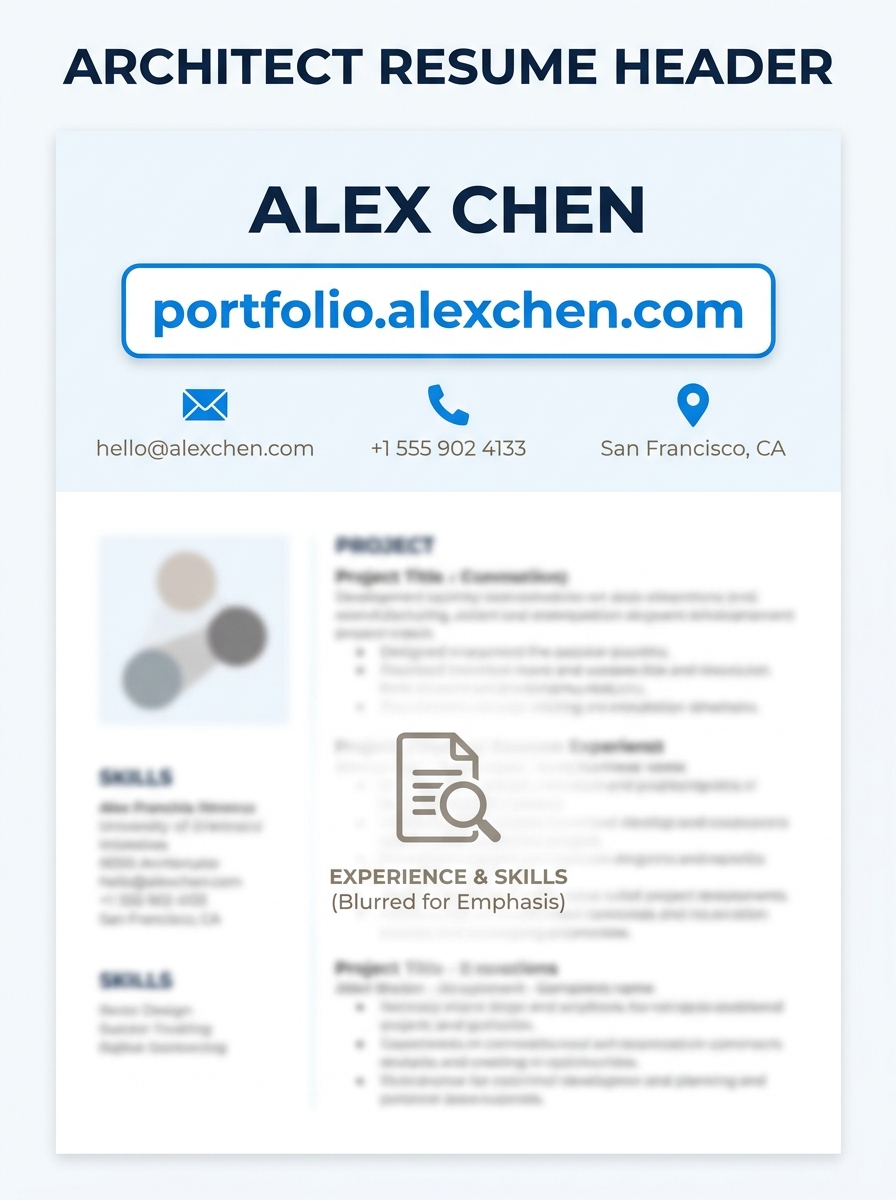
Your resume’s top third is the only part a hiring manager reliably reads during an initial scan. If a portfolio URL doesn’t appear in that zone, assume it won’t be found. Place it directly beneath your name and contact information, formatted as a clean hyperlink (not a shortened URL or QR code alone, since many first-pass reviews happen on screens, not paper). If you’re submitting through an ATS, paste the full URL so the system doesn’t strip the link.
This matters because the five-second decision isn’t really about the resume at all. It’s a triage check: does this person have a portfolio I can open, and does the resume give me enough context to know whether it’s worth opening? If the answer to the first question is no, the second question never gets asked. We’ve covered this screening behavior in detail in our breakdown of what hiring managers actually see first on architect resumes.
The exception: if you’re applying to a large corporate firm through a rigid ATS that strips links, include the portfolio URL in your cover letter’s opening paragraph as well. Belt and suspenders.
Quantify the project, not the software
“Proficient in Revit” is the architect equivalent of a developer writing “Knows JavaScript.” It communicates nothing about what you’ve done with the tool or how well. A strong BIM tools resume entry looks like this: “Built a Revit model from scratch for a £5M hospital project with a compressed timeline, reducing design errors by 25% and saving £100,000 in rework costs.” That example comes directly from Architecture Social’s BIM portfolio guide, and it works because every detail is tied to a real outcome.
The pattern is: tool + project scale + constraint + measurable result. “Used SketchUp for residential projects” becomes “Used SketchUp to develop massing studies for a 12-unit affordable housing project, iterating through six design options in two weeks to meet the client’s density requirements.” The software is still there, but now it’s doing something.
If you’re struggling to attach numbers to design work, our guide on writing resume bullets when you don’t have obvious metrics walks through several architect-specific approaches, including square footage delivered, project budget managed, and review cycles reduced.
Tip: When listing BIM tools, pick the three to four most relevant to the specific job posting and describe each in the context of a project outcome. A sprawling list of twelve software names tells the hiring manager you padded the list, not that you’re versatile.
Make your AIA licensure visible in the first three lines
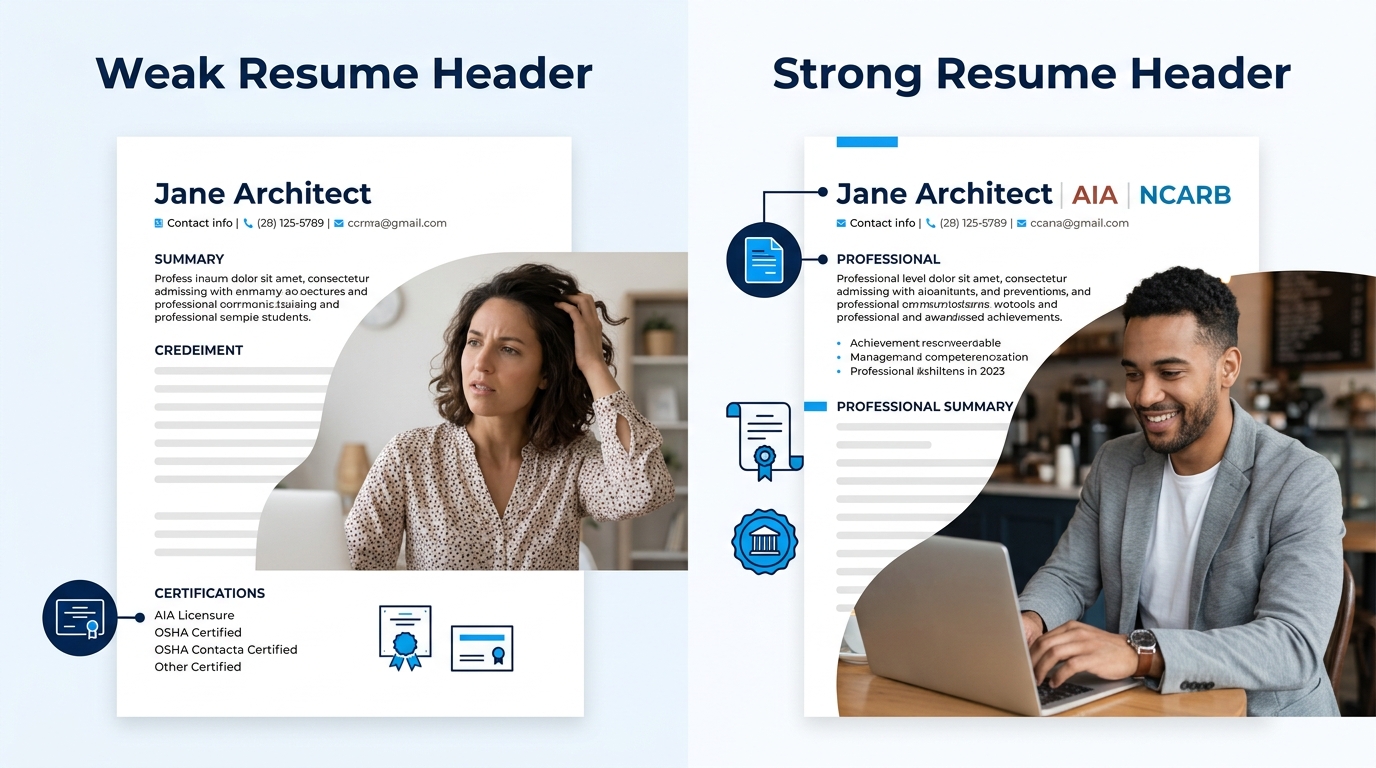
AIA licensure visibility sounds like a formatting detail, but it functions as a trust signal that changes how the rest of your resume gets read. Firm principals scanning a stack of thirty applicants will often sort first by licensure status, because it determines what projects you can legally stamp. If you’re a licensed architect or an AIA member, that information should appear in your header block alongside your name, not buried in a “Certifications” section on page two. Format it the way the profession expects: “Jane Chen, AIA, LEED AP” right at the top.
If you’re not yet licensed, don’t hide that fact. State where you are in the ARE process: “NCARB candidate, 4 of 6 divisions passed.” Honesty about licensure progress reads as ambition. Silence about it reads as avoidance.
This rule breaks when you’re applying outside traditional practice, for roles in real estate development, construction management, or tech companies building spatial computing tools. In those contexts, AIA credentials still matter but shouldn’t dominate the header at the expense of skills the hiring manager actually needs to see.
Show the design problem before you show the design solution
The difference between a portfolio that lands interviews and one that gets a polite rejection often comes down to narrative structure. Too many architect portfolios present finished renders and plans without ever explaining the constraints that shaped them. Hiring managers at firms with serious design culture want to see how you think, not just what you produced. According to Archipro’s guide on evaluating architectural portfolios, evaluators look for different strengths depending on the role: foundational skills and potential in junior candidates, demonstrated judgment and leadership in senior ones.
For your design portfolio credentials to carry weight, each project entry should open with the problem: a difficult site, a contradictory brief, a tight budget, a zoning conflict, or an environmental challenge. Then show how your design responded to that problem. This before-and-after framing gives the hiring manager a mental model of how you’d perform on their projects, which is exactly the information they need to make the call.
A portfolio that shows only finished renders is like a resume that lists only job titles. The interesting part is what happened in between.
On the resume itself, mirror this structure in your bullet points. “Led schematic design for a 40,000 SF mixed-use development on a constrained urban infill site, resolving a 15-foot grade change while maintaining ADA compliance” tells a story in one sentence. “Led schematic design for a mixed-use development” does not.
Treat your resume as the portfolio’s table of contents
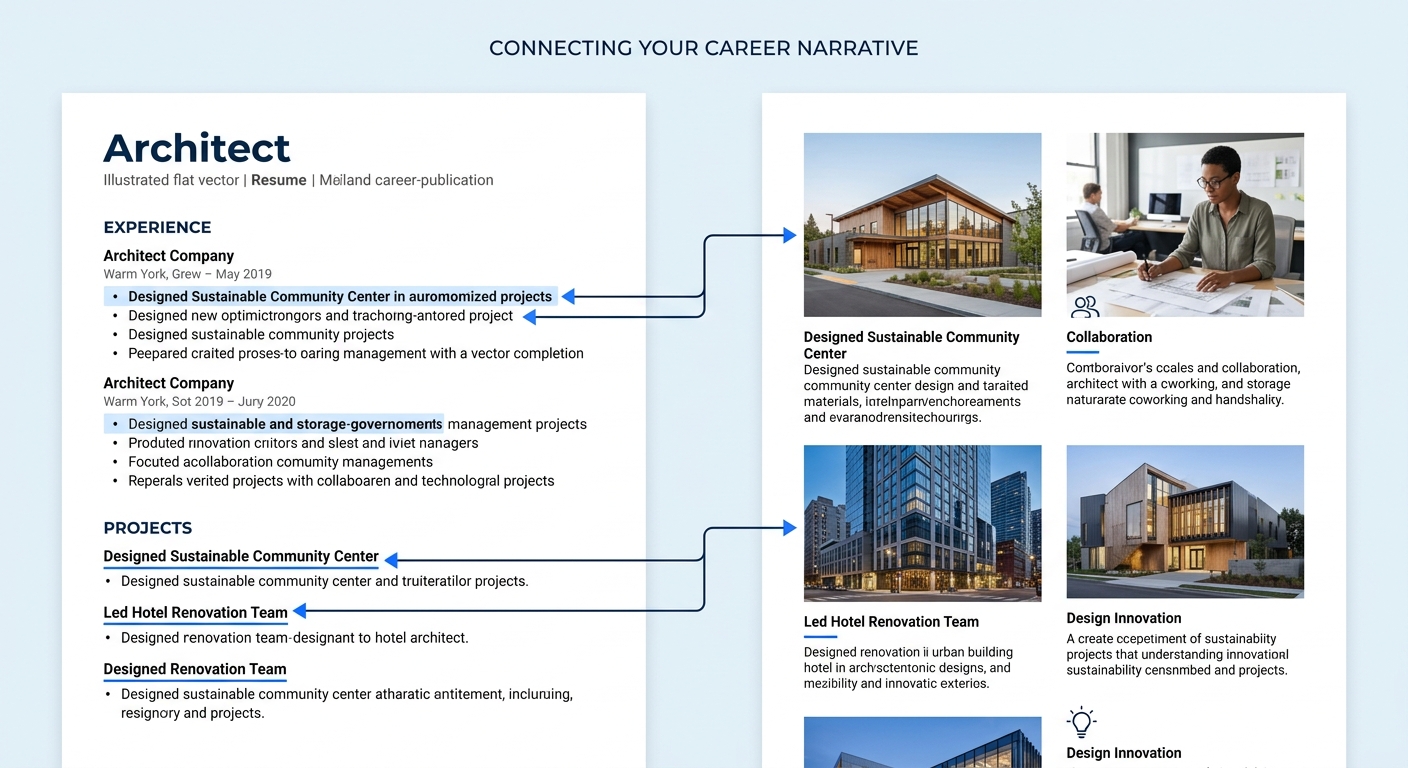
Your architect resume strategy should treat the one-page document as an index that makes the hiring manager want to open your portfolio, not as a standalone artifact that tries to prove your worth through text alone. Every bullet point on the resume should correspond to something visible in the portfolio. If you mention a healthcare project, the portfolio should contain that healthcare project. If you mention parametric facade design, the portfolio should show it.
This alignment sounds obvious, but it fails constantly. Architects update their resumes for a new application, add a bullet about a recent project, and forget to add that project to the portfolio. Or they curate the portfolio around their favorite work but write resume bullets about whatever the job posting mentions. The hiring manager opens the portfolio expecting to see evidence of what the resume claimed, finds something unrelated, and moves on.
The practical move: build your portfolio first, then write the resume to match it. This reversal of the typical workflow is at the heart of why architects lose interviews by hiding their best work. Many architects treat the portfolio as supplementary. The firms that matter treat it as primary.
The approach we described for converting vague developer accomplishments into specific outcomes applies directly to architects. Swap “increased page load speed by 40%” for “reduced construction document revision cycles from four rounds to two by implementing a clash detection workflow in Navisworks.” The formula is the same. The specificity is what sells.
Update the portfolio even when you’re not looking for a job
Reddit’s architecture community has discussed this point extensively, and the consensus among practicing architects is clear: updating your portfolio is a career maintenance habit, not a job-search task. One architect described it as a therapeutic exercise in self-reflection that forces you to think critically about where your career has been and where it’s going. Another pointed out that when two candidates are otherwise equal, the one with the current, thoughtfully organized portfolio wins every time.
The practical argument is straightforward. When you update the portfolio while projects are fresh, you still have access to the files, the high-resolution renders, the process diagrams, and the institutional knowledge about what made the project challenging. Wait two years and half of that material lives on a former employer’s server you can no longer access. The professional argument runs deeper: architects who regularly curate their work develop a sharper sense of their own design identity, which makes them more compelling in interviews and more intentional about the projects they pursue.
Set a calendar reminder. Every quarter, add any completed project work, update project descriptions with final outcomes (occupancy dates, awards, published coverage), and remove anything that no longer represents your current skill level. Your future self, scrambling to apply for a dream position at a firm that just posted an opening, will be grateful.
When These Rules Collide
No framework survives every situation intact. If you’re a recent graduate with two studio projects and an internship, you can’t index a ten-page portfolio to a densely-packed resume because you don’t have enough material for either. In that case, lean hard into the design-problem-first rule and let the portfolio carry 90% of the weight. Your resume will be thin, and that’s fine. Hiring managers evaluating junior candidates know what a junior resume looks like. They’re looking for potential and foundational skill, not a long project history.
If you’re applying to a firm that explicitly asks for a resume and no portfolio (some corporate architecture and engineering firms do this), the rules about quantification and specificity become even more critical. Without a portfolio to back up your claims, every bullet has to do double duty: it needs to convey both the outcome and enough sensory detail about the work that the reader can picture it.
And if you’re mid-career and pivoting from one specialization to another, the portfolio alignment rule will feel impossible to follow because your best work is in a sector you’re trying to leave. In that situation, lead with transferable design thinking. Show how the constraints you solved in healthcare translate to the constraints the new firm faces in hospitality or education. The specific buildings change. The problem-solving methodology shouldn’t.
The one rule that holds regardless of career stage, firm type, or specialization: specificity wins. A hiring manager who opens your materials and immediately understands what you did, at what scale, under what constraints, with what result, will remember you. A hiring manager who reads “Experienced architect with a passion for design excellence” will not remember you, because that sentence could belong to anyone. Make sure yours couldn’t.