


 4.9
4.9 4.5
4.5“Built REST APIs using Node.js” appears on roughly half the backend developer resumes circulating through any mid-size company’s applicant tracking system right now. So does “Developed features for the web application” and “Worked on improving site performance.” These bullets tell a recruiter that a human being showed up at a job and typed code. They communicate nothing about whether that person was any good at it.
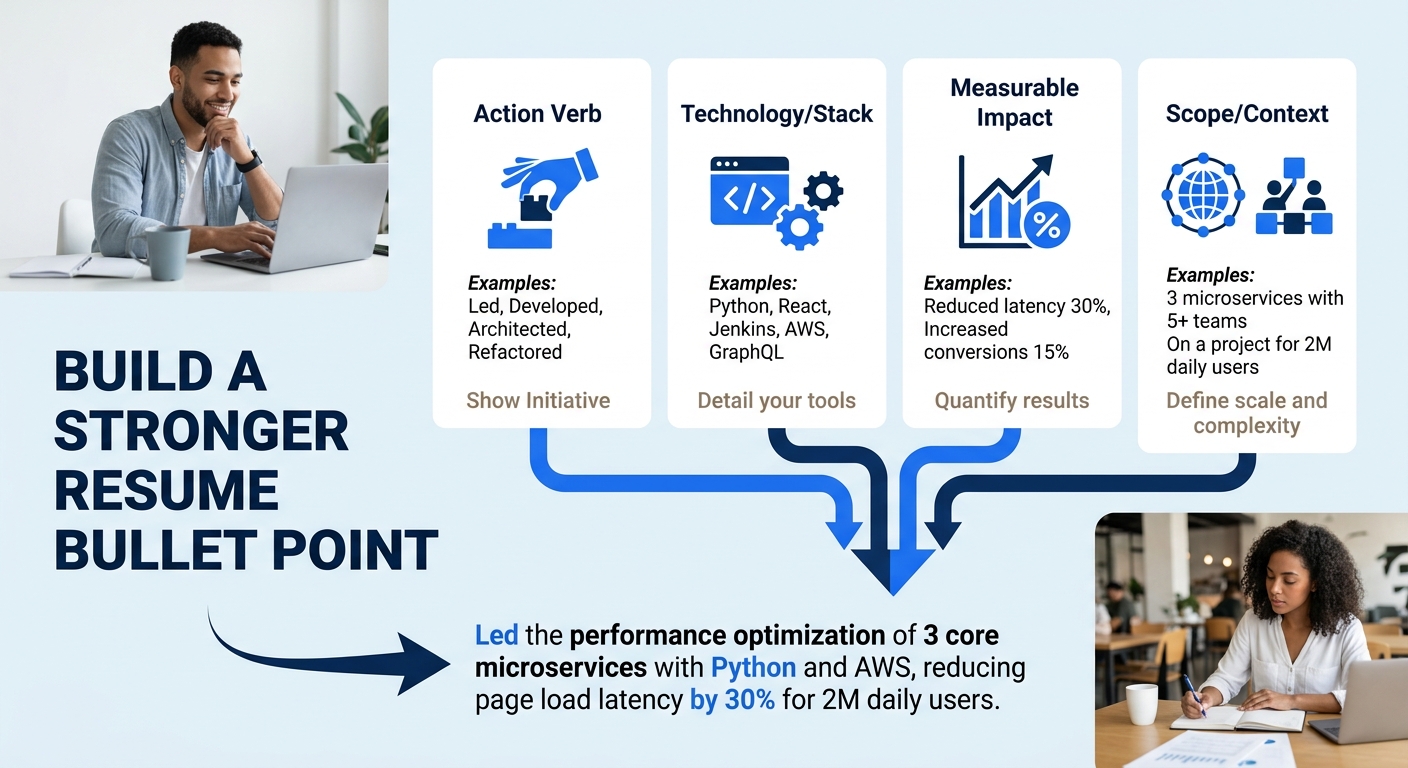
Resume specificity for developers follows a formula, and it’s learnable. Each bullet point on your resume should follow a pattern: Action + Technology + Impact + Scope. Miss any one of those four elements and you’ve written a bullet that could belong to a thousand other candidates. The six rules below will walk you through how to hit all four, consistently, across every line of your work experience section. Some of these will feel obvious. The hard part is actually doing them under the pressure of a blank page.
Always lead with what changed, not what you touched
The single most common mistake on developer resumes is describing what you worked on rather than what you made different. “Worked on the checkout flow” describes proximity to a project. “Reduced checkout abandonment by 18% by refactoring the payment form’s client-side validation” describes a contribution someone can evaluate.
When you sit down to write a bullet, ask yourself one question before typing anything: what was true after I finished that wasn’t true before? The answer to that question is your bullet’s core.
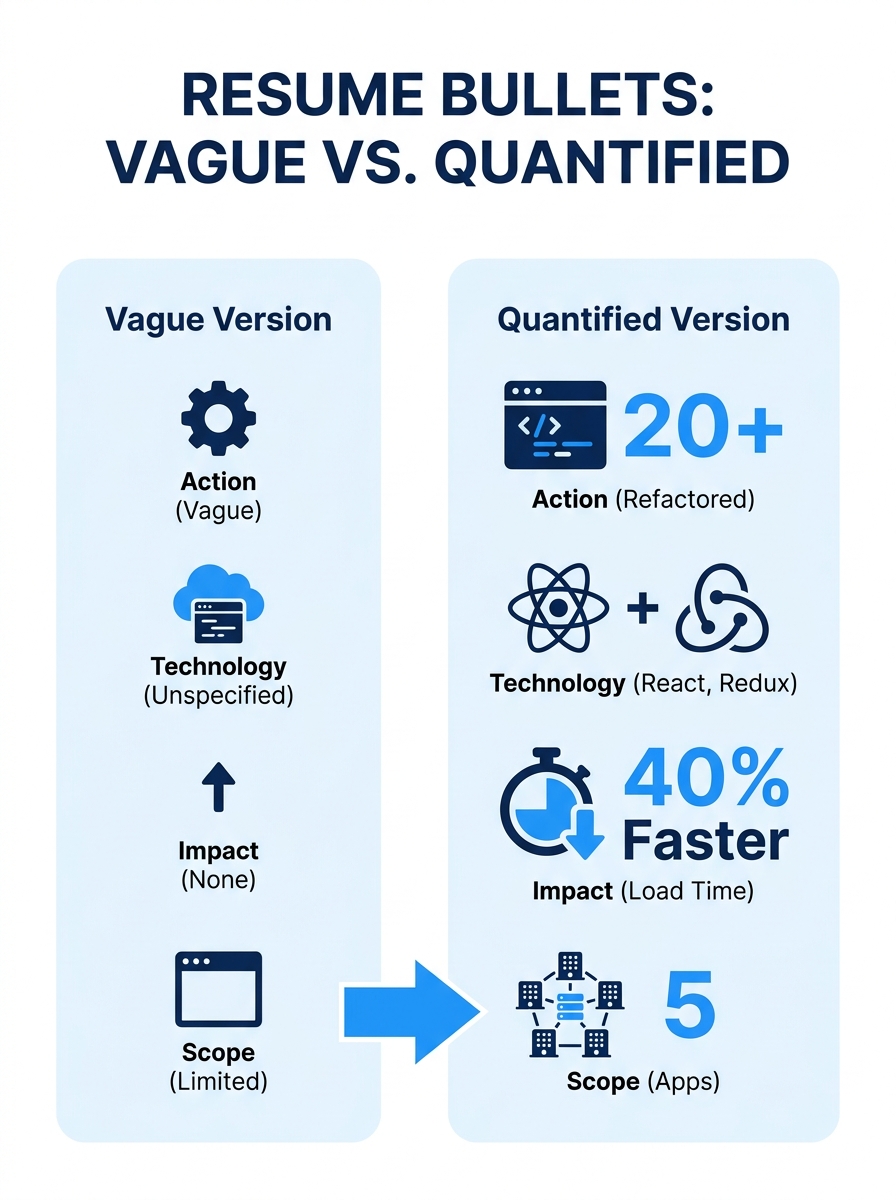
Here’s a before-and-after to make this concrete:
Before: Worked on improving application performance and fixing bugs across the platform.
After: Cut average page load time from 4.2s to 1.8s by refactoring database queries and implementing Redis caching, eliminating the #1 support ticket category for Q3.
The “after” version does three things the “before” doesn’t: it specifies the metric that changed, names the technical approach, and contextualizes why it mattered. As Teal’s guide on quantifying resume work experience recommends, start with an action verb, state the accomplishment clearly, and end with the quantified result. That sequence gives both ATS parsers and human readers what they need in the right order.
Name the stack in every single bullet
ATS-friendly technical bullets do double duty. They prove you’ve used a specific technology and they match the keywords the system is scanning for. Writing “Optimized database performance” is fine English. Writing “Optimized PostgreSQL query execution plans, reducing average response time by 62% across 14 API endpoints” is a resume bullet that actually works.
The Tech Interview Handbook’s guide to FAANG-ready resumes explains why this matters mechanically: some ATS platforms estimate your years of experience with a skill based on where and how often it appears in your resume. If you mention Python only in your skills list but never in your bullet points, the system may rank you lower than someone who weaves it throughout their work history.
This doesn’t mean cramming every tool into every line. It means being specific about which technology you used in that particular accomplishment. “Built a CI/CD pipeline” becomes “Built a CI/CD pipeline using GitHub Actions and Docker, cutting deploy time from 45 minutes to 8 minutes.” The technology names serve as both ATS keywords and proof of hands-on experience.
A practical test
Read each bullet aloud. If you could swap in a different programming language or framework without changing the meaning, the bullet is too vague to be useful.
Measure from the user’s perspective, not yours
Developer resume metrics get weird when engineers default to measuring their own activity instead of its consequences. “Wrote 200+ unit tests” sounds productive, but a hiring manager’s immediate thought is: so what? “Increased test coverage from 34% to 91%, reducing production incidents by 40% over two quarters” tells someone why those tests mattered.
Vernovis’s research on resume metrics for developers highlights engagement rates, user retention, and daily active users as particularly strong metrics for software roles. These are numbers that connect your code to business outcomes.
If you built an internal tool, how many people used it and how much time did it save them? If you rewrote an API, what happened to error rates or response times for the applications consuming it? If you migrated a database, how much did infrastructure costs change afterward?
A thread on r/ExperiencedDevs about quantifying achievements captured this well: one engineer described starting with a simple metric like number of users, frequency of a job’s execution, or how much downtime a discovered blindspot could have caused. The goal is always to translate your work into something a non-engineer can immediately evaluate.
If you can swap in a different programming language without changing the bullet’s meaning, the bullet is too vague to be useful.
Steal the job posting’s vocabulary without shame
Quantifying software engineering impact is only half the battle if you describe that impact in language the ATS doesn’t recognize. Job postings are keyword maps. They tell you exactly which terms the hiring team (and their screening software) expect to see.
If the posting says “microservices architecture,” don’t write “distributed systems” on your resume. If it says “observability,” don’t substitute “monitoring.” The terms might be technically related, but ATS parsers are often doing pattern matching, and synonyms don’t always register as matches.
This is where the skill of translating technical jargon into hiring-manager language becomes critical. You need to speak two languages simultaneously: one that satisfies the keyword parser and one that communicates clearly to the human who reads your resume after the ATS lets it through.
Practical approach: copy the job description into a text document. Highlight every technical term, tool name, and methodology mentioned. Then check your resume against that list. If you have genuine experience with something they’ve listed, make sure your resume uses their exact phrasing at least once.
Treat scope as a standalone metric
Scope is the most underused dimension in action-verb resume language. Two engineers can both “improve API response time by 50%.” One did it for an internal tool with 30 users. The other did it for a customer-facing endpoint handling 2 million requests per day. These are wildly different accomplishments, and without scope, they look identical on paper.
Scope includes: number of users affected, size of the dataset, number of services or endpoints involved, size of the team you collaborated with, number of markets or regions your feature served, and revenue associated with the product line.
Before: Migrated legacy services to cloud infrastructure.
After: Migrated 23 legacy Java services to AWS ECS, supporting a product line generating $4.2M annual revenue, with zero downtime during the transition.
The second version gives a hiring manager a sense of operational complexity. The dollar figure and service count communicate that this was a serious, high-stakes project. If you’ve worked through converting vague experience into measurable impact bullets before, you’ll recognize this as the dimension that separates mid-level resumes from senior ones.
Tip: Don’t have exact numbers? Estimates and ranges are fine. “Served approximately 500K monthly active users” is infinitely more useful than “served users.” Hiring managers know you’re approximating. They care that you’re thinking about scale at all.
Replace “responsible for” with the verb that proves you did the work
“Responsible for backend development” is the developer resume equivalent of writing “was present.” It communicates a job description, not a performance record. The fix is straightforward: replace every instance of “responsible for,” “helped with,” “assisted in,” and “involved in” with a verb that describes what you actually did.
Strong action verbs for developer resumes include: architected, built, deployed, migrated, refactored, automated, instrumented, optimized, debugged, scaled, integrated, shipped. Each of these tells a recruiter the specific type of work you performed. “Architected” means you made design decisions. “Deployed” means you got something into production. “Instrumented” means you added observability. The precision matters because it’s what separates weak resume language from action-driven results.
A related pitfall: the verb “managed.” For engineering managers, “managed” is appropriate. For individual contributors, it’s almost always a missed opportunity. “Managed the migration project” becomes “Led the migration of 12 microservices from Heroku to GKE, reducing monthly infrastructure costs by $8,400.” Same project, completely different impression.
And if you’re working with a resume that’s passed through AI rewriting tools, watch out for the verb homogenization problem. AI tends to smooth everything into the same handful of verbs. You can read more about when AI resume rewriting helps and when it backfires, but the short version is: if every bullet on your resume starts with “Developed” or “Implemented,” you’ve lost the specificity that makes each line worth reading.
When these rules produce nonsense
Every formula has limits, and this one breaks down in a few predictable places.
When you genuinely don’t have numbers. Early-career developers, people who worked at startups with no analytics infrastructure, and engineers on teams that didn’t track the metrics you’d need for a polished bullet will all hit this wall. When that happens, use relative change language (“reduced by approximately half”), directional indicators (“improved from failing to passing SLA thresholds”), or qualitative outcomes (“eliminated recurring production incidents that had triggered two customer escalations”). We’ve written a full guide on crafting resume bullets for roles without hard metrics that goes deeper here.
When the technology is under NDA. You can still describe the type of system, the scale, and the outcome without naming the proprietary tool or the client. “Built a real-time data pipeline processing 2TB daily for a Fortune 100 financial services client” respects confidentiality while still communicating scope and technical depth.
When the impact was shared across a team. Be honest about your contribution. “Contributed to a cross-functional team of 8 that reduced checkout latency by 35%; owned the database optimization layer” is more credible than claiming sole credit for a team win. Hiring managers can smell inflated claims, and credibility matters more than impressiveness.
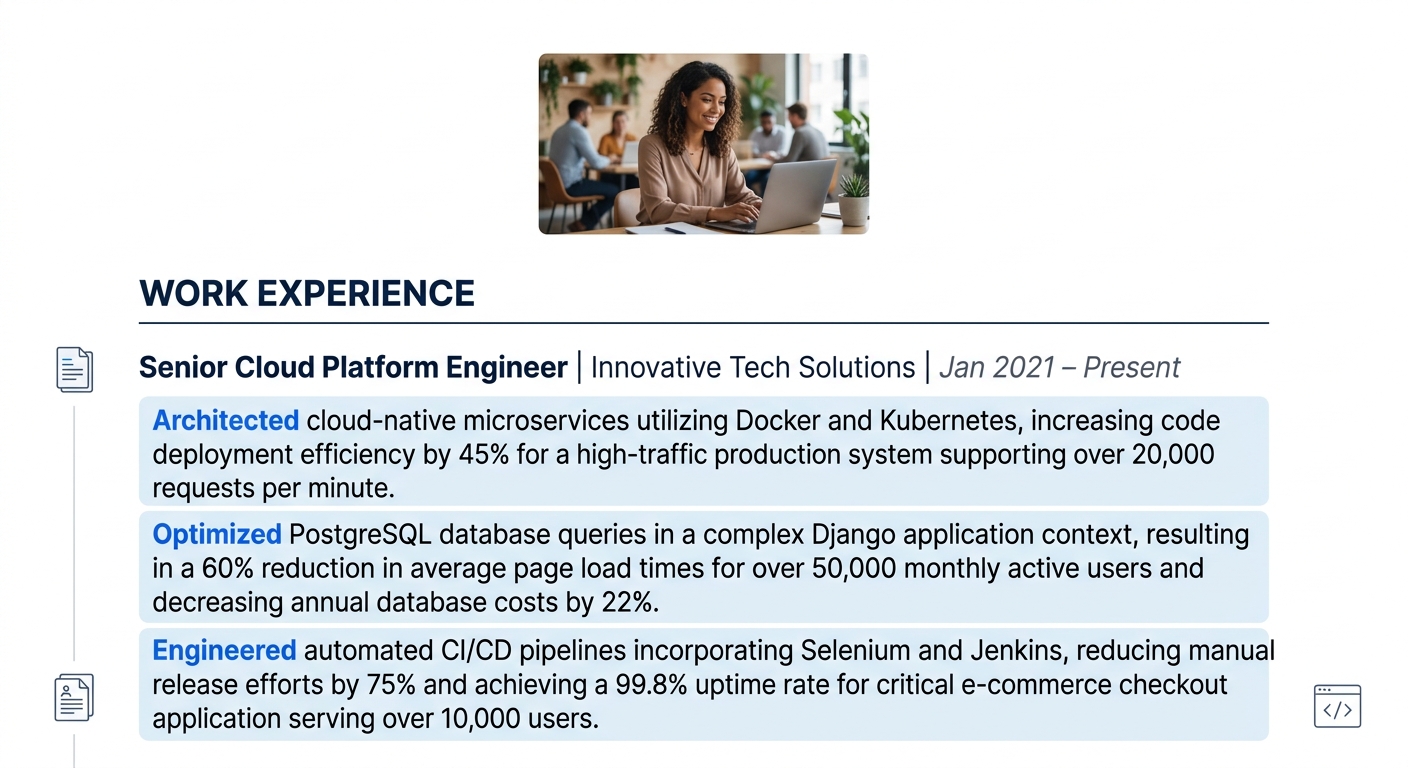
The formula works because it forces specificity, and specificity is what separates a resume that gets parsed, scored, and surfaced from one that sits in an ATS queue indefinitely. But treat it as a guide for revision, not a rigid template. Write your first draft however it comes out. Then go back through each bullet and ask: does this name what changed, say what technology made it happen, quantify the result, and give the reader a sense of how big the thing was? If the answer is yes on all four, you’ve got a bullet worth keeping.