


 4.9
4.9 4.5
4.5Oracle employees opened a 6 a.m. email from “Oracle Leadership” on March 31, 2026, and learned that approximately 30,000 of them no longer had jobs. No town hall. No prior warning. A single corporate message erased roughly 18% of Oracle’s global workforce before most people had finished their morning coffee. That same month, Dell cut 11,000 positions. Amazon’s cumulative 2026 reductions passed 16,000. And by the time April closed out, tech layoffs in 2026 crossed 92,000 across 98 companies, making it the worst year for tech employment on record. We’re only in May.
But the sheer volume of cuts tells only part of the story. What’s changed in 2026 is how displaced tech professionals are responding. Career coaching, once an afterthought for most engineers and product managers, has become the central mechanism through which people are rebuilding — and the nature of that coaching looks nothing like the job-search prep of years past.
The Q1 Cascade: Oracle, Dell, and Amazon Set the Tone
Oracle’s March 31 layoffs weren’t a trimming. The cuts primarily hit Cerner/Oracle Health, Oracle Cloud Infrastructure, and ERP consulting divisions, freeing up an estimated $8–10 billion in annual cash flow redirected toward AI data center construction. Severance packages averaged 12–16 weeks of pay plus continued benefits, according to internal communications and placement firm data. Generous by industry standards, but cold comfort for a workforce told months earlier that their divisions were “strategic priorities.”
Dell followed days later, cutting 11,000 roles and incurring $569 million in severance costs as confirmed in its FY26 10-K filing. Amazon, which had been making rolling cuts throughout Q1, passed 16,000 eliminated positions across corporate divisions by the end of March.
The Challenger, Gray & Christmas March 2026 report captured the acceleration: 60,620 job cuts announced that month alone, with AI cited as the leading reason for layoffs across all industries. The first-quarter total of 52,050 tech-sector cuts represented a 40% increase over Q1 2025.
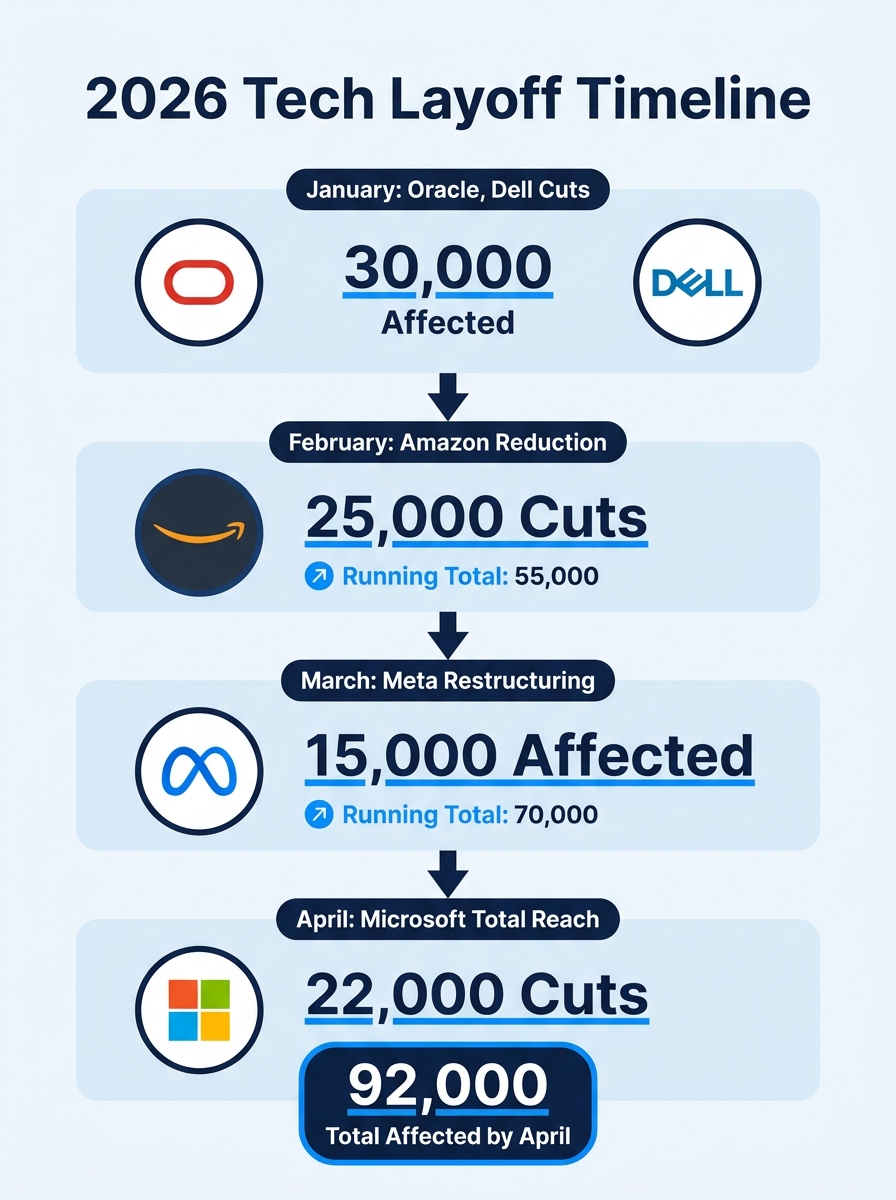
For career coaches working with displaced tech professionals, Q1 established something important: this wave wasn’t about underperformers being shown the door. Entire functional divisions were being eliminated to fund AI infrastructure bets. The people losing their jobs often had strong performance records, deep institutional knowledge, and a decade or more of specialized experience. Their resumes weren’t the problem.
April Escalation: Meta and Microsoft Change the Calculus
On April 17, 2026, Meta announced a 10% headcount reduction affecting roughly 8,000 employees, with layoffs scheduled to begin May 20. The company framed the cuts explicitly as a reallocation: compensation budgets were being redirected toward AI research and infrastructure, completing Meta’s strategic pivot away from metaverse investments and toward generative AI. Internal guidance suggested Meta might reduce total headcount by nearly 20% before year-end.
Then came Microsoft’s move. On April 23, the company introduced its first voluntary retirement program in 51 years of existence, qualifying 8,750 U.S. employees under a “Rule of 70” formula. Notifications were scheduled for May 7, with decisions due by June 6. Where Oracle’s approach had been sudden and blunt, Microsoft’s was structured and deliberate. The underlying message was the same: the company’s future budget has a different shape than its current workforce.
Pinterest and Atlassian added to the April numbers, culling about 15% and 10% of their workforces respectively. The tracker Layoffs.fyi put total tech layoffs over the past year at more than 165,000.

Here’s the detail that matters most for anyone developing a post-layoff career strategy: three-quarters of these cuts stem from cost discipline and restructuring tied to over-hiring during the low-interest-rate era of 2020–2022, according to Challenger’s analysis. The report attributed 15,341 March job cuts across all industries to AI and automation specifically. AI is the narrative. Capital reallocation is the math.
That distinction reshapes everything about how displaced workers should think about their next move.
Where Displaced Workers Are Actually Landing
The assumption that laid-off tech workers either find another tech job or retrain for AI roles turns out to be wrong. LinkedIn data shows that nearly two-thirds of displaced tech workers are moving into entirely different industries. The most common career pivot goes to professional services — consulting firms, accounting firms, and advisory practices — with 19.6% of former tech workers choosing this path.
This tracks with what career coaches on the ground report. Senior engineers with 8–15 years of experience in cloud architecture, security, or SaaS aren’t retraining from scratch. They’re finding that mid-market companies, PE-backed firms, and organizations outside the tech sector desperately need their existing skills. Cloud migration, SOC 2 compliance, enterprise security, and FinOps are in high demand at companies that never over-hired during the boom years and now have budget to grow.
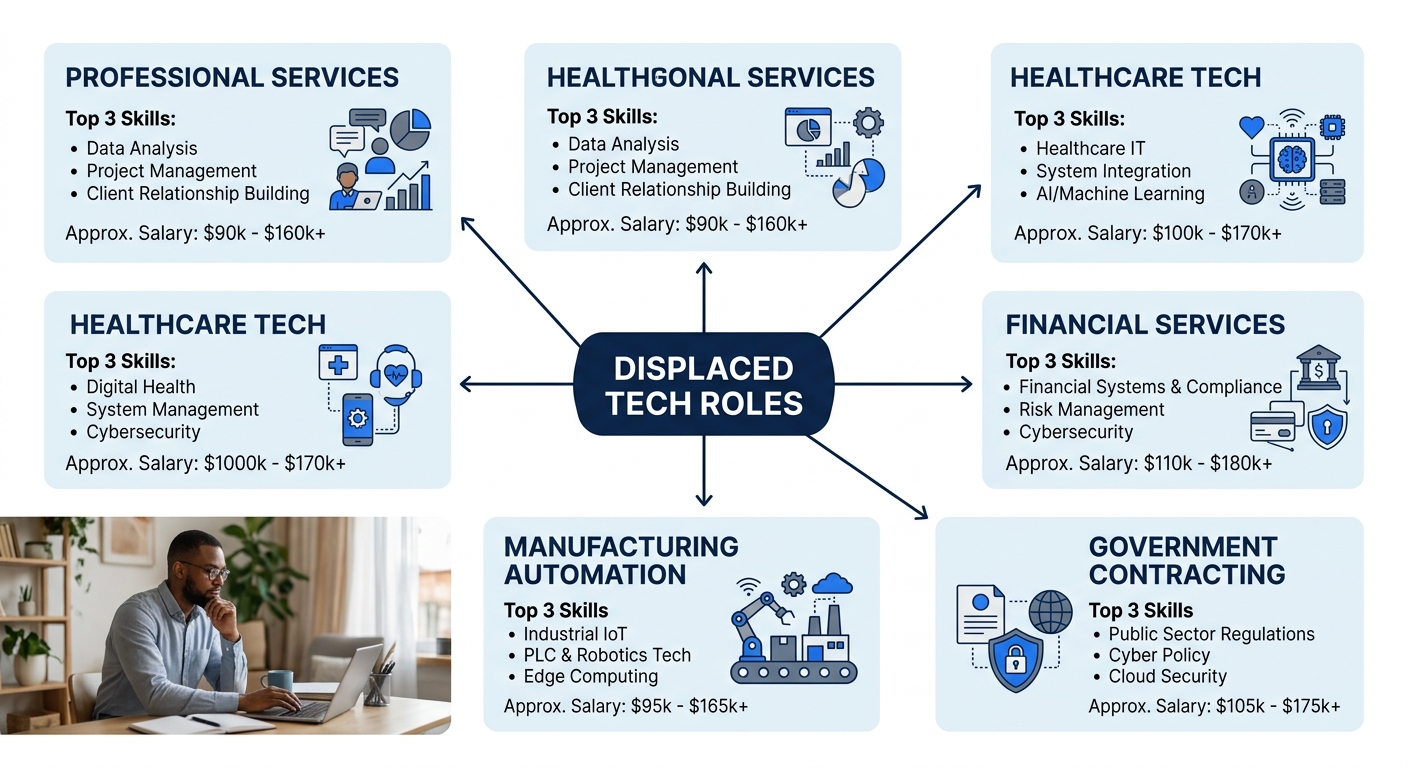
Some of the salary data contradicts the doom narrative entirely. Forbes documented laid-off tech workers securing six-figure roles in healthcare technology, financial services, government contracting, manufacturing automation, and education technology — fields where deep technical skill is scarce and competition for roles is far less intense than at FAANG-tier companies.
Three-quarters of 2026’s tech cuts stem from capital reallocation, not AI replacing workers. The career pivot strategy that works targets companies that avoided the 2021 hiring binge.
Career coaching firms report that senior engineers are securing new roles within 17–30 days when they target this mid-market segment. That speed depends on one thing: reframing existing experience for a different audience. If you’ve been through this, our guide on rebuilding your resume after AI-driven job cuts walks through the specific mechanics of that reframing.
How Career Coaching Changed Shape
The traditional career coaching model — polish resume, practice interview answers, apply widely — has proven inadequate for the scale and nature of 2026’s displacement. What’s replaced it is closer to strategic repositioning, and it follows a distinct sequence.
Identity reconstruction comes first. A layoff from a company you spent years at disrupts more than income. The University of Washington’s Professional & Continuing Education program documented how the loss of routine, identity, and confidence hits before any practical concern about job searching does. Executive coaching research shows that a professional certified coach provides an external perspective that helps clients understand how organizational factors — unclear expectations, sudden strategic pivots, poor change management — contributed to the outcome and turns confusion into clarity. Rebuilding a professional identity requires work that a resume rewrite alone can’t accomplish.
Market alignment comes second. Instead of broad job searching, coaches now map a client’s specific skill set against sectors with verified demand. This means identifying which companies avoided aggressive 2021 hiring, have intact budgets, and are actively building teams. The career pivot strategy for displaced workers in 2026 relies heavily on this targeting work, and it often leads people into industries they hadn’t considered.
Rapid packaging comes third. Once the target sector is identified, the resume, LinkedIn profile, and interview narratives get rebuilt simultaneously to speak that sector’s language. We’ve covered how skills-based resumes reframe experience when job titles don’t match, and this is exactly the situation where that approach pays off. If you’re translating technical jargon into language that non-technical hiring managers understand, the skill translation framework for technical roles applies directly.
The AI career coaching market is projected to reach $15 billion by 2030, and much of that growth is being driven by this moment. Human coaches handle the identity and strategy work. AI tools accelerate the packaging. The combination is proving more effective than either alone.
Tip: If your former employer offers outplacement coaching as part of your severance package, use it. But supplement it with independent coaching that isn’t tethered to the company’s preferred vendors. Outplacement firms optimize for speed of placement. Independent coaches optimize for fit and long-term trajectory.
Emerging Skills That Translate Into Roles Right Now
The IMF published research in January 2026 showing that one in ten job postings in advanced economies now demands skills that didn’t exist five years ago. New tasks, new occupations, and alternative career pathways are being created alongside automation. For workers, staying employable increasingly depends on the ability to update existing capabilities or acquire adjacent ones.
So what are the emerging skills for tech professionals that actually translate into paying roles? Based on hiring data and coaching placement patterns from Q1 2026:
- Systems integration — blending machine learning with process automation and change management. These roles exist across industries, from healthcare to manufacturing, and they pay well because they require both technical depth and organizational awareness.
- Cloud migration and FinOps — companies outside tech are still in early stages of cloud adoption. The expertise that feels commodity-level inside AWS or Azure is premium-priced in healthcare, logistics, and government.
- Enterprise security and compliance — SOC 2, HIPAA, and emerging AI governance frameworks need people who understand both the technology and the regulatory environment.
- MLOps and platform engineering — for those who want to stay adjacent to AI work without competing for pure research roles, the infrastructure layer is where hiring is concentrated.
The pattern across all of these: employers want people who can work at the intersection of technical implementation and business context. Pure coding ability, disconnected from domain knowledge, is the skill set most at risk right now. If you’re working on how to tell your career story in a pivot, building a narrative around that intersection is where the advantage lies.
The State of Play in Early May
As of the first week of May 2026, the tech layoff count stands at 92,000 and climbing. Meta’s May 20 cuts haven’t hit yet. Microsoft’s voluntary retirement decisions aren’t due until June 6. Several smaller companies appear poised to announce their own reductions in the coming weeks.
And yet the picture for individual workers is more complicated than the headlines suggest. The AWS CEO stated publicly this week that demand for software jobs is “accelerating,” and Amazon plans to hire 11,000 interns in 2026. Tesla’s former HR chief argued in Fortune that the “hyperscaler math” driving cuts at Meta and Microsoft doesn’t apply to the companies where most Americans actually work. The Washington Post reported that tech giants investing heavily in AI haven’t significantly shrunk their total workforces — they’re reshuffling, not disappearing.
The career coaching response to all of this has crystallized around a few principles that are worth understanding whether you work with a coach or navigate this on your own. Act quickly, because the 17-to-30-day placement window for senior engineers exists due to real demand right now, and it will compress as more displaced workers enter the market over the summer. Target companies that didn’t over-hire during the boom, where budgets are intact and hiring managers aren’t recovering from their own layoff cycles. Consider contract and fractional engagements, which often offer better rates and faster onboarding than full-time positions. And approach rebuilding after AI job cuts as a strategic exercise with a defined sequence — identity first, market alignment second, packaging third — rather than a reactive scramble of applications and prayers.
The professionals landing well in 2026 share one trait: they stopped treating the layoff as a gap to explain and started treating it as a pivot to execute. The personal branding approach replacing generic AI-polished resumes is part of that shift. The career coaches seeing the best outcomes recognized early in Q1 that this wave required a fundamentally different playbook, one built around rapid strategic repositioning rather than incremental resume tweaks and mass applications. The window for that repositioning is open right now. Based on how the numbers are trending, it won’t stay open at this width for long.