

 4.9
4.9 4.5
4.5Polishing the same resume you carried at your last tech job will extend your search, not shorten it. The 128,000+ engineers displaced in 2026 face a market where 47.9% of eliminated roles were cut because of AI, and the openings replacing them demand different skills entirely. Repositioning your resume around those new demands is the only strategy that matches the data.
TL;DR: The 2026 tech layoff wave has eliminated roles that aren’t coming back in their original form. Engineers who refresh their existing resumes are averaging 4.7 months to re-employment. Those who reposition toward cybersecurity, cloud migration, and AI-adjacent infrastructure are landing roles in weeks, often at higher pay.
47.9% of Cuts Trace Directly to AI Adoption
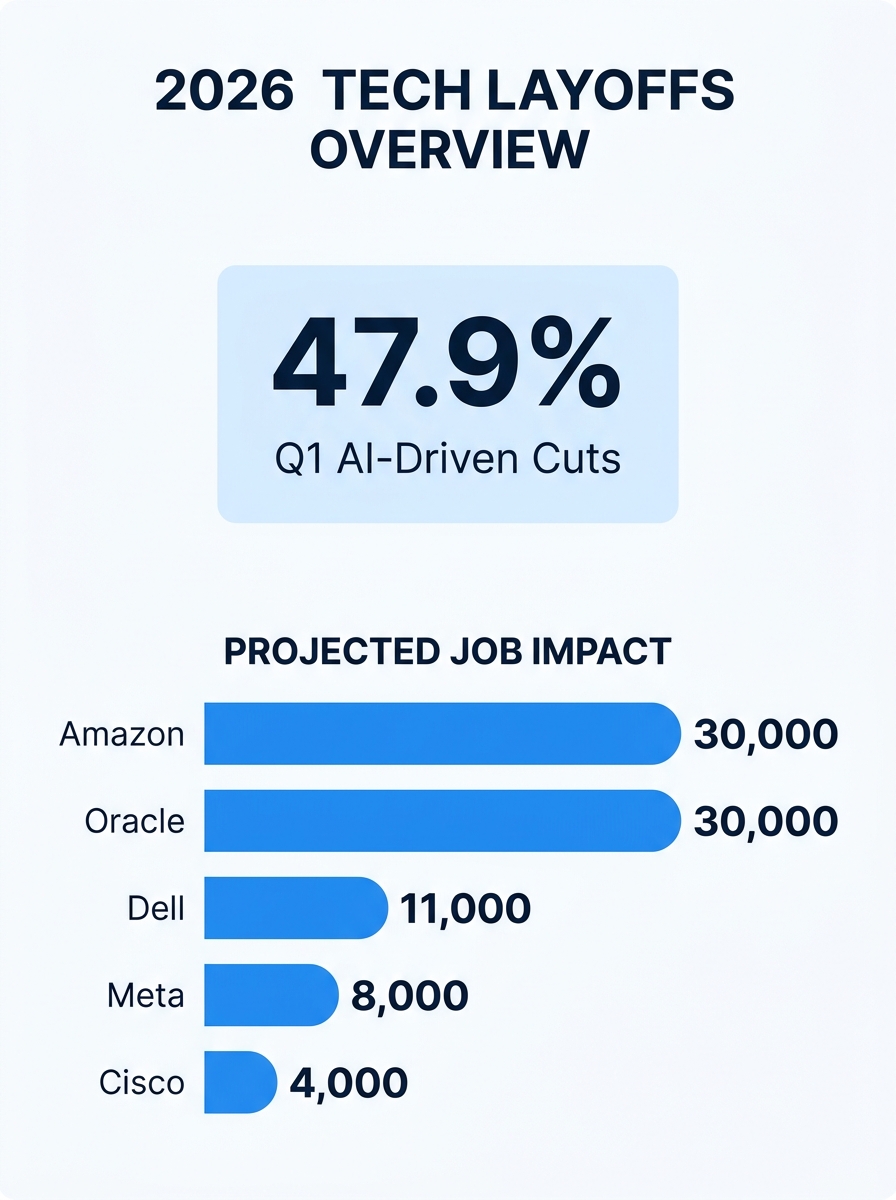
Nearly half of the 78,557 tech workers laid off in Q1 2026 lost their jobs because companies replaced their functions with AI, according to Tom’s Hardware’s analysis of Nikkei Asia data. That figure, 37,638 positions, represents the largest AI-attributed displacement in a single quarter ever recorded. More than 76% of those affected workers were in the U.S.
This week’s announcements underline the acceleration. LinkedIn CEO Dan Shapero told employees on May 13 that the company would cut approximately 875 roles, roughly 5% of its 17,500-person workforce, citing the need for “greater profitability and organizational agility.” Two days later, Cisco announced 4,000 job cuts. The company’s memo to employees was blunt: “The companies that will win in the AI era” need to reorganize now.
These aren’t temporary corrections. When Coinbase announced its restructuring this month, it described moving toward “AI-Native pods” built around smaller teams. Some of those pods are single-person units combining engineering, design, and product work. The old division of labor, one person per specialty per team, is dissolving at companies with the resources to rebuild around AI tooling.
If your resume still describes you in terms of that old division of labor, it describes a job that no longer exists at dozens of major employers. And the algorithms sorting your application will score it lower when it doesn’t match the new language these companies use in their job postings.
The Re-Employment Gap Proves the Resume Problem
Why are displaced engineers stuck for so long? The median time to re-employment has climbed from 3.2 months in 2024 to 4.7 months in early 2026. That 47% increase reflects what happens when over 100,000 displaced engineers all apply to the same shrinking pool of identical roles.
But that 4.7-month number is misleading as an average. Engineers who reposition toward different specialties are getting placed far faster. KORE1 placement data from March 2026 shows senior engineers landing new roles in a median of 17 days when they target mid-market SaaS companies hiring for cloud migration and security work. The distance between 17 days and 4.7 months tells you everything about what’s working and what isn’t.
We wrote previously about how to rebuild a developer resume after tech layoffs, and that guidance still holds for formatting and structure. The difference now is that the target role itself needs to change for many engineers. You can’t optimize a resume for a position that 30 companies eliminated in the same quarter.
The engineers stuck in that 4.7-month limbo tend to share a pattern. They update their dates, add their last project, run the document through an ATS optimizer, and apply to roles with the same title they held before. The resume reads fine. The problem is that fewer companies are hiring for that title, and hundreds of other recently displaced engineers are submitting near-identical applications for every remaining opening.
Three Fields Where Displaced Engineers Are Landing Fast
The career pivot resume cybersecurity path is getting the most traction right now, and it makes sense when you look at actual spending. Even as Meta, Amazon, and their peers direct a combined $725 billion toward AI capital spending in 2026, regulatory and compliance obligations are expanding in parallel. Someone has to secure all that new infrastructure.
Cybersecurity and Compliance
Jayce, a 2026 graduate profiled by Research.com, described the pivot bluntly: “Graduating with a degree in information security and assurance opened my eyes to how vital transferable competencies like critical thinking and problem-solving are, especially when pivoting into cybersecurity analyst roles.” He found that targeting entry-level positions in healthcare and finance offered the fastest path in.
For experienced engineers, the on-ramp is shorter. Your existing knowledge of systems architecture, API design, and cloud infrastructure maps directly onto IAM, SOC 2 compliance, and cloud security roles. Research.com’s 2026 career-pivot analysis recommends using transferable skills in risk assessment, crisis management, and regulatory compliance to move into compliance analyst or cybersecurity specialist positions.
Cloud Migration and Platform Engineering
Mid-market companies are actively hiring engineers with production experience in AWS, Azure, and Oracle Cloud Infrastructure. These organizations often lag two to three years behind the enterprises doing the cutting, which means they need people who’ve operated at scale. If you spent four years running Kubernetes clusters at a company that just laid you off, a Series B startup trying to migrate off on-premise servers is a strong match. KORE1’s 17-day median placement figure comes primarily from this category.
AI-Adjacent Infrastructure
Demand for pure AI research roles remains limited compared to the breathless media coverage. The real hiring is in MLOps, data infrastructure, and model deployment. These are engineering jobs, not research positions, and they reward the same debugging, system design, and reliability skills that traditional software roles required. If you’ve built a CI/CD pipeline, you already understand 60% of what an MLOps role demands. Your AI-proof jobs engineer resume should emphasize that operational experience over any AI coursework you’ve rushed through.
Tip: When repositioning your resume toward cybersecurity or cloud infrastructure roles, group your skills into categories. Beamjobs’ 2026 resume guide recommends [no more than 10-12 relevant items](https://www.beamjobs.com/resumes/software-engineer-resume-examples), organized by type: Security Tools, Cloud Platforms, Programming Languages, Compliance Frameworks. This structure helps ATS systems and human readers quickly assess your fit.
The TRA Framework for Resume Repositioning
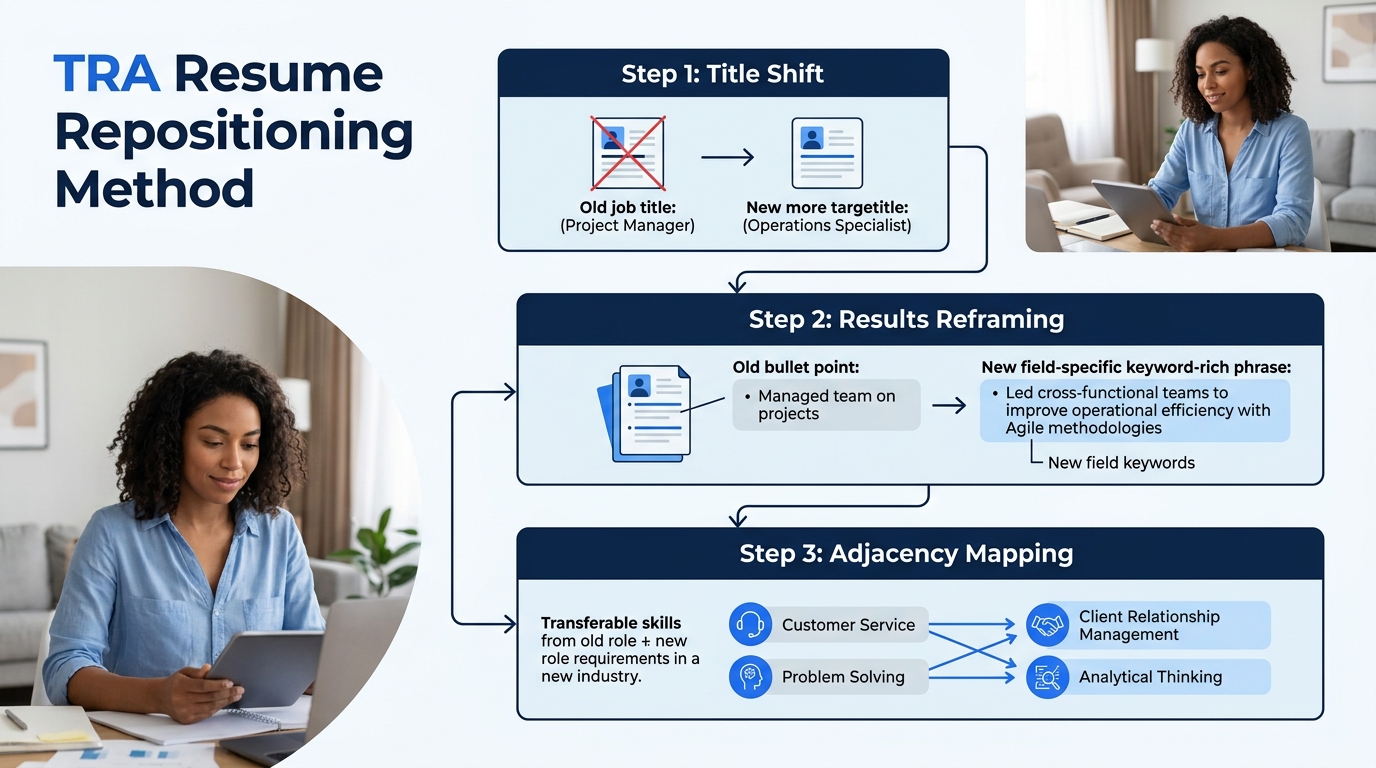
Understanding that you need to reposition is step one. Doing it well on paper is where most displaced engineers stall. I’m proposing a three-part method called TRA: Title, Results, Adjacency.
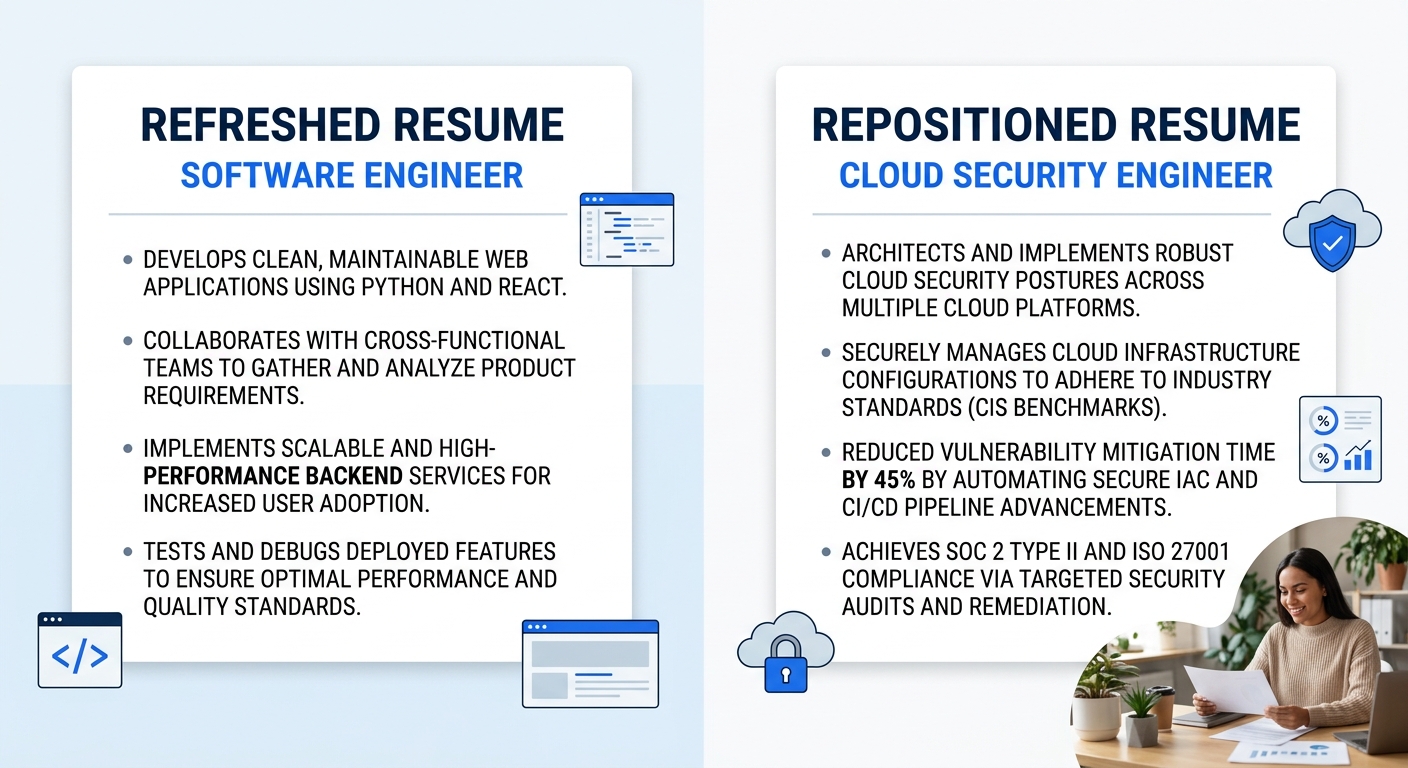
Title shift. Change your target job title at the top of your resume. If you were a Senior Software Engineer pivoting to cloud security, your resume header should read Cloud Security Engineer or Infrastructure Security Engineer. Hiring managers spend roughly 11 seconds on an initial resume scan, and a mismatched title burns most of that window before they reach your first bullet point.
Results reframing. Rewrite your bullet points to emphasize outcomes relevant to the new field. Proficiently’s career-change resume guide offers a useful before-and-after: instead of “Managed the project plan for a new software rollout,” try “Led the go-to-market strategy for a new software platform, coordinating Engineering, Marketing, and Sales to reach 30% user adoption in the first 90 days.” The experience is identical. The framing highlights cross-functional coordination and measurable impact, which translate across fields.
Adjacency mapping. For every skill on your old resume, ask: what does this enable in my target role? Python scripting maps to security automation. Database management maps to data governance. Distributed systems knowledge maps to cloud architecture. Your resume should make these connections explicit rather than hoping a recruiter sees them on their own. We’ve covered how to turn upskilling into bullet points that impress hiring managers, and the same principle applies here when translating existing skills for a new audience.
If repositioning resume tech industry work feels overwhelming, consider working with interview coaching professionals who specialize in career transitions. One case study from NGT Academy documented an IT professional who pivoted to cybersecurity with structured coaching, landing a cybersecurity engineer role within 12 months at a salary 35% higher than his previous position.
The distance between 17 days and 4.7 months to re-employment tells you everything about what’s working and what isn’t.
The Claim, Tested Against This Week’s Numbers
The TrueUp layoffs tracker recorded 286 events affecting 128,270 workers as of May 13, the highest total since 2023. LinkedIn, Cisco, Meta, Oracle, Dell, Amazon, Intel, ASML, and Coinbase have all cut headcount this year while simultaneously increasing AI investment. The pattern is consistent: companies are spending more on technology and less on the people who used to build it the old way.
That pattern will continue through the rest of 2026. Meta’s 8,000-person layoff takes effect May 20, with additional reductions planned for the second half of the year. Intel has dropped from 124,800 employees to under 100,000 and is still cutting. ASML is eliminating 1,700 positions in IT and tech management specifically to “reduce bureaucracy and shift toward engineering roles.” Even the definition of “engineer” is narrowing.
According to the U.S. Career Institute’s analysis of automation-resistant jobs, the roles safest from AI displacement are those requiring social skills, emotional intelligence, and creative problem-solving that doesn’t follow a rigid routine. For engineers, this means the most durable career moves point toward roles that combine technical depth with human judgment: security architecture, incident response, client-facing platform consulting, and infrastructure reliability.
Every announcement this week reinforces the original claim. Refreshing your resume for a role shaped like your old one is the wrong move. The roles themselves are changing. Your resume needs to change with them, and the engineers doing that work, whether through repositioning after AI-driven layoffs or pivoting to an entirely new specialty, are the ones beating the 4.7-month median and landing in weeks. The tech layoffs 2026 resume problem is real, it’s accelerating, and the fix starts with accepting that your next title won’t look like your last one.