


 4.9
4.9 4.5
4.5Between the TrueUp and Crunchbase layoff trackers, the tech industry has shed north of 128,000 positions in 2026 alone, averaging about a thousand people per day. For each person affected, the natural first move is to open a resume file and start editing. But the people who recover fastest tend to do something different first: they stop and figure out what they’re rebuilding toward.
That distinction between resume polishing and career strategy is the thread running through every rule below. These seven principles come from coaching frameworks, labor displacement research, and the patterns we see across thousands of post-layoff resume rebuilds. They apply whether you’re a senior engineer, a product manager, or a director whose entire division got reorganized. The rules are ordered roughly chronologically from the day of the layoff forward, and each one carries a caveat about when it bends.
Treat the first 72 hours as a strategy window, not a resume sprint
Career coach Kyle Elliott advises newly laid-off tech workers to focus on two things immediately: update your LinkedIn headline and reach out to five former colleagues. The resume, he argues, can wait.
This runs against every instinct. After a layoff, your brain wants to do something that feels like progress, and formatting bullet points scratches that itch. But the first 72 hours are when your professional network is most activated. Former colleagues are thinking about you, your manager may feel genuine guilt, and people in adjacent teams may have leads. That window closes quickly.
Use those first hours to document every project, metric, and collaborator you can remember while your access is being revoked. Negotiate your severance package (you almost always have room to negotiate, especially on benefits continuation and outplacement services). And tell 10-15 people in your network what happened, without a polished pitch, without a resume attached, just the honest update.
The resume work improves dramatically when it’s informed by those conversations, because you’ll hear where the market actually has openings and what language companies are using in their current postings.
When this rule bends: If you’re on a visa with a ticking clock, the resume needs to go out immediately. In that case, start with a quick update of your strongest bullet points and refine in parallel with outreach.
Separate the resume question from the career direction question
The default post-layoff workflow looks like this: update resume, apply to similar roles, hope for the best. The problem with this sequence is that it conflates resume vs career strategy into a single task. They’re different problems requiring different thinking.
Your resume is a document that translates your experience into a hiring committee’s language. Your career strategy is the upstream decision about which hiring committees you want to reach in the first place. Polishing the resume before settling the strategy question is like formatting a document before deciding what it should say.
This is where mid-career transition coaching earns its keep. A coach spends the first sessions helping you audit your skills, interests, energy patterns, and financial constraints before a single bullet point gets rewritten. We’ve covered how software engineers hit this exact clarity crisis when optimization of existing materials can’t solve a fundamentally strategic question.
If you’re considering a post-layoff career pivot into an adjacent field (say, from backend engineering to developer relations, or from product management to solutions consulting), that pivot changes every line of your resume. Getting the direction wrong and then spending three weeks tailoring applications to the wrong roles is a costly mistake, measured in both time and confidence.
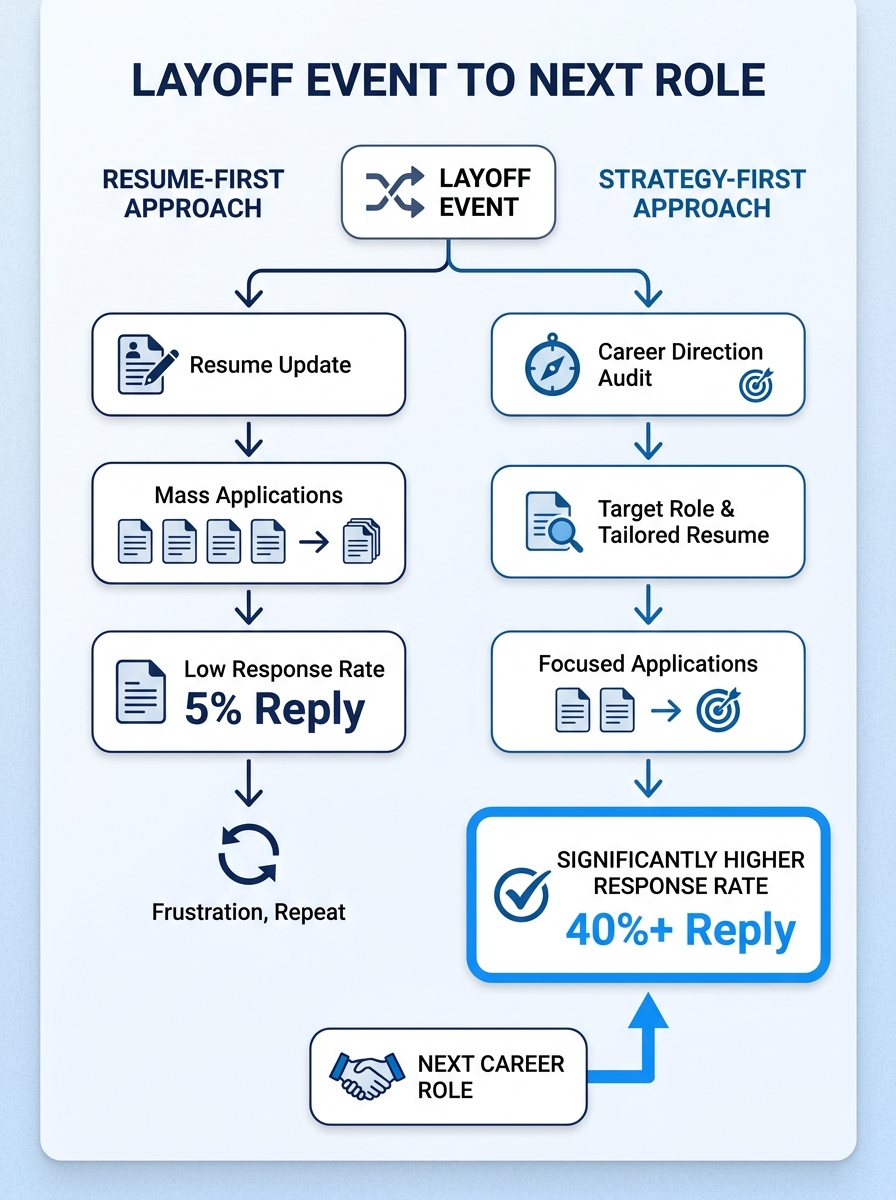
When this rule bends: If you were already happy in your role and you’re confident the same type of position exists elsewhere, you don’t need a deep strategic audit. Move straight to resume optimization and apply.
Hire a coach before you’ve burned through your severance
Career coaching for displaced tech workers typically costs between $150 and $500 per session, with most engagements running four to eight sessions. That’s $600 to $4,000 at a time when your income just dropped to zero. The sticker shock is understandable.
But the math works differently when you factor in the cost of an extended, unfocused job search. If your previous salary was $180,000 and a coach helps you land a role eight weeks faster than you would have on your own, that’s roughly $28,000 in recovered earnings. The International Coaching Federation formalizes this logic: coaching ROI equals financial impact times confidence level, divided by coaching cost. Even at a conservative 50% confidence attribution, the coaching ROI for displaced workers clears 300% in that scenario.
The timing matters because severance packages create a natural budget for this kind of investment. People who wait until the severance runs out often can’t afford coaching precisely when they need it most. According to Boon Health’s analysis of coaching metrics, you’ll see leading indicators like renewed confidence and clearer positioning within the first 90 days, even though business outcomes like landing the new role may take six to twelve months to materialize.
Tip: If your company offers outplacement services as part of a severance package, use them, but don’t treat them as a substitute for independent coaching. Outplacement tends to focus on resume formatting and generic interview prep. Independent coaches are more likely to challenge your assumptions about what role you should pursue next, and to help you prepare the [right documents before your first session](/blog/career-coaching-preparation-checklist-documents).
When this rule bends: If your target role is clear, your resume is strong, and your main barrier is volume of applications, a coach may be overkill. You might get more value from a resume review service and a structured accountability partner.
Fill the chronological gap with evidence, not explanations
A 2026 CareerBuilder survey found that 58% of recruiters specifically look for explanations of employment gaps. But the more telling finding is what happens when they find a gap without context: they move on to the next candidate.
The standard advice is to add a parenthetical after your most recent role noting that the position was eliminated in a restructuring. That’s necessary but insufficient. The real work is what comes below that note on your resume.
The strongest post-layoff resumes include a dedicated “Professional Development” section placed immediately after the most recent role. This section lists certifications earned, freelance projects completed, open-source contributions, and courses finished during the gap. For tech workers, 74% of whom say they need to upskill to stay employed according to edX research, this section does double duty: it fills the timeline and signals that you’re actively building relevant skills.
We’ve written about mapping upskilling into resume bullet points that impress hiring managers, and the principles there become especially important after a layoff, when the temptation is to list every online course you completed rather than selecting the three or four that directly support your target role.
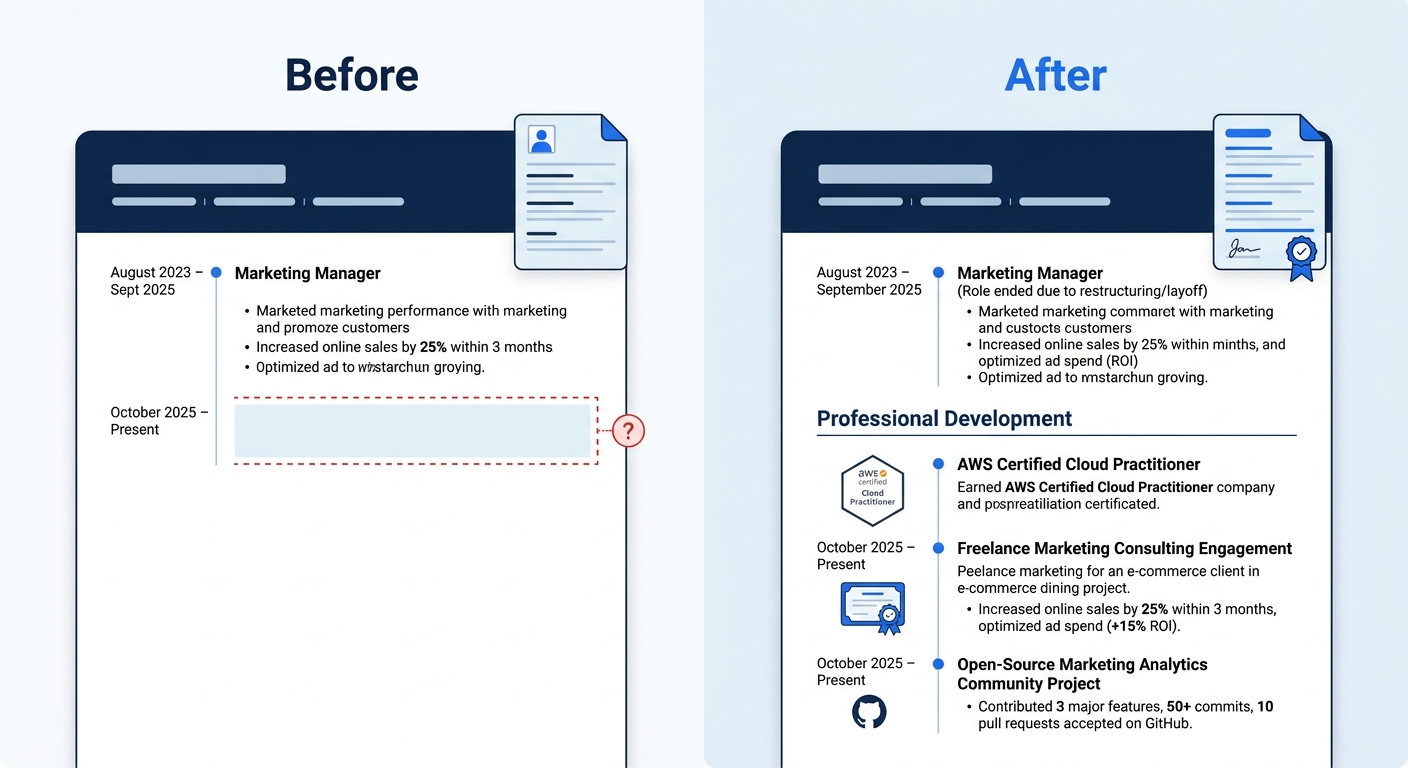
When this rule bends: Short gaps of two to three months rarely need this treatment. If you took a month off to decompress and then landed your next role, a brief gap is normal and most recruiters won’t blink.
Measure coaching ROI the same way organizations do
When organizations evaluate executive coaching, they don’t ask “did the person feel better?” They track engagement scores, manager confidence ratings, and session attendance in the first 90 days, then harder metrics like retention rates and promotion velocity over six to twelve months.
You can apply the same framework to your own coaching investment. Before your first session, write down three concrete outcomes you want: a target role title, a target compensation range, and a target timeline for landing an offer. After each session, assess whether you’re closer to those targets and, critically, whether the targets themselves have shifted based on new information. If a coach helps you realize that your target role should be different from what you assumed, that’s a high-value outcome even though it doesn’t show up as “applications sent.”
The career coaching tech layoffs 2026 conversation is evolving because so many displaced workers are going through this process simultaneously. Coaches who specialize in tech transitions have refined their frameworks through hundreds of engagements over the past two years, and the quality of guidance available now reflects that accumulated experience.
The people who recover fastest from tech layoffs aren’t the ones who update their resume first. They’re the ones who figure out what they’re rebuilding toward before they start writing.
When this rule bends: If you’re working with a free or employer-sponsored coach, the ROI math is already settled. Focus on getting the most out of the sessions rather than tracking whether the investment justified itself.
Rebuild your public profile in parallel with your resume
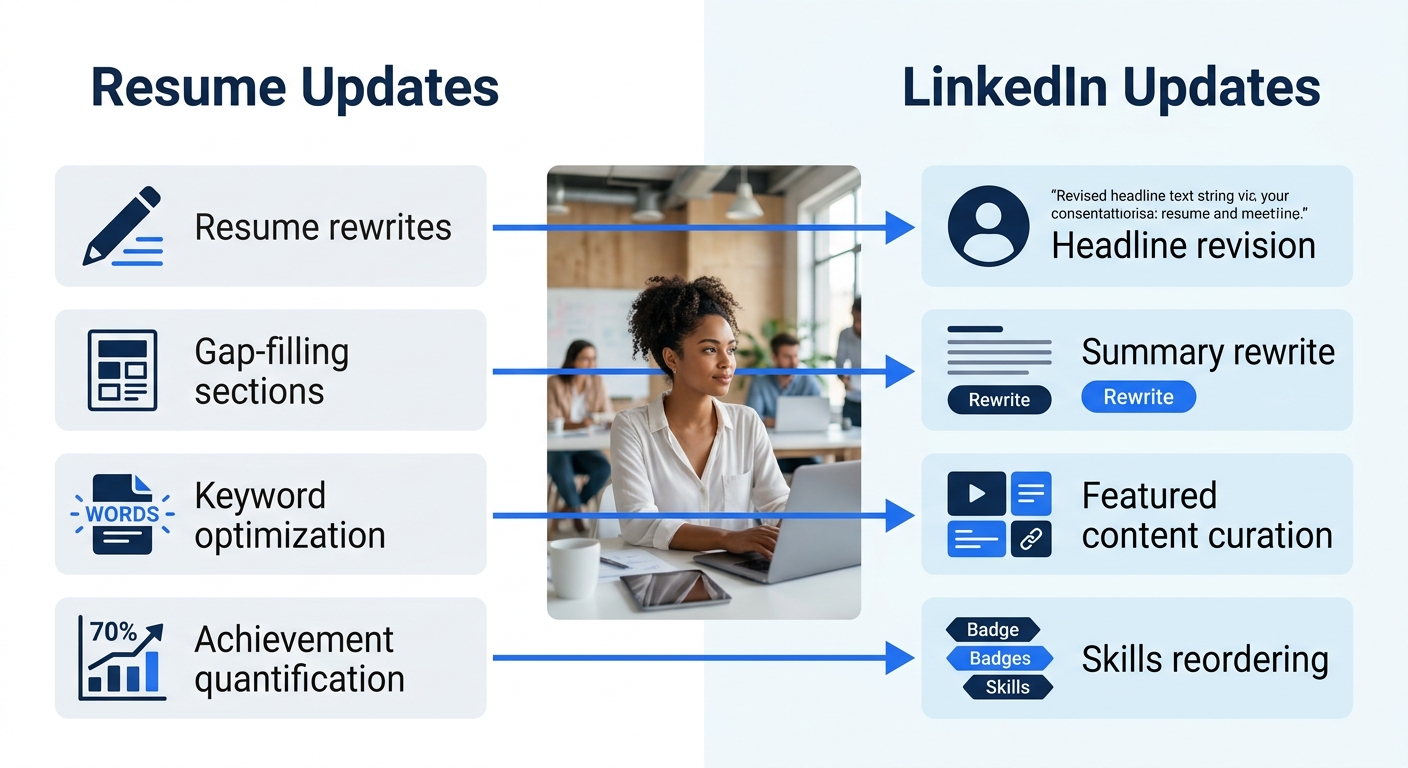
Your resume and your LinkedIn profile serve different audiences, but they need to tell the same story. After a layoff, many people update one and forget the other, creating a mismatch that recruiters notice immediately. As we’ve covered in our piece on how hiring managers routinely Google candidates before scheduling interviews, alignment between your online presence and your application materials has become a screening criterion in its own right.
For a post-layoff career pivot, your LinkedIn headline should reflect where you’re going, not where you’ve been. “Senior Backend Engineer” is accurate, but if you’re targeting solutions architecture roles, a headline like “Solutions Architecture | 8 Years Building Distributed Systems at Scale” signals intent. Coaches often work through this positioning exercise before touching the resume, because the headline forces you to commit to a direction in plain language.
The same logic applies to your summary section, your featured content, and your endorsements. If your resume says you’re pivoting into data engineering but your LinkedIn skills section still lists seventeen variations of PHP, the two documents are arguing with each other. A good coach will walk through both documents in the same session to make sure they’re telling a unified story.
When this rule bends: If you’re applying exclusively through job boards and direct applications where recruiters won’t see your LinkedIn, the parallel rebuild is less urgent. But that’s an increasingly rare scenario.
Treat networking as a skill you practice, not a task you complete
About 80% of jobs are filled through personal and professional networks, according to senior recruiting executives. That statistic gets cited so often it starts to feel abstract, but after a layoff it takes on practical urgency. Your applications are competing against candidates who already have an internal referral.
Career coaches who focus on mid-career transition coaching typically dedicate at least one full session to networking strategy, and the approach they teach looks different from the “blast your network” instinct most people default to. Effective post-layoff networking is specific: you reach out to a particular person because they work at a particular company where you’ve identified a particular role, and you ask for a 15-minute conversation about what that team actually needs.
This targeted approach produces better information for your resume, too. When a contact tells you “our team is drowning in migration projects and we need someone who can talk to both engineering and product,” you now have language to use in your bullet points that directly mirrors how the hiring team describes their own pain points. You’ve built the kind of resume that passes both ATS screening and the human reader, because it reflects the vocabulary real people inside the company are using.
When this rule bends: Networking advice assumes you have some network to activate. If you immigrated recently, changed industries, or worked at a single company for a decade without building external relationships, the networking ramp is longer. Start with alumni groups, online communities in your technical specialty, and local meetups. The contacts you build during a job search often become the professional network you should have been building all along.
When these rules collide with reality
Every rule above assumes a certain amount of financial runway, professional network, and clarity about what you want to do next. When those assumptions fail, the rules need modification.
If your severance is minimal and your savings are thin, the strategy-first approach compresses. You may need to take a role that keeps the bills paid while doing the career-direction work in parallel. A coach worth their fee will help you plan a two-stage recovery: stabilize first, then pivot when the financial pressure eases.
If you’re 50+ and navigating age-related hiring bias alongside the layoff, the rules still apply but the timeline stretches. We’ve written about modernizing an experienced professional’s resume without erasing their expertise, and the principles in that piece pair well with coaching that specifically addresses how seasoned professionals position themselves in a market that skews younger.
The tech industry will continue reorganizing. The Crunchbase layoff tally for 2026 is already tracking higher on a per-day basis than 2025, and displaced worker programs at the federal level remain underfunded relative to the scale of disruption. The question for each displaced worker isn’t whether more disruption is coming, but whether their recovery strategy matches the scale of the change they’ve already experienced. A coached, strategic approach to the rebuild won’t guarantee a faster landing. But it will almost certainly produce a more intentional one, and in a market moving at a thousand layoffs a day, intentionality is the edge that compounds over time.