

 4.9
4.9 4.5
4.5Meta’s 8,000-person layoff takes effect May 20, 2026. Microsoft’s voluntary buyout targets roughly 8,750 employees under its “70 rule” program. If you’re caught in either wave, or among the 108,000+ tech workers cut so far this year, three resume repositioning strategies are competing for your attention. Each carries real tradeoffs depending on where you want to land.
TL;DR: Three distinct approaches dominate resume reframing after AI-driven layoffs: positioning yourself as an AI collaborator, pivoting your skills to non-tech industries, or doubling down as a deep specialist. The right pick depends on your target employer, risk tolerance, and how fast you need your next paycheck.
The layoffs at Meta and Microsoft aren’t isolated. LinkedIn confirmed this week it’s cutting marketing staff to shift budget toward AI. Cisco announced 4,000 job cuts in an AI-driven restructuring. Amazon, Snap, Block, and Coinbase have all cited AI efficiency as the reason for headcount reductions in 2026. Goldman Sachs reports that 75% of S&P 500 companies are framing workforce realignment around AI as central to post-ChatGPT returns.
And here’s the awkward irony: a Gartner study found that companies reducing their workforce for AI haven’t actually improved financially. The cuts are happening anyway. So the question isn’t whether your layoff was justified. The question is what your resume says about you tomorrow morning.
We see three clear strategies emerging for repositioning tech skills post-AI automation. They’re different enough that choosing the wrong one for your situation wastes months.
Strategy 1: The AI Collaborator Reframe
This approach rewrites your resume to emphasize that you worked with AI systems, not in spite of them. It’s the fastest path back into Big Tech or mid-size tech companies that are actively hiring for AI-adjacent roles.
Meta CEO Mark Zuckerberg told employees during an April 2026 town hall that AI is enabling smaller teams to accomplish what previously required large engineering groups, predicting AI could handle up to 50% of software development within a year. Microsoft AI chief Mustafa Suleyman went further, claiming AI could replace most white-collar jobs within 12 to 18 months. Whether or not those timelines prove accurate, they reveal what hiring managers at these companies value right now: people who can demonstrate fluency in human-AI collaboration.
The resume rewrite here is surgical. You’re taking existing bullet points and reframing them around AI-augmented workflows. For example:
Before: “Led a team of 12 engineers to ship the notifications redesign across iOS and Android.”
After: “Led a 12-person engineering team that integrated Copilot-assisted code review into the CI/CD pipeline, shipping a cross-platform notifications redesign 3 weeks ahead of schedule with 22% fewer post-launch bugs.”
The second version tells the same story but signals that you’re comfortable operating in the environment these companies are building toward. If your day-to-day involved GitHub Copilot, internal ML tools, automated testing frameworks, or AI-driven analytics dashboards, those details belong in your bullets now. Employers scanning a resume after tech layoffs 2026 are looking for evidence that you’ll thrive in a leaner, more automated team structure.
Tip: Don’t fabricate AI experience you don’t have. Hiring managers at Meta and Microsoft know which teams used which internal tools. Instead, identify every point where automation touched your work, even peripherally, and name it explicitly.
The tradeoff: This strategy keeps you in the tech talent pool that’s currently flooded. According to Crunchbase’s layoff tracker, the tech sector has been shedding jobs steadily since 2023. You’re competing against thousands of other experienced engineers, PMs, and designers who are all telling similar AI-collaboration stories. The hiring cycle for a strong candidate is running about 3 months, based on what we’re hearing from job seekers in forums and our own readership. If you’ve already done the work of rebuilding a developer resume after tech layoffs, this strategy layers on top of that foundation.
Strategy 2: The Industry Pivot
Goldman Sachs forecasts that sectors integrating AI strategically will create significant opportunities for reskilled professionals, particularly in data analysis, machine learning, and AI operations. The employers doing this hiring sit outside traditional tech: healthcare systems, financial institutions, logistics companies, defense contractors, and government agencies.
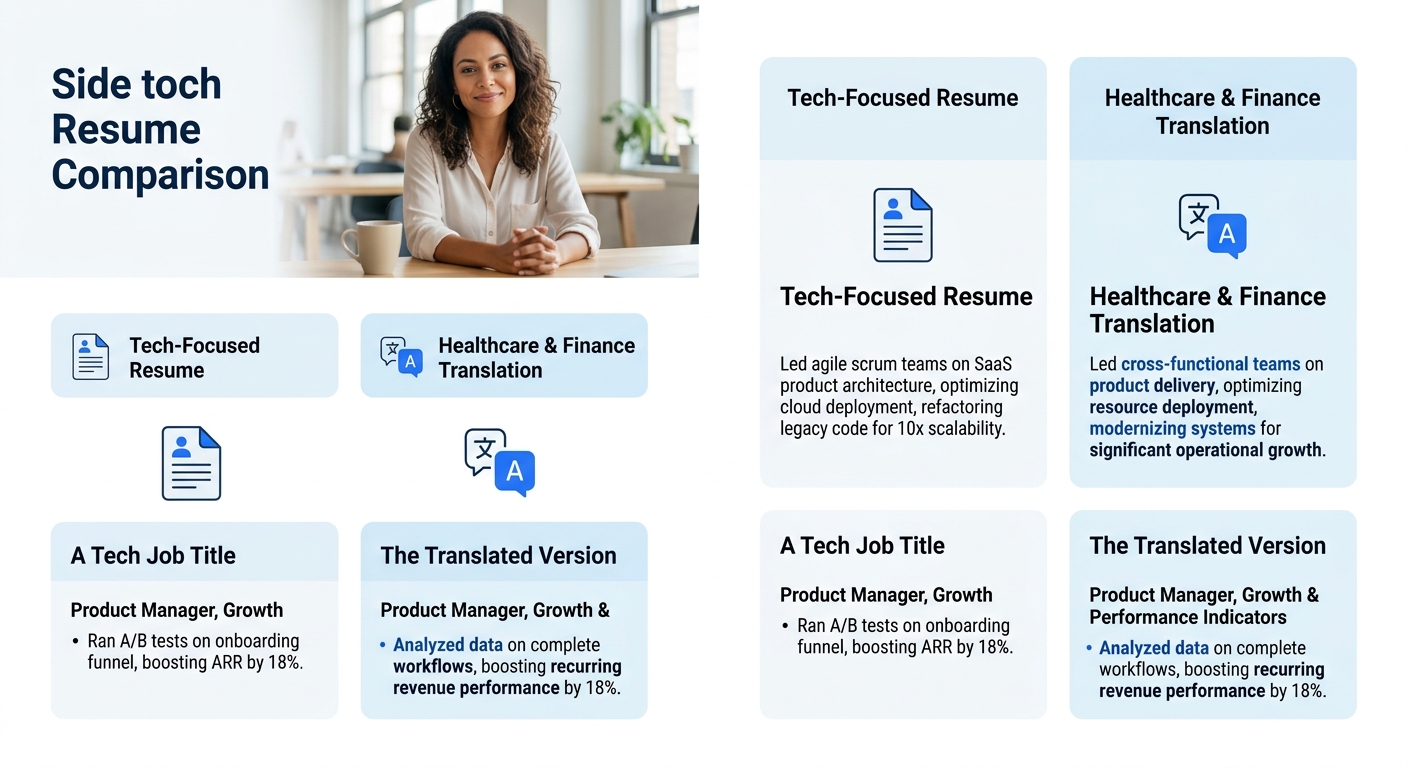
A career pivot after Microsoft Meta cuts sounds dramatic, but the resume mechanics are more about translation than reinvention. The skills you built at a tech giant are genuinely valuable in industries that are 3 to 5 years behind Silicon Valley’s automation curve. The challenge is that your resume currently speaks a language those hiring managers don’t understand.
A product manager at Meta who oversaw content moderation tooling has direct experience in compliance automation, risk scoring, and policy implementation at scale. A Microsoft Azure engineer who managed infrastructure provisioning understands exactly what a hospital system’s CTO needs for their EMR migration. But if the resume still says “Meta” across the top and lists internal codenames and acronyms, a hiring manager at UnitedHealth or JPMorgan’s tech division won’t connect the dots.
The rewrite here is deeper than Strategy 1. You’re reshaping your executive summary, retitling your role descriptions, and rebuilding your bullet points around the language of the target industry. If you’re wrestling with how your summary section should read at this level, there’s a useful breakdown of why buzzwords tank senior-level resumes that applies directly here.
The tradeoff: You’ll probably take a pay cut, at least initially. Tech compensation at Meta and Microsoft runs 20% to 40% above equivalent roles in healthcare, finance, and government. The offset is less competition: Brookings research on AI-driven job displacement found that workers with the highest AI exposure rates possess characteristics giving them higher capacity to navigate job transitions successfully. Your tech background is a genuine advantage in industries that are still figuring out how to adopt the tools you’ve been using daily.
And the job security calculus shifts. A 14% displacement rate among all workers affected by AI, as reported by National University’s AI job statistics analysis, hits hardest in pure-tech and creative fields. Industries with physical infrastructure, regulatory complexity, and in-person service components are much harder to automate.
Strategy 3: The Deep Specialist Doubledown
Why does this approach work when the other two are about broadening your appeal? Because some roles are so specialized that the talent pool is inherently small, and layoffs don’t change the underlying demand.
If your expertise sits in areas like security engineering, infrastructure reliability, database architecture, embedded systems, or developer tooling, the smartest resume move is often to go narrower rather than broader. The concept the industry calls “T-shaped” professionalism applies here: deep, expert knowledge in a core area combined with working knowledge of adjacent fields. Companies like Cisco (which is cutting 4,000 general roles while simultaneously investing heavily in AI infrastructure) still need the people who understand the plumbing underneath the AI layer.
The companies cutting thousands of generalist roles are simultaneously struggling to fill specialist positions that sit underneath the AI layer.
The resume rewrite for this strategy is the most technical of the three. You’re stripping out general project management language and replacing it with specific technologies, protocols, certifications, and measurable outcomes. Think version numbers, throughput metrics, uptime percentages, compliance frameworks. If you managed Kubernetes clusters handling 2 million daily requests at Microsoft, say exactly that. If you designed Meta’s internal authentication flow for 3 billion monthly active users, that number tells the story.
This approach pairs naturally with mapping upskilling into bullet points. Certifications in cloud security (CCSP, AWS Security Specialty), site reliability (Google SRE certification), or AI/ML infrastructure (MLOps-related credentials) signal that you’re investing deeper into your specialty rather than scrambling sideways.
The tradeoff: You’re betting on a specific market staying hot. If demand for your niche cools, you’ve optimized yourself into a corner. And the job search will be slower because there are simply fewer openings for highly specialized roles at any given time. You might wait 4 to 6 months for the right fit rather than 2 to 3 months for a generalist position.
How These Three Approaches Stack Up
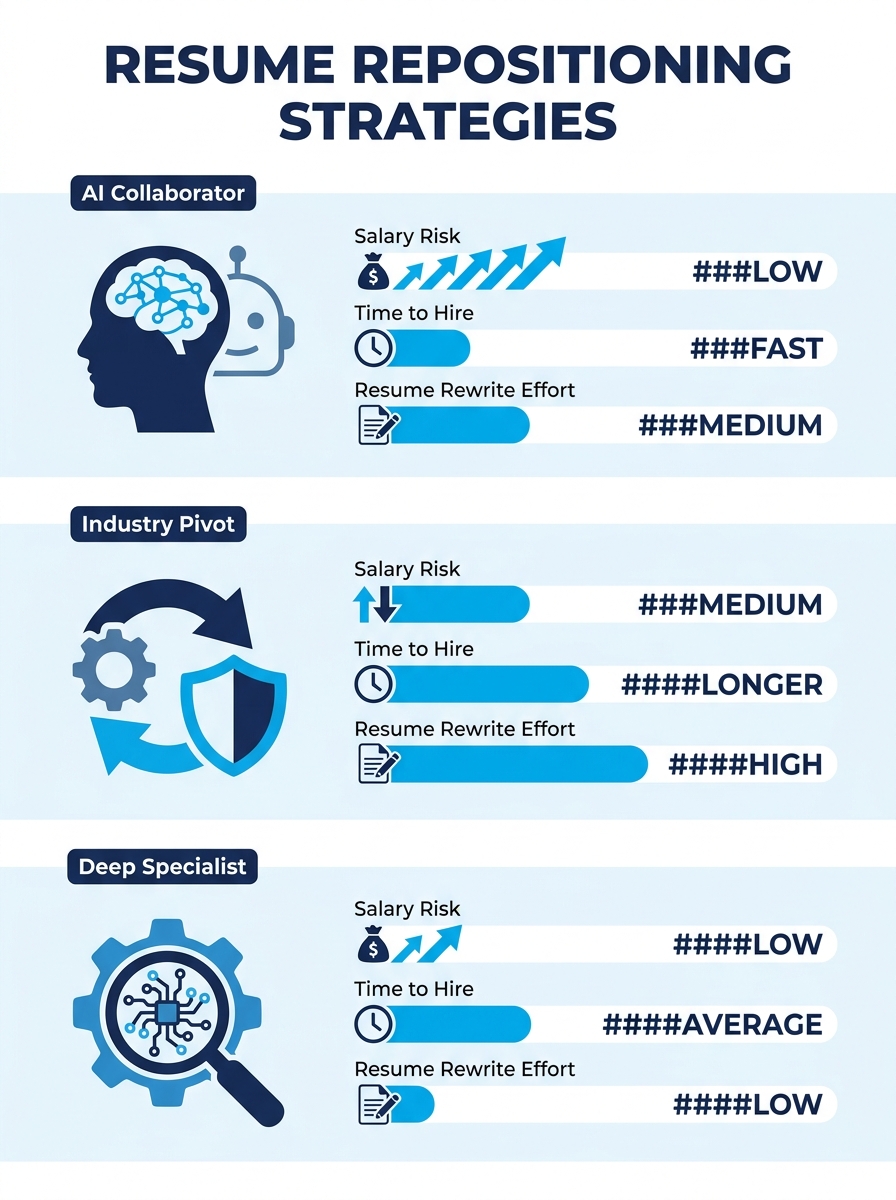
| AI Collaborator Reframe | Industry Pivot | Deep Specialist | |
|---|---|---|---|
| Resume rewrite effort | Moderate (reframe existing bullets) | Heavy (retranslate everything) | Moderate to heavy (add technical depth) |
| Target employers | Tech companies still hiring | Healthcare, finance, defense, government | Tech and non-tech orgs needing niche expertise |
| Salary risk | Low (comparable comp bands) | Moderate to high (20-40% cut possible) | Low (specialists command premiums) |
| Competition level | Very high (flooded talent pool) | Low to moderate | Low (small talent pools) |
| Typical time to hire | 2-4 months | 1-3 months | 4-6 months |
| Biggest risk | Getting lost in the crowd | Undervaluing your experience | Market shift in your niche |
Who Should Pick Which
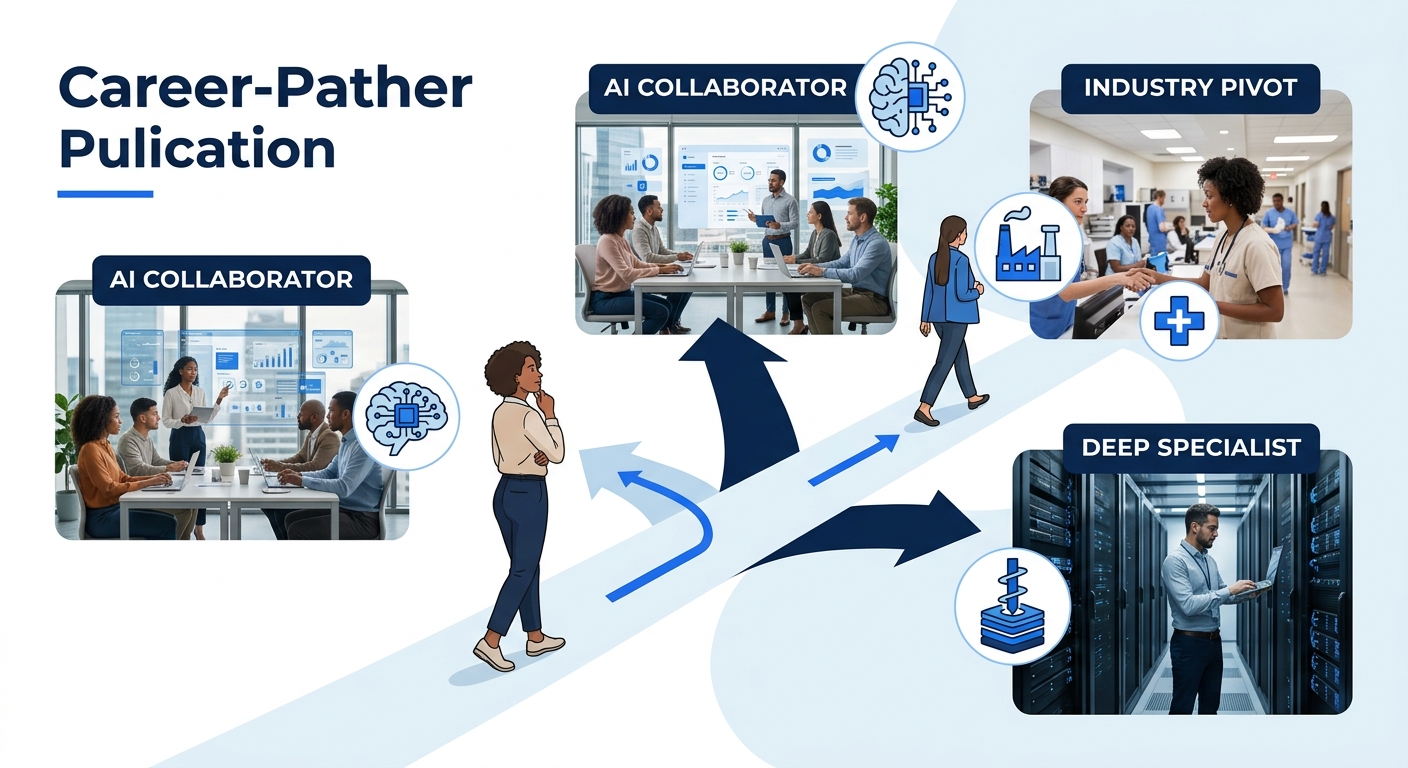
If you’re a generalist PM, designer, or full-stack engineer with 3 to 7 years of experience, the AI Collaborator reframe gets you back into tech fastest, but you need to differentiate aggressively. Every laid-off Meta PM is telling the same story right now. The ATS-to-hiring-manager translation gap is especially brutal when thousands of applicants are using identical AI-collaboration keywords. Your resume has to pass the algorithm and then stand out to a human who’s seen 50 versions of the same pitch today.
If you’re mid-career with 8+ years and some financial cushion, the industry pivot offers the strongest long-term positioning. You’re moving toward sectors where your skills are scarce and your experience is valued, rather than fighting for shrinking headcount at companies that have publicly stated they’re replacing your role with AI. Getting the translation right takes work, and if you’re feeling stuck on the rewrite, working with a professional resume service can accelerate the process significantly when the stakes are this high.
If you’re a senior-to-staff-level specialist with deep domain expertise, the doubledown strategy plays to your strengths. Just make sure you’re validating demand in your niche before committing. Search current postings for your exact specialty. If companies are hiring at your level, even at reduced volume, you’ll land well because the competition is thin. Meanwhile, use one of the best resume builders to make sure the formatting doesn’t undercut the substance of what you’re presenting.
And one final note that applies regardless of which path you choose: the resume reframing after job loss is genuinely the easier part of this process. Gregory K. Webster, Ph.D., who has navigated corporate downsizing at Bayer and Alpharma, describes three stages after layoff: getting yourself in order, getting your career in order, and moving on with your life. Most people try to skip stage one. If you need support during the transition period, we’ve written about why career coaching works as a strategic recovery tool after tech industry disruption, and the evidence strongly supports investing in that step before you overhaul a single bullet point.
The Meta and Microsoft cuts aren’t the last wave. AP News reported this week that the words “artificial intelligence” are showing up in more and more layoff notices across every sector. Your resume needs to account for that reality regardless of which door you walk through next.