


 4.9
4.9 4.5
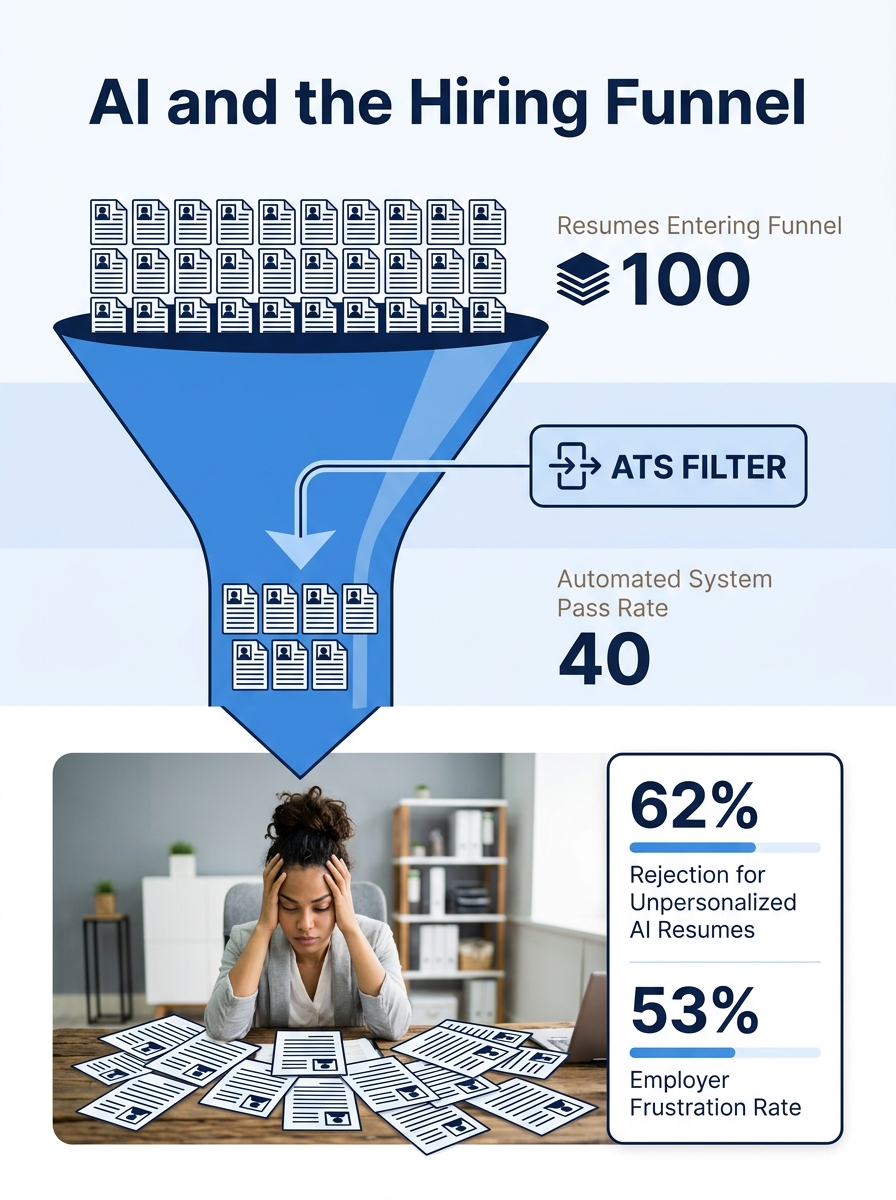
4.5Run the same product manager job description through five popular AI resume builders and the outputs converge on identical phrasing within seconds. The same action verbs, the same bullet structures, the same hollowed-out summary. A Resume Now employer survey found that 62% of employers reject AI-generated resumes that lack personalization.
TL;DR: One-click job matching tools produce resumes that pass keyword filters but read identically to hundreds of competing applications. With 62% of employers rejecting unpersonalized AI output and 53% reporting frustration with robotic-sounding content, you need concrete rules that protect what makes your candidacy distinct while still clearing ATS requirements.
That 62% rejection rate is the market correcting for a growing problem: algorithmic resume homogenization. AI resume customization tools are useful starting points, but their defaults flatten your career into the same template every other applicant is submitting. The six rules below help you use these tools without becoming invisible.
Recognize that hiring managers are drowning in identical resumes
The core ATS keyword optimization pitfall in 2026 isn’t failing to include the right terms. It’s that everyone includes the right terms now, and nobody stands out. As one HR professional put it on Reddit’s r/findapath, “my cousin works in HR and she said half the resumes they get look exactly the same now cause everyone uses ChatGPT.” Resumeble’s 2026 analysis of AI resume builders confirms the pattern: “If many applicants use the same design and similar phrasing, resumes start to blend together.”
Hiring manager fatigue with identical resumes is a documented, measurable phenomenon. The Resume Now survey found that 53% of employers are specifically frustrated by AI-generated content that feels impersonal or robotic. And recruiters are now spending roughly 11 seconds per resume before making a keep-or-reject decision. When your document looks structurally indistinguishable from every other document in the pile, those 11 seconds work against you.
This rule breaks when you’re applying to a high-volume entry-level role where format compliance genuinely matters more than differentiation. Government positions with rigid formatting requirements, think USAJOBS, are another exception. But for the vast majority of professional roles where 90% of recruiters use AI-powered screening tools (per LinkedIn’s Global Talent Trends data), sameness is the bigger risk than imperfect formatting.
Treat one-click output as raw material, never the finished product
USA Today reported that resume builders, by narrowing choices around formatting and structure, remove early hurdles: users move faster from “Does this look right?” to “Does this say what I mean?” That’s genuinely valuable. The resume builder limitations emerge when you skip the second question entirely and submit whatever the tool generates.
One-click job matching features analyze structured data (skills, experience, qualifications) and unstructured data (resume text, cover letters), then rank content by relevance to the posting. Modern matching algorithms process both categories simultaneously to produce relevance scores. These algorithms are good at identifying gaps in keyword coverage. They are consistently bad at preserving the specific, human details that separate your application from 200 others with the same keyword profile.
A practical test: after running any AI resume customization tool, read the output aloud. If you could swap in a different person’s name and the resume would still make sense, the tool has stripped your identity. The bullet “Led cross-functional team to deliver project on time and under budget” applies to thousands of project managers. The bullet “Coordinated 4 engineering pods across 3 time zones to ship the payment migration 2 weeks early, saving $340K in vendor overlap” belongs to exactly one person.
Tip: After every one-click customization pass, highlight each bullet containing a specific number, a named project, or a measurable outcome. If fewer than 60% of your bullets survive that test, the tool over-generalized your experience and you need to restore your original details.
Mirror exact phrases from the job posting without surrendering your story
ATS keyword optimization requires precision. The Interview Guys’ 2026 ATS guide puts it plainly: you need exact phrases from job descriptions, not synonyms or variations. A posting asking for “stakeholder management” will filter out resumes that say “client relationship building,” even when the underlying skill is identical. ATS scanners check 4 core areas, according to ResumeAdapter’s Optimization Hub: keyword match, compatibility, formatting, and missing skills.
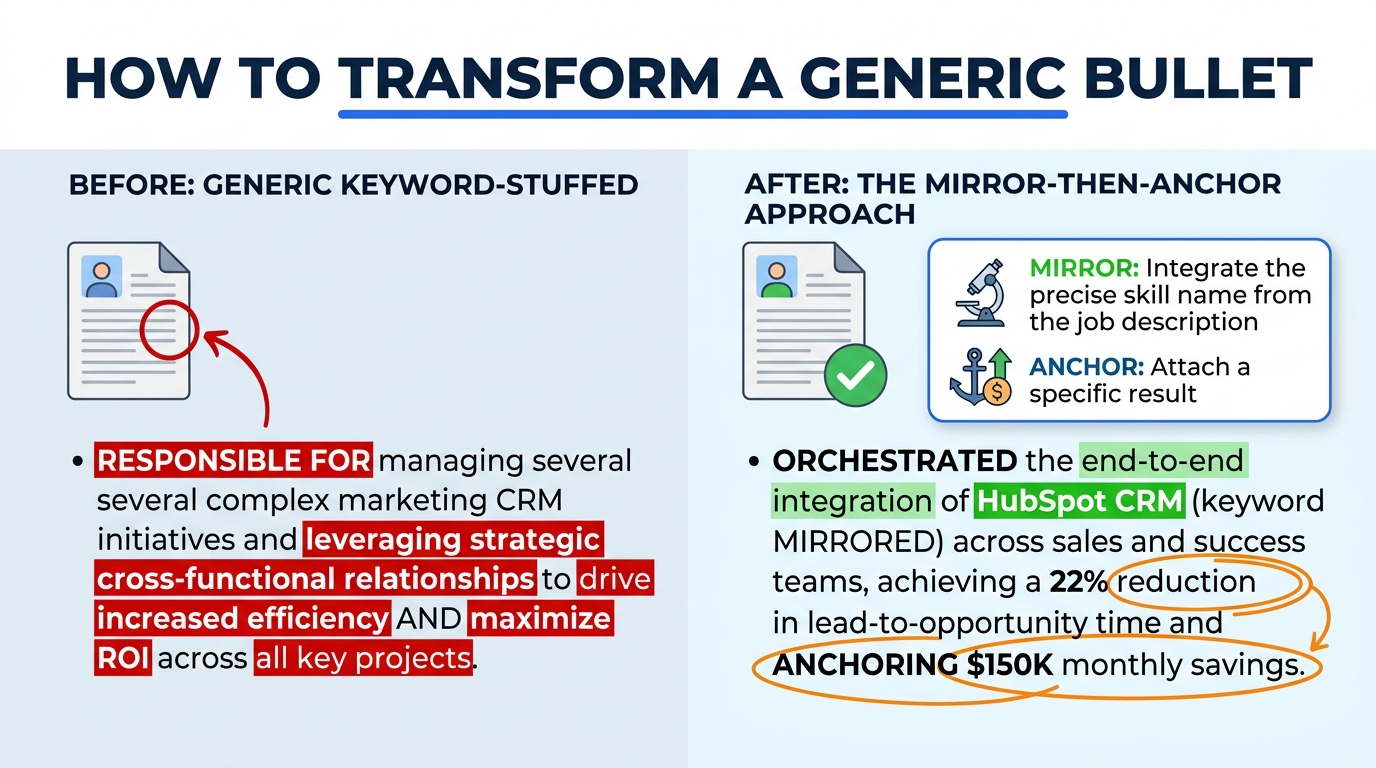
But here’s where candidates fall into the trap: they swap in the posting’s language and, in doing so, erase the context that made their experience compelling. The fix is a method I call the Mirror-Then-Anchor approach. Use the posting’s exact terminology (mirror), then immediately anchor it with a specific detail from your actual work.
Before: “Experienced in stakeholder management and cross-functional collaboration.”
After: “Managed stakeholder alignment across 6 department heads during the ERP rollout at Meridian Health, reducing sign-off delays from 3 weeks to 4 days.”
Both versions pass the ATS check for “stakeholder management.” Only one version makes a hiring manager pause during those 11 seconds. The gap between ATS optimization and human readability is exactly where most resume builder output fails. A QA professional on Reddit summarized the real issue: “ATS isn’t counting how many times you said ‘quality assurance.’ It’s checking if you have the terms they’re searching for at all. The problem most people have is they describe their work in generic terms when the job posting uses specific ones.”
Audit every AI-suggested bullet against something you actually did
The Times Square Chronicles reported on a growing paradox in hiring: candidates use AI to generate and optimize resumes, then employers use AI to screen those same resumes. The result is, in their words, “a strange loop, AI evaluating content that was often created by AI.” When everyone has access to tools that produce polished, keyword-optimized resumes, it becomes genuinely difficult to distinguish candidates who have the skills from those who know how to prompt a generator.
Some applicants have pushed this even further. Fisher Phillips LLP documented cases where candidates embed hidden instructions in white text to manipulate ATS screening tools, prompting employers to update their systems and, in some cases, automatically reject any submission with hidden formatting. This technological arms race benefits nobody applying in good faith.
The audit rule is simple: for every bullet your resume builder suggests, ask whether you can describe the situation, your specific action, and the result in a 30-second conversation. If you can’t, the bullet doesn’t belong on your resume. Hiring managers probe resume claims in interviews, and this connects directly to the broader escalation in AI resume sorting reshaping how employers evaluate candidates. A bullet you can’t defend will damage trust faster than a gap on your resume ever would.
For every bullet your resume builder suggests, ask whether you can describe the situation, your specific action, and the result in a 30-second conversation. If you can’t, cut it.
Maintain at least three role-specific resume versions
The “one perfect resume” is a myth that AI resume customization tools accidentally reinforce. When you feed a single master document through a one-click matcher for different roles, the tool tweaks keywords but preserves the underlying structure. The output ends up about 15% different across applications while reading as generically “optimized” to anyone who reviews multiple applicants.
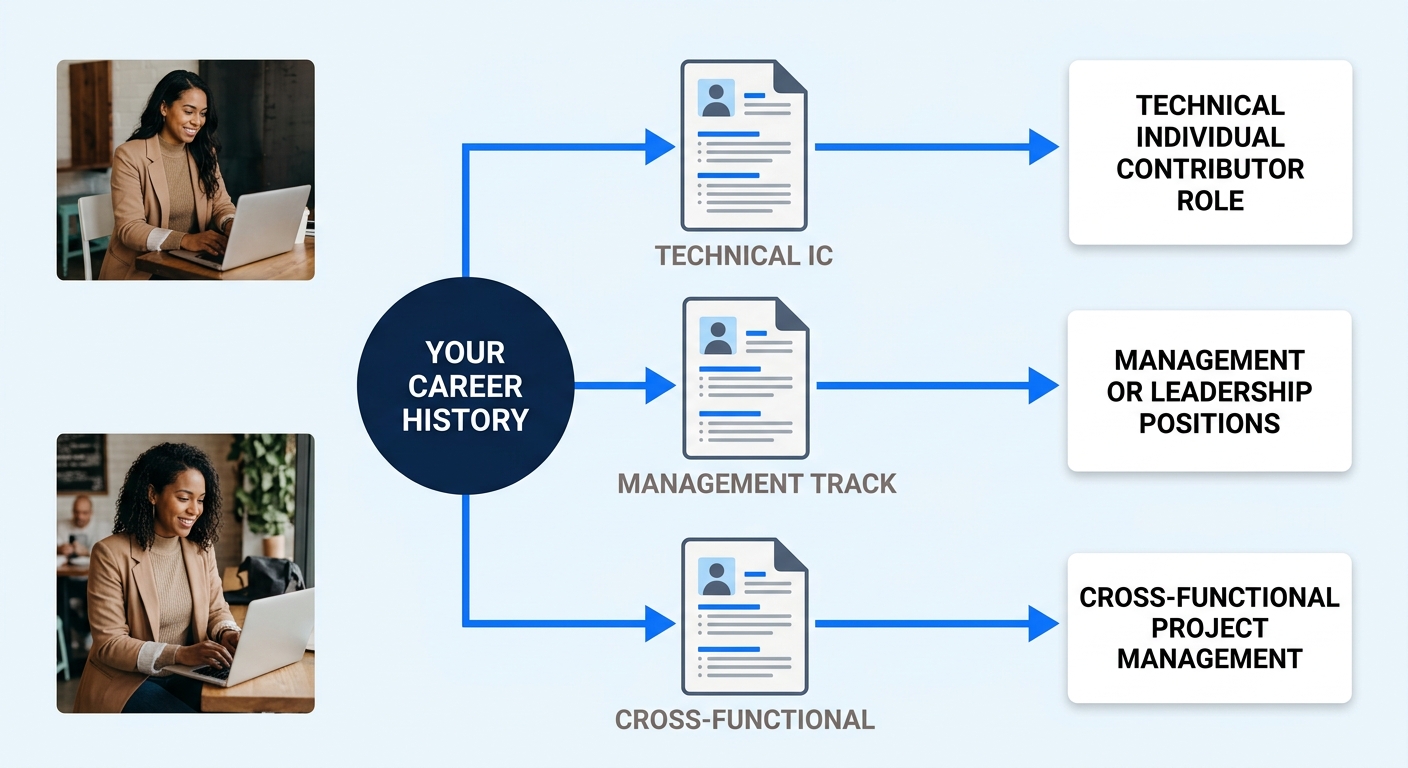
Build a minimum of 3 distinct base versions, each structured around a different value proposition. A senior engineer applying to both IC and management-track roles needs fundamentally different framing, not the same resume with “team leadership” keywords swapped in. The choice of which resume builder features matter shifts depending on your career stage and the types of roles you’re targeting.
Here’s what each version should emphasize differently:
| Resume Version | Lead Summary Focus | Bullet Emphasis | Skills Section Priority |
|---|---|---|---|
| Version A (IC/Technical) | Technical depth, specific tools, system-level impact | Architecture decisions, performance metrics, code-level contributions | Hard skills, certifications, tool proficiency |
| Version B (Management) | Team scale, delivery outcomes, stakeholder alignment | Headcount managed, budget figures, cross-team coordination | Leadership competencies, process frameworks |
| Version C (Cross-functional) | Breadth of impact across departments | Revenue influence, customer outcomes, strategic initiatives | Hybrid technical and business skills |
Run each version through your preferred keyword alignment tool separately. Customize from the version closest to the target role, not from a single master document.
Always verify that your formatting survives the ATS parse
Formatting failures are silent killers. One Reddit user in r/findapath discovered that “half my bullet points and information were getting cut off by ATS” because of formatting issues, problems they only found after switching to a dedicated resume builder and running a parse check. The ResumeAdapter ATS Optimization Hub identifies 4 specific areas that ATS scanners evaluate: keyword match, compatibility, formatting, and missing skills. A failure in any single category can mean automatic rejection before a human ever sees your name.
Run your finished resume through at least one free ATS scanner before every submission. Confirm that section headers parse correctly, that your bullet points aren’t truncated, and that your contact information populates the right database fields. A resume with 95% keyword coverage is worthless if the parser reads your “Professional Experience” section as a single unformatted block of text.
This rule applies universally. Even if you’ve ignored every other guideline here because your situation is unusual, verify formatting. It’s the area where resume builder limitations create problems you’ll never learn about, because the rejection happens silently and automatically.
When These Rules Break Down
These rules assume you’re applying to roles where both ATS screening and human review exist in the pipeline. That covers roughly 90% of professional hiring. But real exceptions exist, and ignoring them would be as rigid as the resume builders this article critiques.
If you’re responding to a direct referral where a hiring manager already has your name, keyword optimization matters less and storytelling matters more. If you’re in a creative field where portfolio work carries the primary weight (as explored in the discussion of the architecture portfolio resume paradox), the resume functions as a supplement rather than the main document. And if you’re applying to early-stage startups with no formal ATS, a clean one-page narrative resume with zero keyword engineering sometimes outperforms a heavily optimized application.
The constant across every situation is this: your resume needs to sound like a specific human wrote it about specific work they actually performed. AI resume customization tools can accelerate the process of tailoring that document to different audiences. They cannot create the underlying human document for you, and 62% of employers are actively penalizing applicants who let the tool do too much of the writing. Templates get you past the filter. Specific, verifiable details about your actual contributions are what get you the interview.