

 4.9
4.9 4.5
4.5ATS software parses your resume by identifying standard section headings like “Work Experience,” “Education,” and “Skills,” then extracting keywords from each section independently. A certification placed in the wrong section can be invisible to the recruiter’s search query, no matter how relevant that credential actually is to the role.
TL;DR: Your continuous learning entries need to land in the specific resume sections where ATS parsers actually look for them. A certification buried in a summary paragraph or shoved into “Work Experience” gets misclassified during keyword extraction. This audit framework covers which credentials go where, which ones to cut entirely, and how section-level parsing determines whether your upskilling helps or hurts your candidacy.
How ATS Parsing Assigns Your Credentials to Sections
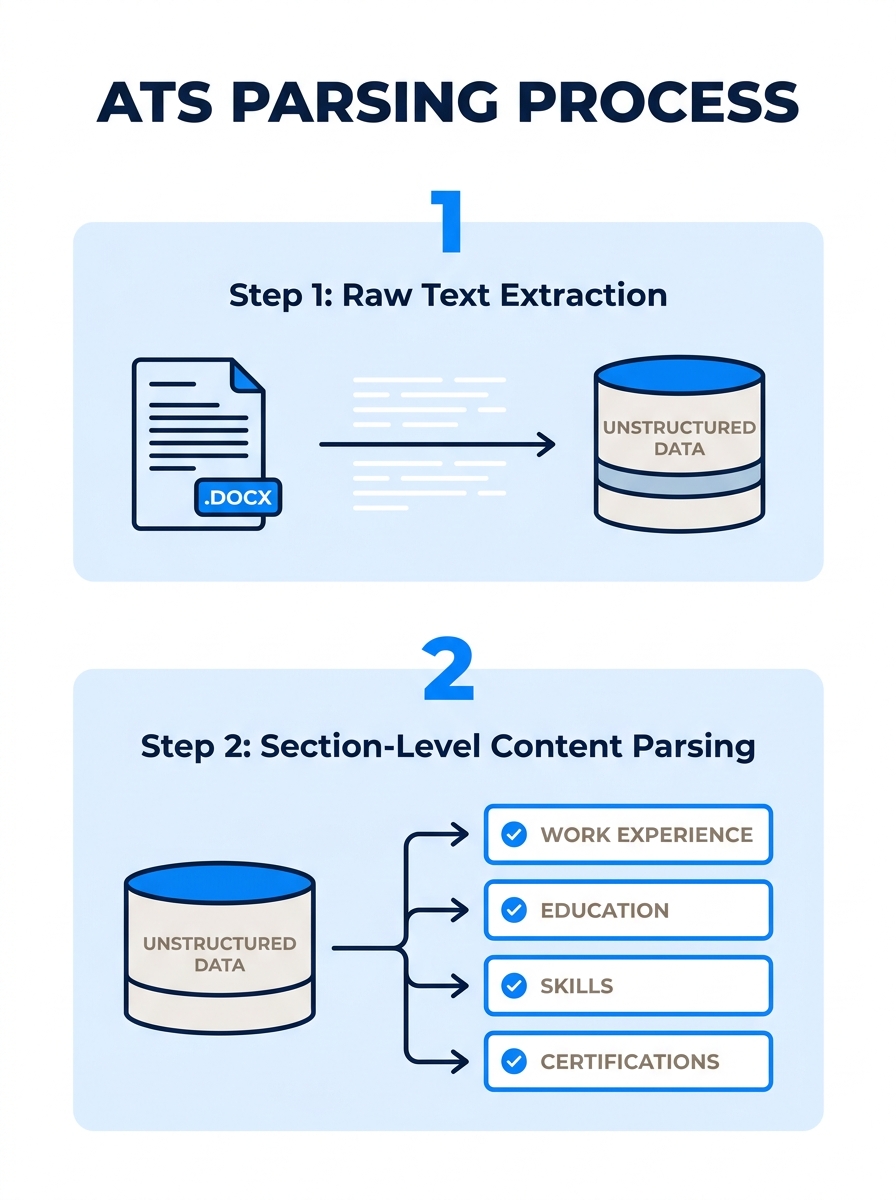
When you upload a resume, the ATS doesn’t read it the way a human does, top to bottom with context awareness. It performs text extraction first, pulling information out of your file and organizing it into a database. Then it parses, identifying segments of your resume by matching section labels to its expected categories: “Work Experience,” “Education,” “Skills,” and so on.
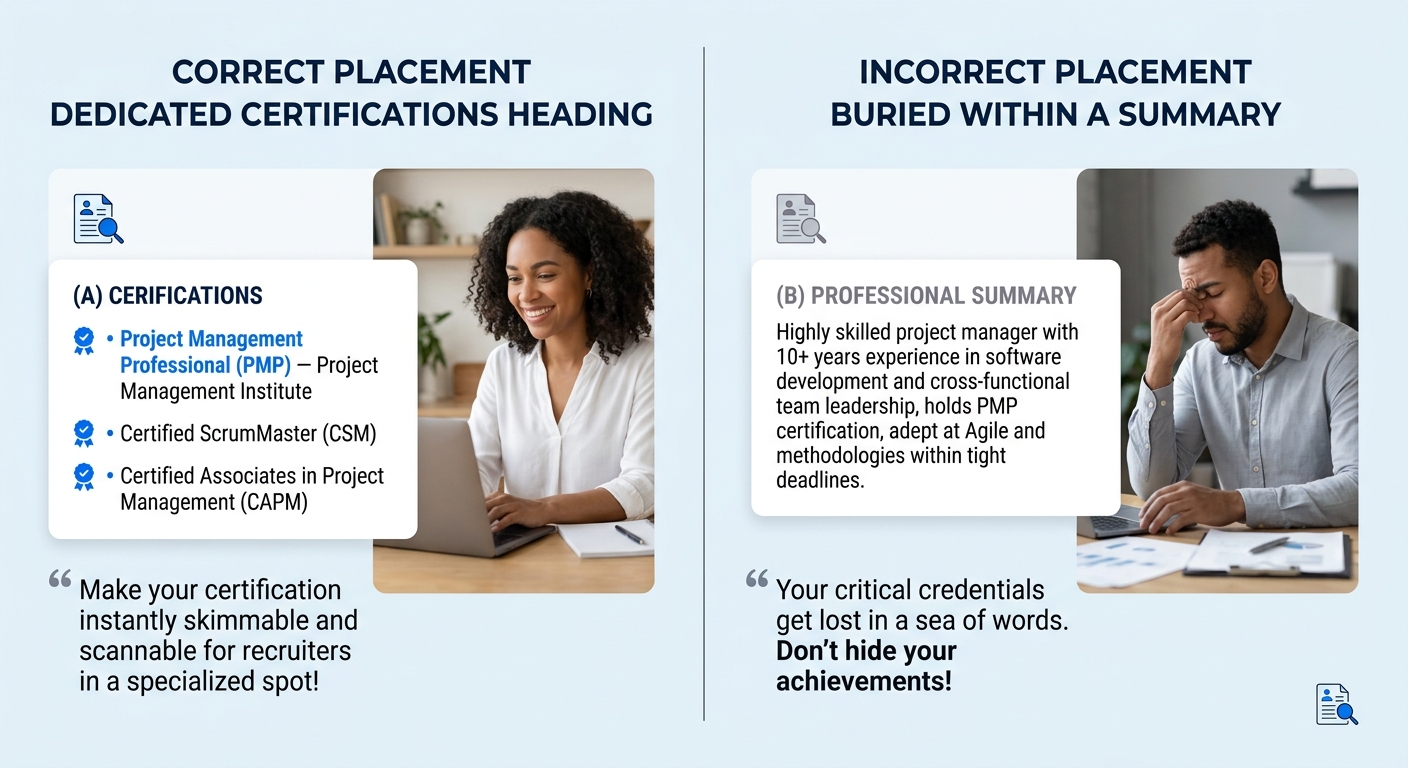
This two-step process means the system treats each section as its own container. A Google Data Analytics Certificate listed under your “Professional Summary” paragraph won’t be parsed as education or as a certification. The ATS has no reason to look for credentials there. It’s reading that block for job titles, years of experience, and keyword density, not for proof of coursework. According to Indeed’s ATS formatting guidance, standard section headings are what the system relies on to “pinpoint your qualifications, such as years of experience or hard skills.”
The implication is mechanical: credential positioning for ATS depends entirely on which section label sits above the entry. Place the same certification under three different headings, and the parser will classify it three different ways. Only one of those placements will match what the recruiter’s keyword search is scanning.
The Three-Bucket Sorting Test
Every piece of continuous learning on your resume belongs in one of three buckets. Sorting incorrectly is how 96% of hiring managers who prioritize evidence of recent skill development, per LinkedIn’s 2024 Talent Report, end up never seeing yours.
Bucket 1: Dedicated Certifications Section. Formal professional certifications with an issuing body, an expiration date, and industry-recognized acronyms (PMP, AWS Solutions Architect, CPA, SHRM-CP) go here. These are the credentials recruiters type into ATS search fields. They need their own section labeled “Professional Certifications” or “Licenses and Certifications.” Each entry should include the credential name spelled out, the issuing organization, the date earned, and a credential ID or verification link if you have one. As LockedIn AI’s 2026 certification guide notes, “Recruiters usually know what the prerequisites are and set the ATS systems accordingly.”
Bucket 2: Education Section (Renamed). Certificates from universities, MOOCs, and structured programs that required coursework but don’t confer a professional license belong under education. Career coach Yurovsky recommends renaming your education section to “Education and Certifications” when you’re including these entries. A 6-month data science certificate from a university is closer to education than it is to a professional license, and the parser treats it accordingly.
Bucket 3: Skills Section (Or Nowhere). Short courses, workshops, webinars, and micro-credentials under 20 hours of instruction rarely warrant their own line item. The skills they taught you belong in your skills section as keywords. The course name itself usually doesn’t. If a 4-hour LinkedIn Learning course on SQL taught you enough to use SQL at work, list “SQL” in your skills section and demonstrate it in your work experience bullets. The course title adds no value to the ATS scan and takes up space a human reviewer will notice.
Tip: Limit your certifications section to 3 to 5 entries directly relevant to the target role. A resume listing 12 certifications across unrelated fields reads as unfocused, and Resume Worded’s placement research confirms that irrelevant certifications can hurt more than help because they dilute the keyword signal the ATS is looking for.
Why the Distinction Between Certifications and Certificates Matters for Placement
This is where resume skills section optimization gets tricky. A certification (PMP, CPA, Series 7) is issued by a professional body, typically requires passing an exam, and often needs renewal. A certificate (Google UX Design Certificate, HubSpot Content Marketing Certificate) is issued after completing a course or program. Individual companies may require certain certificates when hiring for specific roles, but as Harvard Career Services points out, “you generally aren’t shut out of a career without one.”
The practical resume consequence: certifications get their own section because recruiters search for them by acronym. Certificates get folded into education or, when they’re short enough, converted into skills-section keywords. Indeed’s hiring data shows that listing a certification “verifies your relevant skillset and commitment to the industry” and “may make up for what you lack in practical experience,” making placement in a clearly labeled, parsable section worth the 2 minutes it takes to set up.
If you’ve been running AI-assisted resume audits, this is one of the gaps automated tools catch well: credentials sitting in sections where no parser or recruiter search will find them.
Stackable Credentials and the Sequencing Problem
Stackable credentials (short, focused learning experiences designed to build on one another) create a specific resume problem. You might hold 4 or 5 certificates that represent a coherent learning path, but listed individually, they look like scattered upskilling with no direction.
Bellevue University describes stackable credentials as building blocks that “let you build knowledge step-by-step, earning meaningful credentials along the way.” Complete College America’s research frames them as sequential qualifications that “allow students to accumulate qualifications over time while advancing toward higher-paying employment opportunities.” And Assessment Systems’ analysis confirms that stackable credentials “provide incremental steps for career advancement” as professionals build a diverse skill set.
The resume fix is structural. When you hold 3 or more credentials in a single learning path, group them under one parent heading within your Education and Certifications section. For example:
Google Cloud Professional Path (2024–2026)
- Associate Cloud Engineer, Google Cloud, May 2024
- Professional Cloud Architect, Google Cloud, January 2025
- Professional Cloud DevOps Engineer, Google Cloud, March 2026
This grouping communicates intentional progression instead of random course-collecting. It also concentrates your keyword density for ATS matching: the parser sees “Google Cloud” three times in a single cluster rather than scattered across different resume sections. A strong continuous learning resume strategy shows direction, and grouping is how you signal that direction to both algorithms and humans.
The parser sees “Google Cloud” three times in a single cluster rather than scattered across different resume sections. Grouping communicates intentional progression instead of random course-collecting.
For career changers specifically, this sequencing approach pairs well with translating experience into ATS-friendly language, because the credential stack validates the pivot while your rewritten experience bullets provide the proof.
What to Cut Entirely
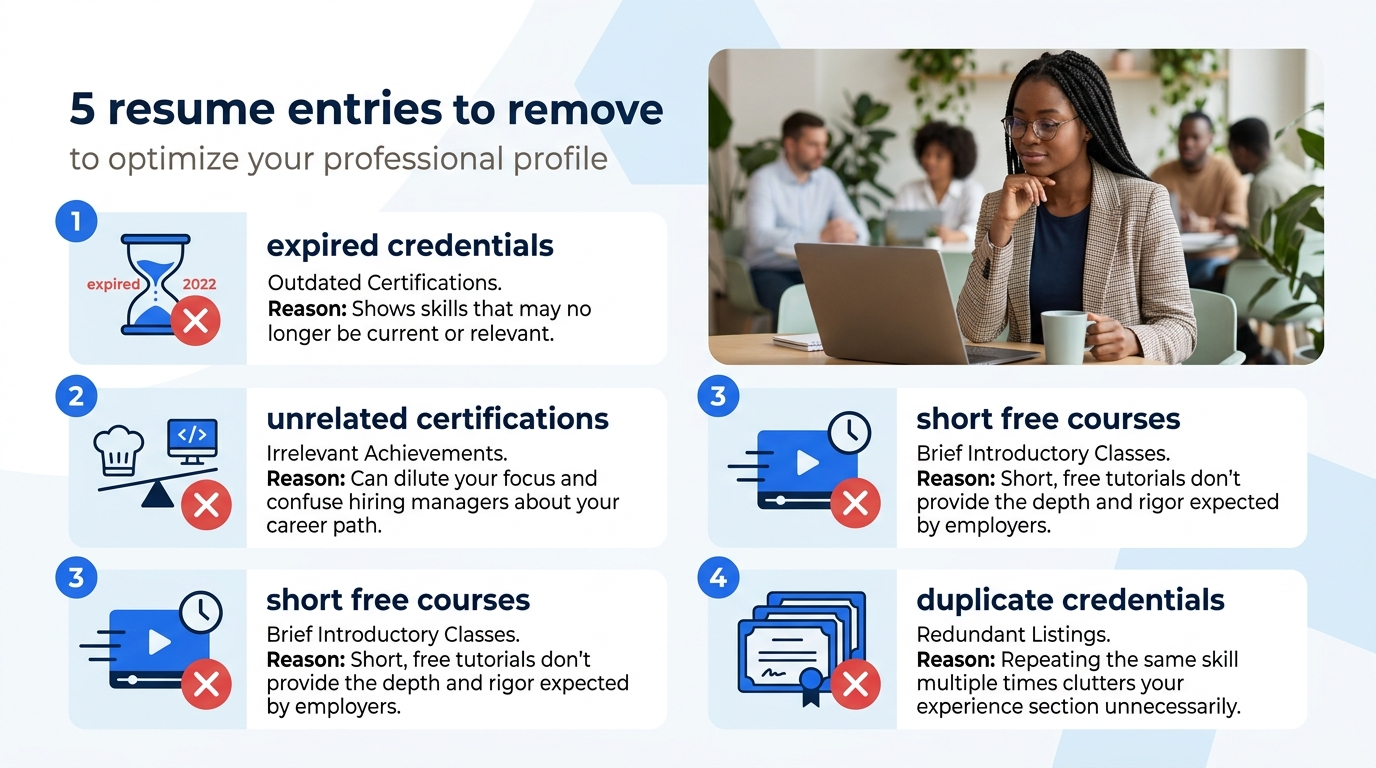
The audit isn’t finished when everything’s sorted into the right section. Some entries need to come off your resume altogether. Here’s where upskilling doesn’t belong, period:
Expired credentials with no renewal. A CCNA you earned in 2017 and never renewed signals outdated knowledge. If the certification body requires recertification and you haven’t done it, remove the entry. A hiring manager checking the credential’s validity will see it’s lapsed, and the ATS keyword match won’t help you survive that scrutiny.
Credentials unrelated to the target role. A yoga teacher certification on a financial analyst resume occupies space where a relevant skill could go. Resume Worded’s guidance is direct: certifications “should only be included if they’re relevant to the job.” The keyword match might even hurt you, since nearly 90% of employers now use AI-based resume filtering, and irrelevant keyword clusters can confuse relevance scoring.
Free courses under 10 hours with no assessment. A 2-hour webinar on “Introduction to Machine Learning” doesn’t demonstrate competency. If there was no exam, no project, and no graded assessment, it’s padding. Cut it and use the skills section to list the actual tools you learned, paired with a work experience bullet showing you applied them. Converting vague learning into measurable outcome statements is a more effective use of that resume real estate.
Duplicate credentials at different levels. If you hold both Google Analytics Individual Qualification and Google Analytics 4 Certification, list only the more advanced or more recent one. Stacking both tells the recruiter nothing except that you took two tests on overlapping material.
Where This Mechanism Breaks
The three-bucket model works cleanly for traditional roles with established certification ecosystems. It gets messier in three specific scenarios.
Emerging fields without standardized credentials. AI engineering, prompt design, and climate tech don’t yet have universally recognized certifying bodies. A “Certified Prompt Engineer” credential from a startup bootcamp carries different weight than a PMP from PMI, and ATS systems don’t distinguish between them. In these cases, professional certifications placement matters less than demonstrating the skill through project work and quantified impact bullets. You’re better off linking to a portfolio than listing a credential the recruiter hasn’t heard of.
Roles that value breadth over depth. Product managers, consultants, and generalist operators often hold credentials across 4 or 5 domains. The three-bucket sort might tell you to list all of them, but a hiring manager scanning your resume for 6 to 7 seconds (the average first-pass review time documented across multiple recruiter surveys) won’t process that many. The model can’t tell you which 3 credentials to keep and which 2 to drop. That requires reading the job description and making a judgment call. Tools like Jobscan’s match rate feature can help you “visualize and quantify how closely your resume aligns with the job description,” but the final edit is yours.
Internal mobility candidates. If you’re applying within your current company, the ATS is often the same system your HR team uses to track your existing certifications. Your internal profile may already show credentials that an external resume would need to list. The mechanism described here is designed for writing resumes that satisfy both ATS algorithms and human reviewers in external job searches. Internal moves play by different rules, and stacking your resume with credentials your manager already knows about can read as padding rather than preparation.
The audit itself is straightforward: pull every learning entry off your resume, sort it into the correct bucket, check that each bucket maps to the right section heading, and cut whatever doesn’t serve the target role. The mechanism underneath, section-level ATS parsing, is what makes placement matter more than the credential itself. A well-earned certification listed in the wrong section is functionally invisible. A mid-tier certificate listed in the right one gets found.