
 4.9
4.9 4.5
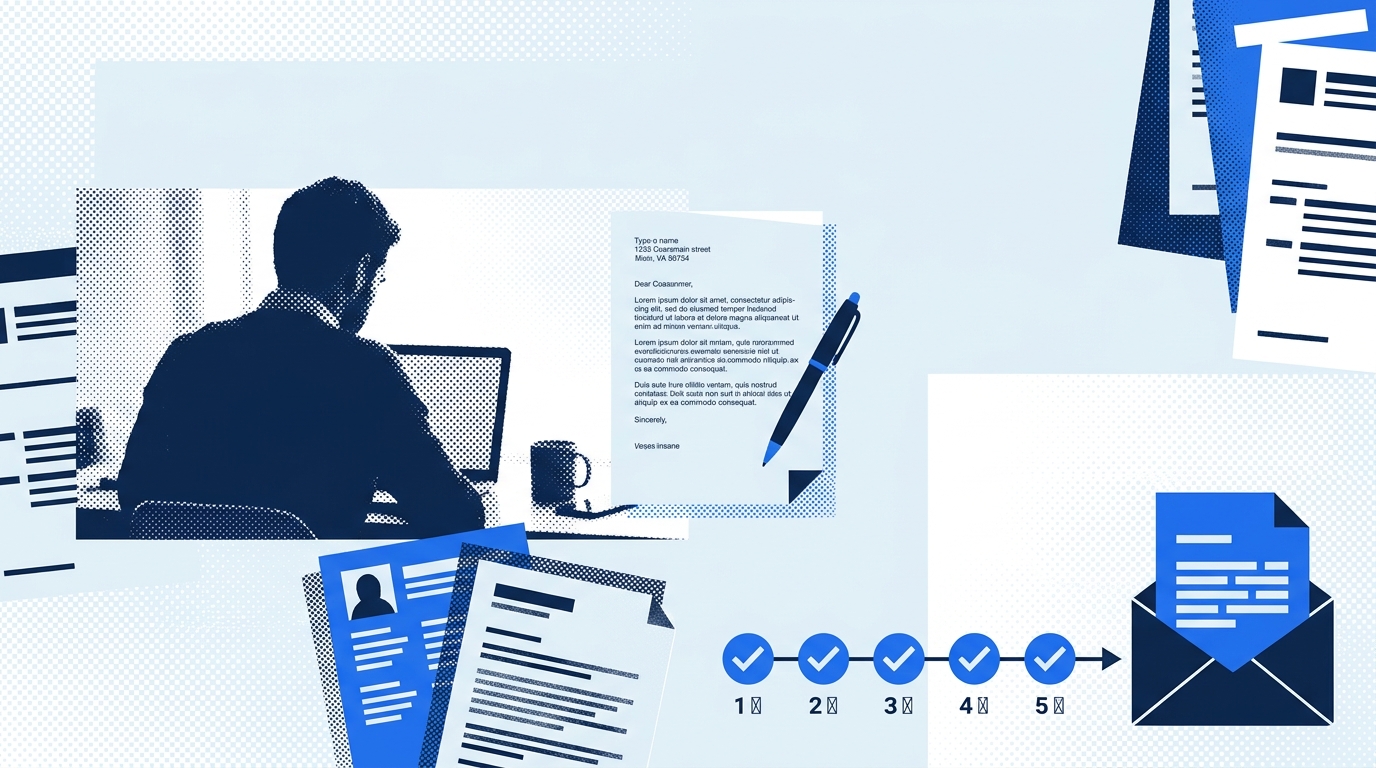
4.5Recruiting surveys show 39.9% of hiring managers read cover letters after reviewing a resume, and 25.6% say a strong letter tips the decision on borderline candidates. This guide walks you through building a tailored cover letter from professional samples in five steps, about 30 minutes total.
TL;DR: Find a proven cover letter sample that fits your experience level, then customize it section by section using the job posting as your script. Keep it to 250–400 words, lead with a specific achievement, and close with a direct interview request.
Before You Start
You need three things before touching a blank document. First, the full text of the job posting you’re applying to, copy it into a separate file so you can reference it line by line. Second, your current resume, because you’ll pull specific numbers and achievements from it. Third, access to 2–3 cover letter samples in your target field.
For samples, Indeed’s library organizes free cover letter templates by job title, which makes finding your industry straightforward. Zety and ResumeGenius each maintain collections of over 200 examples written by Certified Professional Resume Writers (CPRWs), spanning entry-level to executive roles. You don’t need to buy anything, free samples work fine as structural guides. If you’ve already browsed our ready-to-use sample templates, grab one of those as your starting framework.
Time commitment: 25–35 minutes for the full process. Tools needed: a word processor (Google Docs, Word, or similar), the job posting, and your resume. Knowledge level: no prior cover letter experience required.
Step 1. Pick a Sample That Matches Your Experience Level
The right sample saves 15–20 minutes of structural guesswork. You’re looking for a letter that mirrors your career stage, entry-level, mid-career, or senior, and your general industry category.
For entry-level applicants or recent graduates with limited work experience, Indeed’s entry-level cover letter guide provides samples that emphasize academic projects, internships, and volunteer work rather than years of job history. Mid-career professionals should look for samples that lead with quantified results (revenue generated, projects completed, teams managed). Senior or executive applicants need samples that demonstrate strategic impact across an organization.
Pick one sample. Reading 15 samples creates analysis paralysis. You need a structural blueprint, and one good match gives you that.
You’ll know it worked when: you can point to 3–4 structural elements in your chosen sample (greeting format, opening hook, body paragraphs, closing ask) that feel natural for your experience level.
Step 2. Map the Job Posting to Your Letter’s Body
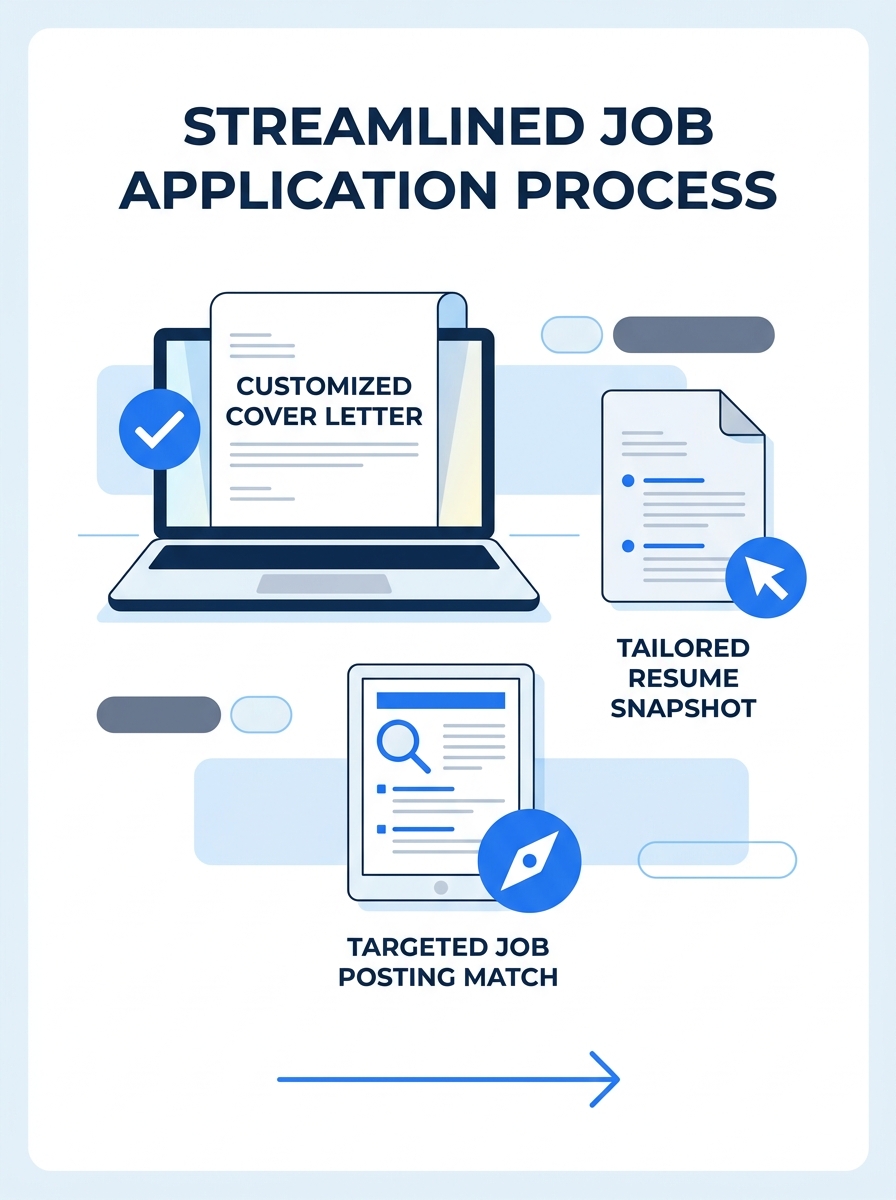
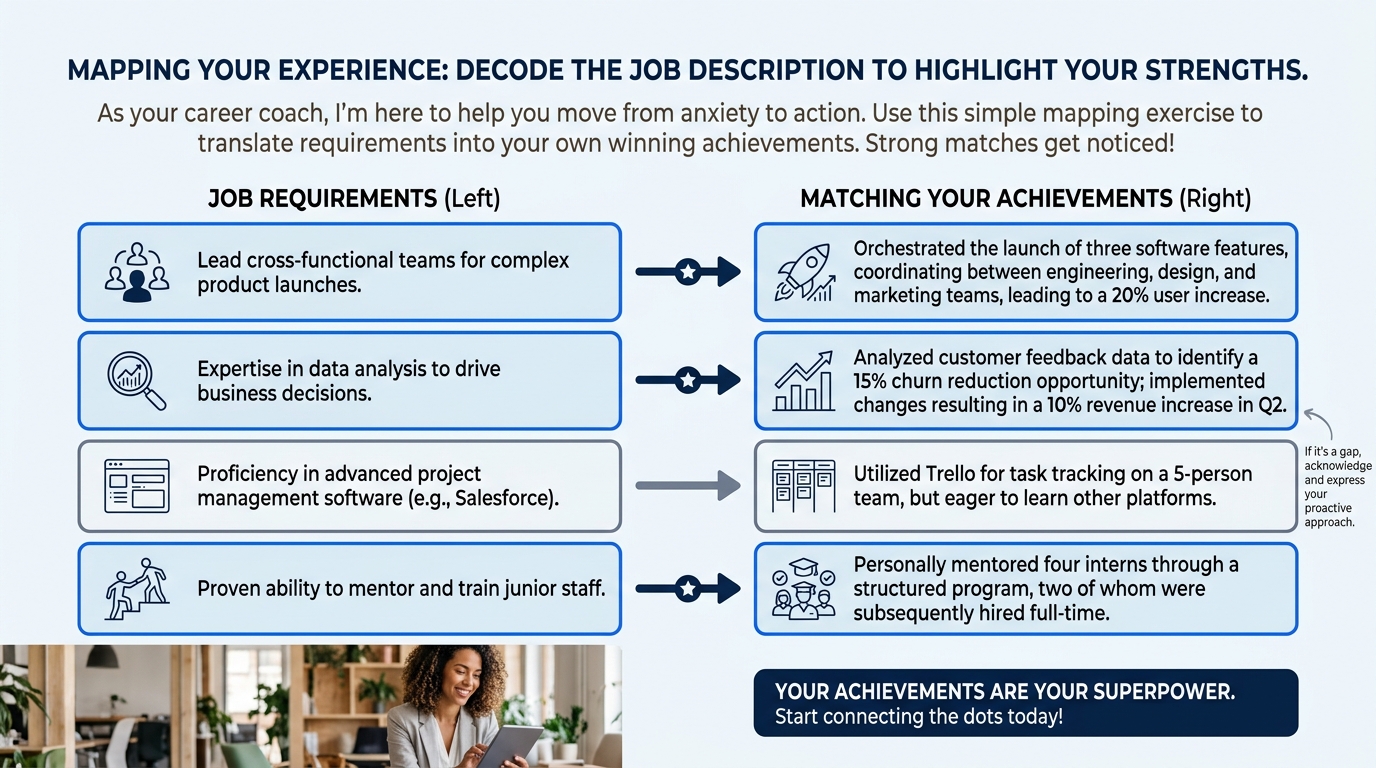
Open your chosen sample side-by-side with the job posting. Highlight the 3–5 most important requirements listed in the posting, these typically appear in the first few bullet points or get repeated in different sections of the description. The University of Michigan Career Center advises applicants to “describe your qualifications for the type of position you seek using specific examples from academic, work, volunteer, and/or co-curricular experiences.” This mapping step is how you make that concrete.
Create a simple two-column list (on paper or in a note):
| Job Requirement | Your Matching Evidence |
|---|---|
| “3+ years project management” | Led 4 cross-functional projects at [Company], 2023–2025 |
| “Experience with Salesforce” | Managed Salesforce CRM for 200+ client accounts |
| “Strong communication skills” | Presented quarterly reports to C-suite (12 presentations) |
You want 3–5 rows. Two feels thin. Six or more won’t fit in a 250–400 word letter, which is the widely recommended length for cover letters according to current hiring data. MIT’s career advising office specifies the letter should fit on a single page with a font size between 10 and 12 points.
You’ll know it worked when: every major requirement in the posting has a corresponding proof point from your background. If you’re missing evidence for a top requirement, that’s a useful signal, address the gap honestly in your letter or reconsider whether this role is the right fit.
Step 3. Write an Opening That Earns the Second Sentence
This is where most cover letters die. Survey data shows 38.9% of hiring managers skip cover letters entirely, so the readers who do engage are looking for a reason to keep going within the first line. Generic openers like “I am writing to apply for the position of…” give them a reason to stop instead.
Your opening sentence should do one of three things: name a specific result you’ve achieved that connects to the role, reference something concrete about the company that drew you to apply, or state the value you bring in a single declarative sentence.
Strong opening examples drawn from professional samples for cover letter guidance:
- “Managing a $2.4M digital advertising budget at [Company] taught me that conversion optimization is a math problem, and the Marketing Manager role at [Target Company] is the exact equation I want to solve next.”
- “Your team’s expansion into APAC markets caught my attention because I spent 3 years building distribution partnerships across Southeast Asia for [Company].”
And here’s what to avoid. Zety’s career writing team flags passive hedging directly, recommending that applicants “opt for action verbs and strong phrasing that convey confidence” instead of openers like “I believe I might be a good fit for this role.”
You’ll know it worked when: your opening sentence contains at least one specific detail, a number, a company name, a project, that couldn’t be copy-pasted into a letter for a different job.
Step 4. Fill the Body With Measurable Proof
The body of your cover letter, typically 2–3 paragraphs totaling 150–250 words, is where you connect your mapping table from Step 2 to a narrative. Each paragraph should anchor around one achievement and link it directly to something the employer needs.
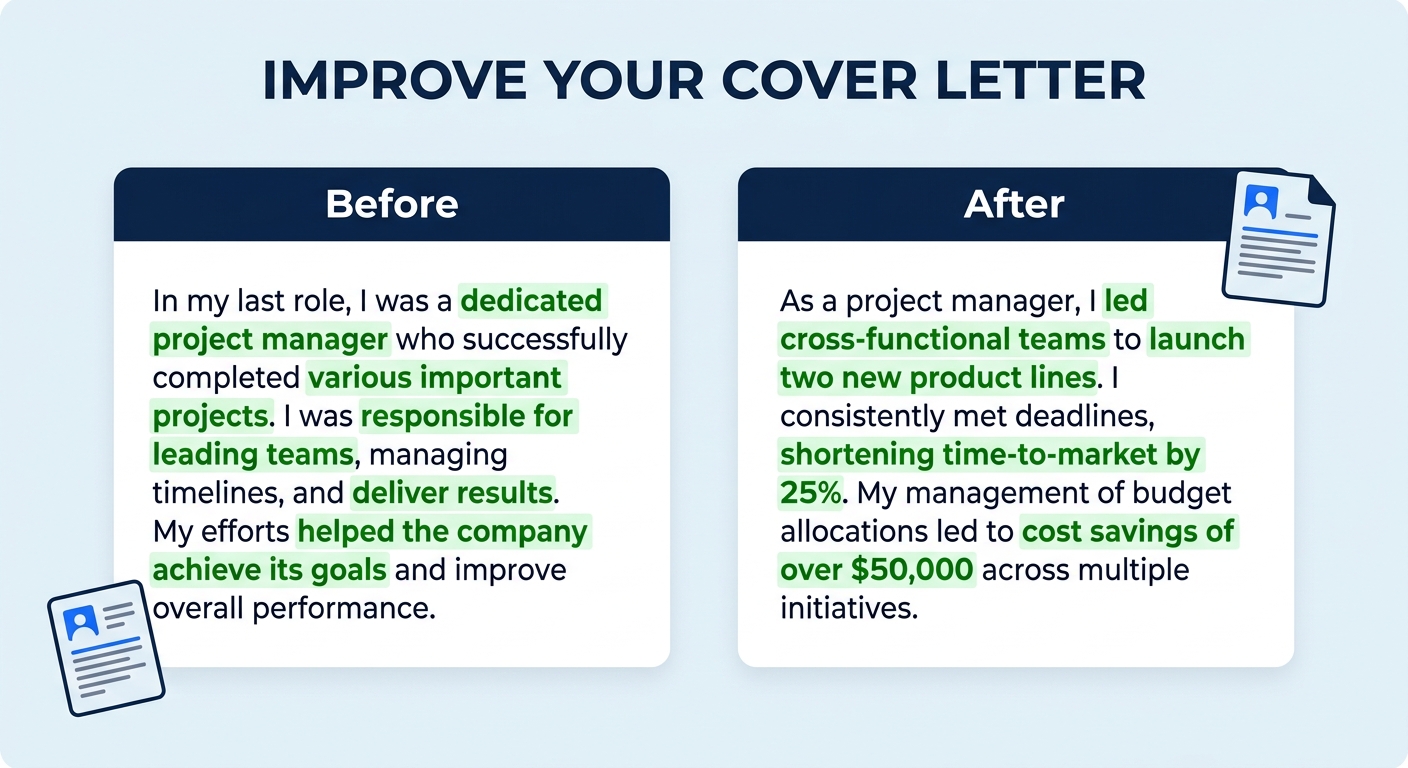
Follow this formula for each body paragraph: Context (where you were, what the challenge was), Action (what you did, specifically), Result (what changed, with a number if possible). You’ve seen this pattern across most professional samples of cover letter collections, and it works because it mirrors how interviewers evaluate candidates. They want evidence, not assertions.
Example body paragraph from a mid-career marketing sample:
“At Meridian Digital, I inherited a paid search account with a 1.8% conversion rate and a $340K annual spend. Over 14 months, I restructured the campaign architecture around long-tail keywords and rebuilt the landing pages. Conversion rate climbed to 4.1%, and cost per acquisition dropped 38%.”
That’s 52 words. It contains 5 specific numbers. It tells a story. And it directly addresses common job requirements for marketing roles, campaign management, conversion optimization, budget responsibility.
If you’re writing an entry-level letter with limited work history, swap job achievements for academic projects, relevant coursework, or volunteer experience. The structure stays identical (context, action, result), even if the scale is smaller. We’ve compiled several cover letter examples for every job type that show this adaptation across industries.
Tip: Don’t repeat your resume. The cover letter adds context that bullet points can’t carry: why you chose a certain approach, what you learned from a project, or how a result changed the team’s direction. If your cover letter reads like your resume in paragraph form, rewrite the body paragraphs.
You’ll know it worked when: each body paragraph contains at least one measurable result (a percentage, a dollar figure, a timeframe, a quantity), and each one addresses a different requirement from the job posting.
Step 5. Close With a Direct Request
Your closing paragraph does two things: restates your fit for the role in a single sentence and asks for the interview. No grand philosophizing, no multi-paragraph summary. Keep it to 30–50 words.
Example closing:
“My background in supply chain analytics and process redesign aligns directly with what your operations team needs right now. I’d welcome the chance to discuss how I can contribute, I’m available for a conversation at your convenience.”
UCF’s experiential learning office recommends you “restate your interest in this position and how your unique qualifications fit the position” before requesting the interview or indicating you’ll follow up. Notice the formula: one backward-looking sentence (summarizing fit) and one forward-looking sentence (requesting the meeting).
Sign off with “Sincerely,” “Best regards,” or “Thank you,” followed by your full name. Include your phone number and email below your name, matching whatever appears on your resume header.
You’ll know it worked when: your closing paragraph is 2–3 sentences long, contains a clear request for an interview, and includes your contact information.
Common Mistakes and How to Fix Them
Problem 1: The letter runs over one page. This happens when you try to address every single job requirement. Fix it by cutting your mapping table to the top 3 requirements. A 250–400 word letter that nails 3 points beats a 600-word letter that touches 8 points superficially. The 25.6% of recruiters who say cover letters influence borderline decisions are reading for quality of argument, not volume.
Problem 2: The opening sentence is generic. Read your first line and ask: could I send this same sentence to 10 different companies without changing a word? If yes, rewrite it with a specific number, project name, or company reference. Go back to the strong and weak examples in Step 3.
Problem 3: The body paragraphs describe duties instead of results. “Managed social media accounts” is a duty. “Grew Instagram following from 4,200 to 31,000 in 9 months” is a result. Check each body paragraph: does this sentence tell the reader what changed because of your work? If it describes what you were responsible for without saying what happened, revise it using the context-action-result formula from Step 4.
A 250–400 word letter that nails 3 points beats a 600-word letter that touches 8 points superficially.
Where to Go From Here
Once you’ve completed your letter using these five steps, you have a working template you can adapt for every application. The mapping step (Step 2) is the one you’ll redo each time, the structural skeleton stays the same, but the evidence you highlight shifts based on what each employer prioritizes.
If you want to refine your approach further, our cover note letter examples break down formatting conventions in more detail, and the cover letter and sample templates collection includes industry-specific variations for healthcare, finance, technology, and education. For candidates switching fields, the career pivot framework published by a Forbes career contributor offers a useful test for whether your letter should emphasize transferable skills or domain-specific knowledge.
Your cover letter’s job is to get you 30 minutes in a room (or on a video call) with a hiring manager. These five steps give you a reliable method for producing that letter from real samples for cover letter guidance that professional resume writers and university career centers have already validated. Each application gets faster once the structure feels natural, and it will, usually by the third or fourth letter you write.