
 4.9
4.9 4.5
4.5Five cover letter templates, data-driven, short-and-sweet, problem-solving, culture-aligned, and AI-assisted, cover the situations you’ll face across any job search. Each template below includes exact structure, sample language, and a pass/fail checklist so you know when the letter is ready to send. Build time per letter: 20 to 30 minutes.
TL;DR: Pick the template that matches your situation (career level, industry, and how much relevant experience you have), fill in each section using the structure provided, then run the 4-point verification checklist at the end before submitting. The whole process takes under 30 minutes per application.
Before You Start
You need four things in front of you before you open a blank document. Missing any one of them turns a 25-minute task into a 90-minute struggle.
What to gather:
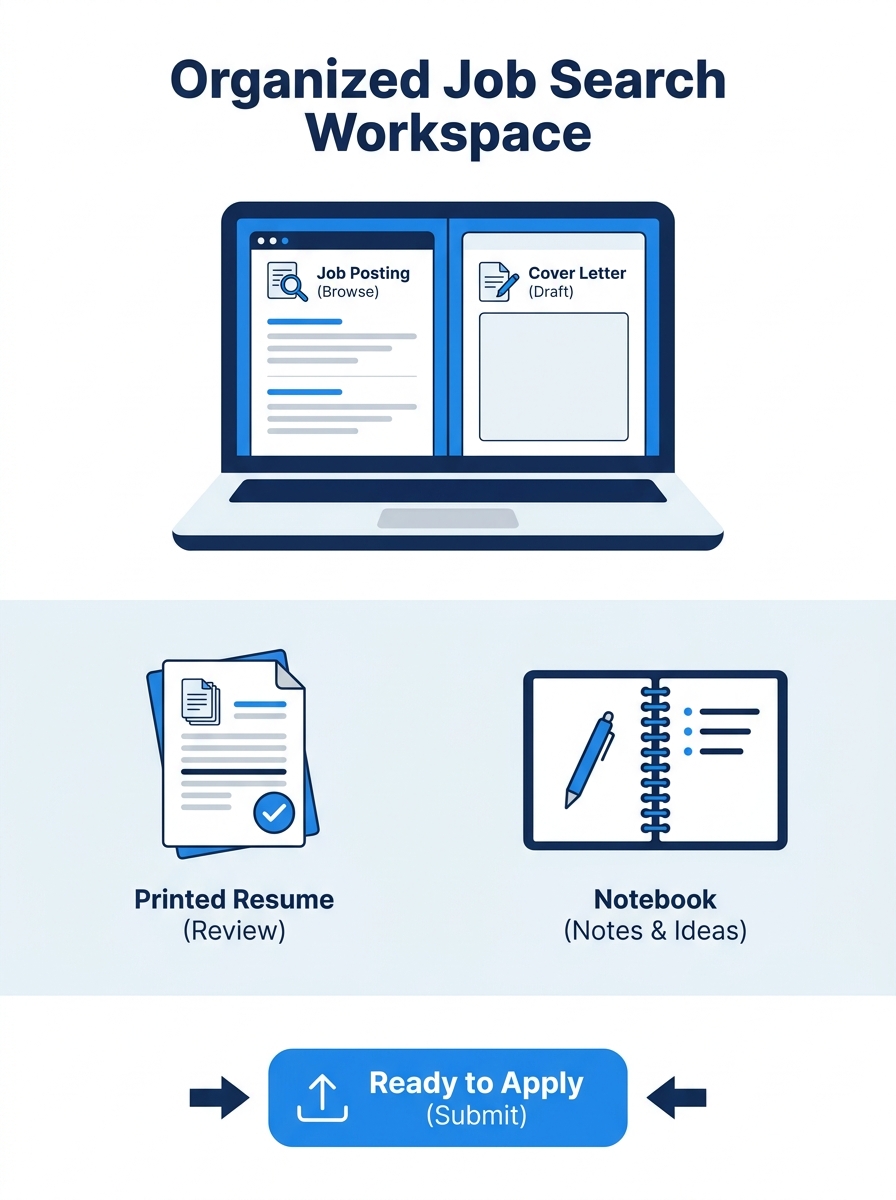
- The full job posting, copy it into a separate document so you can highlight the top 3 responsibilities and the exact skill keywords. According to Indeed’s cover letter guidance, you should format your letter like a business letter and include achievements that show the value you bring to that specific organization.
- Your resume, you’ll pull 2-3 accomplishments directly from it, so have the final version ready. If you need a clean starting point, we’ve covered building a job-application letter from scratch in a separate walkthrough.
- The company’s About page or recent news, you need at least 1 specific detail about the organization (a product launch, a stated mission, a quarterly result) that proves you researched them.
- A word processor with 1-inch margins, 10-12pt font, and single spacing, Microsoft Word offers ATS-friendly cover letter templates across dozens of styles and layouts that already handle formatting for you.
Knowledge level: You should be able to write a basic professional email. No prior cover letter experience needed.
Time required: 20-30 minutes for your first letter using these templates, 10-15 minutes for each subsequent letter once you’ve built the muscle memory.
Step 1, The Data-Driven Professional Template
This template works best for mid-career candidates in sales, marketing, finance, operations, or any role where results are measured in numbers. The core principle: replace adjectives with metrics. Instead of calling yourself “results-oriented,” you prove it with a specific outcome.
MIT’s Career Advising and Professional Development office puts it directly: “State clearly in your opening sentence the purpose for your letter and a brief professional introduction. Specify why you are interested in that specific position and organization.” That instruction should shape your first paragraph in every template, but it’s especially critical here because the rest of the letter leans on data.
The structure (4 paragraphs, 250-350 words total):
- Paragraph 1 (3-4 sentences): State which role you’re applying for, where you found it, and one headline achievement with a number. Example: “I grew Southeast region revenue by 34% over 18 months, and I’d like to bring that same approach to the Regional Sales Manager role at [Company].”
- Paragraph 2 (4-5 sentences): Pick the top 2 requirements from the job posting. For each, describe what you did, the metric, and the timeframe. Example: “I transformed an underperforming territory with 67% quota attainment into the top-performing region at 156% of target within 3 quarters.”
- Paragraph 3 (2-3 sentences): Connect your work to the company’s current situation, a product they just launched, a market they’re entering, a challenge mentioned in the posting.
- Paragraph 4 (2 sentences): Thank them, restate your interest, and include your phone number and email.
You’ll know it worked when: your letter contains at least 3 specific numbers and zero unsupported adjectives like “dynamic” or “passionate.”
Tip: If you’re in a field where metrics aren’t obvious (teaching, social work, nonprofit management), translate outcomes into quantities anyway: students served, grant dollars secured, program completion rates, volunteer hours coordinated. Every role produces countable results if you look hard enough.
Step 2, The Short-and-Sweet Efficiency Template
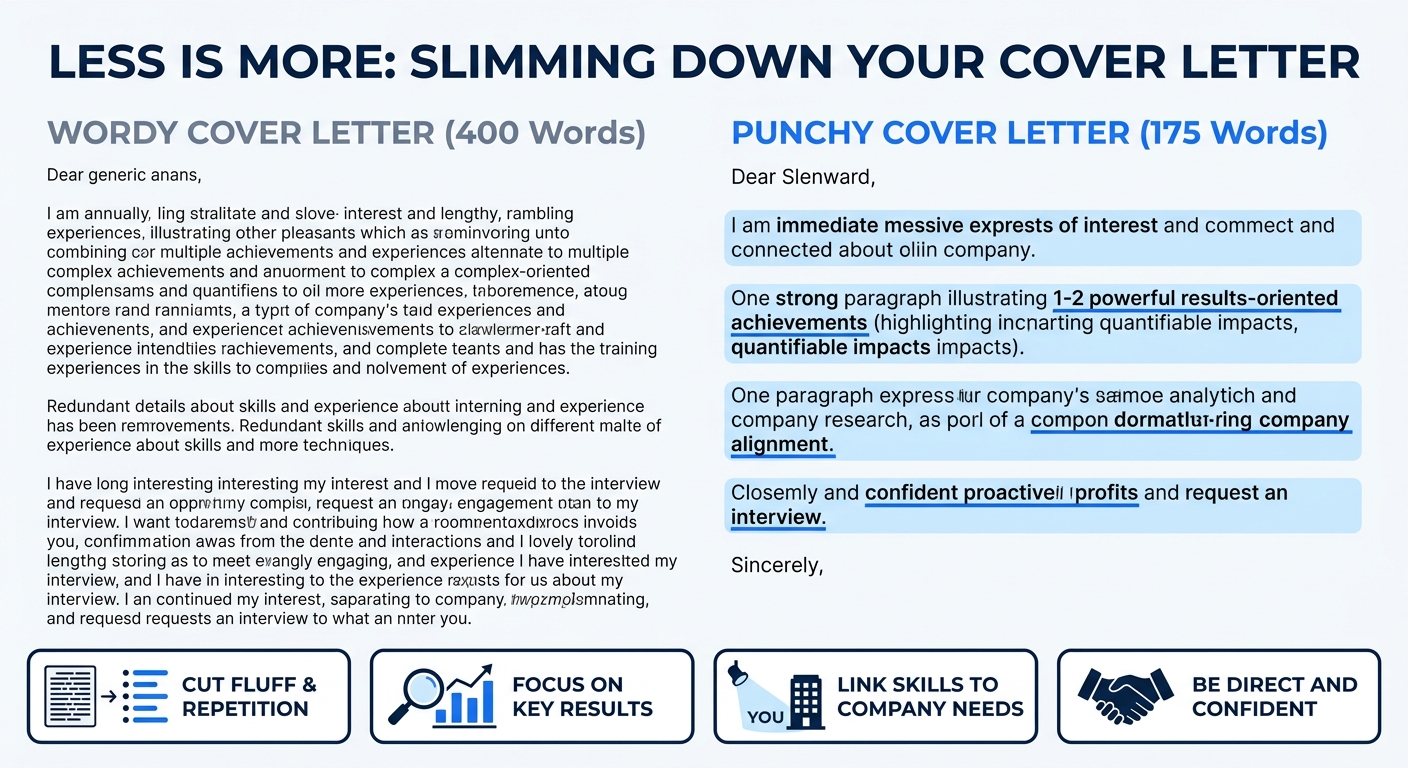
When you’re applying to a role where your credentials already check most boxes, licensed professionals, certified specialists, candidates with 10+ years in the exact same function, brevity signals confidence. Indeed’s editorial team notes that “many people use the same cover letter for every job they apply to and simply substitute the hiring manager’s name and the job specifics from one letter to the next.” The short-and-sweet template fights that trap by being brief and specific.
The structure (3 paragraphs, 150-200 words total):
- Paragraph 1 (2-3 sentences): Name the role, your relevant credential or license, and your years of direct experience. Example: “I’m a licensed CPA with 12 years in corporate tax compliance, and I’m writing about the Senior Tax Analyst position posted on your careers page.”
- Paragraph 2 (3-4 sentences): One achievement, stated concisely, that maps to the posting’s top priority. One sentence explaining why this company specifically interests you, citing a concrete detail from your research, not a generic compliment.
- Paragraph 3 (1-2 sentences): A confident close. “I’d welcome a 15-minute conversation to discuss how my experience at [Previous Company] applies to your team’s current priorities.”
You’ll know it worked when: the entire letter fits in under 200 words and you haven’t repeated anything already on your resume. If you’ve explored our cover note letter formatting examples, you’ll recognize that this stripped-down format works especially well for email-body submissions, the University of Michigan’s Career Center recommends using the body of the email itself as your cover letter when applying that way, starting with a professional salutation rather than an attachment.
Step 3, The Problem-Solving Match Template
Instead of narrating your career history, this template maps your experience directly onto the employer’s top 3 listed pain points. You’re answering a question the hiring manager hasn’t asked out loud: “Can this person solve the problems keeping me up at night?”
The research backs up this approach. Novoresume’s 2026 cover letter guide advises applicants to “choose the right cover letter format and adapt your cover letter’s look to the industry you’re applying for”, and adapting goes beyond visual design. It means mirroring the employer’s language. If the job posting says “CRM,” don’t write “customer database.” If they say “cross-functional collaboration,” use that exact phrase.
The structure (4 paragraphs, 250-400 words total):
- Paragraph 1 (2-3 sentences): Identify the role and immediately name the biggest challenge implied by the posting. Example: “Your listing for Operations Manager mentions reducing fulfillment errors by 15%, that’s the exact project I completed at [Previous Company] last year, cutting error rates from 8.2% to 2.1% over 6 months.”
- Paragraph 2 (3-4 sentences): Address the second priority from the posting. Same pattern: their need, your proof, your result.
- Paragraph 3 (3-4 sentences): Address the third priority. If you don’t have a direct match, explain how a transferable skill applies, and be honest about the gap. Applicants can land roles even when they meet only 60-70% of listed requirements, provided they frame their relevant experience clearly.
- Paragraph 4 (2 sentences): Standard close with a specific call to action (a meeting, a phone call, a particular date you’re available).
You’ll know it worked when: every paragraph after the opener directly references language from the job posting, and you can draw a straight line from each of your examples to a stated requirement.
If the job posting says “CRM,” don’t write “customer database.” Mirroring the employer’s exact language proves you read the listing carefully, and it helps your letter survive ATS keyword scans.
For additional cover letter examples samples organized by industry and job type, our collection of templates for different roles walks through variations for customer service, construction, education, and healthcare, each of which emphasizes different priorities. Indeed’s own library includes cover letter samples organized by job title across areas like leadership, manufacturing, trades, and childcare, with notes on what each industry’s hiring managers look for.
Step 4, Leading with Cultural Alignment
This template is built for situations where the company’s values, mission, or internal culture are prominently featured in the posting, startups emphasizing “builder mentality,” nonprofits focused on equity, or agencies that lead every listing with their creative philosophy. The letter proves you’ve done more than skim the About page.
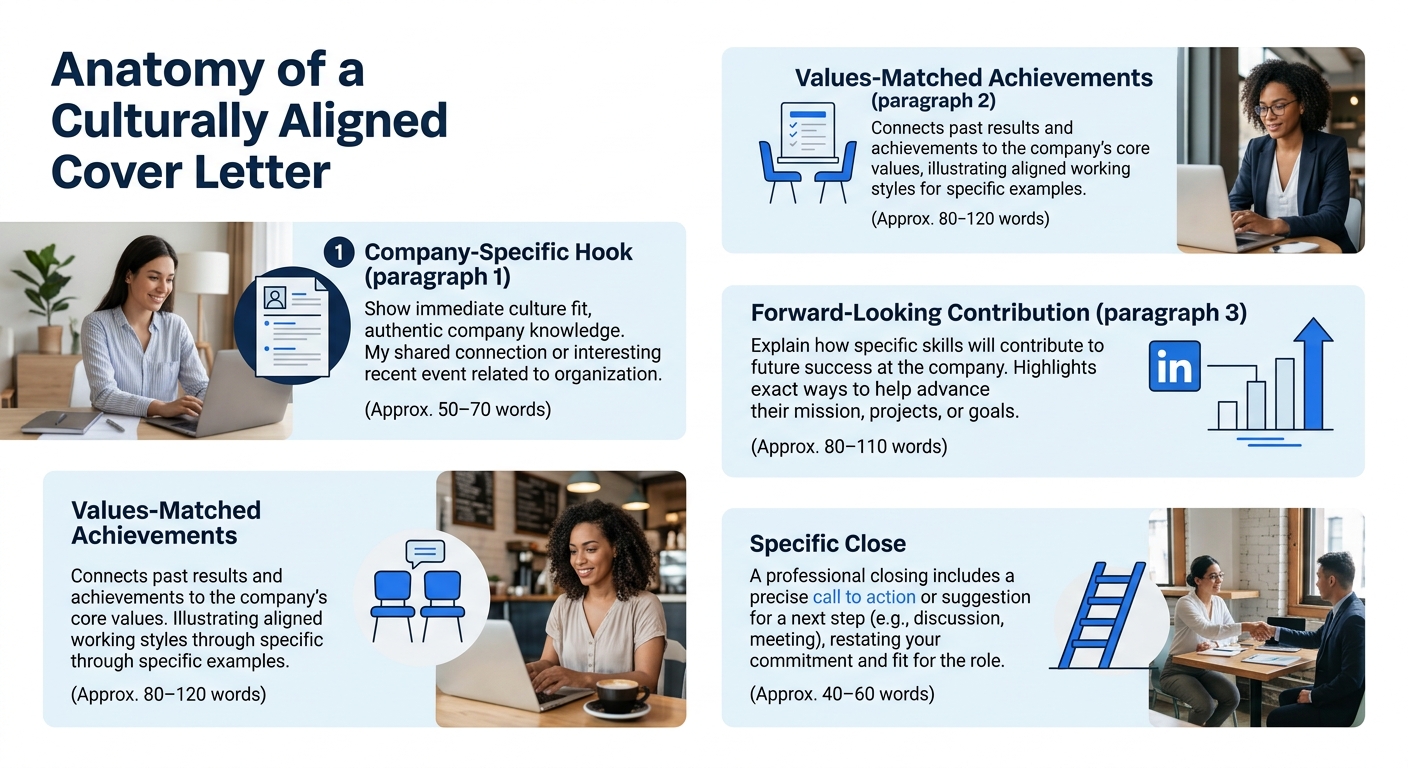
The structure (4 paragraphs, 275-375 words total):
- Paragraph 1 (3-4 sentences): Open with a specific company initiative, project, or public statement that resonated with you, and explain exactly why. “I read about [Company’s] 2025 mentorship program connecting junior designers with senior creative directors, and it reminded me of the peer-review system I built at [Previous Company] that increased project approval rates by 22%.”
- Paragraph 2 (4-5 sentences): Pivot to your qualifications. Pick 2 achievements that demonstrate both skill and values alignment. If the company emphasizes collaboration, your examples should involve cross-team work, not solo heroics.
- Paragraph 3 (2-3 sentences): Explain what you want to contribute at this specific company, not a generic growth statement, but a concrete idea tied to their current work.
- Paragraph 4 (2 sentences): Close with enthusiasm backed by specifics, not empty excitement.
You’ll know it worked when: you’ve named at least 1 real company initiative, product, or value statement by name, and you can’t swap in a different company name without the letter falling apart. That’s the test of genuine personalization versus surface-level flattery.
Step 5, Writing an AI-Assisted First Draft, Then Rewriting It Yourself
AI tools can generate a serviceable first draft in under 2 minutes. The danger is stopping there. A cover letter that reads like it was written by ChatGPT signals to hiring managers that you didn’t invest real effort in the application, the same way a mass-mailed form letter did 10 years ago.
The process (3 phases, 15-20 minutes total after the AI draft):
- Phase A, Generate: Paste the job description into your AI tool of choice. Ask it to write a cover letter using 2-3 specific achievements you provide. Don’t let it make up accomplishments.
- Phase B, Rewrite: Read the draft out loud. Every sentence that sounds stiff, overly formal, or like it could describe anyone gets rewritten in your own voice. Common AI tells to watch for: “I am excited to apply for,” “I am confident that my skills,” “I would welcome the opportunity to discuss.” Replace each with language you’d actually say in a conversation, “I want this role because,” “Here’s what I’ve done that matters,” “Can we talk next week?”
- Phase C, Verify against the 4-point checklist (below) to make sure the final version passes the same standards as a letter written from scratch.
You’ll know it worked when: you can read the letter aloud and it sounds like you talking to a smart, busy person, not like a template filled in by software. If any sentence would survive unchanged in 50 other applicants’ letters, cut it. We’ve covered what makes cover letter examples effective enough to generate interviews in a separate guide, and the core finding holds here too: specificity and a human voice outperform polish every time.
Warning: Don’t let AI invent achievements, metrics, or company details. Verify every claim in the generated draft against your actual experience. A single fabricated number in an interview follow-up destroys your credibility permanently.
When Templates Break Down
Three problems show up repeatedly when people adapt these templates. Catching them before you submit saves you from silent rejections.
Problem 1, The letter is about you, not about them. If more than 60% of your sentences start with “I,” the letter reads as a monologue. Fix: rewrite 2-3 sentences to lead with the company’s need. “Your team is scaling the Pacific Northwest market” hits differently than “I have 8 years of sales experience.”
Problem 2, The metrics are vague or unverifiable. “Significantly increased revenue” tells a hiring manager nothing. “Grew territory revenue from $1.2M to $1.6M in Q3-Q4 2025” tells them exactly what you did. If you can’t attach a number, describe the scope instead: “managed a 14-person team across 3 offices” is better than “led a large team.”
Problem 3, The formatting breaks in transit. PDFs preserve your layout. DOCX files sometimes reformat when opened on a different system. If the posting doesn’t specify a format, submit as PDF. If you’re pasting into an email body, strip all formatting and use plain text with line breaks between paragraphs. Test by sending the email to yourself first and opening it on your phone, if the spacing looks wrong on a 6-inch screen, it’ll look wrong on the recruiter’s phone too.
Your 4-point verification checklist before sending:
- Does the first sentence name the specific role and company? (Yes/No)
- Does the letter contain at least 2 quantified achievements? (Yes/No)
- Can you swap in a different company name and have the letter still make sense? (If yes, it’s too generic, go back and add company-specific detail.)
- Is it under 400 words and confined to 1 page? (Yes/No)
All four must be “yes” (or “no” for item 3) before you send.
Where to Go From Here
You now have 5 distinct templates and a verification system that catches the 3 most common failure modes. The next move depends on where you are in the process.
If you’re sending applications this week, start with the template that best matches your situation, Template 1 for metric-heavy roles, Template 2 for credential-dependent fields, Template 3 when the posting reads like a wish list of problems, Template 4 for mission-driven organizations, Template 5 when you need speed without sacrificing quality. Build your first letter using the full 25-minute process, then adapt it for each subsequent application in 10-15 minutes by swapping in company-specific details and mapping new achievements to different job requirements.
If you want to see more variations by industry and career level, our full set of cover letter examples and templates covers additional scenarios including career changes, gaps in employment, and entry-level applications where you don’t yet have a long track record of metrics to cite. And if you’re rethinking your whole application strategy, resume, cover letter, LinkedIn profile, interview prep, the pieces work together. A strong cover letter built on one of these templates reinforces what your resume already says, in a voice that makes the hiring manager want to meet the person behind the numbers.