

 4.9
4.9 4.5
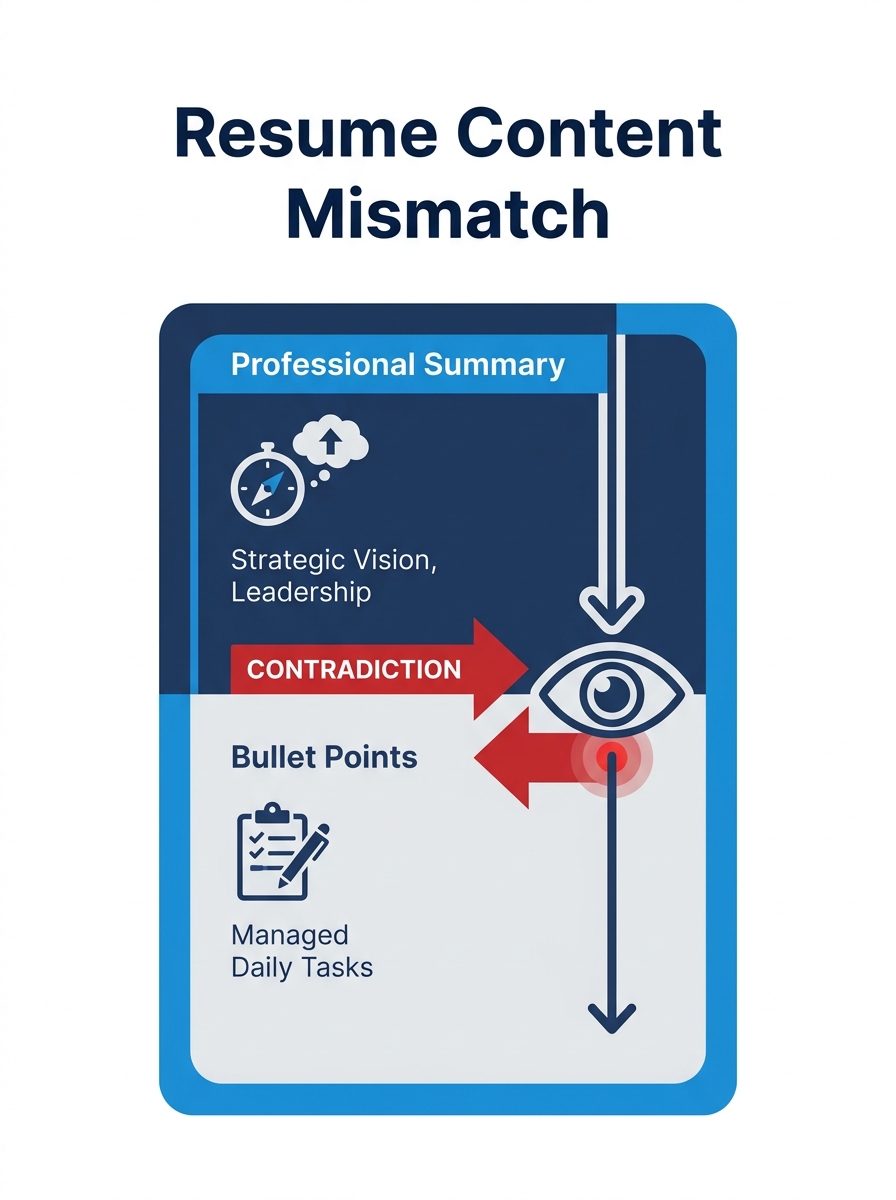
4.5The most damaging resume red flags are internal contradictions between your professional summary and your bullet points. A summary that claims “strategic leadership” while every bullet beneath it describes task execution creates a credibility gap that hiring managers register within seconds, and candidates almost never catch it themselves.
The Google Recruiter’s Diagnosis
Farah Sharghi, a former Google recruiter, told CNBC on June 30, 2026 that the biggest resume mistake is “completely invisible to most candidates.” Her specific focus was on jargon and missing context — insider language that means nothing to an outside reader. But the problem she described runs deeper than vocabulary. When a candidate loads their professional summary with aspirational, high-level language and then fills their bullet points with narrow, task-level descriptions, the two sections actively undermine each other.
This is the resume equivalent of a restaurant menu promising “elevated French cuisine” and then serving microwaved soup. The promise and the proof don’t match, and the person reading your document notices the gap before you ever get a chance to explain it.
Sharghi’s advice was concrete: add context before your bullets that explains the organization and role in plain terms, remove insider jargon, and replace vague traits like “team player” with specific, verifiable metrics. That guidance applies directly to professional summary alignment. Your summary makes a claim. Your bullets must substantiate it. When they don’t, you have two competing narratives on a single page.
HR professionals are wired to catch exactly this kind of inconsistency. Research from Enhancv confirms that hiring managers carry a negativity bias — they’re actively scanning for details that seem off, including inconsistencies and gaps, as a way of protecting the organization from risk. Your contradictory summary doesn’t get the benefit of the doubt. It gets the trash pile.
Two Writers on the Same Page
Why does this happen so often? Because most people write their professional summary and their bullet points at completely different times, with completely different mental models.
The summary gets written last, usually in a rush, after you’ve already detailed your work history. You’ve spent 45 minutes crafting bullet points for 3-4 roles. You’re tired. You scroll to the top and realize you need a summary, so you write something that sounds impressive. “Results-driven marketing leader with 8+ years of experience driving cross-functional initiatives and delivering measurable business outcomes.” Sounds authoritative. Feels right.
Then someone reads your most recent bullets:
- Managed social media calendar for 3 platforms
- Coordinated with design team on email newsletter layouts
- Tracked monthly website traffic in Google Analytics
- Assisted marketing director with quarterly budget reports
The summary says “leader.” The bullets say “coordinator.” The summary says “driving cross-functional initiatives.” The bullets say “assisted with.” The summary says “measurable business outcomes.” No bullet contains a single number.
Columbia University’s career education program recommends that a professional summary function as “a snapshot of your skills, accomplishments, and knowledge” in 2-5 concise phrases. The word “snapshot” matters. A snapshot captures what’s already there. It doesn’t fabricate a different scene. If your bullets document coordination and support work — and that’s genuinely what you did — your summary needs to frame that honestly while still positioning it attractively.
This problem compounds when you factor in job-hopping patterns and long search timelines. With average job searches now stretching past 11 weeks, candidates often update bullet points for each application while leaving the summary untouched from the original version they wrote months earlier. The document drifts further apart with every edit.
The Hiring Manager’s Top-Down Read
Understanding hiring manager psychology here is critical, because the sequence matters as much as the content. Hiring managers don’t read resumes randomly. They start at the top. Your summary establishes a mental model — a set of expectations about who you are and what you can do. Then every bullet point they scan either confirms or contradicts that model.
Resume Pilots’ consistency checklist identifies internal contradictions as one of the fastest ways to get a recruiter to say “no,” noting that “sometimes the small things that go unnoticed make the biggest impact.” And the impact isn’t neutral. When a hiring manager’s expectations from your summary don’t match the evidence in your bullets, the result isn’t confusion — it’s skepticism. They don’t think “oh, they probably meant something different.” They think “this person is either exaggerating or doesn’t understand their own experience level.”
Elon Musk told IBTimes this week that he now trusts conversation over résumé credentials, admitting he’s fallen for what he called the “pixie dust” effect — impressive surface language that doesn’t hold up under scrutiny. Whether you agree with Musk’s hiring philosophy or not, his observation describes precisely what a misaligned summary creates: pixie dust at the top, reality at the bottom.
When a hiring manager’s expectations from your summary don’t match the evidence in your bullets, the result isn’t confusion — it’s skepticism.
The Triad Goodwill career resource center puts it directly: “These errors signal a lack of attention to detail and professionalism.” And that’s arguably worse than any single weak bullet point. A weak bullet point is a missed opportunity. A contradictory summary is an active red flag that makes a hiring manager question everything else on the page.
This is also where cross-referencing destroys candidates. Novorésumé’s 2026 red flags guide identifies having “different versions of your work history on your resume and LinkedIn profile” as a major concern, with hiring managers routinely checking both documents. If your resume summary claims strategic leadership, your bullets describe task execution, and your LinkedIn headline says something else entirely, you’ve created three competing narratives about the same person. That’s 3 versions of you, and none of them build trust.
If you’re concerned your resume has AI-polished language that sounds too perfect, the summary is usually where the problem started. AI tools tend to generate ambitious, superlative-heavy summaries that sound nothing like the human-written bullets below them.
Rebuilding the Summary From Evidence
The fix requires working backwards. Instead of writing a summary and hoping your bullets support it, you build the summary from what your bullets already prove. Here’s how that process worked on a real pattern we see constantly in professional resume writers’ revision notes.
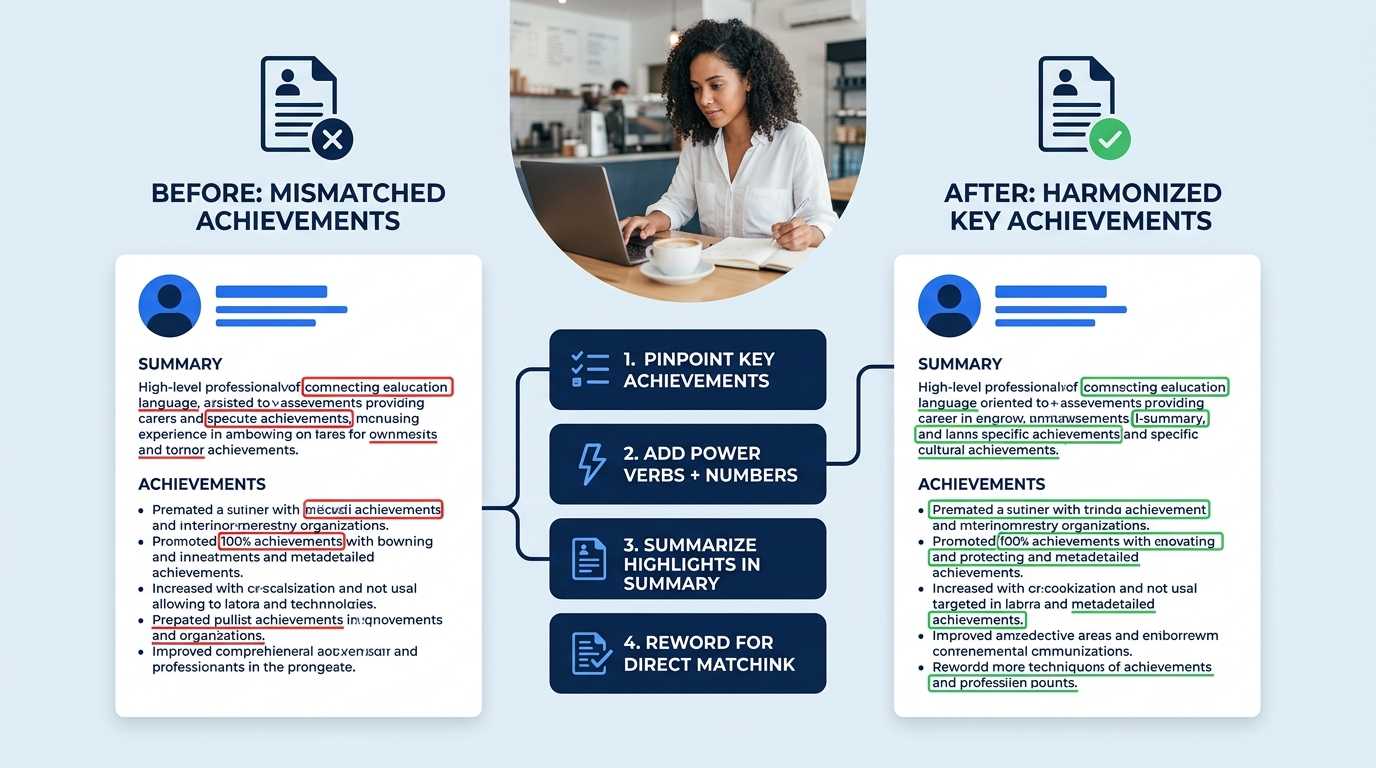
Step 1: Audit every bullet for its actual achievement statement structure. Pull the 3-5 strongest bullets across your entire resume — the ones with numbers, outcomes, or clear scope. If you’re struggling to find quantified achievements, our guide on converting vague descriptions into measurable impact walks through the process for any experience level.
For the marketing coordinator example above, an honest audit might find:
- Managed content calendar across 3 platforms reaching 12,000 followers
- Reduced email newsletter production time by 30% through new design workflow
- Tracked and reported monthly traffic data that informed $45K quarterly ad budget
Step 2: Identify the 2-3 themes those strong bullets share. In this case: content operations, process improvement, data-informed decision support. Those are the real themes — not “strategic leadership” or “driving business outcomes.”
Step 3: Write a summary that names those themes explicitly. Columbia recommends 2-5 phrases, and each phrase should echo language that appears somewhere in your bullets. ResumeBuilder.com advises grouping bullets under subject categories like “Revenue Growth” or “Team Development” for senior professionals — your summary should reflect those same categories.
A rebuilt summary for our example:
“Marketing coordinator with 3+ years managing multi-platform content operations, streamlining production workflows, and translating audience data into budget recommendations for leadership teams.”
Every claim in that summary has a bullet point to back it up. “Multi-platform content operations” matches the 3-platform calendar bullet. “Streamlining production workflows” matches the 30% efficiency improvement. “Translating audience data into budget recommendations” matches the traffic-to-ad-budget reporting. No pixie dust. Every word earns its spot.
Tip: Test your alignment by reading your summary aloud, then asking: “Which specific bullet point proves this claim?” If any phrase in your summary doesn’t have a matching bullet, cut it or add a bullet that supports it.
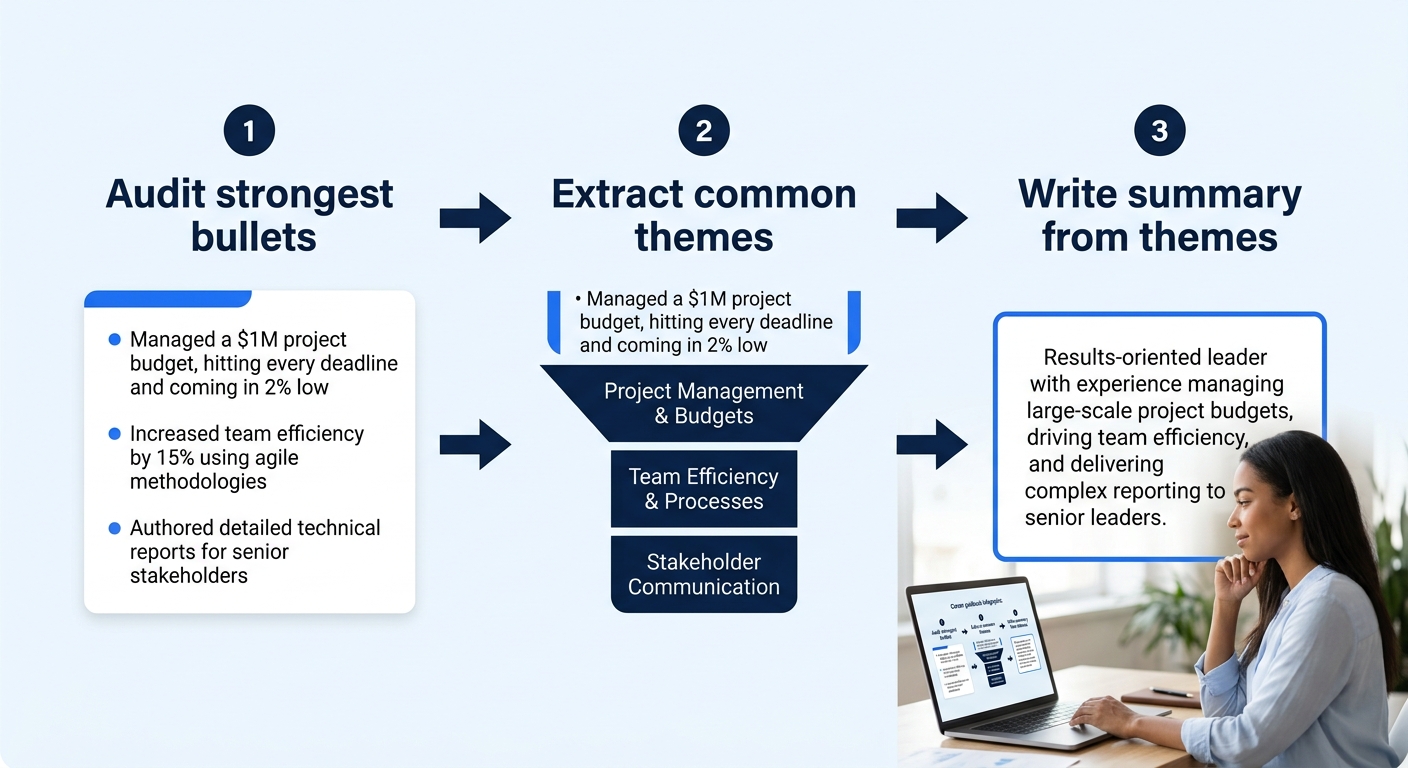
For more detail on converting generic duty descriptions into strong achievement statements, the action verb swap strategy breaks down the mechanics of turning passive task language into active impact language — which makes both your summary and your bullets stronger simultaneously.
When the Top of the Page Finally Matches the Middle
The marketing coordinator case illustrates something that applies to every career level, from entry-level to executive. Get Set Resumes frames it well: “Your resume should act as a factual backbone,” with alignment built on accuracy (“Are your timelines, job titles, and responsibilities precise?”) and impact (“Are the accomplishments measurable or clearly stated?”). That backbone principle means your summary, your bullets, your LinkedIn profile, and your interview talking points should all tell one coherent story. The same story. Told at different zoom levels, but never contradicting itself.
Teal’s accomplishment guide reinforces that “each job has unique requirements, and tailoring your resume to match these can significantly boost your chances of getting noticed.” Tailoring doesn’t mean fabricating a new identity for each application. It means selecting which of your proven, bullet-supported strengths to emphasize in your summary for a specific role. The bullets stay honest. The summary shifts its spotlight.
This is why the summary-bullet contradiction matters more than most resume red flags candidates worry about. Gaps, short tenures, missing degrees — hiring managers have learned to contextualize those. But a document that argues against itself on the same page signals something harder to explain away: either carelessness or exaggeration. Neither one gets you an interview.
Browse more career guides on our blog for deeper dives into specific resume sections, or run the audit on your own document tonight. Read your summary. Read your bullets. Ask yourself if they sound like they’re describing the same person. If the answer is no, you’ve found the invisible red flag — and now you know exactly how to fix it.