

 4.9
4.9 4.5
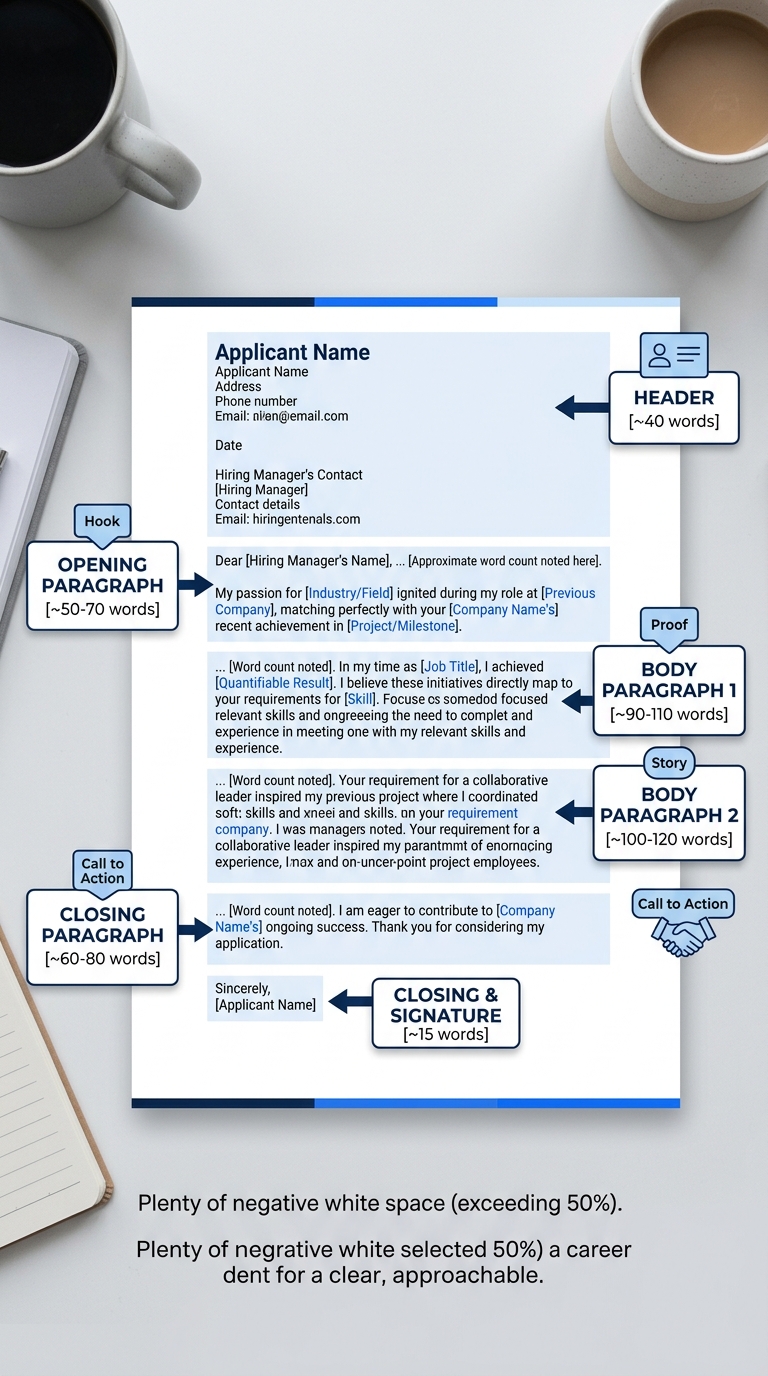
4.5This guide walks you through writing a one-page cover letter from scratch, built on one of three proven formats, in about 45 minutes. You’ll pick a format, draft four focused paragraphs, and edit until the letter sounds like you wrote it over coffee, not copied it from a template bank.
TL;DR: Choose between problem-solution, achievement-focused, or narrative format based on your career stage. Mirror the job posting’s exact language, quantify 2-3 accomplishments, keep everything under one page at 10-12 point font, and read the final draft aloud to catch stiff phrasing.
Before You Start
You need three things on your desk before writing a single word. Missing any of them will produce a generic letter that hiring managers skip.
A specific job posting you’re applying to. Not a general role description. The actual posting with its bullet-pointed requirements, company name, and (ideally) hiring manager name. You’ll pull exact phrases from this document into your letter. If the posting says “CRM,” you write “CRM,” not “customer database.”
Your current resume. You won’t repeat what’s on it, but you need it open for reference. The cover letter provides context your resume can’t: why this company, why this role, why now. If your resume needs updating first, work through the process of aligning your summary with your bullet points before starting the letter.
45 uninterrupted minutes. Drafting takes about 25 minutes. Editing and reading aloud takes another 20. Rushing this produces the kind of flat, interchangeable letter that 94% of hiring managers say they can spot immediately, according to recent industry hiring data.
Knowledge level: You don’t need any previous cover letter experience. If you’ve written one before that felt weak, you’ll understand why by Step 3.
Step 1: Pick Your Format
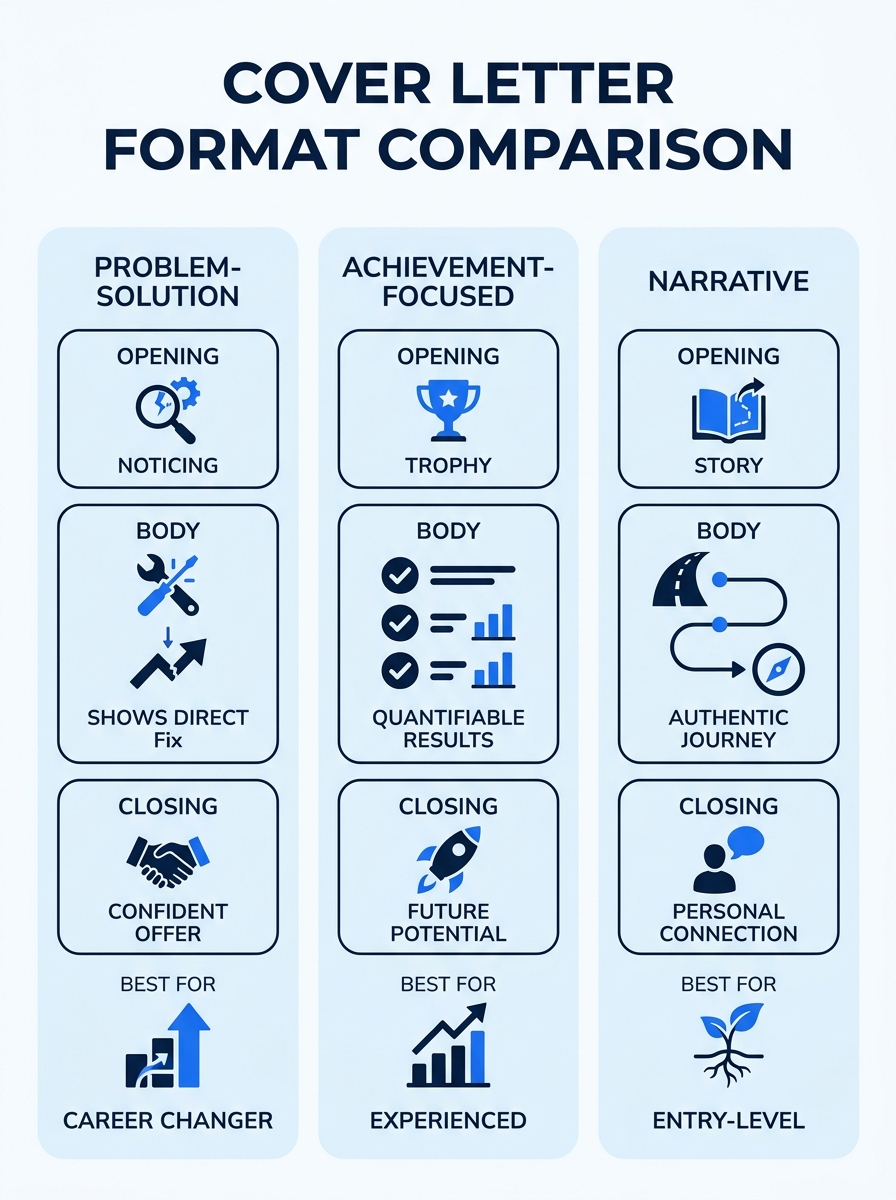
Three letter cover examples dominate successful applications right now. Each serves a different career situation, and picking the wrong one wastes your strongest material.
| Format | Best For | Structure | When to Avoid |
|---|---|---|---|
| Problem-Solution | Experienced professionals with 5+ years | Opens with a company challenge, positions you as the fix | Entry-level roles where you lack industry context |
| Achievement-Focused | Technical roles, sales, operations | Uses 3-4 bullet points with specific metrics | Creative fields where numbers feel forced |
| Narrative | Career changers, creative industries | Story-driven, emphasizes cultural fit | Roles that demand quantifiable output |
The problem-solution format works well for experienced hires because it demonstrates research. You identify a real challenge the company faces (from their job posting, earnings calls, or press coverage) and explain how your specific skills address it. A marketing director applying to a SaaS company losing market share would open with that challenge, then pivot to a campaign that drove similar results elsewhere.
The achievement-focused format front-loads numbers. If you increased social media engagement by 87% while reducing ad spend by 23%, those figures go in the body as bullet points. According to Indeed’s cover letter guidance, customizing these metrics to match the job title makes the letter feel written for this role specifically, not repurposed from your last application.
The narrative format works for career changers because it explains the “why” behind a pivot. Hiring managers reading a career-change application want to understand motivation, not just qualifications.
You’ll know you’ve completed this step when you can name your chosen format and explain in one sentence why it fits this specific application.
Step 2: Set Up the Header
Your header matches your resume header exactly. Same font, same contact information layout, same visual style. This creates a cohesive application package.
Include these elements in order:
- Your full name (same size and weight as your resume header)
- Phone number, professional email, city/state (no full street address needed)
- LinkedIn profile URL (if it’s updated and active)
- Today’s date
- The hiring manager’s name, title, company name, and company address
Finding the hiring manager’s name takes 5 minutes. Check the job posting first. If it’s not there, search LinkedIn for the department head at that company. The University of Michigan Career Center recommends using LinkedIn and the organization’s website to gather contact information before writing. Addressing a letter to “Dear Hiring Committee” works as a fallback, but a specific name increases engagement.
You’ll know it’s right when your cover letter header and resume header look like they belong to the same document.
Step 3: Write the Opening Paragraph
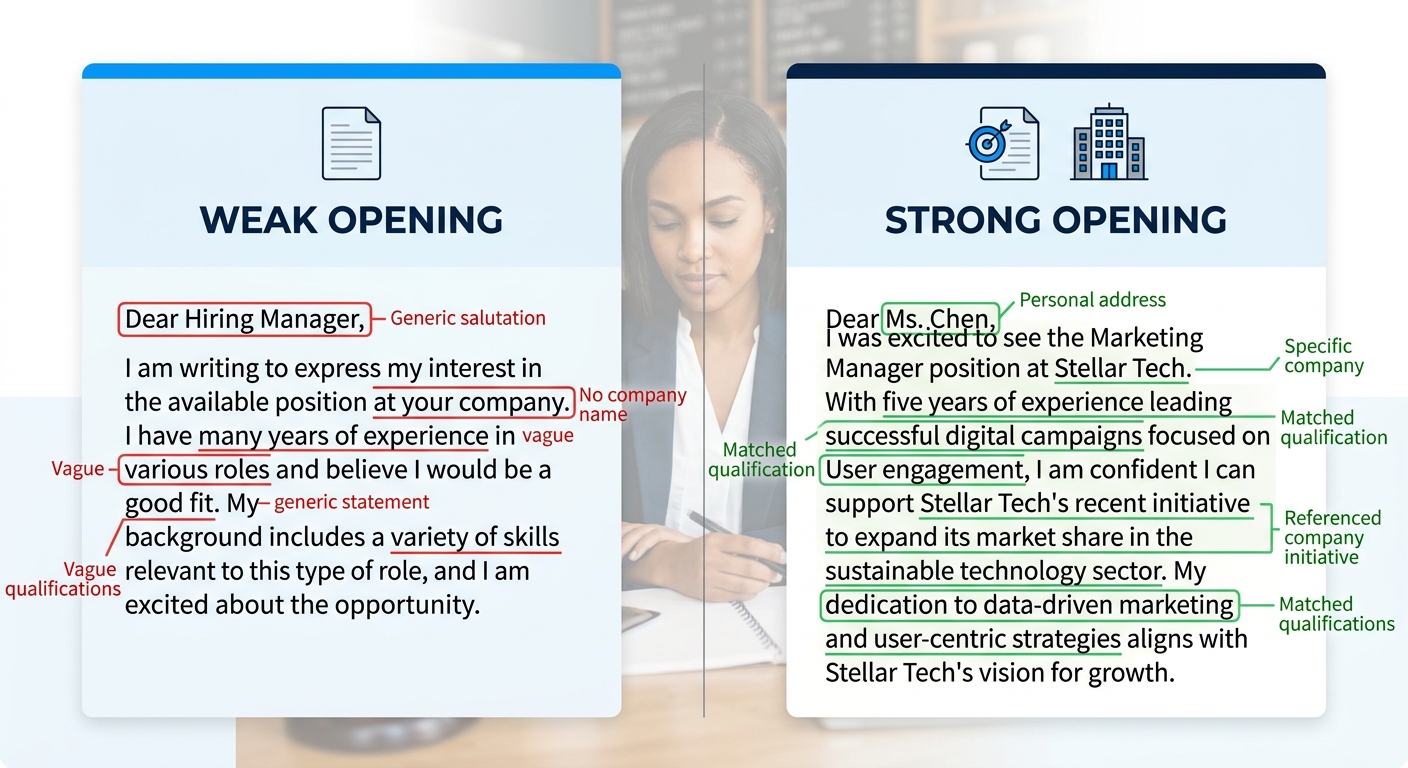
This is where 80% of cover letters fail. The opening paragraph has one job: make the hiring manager want to read paragraph two.
MIT’s career advising department states that a cover letter should be no longer than one page with a font size between 10-12 points. That means your opening paragraph gets 3-4 sentences at most. Here’s what each sentence does:
Sentence 1: Name the exact role and where you found it. “I’m applying for the Senior Product Designer position posted on your careers page.” Direct. No throat-clearing.
Sentence 2: State your strongest qualification for this specific role. Pull the top requirement from the job posting and match it. If they want “5+ years leading cross-functional design teams,” and you have seven years doing exactly that, say so.
Sentence 3 (problem-solution format only): Reference a specific company challenge or initiative. “Your Q1 expansion into the European market creates exactly the kind of localization challenge I’ve solved twice before.”
Sentence 3-4 (achievement and narrative formats): Deliver your hook. For achievement-focused letters, preview your biggest number. For narrative letters, name the moment or experience that connects you to this company’s mission.
Warning: Do not open with “I am writing to express my interest in…” This phrasing appears in an estimated 66% of cover letters, according to hiring survey data. It signals a template immediately.
You’ll know this step worked when your opening paragraph mentions the company by name, references a specific requirement from the job posting, and contains zero sentences that could apply to a different company.
Step 4: Build Two Body Paragraphs
The body of your cover letter carries the proof. Two paragraphs, each structured around a single claim backed by evidence.
Body paragraph 1 answers: “What have I done that proves I can do this job?” Pick one accomplishment from your resume and add context the resume can’t provide. Your resume says “Increased customer retention by 34% over 18 months.” Your cover letter explains how: the insight that led to the strategy, the obstacle you navigated, the team you coordinated. This is the distinction between a resume bullet and a cover letter paragraph. If you’ve worked on identifying the right way to quantify achievements, you already have the raw material.
For achievement-focused formats, this paragraph can include 3-4 short bullet points with metrics:
- Reduced onboarding time from 14 days to 6 days by redesigning the training workflow
- Managed a $2.1M annual budget across three product lines
- Led a 12-person cross-functional team through a platform migration with zero downtime
Body paragraph 2 answers: “Why this company specifically?” This is where your research shows. Reference something concrete: a recent product launch, a value on their about page, a challenge mentioned in the job posting. The goal is to demonstrate that you didn’t send this same letter to fifteen companies.
The cover letter provides context your resume can’t: why this company, why this role, why now.
Mirror the posting’s language. If the job description says “stakeholder management,” use that exact phrase. If it says “data-driven decision making,” don’t rephrase it as “analytics-based choices.” ATS systems and human readers both respond to terminology alignment. This same principle applies when you’re fixing the red flags that make recruiters skip applications.
You’ll know these paragraphs work when each one contains at least one specific number and at least one reference to something unique about this company or role.
Step 5: Write the Close and Read Aloud
The closing paragraph is three sentences. Don’t overthink it.
Sentence 1: Restate your enthusiasm for the specific role (not “a position at your company” but “the Senior Product Designer role”).
Sentence 2: Name a concrete next step. “I’d welcome the chance to discuss how my localization experience maps to your European expansion” beats “I look forward to hearing from you.”
Sentence 3: Thank them for their time and sign off.
Use “Sincerely” or “Best regards” as your closing. Skip “Warmly,” “Cheers,” or “Respectfully yours” unless you’re applying in an industry where those are standard.
Now the critical edit: read the entire letter aloud. Every word. If you stumble over a phrase or it sounds like something a corporate memo would contain, rewrite that sentence in the way you’d actually say it to a smart colleague. The 83% of hiring managers who consider cover letters important for hiring decisions are also increasingly suspicious of letters that sound AI-generated. If you’ve used any AI tools during drafting, review our guide on keeping AI-assisted writing from sounding robotic.
After reading aloud, check the page count. One page maximum. If you’re over, cut the weakest sentence from each body paragraph first. Reduce font size only as a last resort, and never go below 10 points.
Tip: Save each cover letter with a clear filename: “YourName_CompanyName_CoverLetter.pdf.” Hiring managers download dozens of attachments. Make yours findable.
Common Problems and How to Fix Them
Problem 1: The letter sounds like your resume in paragraph form. This happens when you copy bullet points and add transition words. Fix it by asking “what’s the story behind this number?” for each accomplishment. The cover letter gives the context, reasoning, and motivation that a resume bullet can’t hold.
Problem 2: You can’t find the hiring manager’s name. Try LinkedIn first, filtering by company and department. Check the company’s team page. If both fail, “Dear Hiring Team” or “Dear [Department] Hiring Committee” works. Avoid “To Whom It May Concern,” which reads as dated.
Problem 3: The letter runs over one page. Cut adverbs first. Then cut any sentence that restates something already on your resume without adding new context. If you’ve explored our collection of winning cover letter templates, you’ll notice every strong example stays well under the one-page ceiling. The University of Michigan’s career center puts it bluntly: keep it short, do not exceed one page.
Where to Go From Here
Once your cover letter is finished, you have a reusable framework, not a reusable letter. The structure stays the same for every application. The content inside it changes completely each time.
For your next application, start again at Step 1 and ask whether the same format still fits. A problem-solution letter that worked for a senior operations role won’t serve a creative director application. Swap formats when the role demands it. Keep a folder of your best letter cover examples so you can reference your own phrasing when a similar role comes up months later.
If your resume needs the same level of targeted attention, the tips on building a cover letter from specific templates pair well with this process. And if you’re noticing that your applications aren’t converting to interviews despite strong letters, the issue often lives in the resume itself. Work backward from the job posting the same way you did here: match their language, quantify your impact, and cut anything that doesn’t directly support your candidacy for this one role.