
 4.9
4.9 4.5
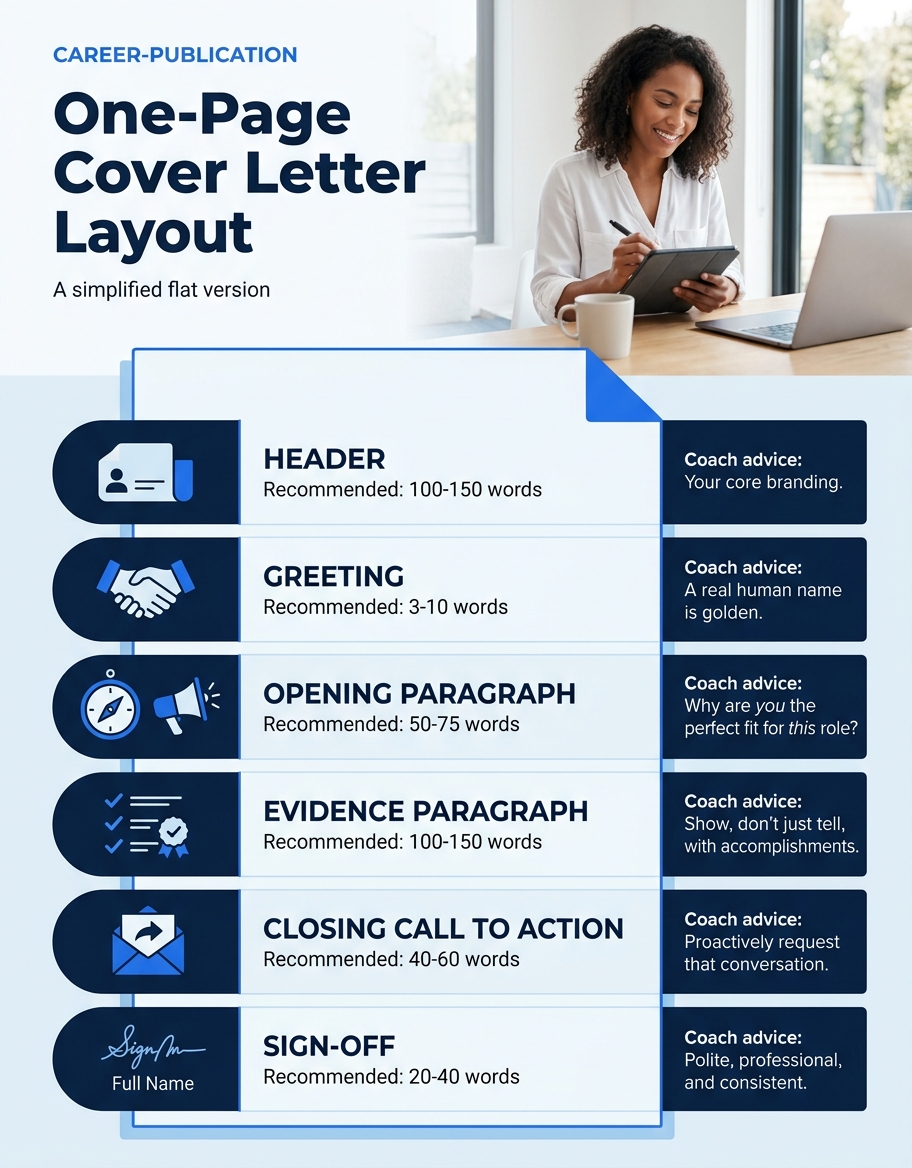
4.5Five steps, one customized template, roughly 25 minutes of focused work, that’s the path from blank page to a finished cover letter and sample you can adapt to any job posting. The structure below follows the six-section format that MIT’s career advising office, the University of Michigan Career Center, and Microsoft’s own template library all recommend, with specific formatting rules and sample language for each section.
TL;DR: Every effective cover letter follows six sections: header, greeting, opening paragraph, evidence paragraph, closing call to action, and sign-off. Keep yours under one page (200-400 words), customize it to each company, and use 10-12 point font. Generic letters get tossed, 72% of hiring managers penalize applications that aren’t tailored.
Before You Start
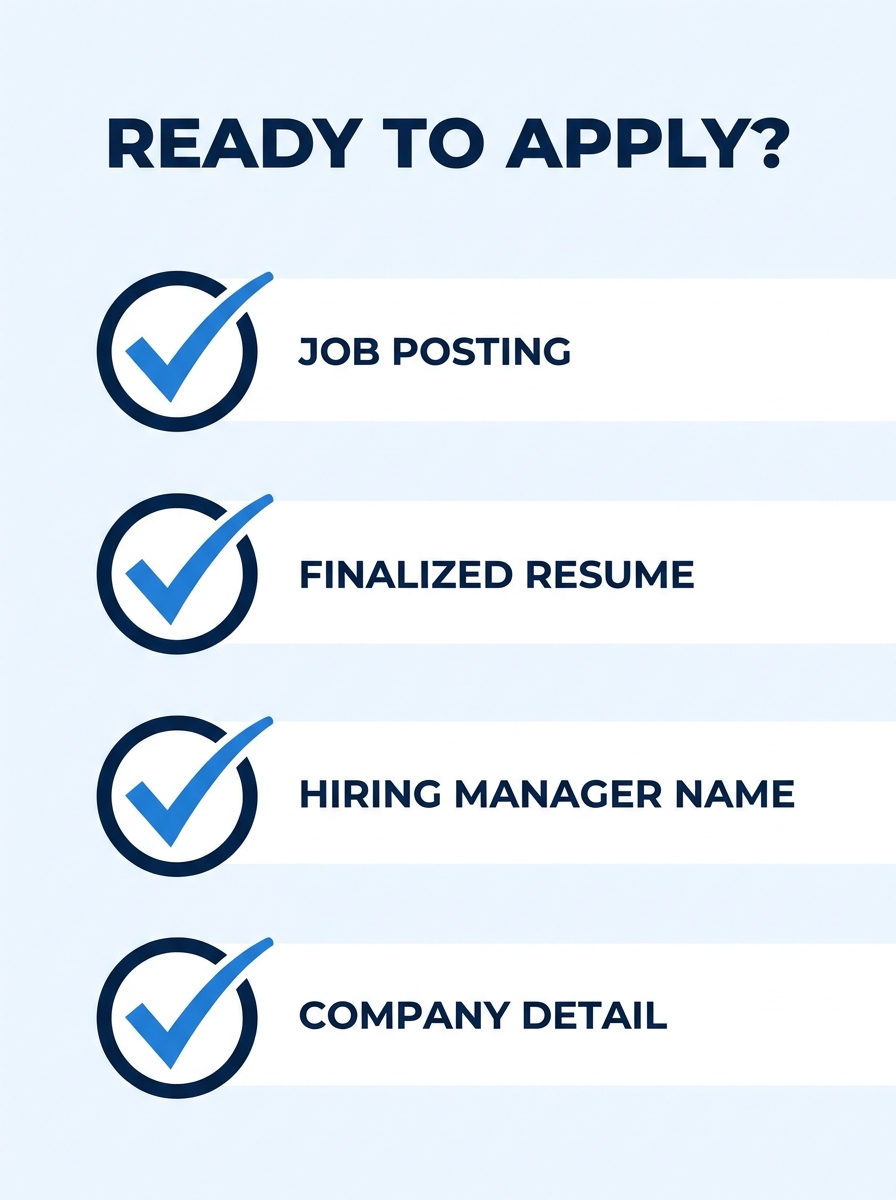
You need four things ready before touching any template. Missing one of them will either slow you down mid-draft or produce a letter that reads as generic, which defeats the purpose entirely.
The job posting itself. Print it or paste it into a separate document. Highlight the top three responsibilities and any specific qualifications they mention by name. You’ll mirror this language in your evidence section.
Your resume, finalized. Your cover letter should complement your resume, not repeat it. If you’re still tweaking bullet points, finish that first. (If you need help choosing a builder that passes ATS parsing, we tested six platforms against real applicant tracking systems, that piece walks through what worked and what didn’t.)
The hiring manager’s name. Check the job posting, the company’s LinkedIn page, or the team page on their website. According to MIT’s career advising guide, if you genuinely can’t find a name, “Dear Hiring Manager” is acceptable, but a named greeting signals effort.
One company-specific detail. A recent product launch, a quarterly earnings highlight, a news article about their team. You’ll use this in your opening paragraph to prove you researched them, which matters because 72% of hiring managers say customization is a deciding factor in whether they keep reading.
Info: Time estimate: gathering these four items takes 10-15 minutes. The actual writing takes another 15-20. Budget 30 minutes per application, and you’ll produce a stronger letter than 83% of candidates who skip the cover letter entirely.
Step 1: Build Your Header and Contact Block
The header sits at the top of your document and mirrors the contact block on your resume. It establishes you as a real, reachable person before the reader hits a single sentence of persuasion.
Include your full name, phone number, email address, city and state (full street address is no longer expected), and a link to your LinkedIn profile if it’s updated. Below your information, add the date and the recipient’s details: their name, title, company name, and company address.
The University of Michigan Career Center specifies the formatting: use a font between 10 and 12 points (matching your resume font), set margins between 0.5 and 1 inch, and left-justify everything. Your header should start no more than 2 inches from the top of the page.
You’ll know it worked when your header and the top of your resume look like they belong to the same document, same font, same sizing, same general layout. If someone printed both and placed them side by side, they’d clearly come from one person.
Step 2: Write a Greeting That Names a Real Person
Address the letter to a specific individual whenever possible. “Dear [First Name] [Last Name]” is the standard format. Skip gendered titles unless you’re certain of the person’s preference.
If the job posting includes a reference number or code, MIT’s career advising guide recommends including it in the first line after your greeting so HR can route your application correctly. Something like: “Re: Marketing Coordinator, Reference #MK-2847.”
You’ll know it worked when you can read the greeting aloud and it sounds like you’re writing to a specific human being at a specific company, not broadcasting into a void.
Step 3: Draft Your Opening Paragraph, The Hook
This is where most cover letters fail. The opening paragraph has one job: make the hiring manager want to read paragraph two. Research from hiring surveys shows that 45% of hiring managers read the cover letter before the resume, which means your first 40-50 words are doing the heaviest lifting of your entire application.
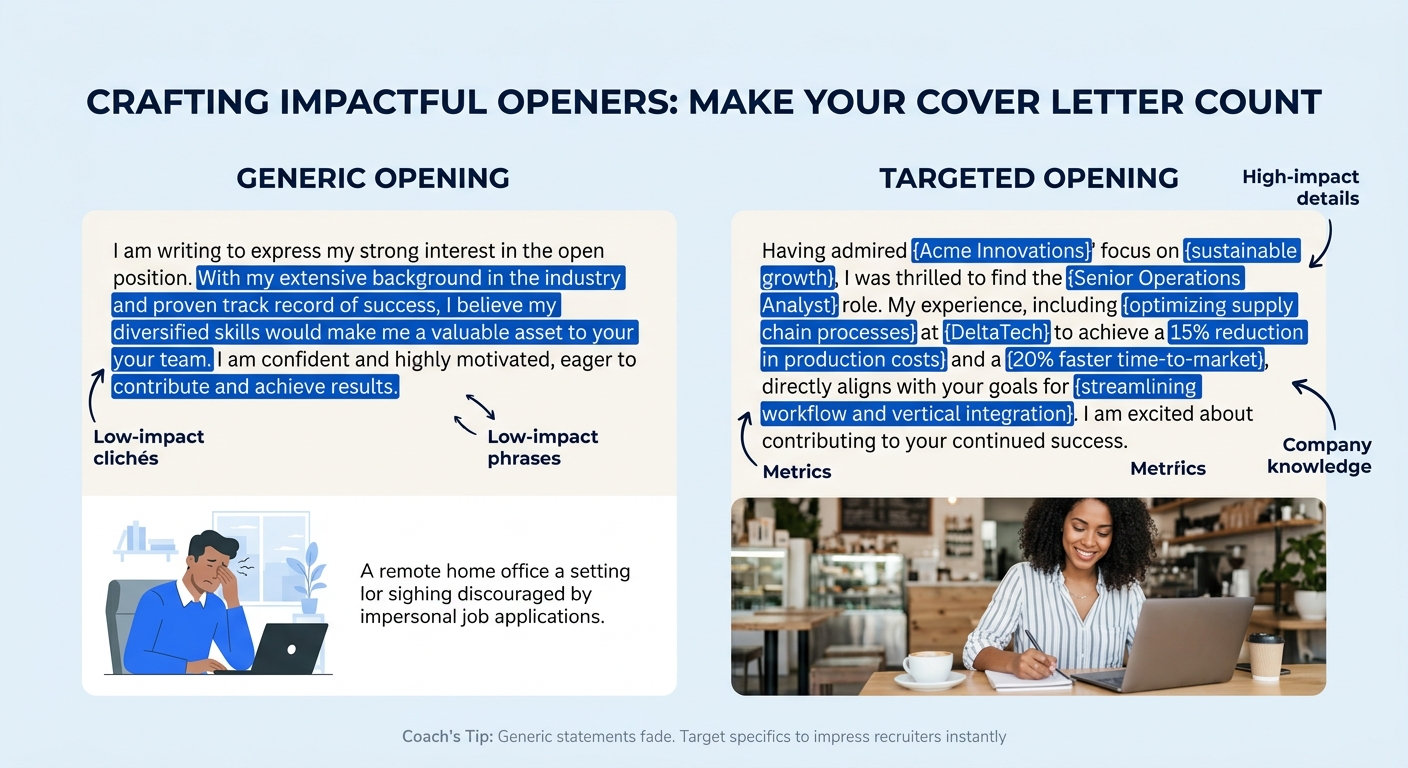
The problem-solution format outperforms generic templates here. Name the company, reference the role, and connect it to something specific about why you’re writing. Avoid restating your resume or opening with “I am writing to apply for…”, that’s the equivalent of starting a conversation by announcing you’re about to start a conversation.
Sample opening (mid-career):
“Your Q2 product roadmap for Meridian Health’s patient portal expansion caught my attention because I spent the last four years building exactly that kind of infrastructure at CarePoint, where my team reduced patient onboarding time by 38%.”
Sample opening (entry-level):
“The data analytics internship at Greystone Partners aligns directly with the supply-chain modeling work I completed during my capstone project at UW-Madison, where our team’s demand-forecasting model improved prediction accuracy by 12% over the department’s existing tool.”
Notice both samples include a named company, a specific role, and a measurable result. Stories are 22 times more memorable than facts alone, so weave a brief narrative around your number rather than dropping statistics without context.
You’ll know it worked when your opening paragraph could not be copy-pasted into an application for a different company without rewriting at least two sentences.
Step 4: Build the Evidence Section
The middle paragraph (or two short paragraphs, depending on length) provides proof for the claim your opening paragraph made. This is where you match your experience to the job posting’s top requirements, the ones you highlighted during prep.
Pick two or three of the job posting’s listed responsibilities and connect each one to a specific thing you’ve done. Use the format: what you did → what happened as a result. Quantify wherever possible, but don’t fabricate metrics. “Managed a team” becomes “managed a five-person content team that published 47 articles per month.” “Improved processes” becomes “redesigned the client intake workflow, cutting average onboarding from 14 days to 6.”
If you’re changing careers and struggling with how to frame your past experience for a new industry, the same principles apply, you’re translating skills, not inventing them. We covered that translation process in detail for career changers whose résumés still speak the wrong industry language.
For entry-level candidates with limited work history, Upwork’s template guide recommends leaning heavily on transferable skills and academic achievements. A senior thesis, a capstone project, a leadership role in a campus organization, these all count when framed with specifics.
You’ll know it worked when each paragraph in this section contains at least one concrete number or outcome, and every claim maps directly to a requirement listed in the job posting.
Your opening paragraph could not be copy-pasted into an application for a different company without rewriting at least two sentences. That’s the test.
Step 5: Close With a Call to Action and Sign Off
The closing paragraph does three things: restates your interest, proposes a next step, and thanks the reader. Keep it to three or four sentences. The Microsoft Word Blog’s formatting guide identifies this section as the “closing call to action”, you’re asking for something specific, like a conversation or an interview.
Sample closing:
“I’d welcome the chance to discuss how my experience with enterprise onboarding systems fits Meridian Health’s expansion plans. I’m available for a call or video interview at your convenience and can be reached at (555) 234-5678 or [email protected]. Thank you for your time and consideration.”
Sign off with “Best regards,” “Sincerely,” or “Thank you” followed by your full name. Skip “Warmly,” “Cheers,” or anything overly casual unless you’re applying to a company whose culture explicitly signals informality.
You’ll know it worked when your closing paragraph includes a specific action you’re inviting the reader to take, your contact information, and a professional sign-off. The total letter should fit on one page, MIT’s guide and the University of Michigan Career Center both set this as a hard ceiling.
Formatting Specs at a Glance
| Element | Specification |
|---|---|
| Total length | 200-400 words, never more than one page |
| Font size | 10-12 point, matching your resume |
| Font type | Same family as your resume (e.g., Calibri, Garamond, Arial) |
| Margins | 0.5 to 1 inch on all sides |
| Alignment | Left-justified throughout |
| Spacing | Single-spaced with a blank line between paragraphs |
| File format | PDF unless the posting specifically requests .docx |
| File name | FirstName-LastName-CoverLetter.pdf |
When Things Go Wrong
Problem: Your letter runs longer than one page. This is the single most common issue. Cut your evidence section first, you probably included four examples when two strong ones would carry more weight. Remember, 200-400 words is the sweet spot. If you’re over 400, you’re over-explaining.
Problem: The letter sounds like your resume in paragraph form. Read both documents back to back. If you spot the same phrases in both, rewrite the cover letter versions. Your resume lists what you did; your cover letter explains why it matters to this company. We have additional sample cover letters organized by scenario that show this distinction clearly.
Problem: You can’t find the hiring manager’s name. Try LinkedIn’s company page, filter by department, or call the company’s front desk and ask. If none of that works, “Dear Hiring Manager” is fine, 32% of job seekers now use AI tools to draft their letters, so a human-sounding letter addressed generically still outperforms a robotic one addressed to the right person.
Warning: Don’t send the same letter to multiple companies with only the company name swapped. Hiring managers spot this pattern quickly, and it signals low effort. The company-specific detail in your opening paragraph and the job-requirement mapping in your evidence section should change with every application.
Where to Go From Here
You’ve got the structure, the formatting rules, and the section-by-section approach for building a cover letter that holds up against real hiring expectations. The next move is practice, pick one job posting from your current search, set a 30-minute timer, and build a letter from scratch using the steps above. Your first attempt will take the full 30 minutes. By your third or fourth letter, you’ll have your evidence stories polished and reusable, and the per-application time drops to around 15 minutes.
If you want to see more finished examples across different industries and career stages, we’ve collected ready-to-use cover letter samples with annotations explaining what works in each one. And if your resume still needs attention before you start sending applications, sorting that out first will give your cover letters a stronger foundation to build on, the two documents work as a pair, and a weak resume undermines even the best letter.