
 4.9
4.9 4.5
4.5The letter cover sample in this guide follows the same six-section structure that MIT’s career advising office, the University of Michigan Career Center, and Microsoft’s 2026 Word Blog formatting guide all recommend independently. Below the sample, you’ll find the step-by-step process to customize each section for any specific job posting in under 30 minutes.
Before You Start
You need four things before you write a single word. Skipping any of them leads to the kind of generic letter that 35% of hiring managers discard for failing to mention relevant skills:
- The job description, open in a separate tab or printed. You’ll pull keywords, required skills, and the hiring manager’s name directly from it.
- Your current resume, so achievements and dates stay consistent across both documents.
- A word processor that lets you save as PDF. Google Docs, Microsoft Word, and LibreOffice all work. ATS platforms can eliminate up to 50% of candidates based on formatting alone, and PDF preserves your layout.
- 15-30 minutes of uninterrupted time. The process below is sequential, and switching between tasks inflates the time by roughly 2x.
Info: The goal is a one-page document. MIT’s career office specifies a [font size between 10 and 12 points](https://capd.mit.edu/resources/how-to-write-an-effective-cover-letter/), and 70% of employers prefer letters that run one-half page or shorter. Aim for 250-400 words of body text total.
A Complete Letter Cover Sample
Below is a full letter cover sample for a marketing coordinator role. Each section is labeled so you can see how the six parts fit together. The steps that follow show you how to rewrite each section for your own target job.
[Header] Jane Doe (555) 867-5309 | [email protected] | linkedin.com/in/janedoe Chicago, IL 60614
[Date] July 28, 2026
[Greeting] Dear Ms. Rivera,
[Opening Paragraph] Your posting for a Marketing Coordinator at Greenline Media caught my attention because of the emphasis on data-driven campaign management. In my current role at Bower & Associates, I increased email open rates by 22% over six months by segmenting audiences based on purchase history rather than demographics.
[Body Paragraph] At Bower, I manage a $45,000 monthly ad budget across Google and Meta platforms, track ROI weekly, and present performance reports to a five-person leadership team. I also led the migration from Mailchimp to HubSpot, reducing our email production time by 30%. These experiences align directly with your requirements for someone comfortable with marketing automation tools and cross-channel analytics.
[Closing + Sign-Off] I’d welcome the chance to discuss how my experience with audience segmentation and budget management could support Greenline’s Q4 product launch. I’m available for a call or video interview at your convenience.
Sincerely, Jane Doe
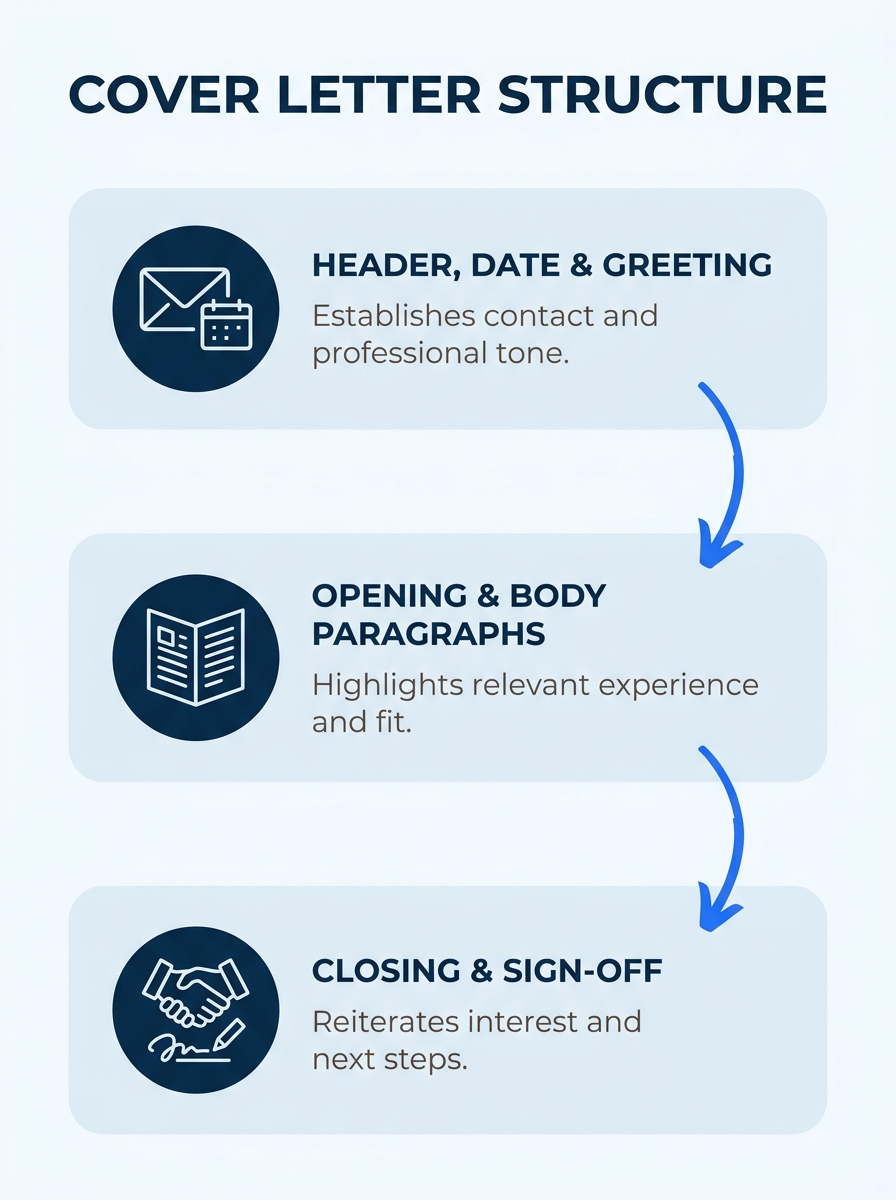
That’s the finished product. Now here’s how to build your own from scratch.
Six Steps to Write Your Own
Step 1: Build the Header Block
The header puts your contact information at the top of the page, matching the format on your resume. Include your full name, phone number, email address, and city/state. A LinkedIn URL is optional but increasingly expected.
The action: Open your word processor. Type your name in bold at the top, followed by a line with phone, email, and LinkedIn URL separated by pipes ( | ) or bullet characters. Add your city and state on the next line. Below that, add the date you plan to send the letter.
You’ll know it worked when the top of your document mirrors the contact block on your resume. If the two don’t match, a recruiter spending their average 30 seconds on your letter will notice the inconsistency.
Step 2: Address the Right Person by Name
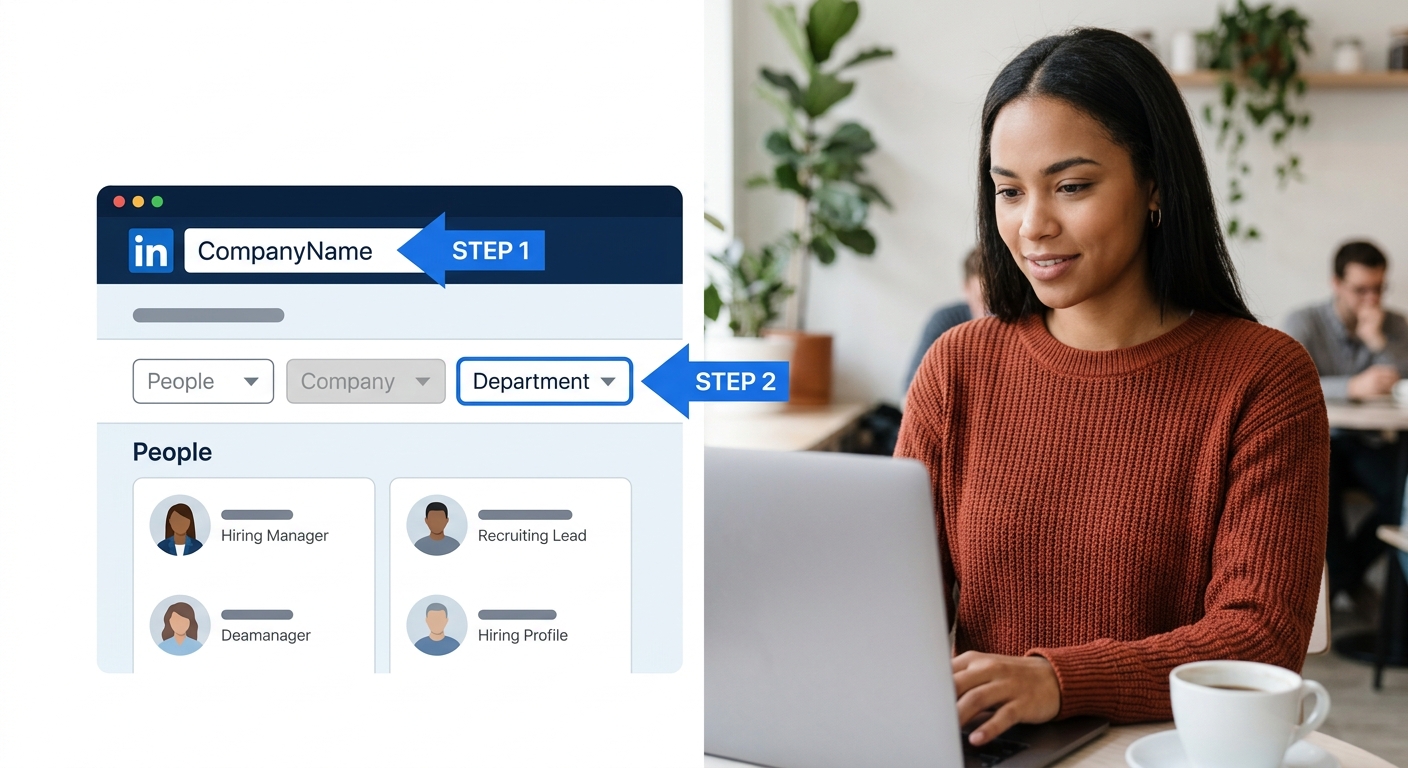
The University of Michigan Career Center puts it directly: “Try to find the name of the person you want to read the letter. It demonstrates a higher level of investment and enthusiasm for the position.” And 26% of hiring managers specifically appreciate being addressed by name rather than by a generic salutation.
The action: Check the job posting for a contact name. If none is listed, search LinkedIn for the department’s hiring manager or team lead. Try the company’s “About” or “Team” page. If you’ve found a referral connection, mention that in the opening paragraph, referrals increase hire rates from 7% to 17%.
You’ll know it worked when your greeting reads “Dear Ms. Rivera” or “Dear Hiring Manager, Sarah Chen” rather than “To Whom It May Concern.” The University of Michigan Career Center recommends avoiding “To Whom It May Concern” entirely. If you genuinely cannot find a name after searching LinkedIn and the company site, use a specific title like “Dear Marketing Director” or “Dear Hiring Manager.”
Step 3: Write an Opening Paragraph That Earns 30 More Seconds
For 41% of hiring managers, the opening paragraph is the single most important part of the cover letter. This is where you name the role, explain why you’re interested, and drop one specific accomplishment, a number, a result, a project name, that makes the reader want to continue.
The action: Write 2-3 sentences. Sentence one names the role and company. Sentence two ties your background to a specific requirement from the job description. Sentence three states a measurable result from your recent work. Look at the sample above: “increased email open rates by 22% over six months” is the kind of concrete claim that separates your letter from the 79% of cover letters that employers still read even when they’re listed as optional.
You’ll know it worked when your opening paragraph contains at least one number and directly references something from the job posting. If you can swap in any other company’s name without changing the paragraph, it’s too generic. And 47% of hiring managers won’t hire candidates who seem unaware of the company, so specificity matters here.
Step 4: Back Up Your Claim in the Body
The body paragraph is where you prove the opening wasn’t a bluff. About 36% of employers look for evidence of multitasking ability, 31% want signs of initiative, and 63% of HR professionals specifically want to understand your motivations for applying.
The action: Write 3-5 sentences that describe relevant responsibilities and results from your current or most recent role. Each sentence should connect to a requirement listed in the job posting. If the posting says “experience with CRM platforms,” you write “I led the migration from Mailchimp to HubSpot.” If it says “budget management,” you write “I manage a $45,000 monthly ad budget.”
You’ll know it worked when every sentence in the body paragraph can be traced back to a line in the job description. You’re building a case, not summarizing your resume. If you’ve already explored our collection of cover letter samples organized by job type, you’ll notice this pattern, strong body paragraphs map directly to the posting’s requirements.
If you can swap in any other company’s name without changing the paragraph, it’s too generic.
Step 5: Close with a Direct Ask
The Microsoft Word Blog’s 2026 formatting guide describes the closing section as a “closing call to action”, the phrase matters. You’re asking for something specific: a phone call, a video interview, a meeting.
The action: Write 2 sentences. The first connects your experience to a specific upcoming project, goal, or challenge the company faces (check their press page, recent blog posts, or quarterly reports). The second states your availability and preferred method of contact.
You’ll know it worked when your closing contains a clear next step. “I’d welcome the chance to discuss” plus a specific topic is stronger than “I look forward to hearing from you,” which 83% of hiring managers have already read hundreds of times.
Step 6: Format, Proofread, and Send
This is where 58% of employers will reject you if they find typos. Formatting errors and spelling mistakes are the single fastest way to end up in the “no” pile, and 81% of hiring managers have rejected applicants after reading poorly written cover letters.
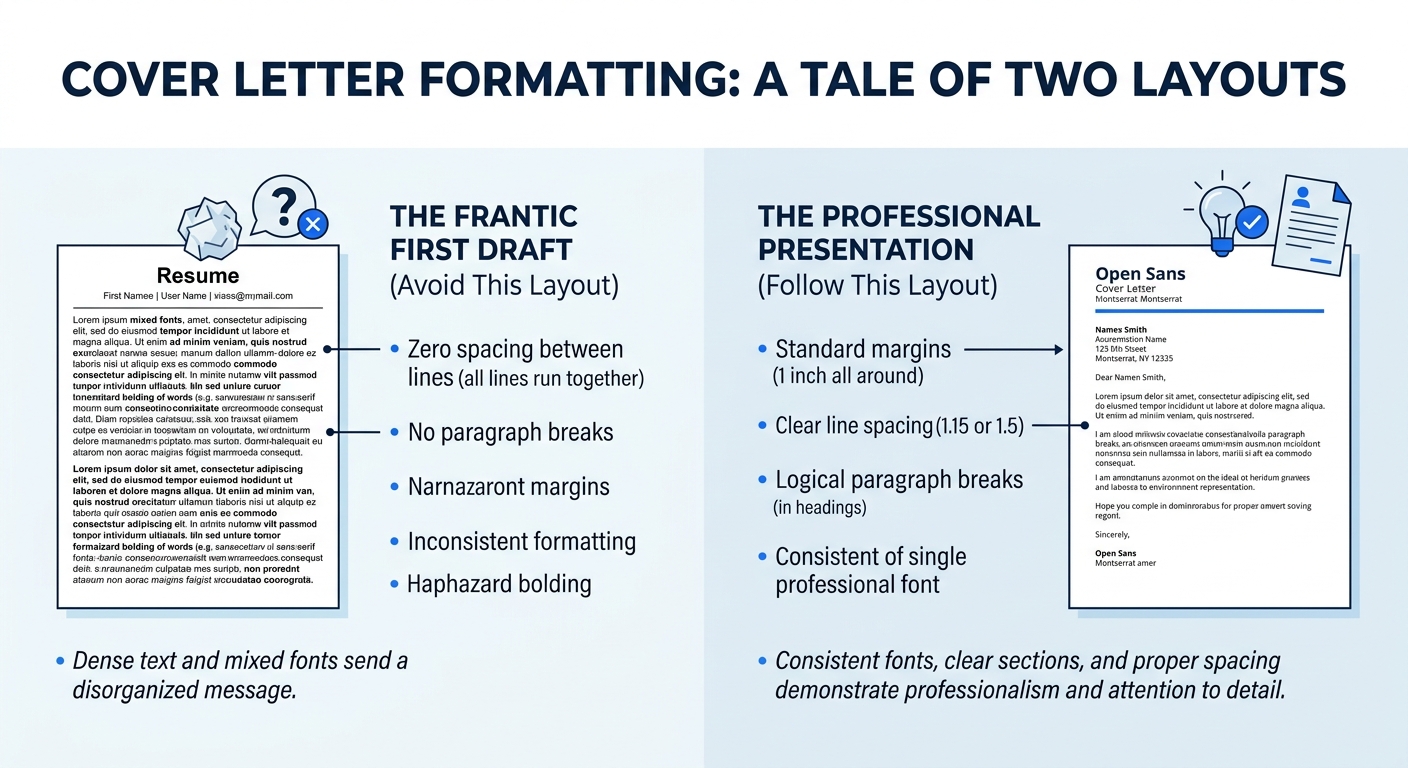
The action: Set your font to a clean sans-serif or serif (Arial, Calibri, Georgia, Times New Roman) between 10 and 12 points. Set margins to 1 inch on all sides. Read the entire letter out loud, you’ll catch awkward phrasing that silent reading misses. Then run spell-check. Save as PDF unless the job posting specifically requests a different file type. Name the file “FirstName-LastName-Cover-Letter.pdf.”
You’ll know it worked when the letter fits on one page, the PDF opens cleanly on your phone (test it), and you’ve read every word at least twice.
When Things Go Wrong
Three problems come up repeatedly, and each one is fixable:
Problem 1: Your letter runs longer than one page. Cut the body paragraph first. Remove any sentence that restates something already on your resume without adding context or results. Remember, 70% of employers prefer half a page or less, you likely have filler.
Problem 2: You can’t find the hiring manager’s name. Use the department head’s title instead (“Dear Director of Engineering”). If you’re applying through an online portal that strips formatting, the greeting matters less than the content. But don’t default to “To Whom It May Concern”, it signals low effort.
Problem 3: You keep writing generic letters. Open the job description in one window and your letter in another. Go line by line through the posting’s requirements. If your letter doesn’t address at least 3 of the top 5 listed qualifications, rewrite the body. Our ready-to-use cover letter template can help you see how this mapping looks in practice.
Tip: Before sending, paste your letter into a plain-text editor and check that no formatting artifacts (smart quotes turning into question marks, bullet points vanishing) survived the conversion. ATS platforms parse plain text, and garbled characters can cause keyword matching to fail entirely.
Where to Go From Here
With the letter cover sample above and the six-step process behind it, you have a working template and the understanding to modify it for any role. The 77% of recruiters who prefer candidates with cover letters are giving you a clear signal: the letter is a competitive advantage when it’s specific, brief, and backed by real numbers.
Your next move depends on where you are in the application process. If you’re still building your resume, pairing this letter with a strong cover letter and template set gives you a consistent application package. If you’re tailoring letters for different industries, browsing examples that have led to interviews across marketing, engineering, healthcare, and nonprofit roles will show you how tone and emphasis shift between fields.
Write one letter well, customize it for the next posting, and keep the file. Each version gets faster. By your third or fourth application, you’ll spend 15 minutes instead of 30, because the structure is already in your hands.