

 4.9
4.9 4.5
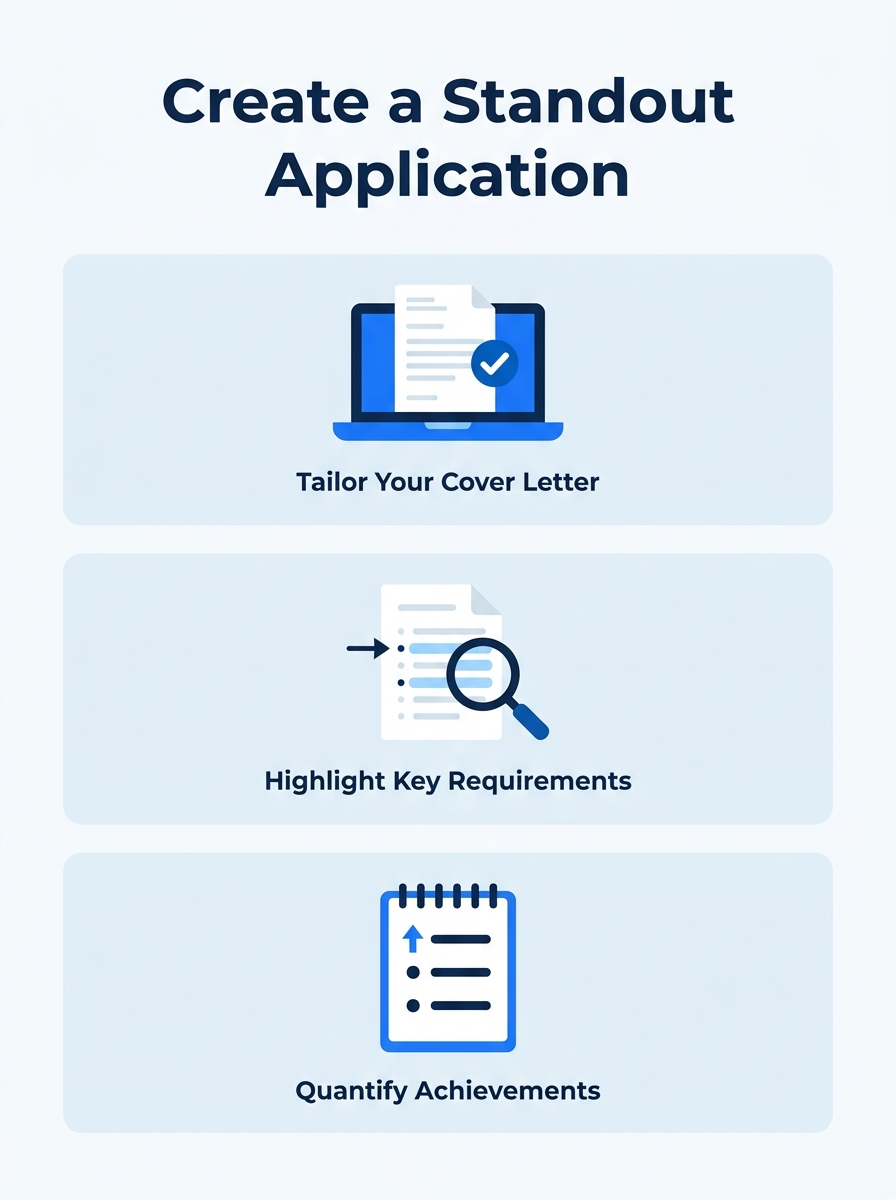
4.5Indeed’s career advice team defines the ideal cover letter as one page with three to four focused paragraphs and zero generic filler. The five cover letter for samples below follow that structure exactly, each built for a different hiring scenario so you can pick the right one and finish writing in under 40 minutes.
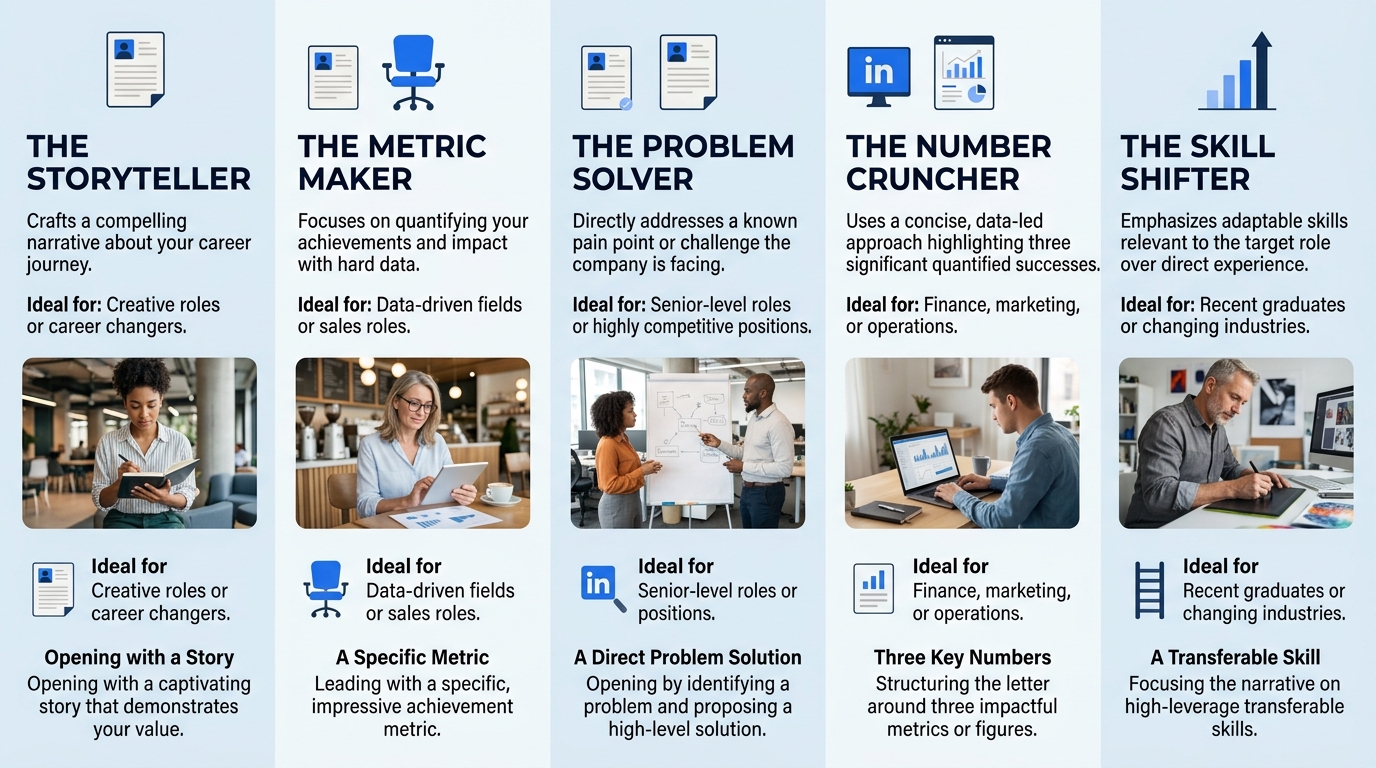
TL;DR: Choose from five ready-to-use cover letter samples (problem-solution, achievement-focused, narrative, data-led, or potential-focused), swap in your details, and run the ATS checklist at the end before you send. Total time: 30-45 minutes per letter.
Before You Start
You need four things before you open a blank document. First, the full job posting with the role title, required qualifications, and any listed keywords. Second, two to three specific accomplishments from your career that relate to what the job asks for, each with a number attached (a percentage, a dollar figure, a team size, a timeline). Third, the name of the hiring manager. The Muse’s cover letter guide is direct on this point: “Never use generic salutations like ‘To Whom It May Concern’ or ‘Dear Sir or Madam,'” and recommends “Hello, Hiring Manager” as your fallback when you can’t find a name.
Fourth, a clean template. Microsoft Word offers free cover letter templates with adjustable fonts and color schemes, and Canva provides printable letter-size layouts you can pair with your existing resume. Pick one with standard left-justified formatting. The University of Michigan’s Career Center specifies that cover letter text should begin no more than 2 inches from the top of the page, with positive, confident language written in active verb voice.
Time required: 30-45 minutes per letter if you have your accomplishments ready. Longer if you need to research the company first.
The Problem-Solution Letter
This format works when you can identify a specific challenge the company faces and show that you’ve solved something similar. Hiring managers are 47% less likely to consider candidates who can’t demonstrate knowledge of the company, according to recent hiring data. The problem-solution structure forces that research upfront.
The sample:
Dear [Hiring Manager Name],
[Company Name]’s expansion into [market/region] creates a real challenge: [specific problem you’ve identified from their job posting, news, or annual report]. I dealt with this exact situation at [Previous Company], where I [specific action you took] and [measurable result, e.g., “reduced onboarding time from 14 days to 6” or “cut security vulnerabilities by 57%”].
My approach centers on [2-3 sentence description of your method]. At [Previous Company], this translated to [second measurable result]. I’d welcome the chance to bring this experience to [Company Name]’s [specific team or initiative].
I’ve attached my resume for your review. I’m available at [phone/email] and flexible on scheduling.
Best regards, [Your Name]
Goal of this format: Prove you understand the company’s situation and have already solved similar problems. You’ll know it worked when your opening paragraph names a real, verifiable company challenge and your body paragraph includes at least one number. If you want more structural variations on this approach, we broke down real cover letter examples with similar problem-solution framing in a separate guide.
Leading With Achievements
MIT’s Career Advising and Professional Development office states that effective cover letters “state clearly in your opening sentence the purpose for your letter and a brief professional introduction.” The achievement-focused format follows that principle by leading with your strongest quantified result, not burying it in paragraph three.
The sample:
Hello [Hiring Manager Name],
In three years as a [Your Title] at [Previous Company], I [biggest quantified achievement, e.g., “increased qualified leads by 89%” or “managed a $2.4M annual budget with zero overruns”]. I’m writing because [Company Name]’s [Role Title] position calls for exactly that skill set.
Two results I’m most proud of: [Achievement 1 with number] and [Achievement 2 with number]. Both required [specific skill from the job description], which your posting highlights as a core requirement.
I’d appreciate 20 minutes to discuss how these results translate to [Company Name]’s goals. My resume is attached.
Thank you, [Your Name]
Goal: Let your numbers do the convincing. Verification: Count the quantified results in your finished letter. If you have fewer than two specific figures (percentages, dollar amounts, team sizes, timelines), add more before sending. And if your resume’s bullet points need the same metric-driven treatment, our proven cover letter templates include guidance on matching your letter’s tone to your resume.
A Narrative That Connects the Dots
Research on storytelling in professional contexts shows that narratives are 22 times more memorable than facts presented alone. The risk with a story-driven cover letter is wandering off-topic, so this sample keeps the narrative to two sentences and ties it directly back to the role.
The sample:
Dear [Hiring Manager Name],
[One-to-two sentence personal hook tied to the industry, e.g., “I rebuilt my first database at 16 after accidentally deleting my school’s library catalog. That early lesson in data recovery shaped every decision I’ve made as a systems administrator since.”]. When I saw [Company Name]’s [Role Title] opening, the connection was immediate.
At [Previous Company], I [relevant achievement with number]. I also [second achievement], working with a team of [size]. Your posting emphasizes [specific skill], which has been central to my work for [number] years.
I’d value the chance to discuss this further. My resume is attached, and I’m reachable at [contact information].
Warm regards, [Your Name]
A cover letter for samples works as a starting framework, not a finished product. The moment you stop customizing, you start blending in with the other 50+ applications on the hiring manager’s desk.
Goal: Create a memorable opening that a hiring manager recalls after reviewing dozens of applications. Verification: Read your hook aloud. If it takes longer than 10 seconds to say, trim it. If it doesn’t connect to the job within two sentences, rewrite until it does.
Numbers First, Context Second
This format works best for roles in sales, marketing, operations, or finance where everything gets measured. Oregon State University’s Career Development Center advises candidates to “list examples and illustrate how and why you are a qualified candidate.” The data-led sample does exactly that through raw numbers in the very first line.
The sample:
Hello [Hiring Manager Name],
Three numbers define my career in [field]: [Number 1, e.g., “$3.1M in new revenue generated”], [Number 2, e.g., “156% average quota attainment over 8 quarters”], and [Number 3, e.g., “94% client retention rate across 40+ accounts”]. Each one reflects the kind of performance [Company Name] describes in your [Role Title] posting.
At [Previous Company], I inherited a territory performing at 67% of target. Within [timeframe], I [specific actions] and brought it to [result]. The key was [brief method description].
I’ve attached my resume with full context on these results. I’m available at [phone/email] for a conversation.
Best, [Your Name]
Goal: Establish credibility in the first sentence through hard metrics. Verification: Each number should be accurate, verifiable if asked during an interview, and relevant to the posted role. If any number feels inflated, replace it with something you can defend under questioning.
For candidates who want to pair this cover letter with a polished resume, our best resume builders comparison tests formatting across real ATS platforms so your resume matches the professional standard your cover letter sets.
Writing for Potential, Not Experience
Entry-level candidates and career changers face a specific problem: thin work history. Applicant tracking systems eliminate up to 50% of applicants before a human reviews anything, so your letter still needs relevant keywords from the job posting. But the body paragraphs shift from “here’s what I accomplished at work” to “here’s what I built, studied, or volunteered for that proves I can do this.”
The sample:
Dear [Hiring Manager Name],
As a [recent graduate/career changer] with [relevant coursework, certification, or volunteer experience], I’m drawn to [Company Name]’s [Role Title] because [specific reason tied to company mission or project, e.g., “your 2026 sustainability initiative aligns with the research I conducted on supply chain emissions at [University]”].
During [academic project/volunteer role/personal project], I [specific action with result, e.g., “analyzed 2,000 data points to identify sourcing inefficiencies, presenting findings to a panel of 12 faculty members”]. This experience built my skills in [skill from job description] and [second skill from job description].
I’ve attached my resume and would welcome a conversation about how my background fits [Company Name]’s needs.
Thank you, [Your Name]
Goal: Demonstrate transferable skills and genuine company interest when you don’t have a long work history. Verification: Your letter should mention the company by name at least twice, reference a specific company initiative or value, and include at least one measurable result from any context, whether academic, volunteer, or personal.
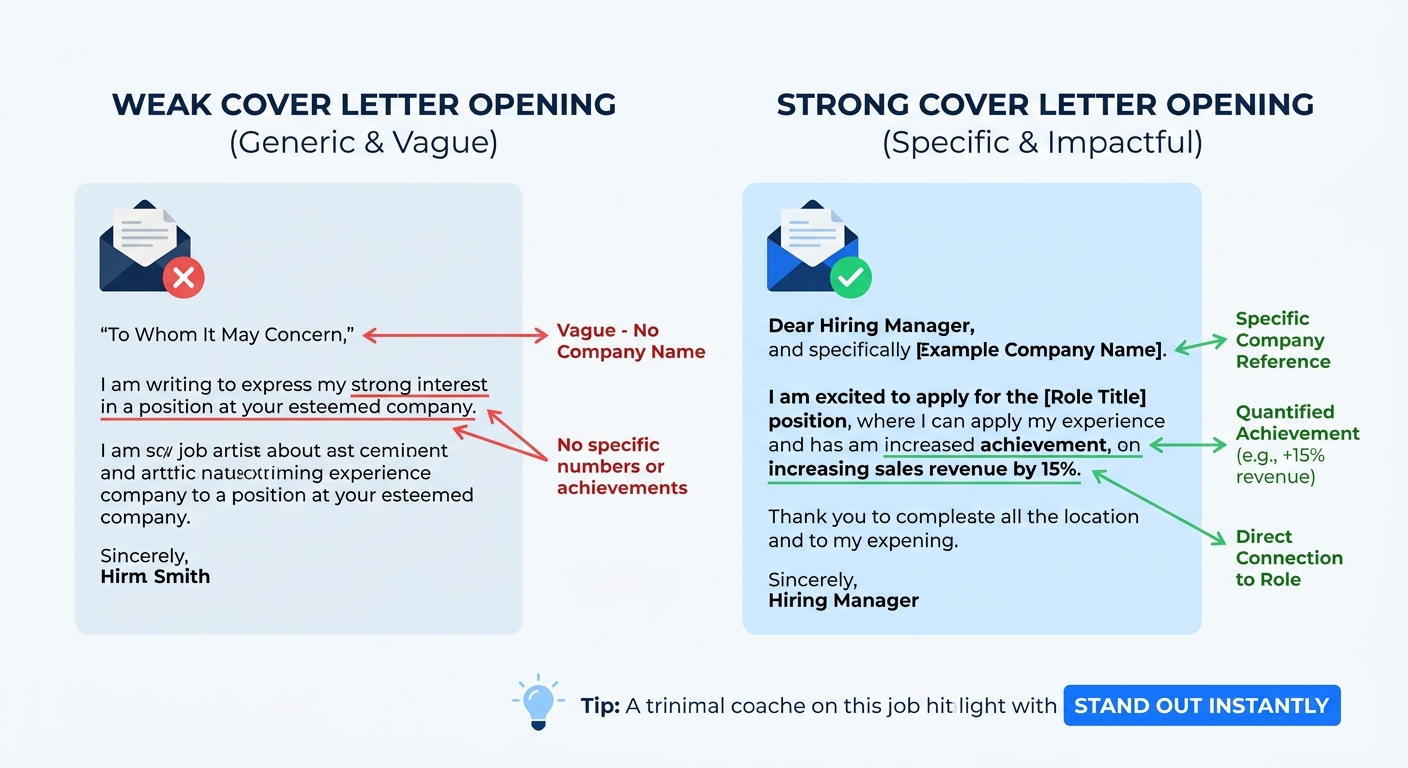
Common Failures and How to Fix Them
Three problems appear in the majority of rejected cover letters. Catch them before you hit send.
Problem 1: The letter reads like a resume summary. Indeed’s cover letter guide is clear: your letter should focus on the most important details of the job and explain the connection between your experience and the role, not restate bullet points the hiring manager will read on your resume anyway.
Fix: Remove any sentence that starts with “I was responsible for.” Replace it with a result describing what changed because of your work.
Problem 2: No company-specific detail. Two-thirds of job seekers now believe cover letters should be half a page or less, which means every sentence has to earn its place. A sentence like “I admire your company’s commitment to excellence” says nothing. A sentence like “Your Q1 product launch in the Nordic market mirrors the expansion I led at [Company]” gives the hiring manager a reason to keep reading.
Fix: Search the company’s recent press releases, LinkedIn posts, or quarterly reports. Pull one specific detail and reference it in your opening paragraph.
Problem 3: ATS formatting errors. Applicant tracking systems scan for keywords and clean formatting. Headers, footers, tables, and unusual fonts can break the scan entirely. Keep your cover letter in a single-column layout, use standard fonts (Arial, Calibri, or Times New Roman at 10-12pt), and mirror 3-5 keywords from the job posting verbatim.
Warning: Copy your finished letter into a plain-text editor before submitting. If the structure falls apart or paragraphs merge together, your formatting will confuse an ATS. Fix the layout in your original document and test again.
Where to Go From Here
You now have five cover letter for samples covering the situations most job seekers encounter: a company challenge you can solve, a track record of measured results, a personal story that sticks, a numbers-first approach for metrics-driven roles, and a potential-focused format for candidates with lighter experience. Pick the sample closest to your situation, fill in your specific details, and run through the troubleshooting checks above.
If your resume needs the same level of attention, the one-hour resume refresh framework breaks the full update into timed tasks you can finish in a single sitting. And if you’re applying to a role that asks for a shorter cover note instead of a full letter, our cover note examples follow a condensed structure built for email-body submissions. The sample that works is the one you actually customize for each application, send on time, and follow up on within a week.