
 4.9
4.9 4.5
4.5Every effective cover letter shares four structural bones: a hook naming the company, a value pitch tied to the posting, evidence through measurable results, and a confident close. This tutorial provides sample cover letter samples across nine industries and walks you through turning any sample into a personalized, send-ready letter under 400 words.
TL;DR: Pick a sample that matches your industry, swap generic lines for quantified achievements from your own experience, address the hiring manager by name, and keep the whole thing under half a page. Seventy percent of employers prefer that length.
Before You Start
You need three things before Step 1:
- A specific job posting you’re applying to. Don’t write a cover letter in the abstract. The posting’s language drives every sentence you’ll write.
- Your resume, finalized. Your cover letter expands on 2-3 resume achievements without repeating them. If your resume isn’t done, finish it first. Our guide on crafting cover letter examples that land interviews covers how the two documents work together.
- The hiring manager’s name. Check LinkedIn, the company’s team page, or call the front desk. According to hiring data, 47% of employers reject candidates who demonstrate zero company knowledge, and using “To Whom It May Concern” signals exactly that.
Time required: 30-45 minutes for your first letter. Subsequent letters using the same base sample take 15-20 minutes.
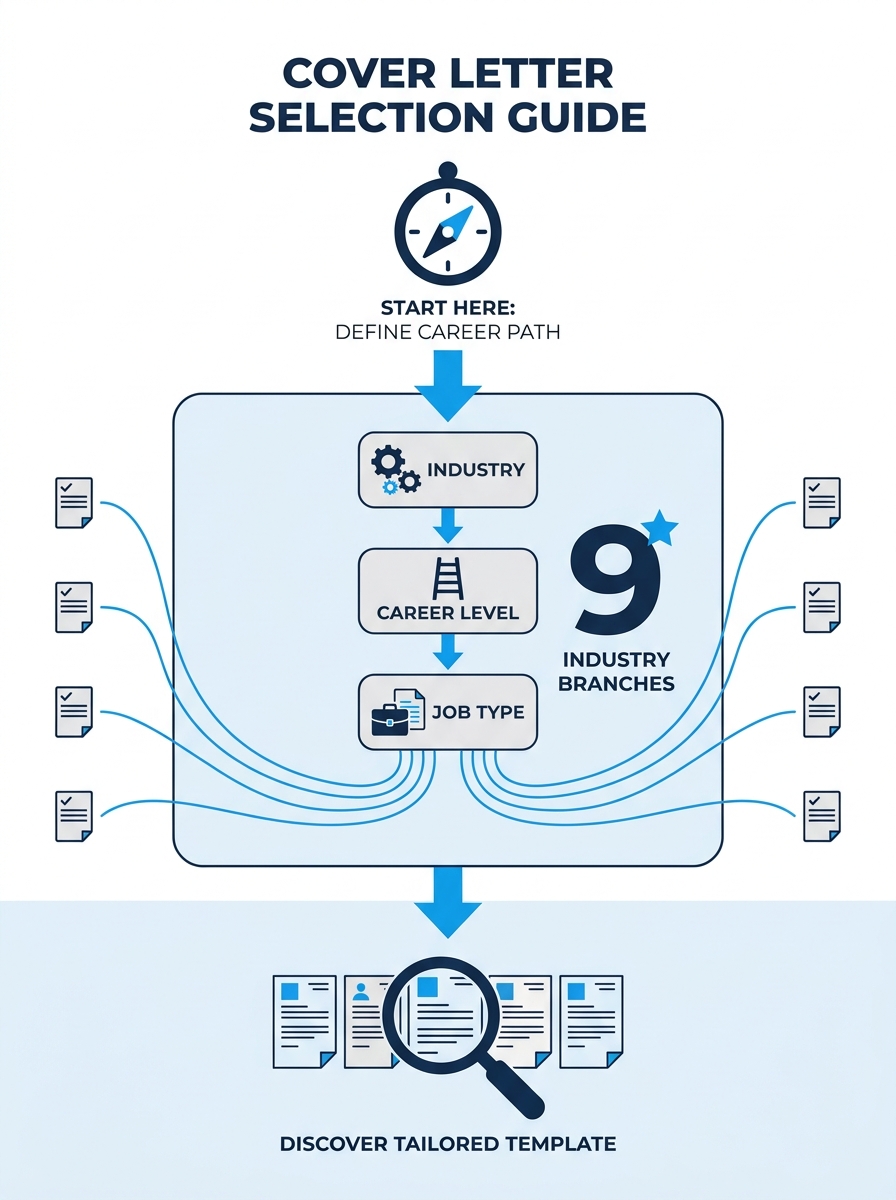
Step 1: Pick the Right Sample for Your Industry
The biggest mistake people make with sample cover letter samples is grabbing whichever one appears first in a search result. A cover letter for a registered nurse and a cover letter for a project manager share the same skeleton, but the evidence they emphasize is completely different. Indeed’s cover letter library organizes samples by job title and is the fastest way to find a relevant starting point.
Here’s how expectations differ by field:
| Industry Category | What Hiring Managers Look For | Key Phrases to Include |
|---|---|---|
| Administrative / Office | Organization, scheduling, correspondence management | “coordinated,” “managed calendars for,” “processed X requests per week” |
| Healthcare / Nursing | Patient outcomes, certifications, empathy under pressure | “patient satisfaction scores,” “HIPAA-compliant,” “managed caseload of X” |
| Construction / Trades | Safety record, equipment operation, physical problem-solving | “zero-incident record,” “operated [specific equipment],” “completed X% under budget” |
| Business / HR / Executive | Leadership, strategy, team collaboration | “grew revenue by X%,” “reduced turnover from X% to Y%,” “led team of X” |
| Technology / Engineering | Technical stack, project delivery, system improvements | “reduced latency by X ms,” “deployed to X users,” “migrated X records” |
| Education / Academic | Curriculum development, student outcomes, classroom management | “improved test scores by X%,” “developed curriculum for X students” |
| Sales / Marketing | Revenue numbers, campaign performance, client acquisition | “closed $X in new business,” “increased conversion rate by X%” |
| Creative / Design | Portfolio highlights, brand impact, stakeholder collaboration | “redesigned [specific asset],” “increased engagement by X%” |
| Entry-Level / Career Change | Transferable skills, enthusiasm, relevant projects | “completed [specific project],” “led [club/volunteer org],” “trained in [tool]” |
You’ll know this step worked when the sample you’ve chosen comes from someone in a similar role, at a similar career stage, applying to a similar type of company. If the sample is for a senior VP and you’re applying for an analyst role, go back and find a closer match.
Step 2: Map the Job Posting to Your Sample’s Structure
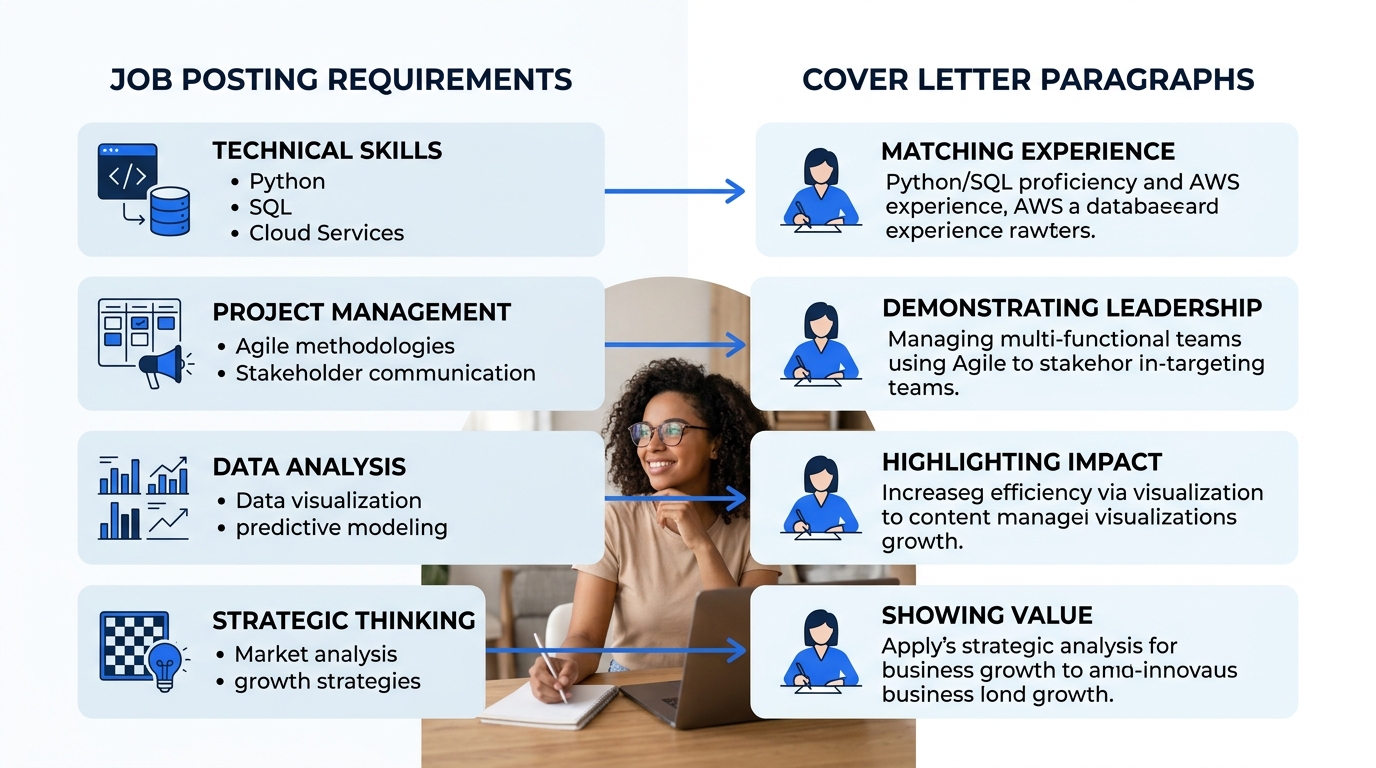
Open the job posting in one window and your chosen sample in another. Read the posting’s “Responsibilities” and “Qualifications” sections line by line. Highlight the three requirements that appear most critical. These are usually listed first, repeated in different sections, or marked as “required” rather than “preferred.”
Your cover letter’s body paragraphs need to answer those three requirements directly. Here’s how the mapping works in practice:
Job posting says: “Manage a portfolio of 15+ enterprise accounts and maintain 95% retention rate.”
Your sample’s generic line says: “I have experience managing client relationships and ensuring customer satisfaction.”
Your adapted version says: “At [Previous Company], I managed 18 enterprise accounts totaling $2.3M in annual recurring revenue, maintaining a 97% retention rate over two fiscal years.”
The generic version is a claim. The adapted version is proof, and proof is what hiring managers remember. Indeed’s own guidance reinforces this: format your letter like a business document and include relevant achievements that show the value you bring to the organization.
You’ll know this step worked when each body paragraph in your draft directly responds to a specific requirement from the posting. If you can’t draw a line from a paragraph to a requirement, cut the paragraph.
Step 3: Replace Every Generic Line with a Quantified Achievement
This is the step where most cover letters die. People get the structure right and then fill it with sentences like “I am a hard-working team player with excellent communication skills.” That sentence tells the hiring manager nothing they can verify or remember.
The fix is mechanical. Go through your draft paragraph by paragraph and find every adjective that describes you (“dedicated,” “passionate,” “experienced”). Replace each one with a number, a dollar figure, a percentage, or a timeframe. About two-thirds of job seekers keep their letters under half a page, which means you have roughly 200-350 words of body text. Every sentence has to earn its spot.
Before: “I am passionate about data analysis and have strong attention to detail.”
After: “I built a reporting dashboard in Tableau that reduced the finance team’s monthly close process from 12 days to 7, saving approximately 40 analyst-hours per quarter.”
The second version is 26 words. It names a tool, a result, and a metric. That’s the standard every line in your letter should meet.
Tip: If you’re struggling to quantify an achievement, ask yourself: How many? How often? How much money? How much time? Even rough estimates (“approximately 40 hours”) are more convincing than vague adjectives.
If you’re curious about how AI tools draft cover letters, know that 11% of applicants now use AI for initial drafts. But the letters that get callbacks still need your real numbers. An AI tool doesn’t know that you managed 18 accounts or saved 40 analyst-hours. You do.
Step 4: Write an Opening Paragraph That Names the Company
Your first paragraph determines whether the hiring manager reads paragraph two. And the single fastest way to signal “I wrote this for you, specifically” is to name the company and reference something concrete about it: a recent product launch, a company value that resonates with you, or a team you want to join.
MIT’s career advising office recommends stating your purpose and a brief professional introduction in the opening sentence, keeping the entire letter under one page with 10-12 point font. Your opening paragraph should be 2-3 sentences, roughly 40-60 words.
Weak opener: “I am writing to express my interest in the Marketing Manager position at your company. I believe my skills make me a strong candidate.”
Strong opener: “When Acme Corp launched its direct-to-consumer subscription model in Q1, I immediately recognized the same distribution challenge I solved at my current company: converting one-time buyers into recurring subscribers. I’m applying for the Marketing Manager role because I’ve spent three years doing exactly this work.”
The strong version names the company, references a real business event, and connects it to specific experience. That’s 48 words, well under budget.
Forty-seven percent of employers reject candidates who demonstrate zero company knowledge, and using “To Whom It May Concern” is the loudest version of that signal.
Step 5: Edit for Length, Tone, and ATS Readability
Seventy percent of employers prefer cover letters that are half a page or less, and drifting past that threshold means your strongest achievements might never get read. Print your draft or zoom to full-page view. If it runs past the bottom margin, you need to cut.
Here’s an editing checklist:
- Length check: Aim for 250-400 words total. Count them. If you’re over 400, cut your weakest body paragraph entirely rather than trimming a sentence from each one.
- Tone check: Read it aloud. If any sentence sounds like something you’d never say in a real conversation, rewrite it. Contractions are fine. “I’m” is better than “I am” for tone (and word count).
- Name check: Confirm you’ve spelled the hiring manager’s name correctly and the company name matches what’s on the posting. This sounds obvious, but recycled cover letters are the #1 source of wrong-company-name errors.
- ATS check: Some applicant tracking systems parse cover letters alongside resumes. Avoid headers, footers, tables, and images inside the document itself. Plain text or a clean single-column PDF works best. If you want to understand how ATS systems screen application documents, that context will help you format both your resume and your cover letter correctly.
- File format: Save as PDF unless the posting specifically requests .docx. Name the file “FirstName-LastName-Cover-Letter.pdf.”
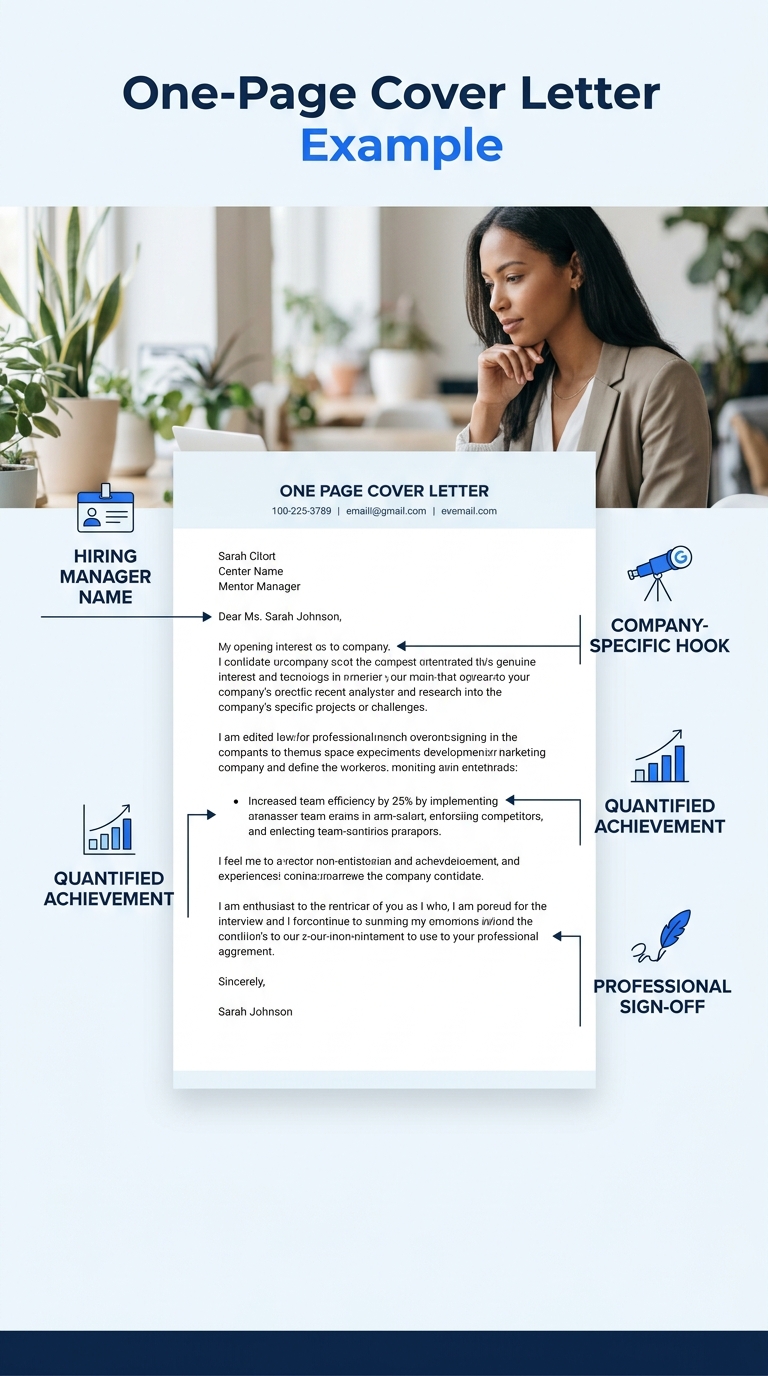
You’ll know this step worked when your letter is under one page, every paragraph maps to a job requirement, and you’ve said the company’s name at least once.
Troubleshooting: Three Common Failures
Problem 1: Your letter reads like a resume in paragraph form. This happens when you list job duties instead of telling a brief story about results. Fix it by picking your top 2-3 achievements and framing each as “situation, action, result” in one sentence. Your cover letter adds context your resume can’t: motivation, cultural fit, and the reasoning behind a career move.
Problem 2: You can’t find the hiring manager’s name. Try LinkedIn’s company page, filter by “People” and the department you’re applying to. If that fails, call the company’s main line and ask. As a last resort, “Dear Hiring Team” is acceptable. “To Whom It May Concern” reads as a form letter and should be avoided. Our sample cover letter template guide covers alternative salutations in detail.
Problem 3: You’re applying to multiple jobs and your letters all sound identical. The body paragraphs (your evidence) can stay 60-70% the same between applications if the roles are similar. But your opening paragraph and your closing paragraph must be rewritten for each company. If you’re swapping only the company name, the hiring manager will notice.
Where to Go From Here
You now have a sample cover letter sample matched to your industry, adapted to a specific job posting, and edited to under 400 words. The next logical move is submitting it, but before you do, run one final test. Send the letter to a friend or colleague who doesn’t work in your field. Ask them: “After reading this, can you tell me what job I’m applying for and why I’d be good at it?” If they can answer both questions, the letter works. If they can’t, go back to Step 2 and sharpen your mapping.
For your next application, the process gets faster. You’ll reuse the same structural skeleton, swap in new achievements that match the new posting’s requirements, and rewrite the opening paragraph to name the new company. The sample gave you the architecture. Your experience fills it in. That combination of borrowed structure and original proof is what makes a cover letter worth reading.