

 4.9
4.9 4.5
4.5ATS software eliminates up to 50% of applicants before a human reads their cover letter. The humans who do read spend 6–7 seconds deciding whether to continue. This guide gives you a four-step method with sample cover letter examples across six job categories, so you clear both filters in about 30 minutes per letter.
Before You Start
You need three things before writing a single word: the full job posting (not a summary or a recruiter’s paraphrase), the name of the hiring manager, and a list of your 3–5 most relevant accomplishments with numbers attached.
LinkedIn and the company’s team page are your best sources for the hiring manager’s name. This matters because 26% of hiring managers specifically value being addressed directly. If you genuinely can’t find the name, “Dear Hiring Manager” is acceptable for entry-level and mid-career roles. For executive positions, Resume.io’s cover letter guide notes that “addressing your letter recipient by name is practically a must” since skipping it signals you didn’t do basic research.
One more prerequisite: your cover letter should never exceed one page. MIT’s career advising office is direct about this: “A cover letter should be no longer than one page with a font size between 10-12 points.” Survey data backs this up, with 70% of hiring managers preferring letters no longer than half a page.
Set aside 30–45 minutes per letter. Trying to rush this in 10 minutes produces the kind of generic output that gets discarded.
Step 1: Mine the Job Posting for Keywords
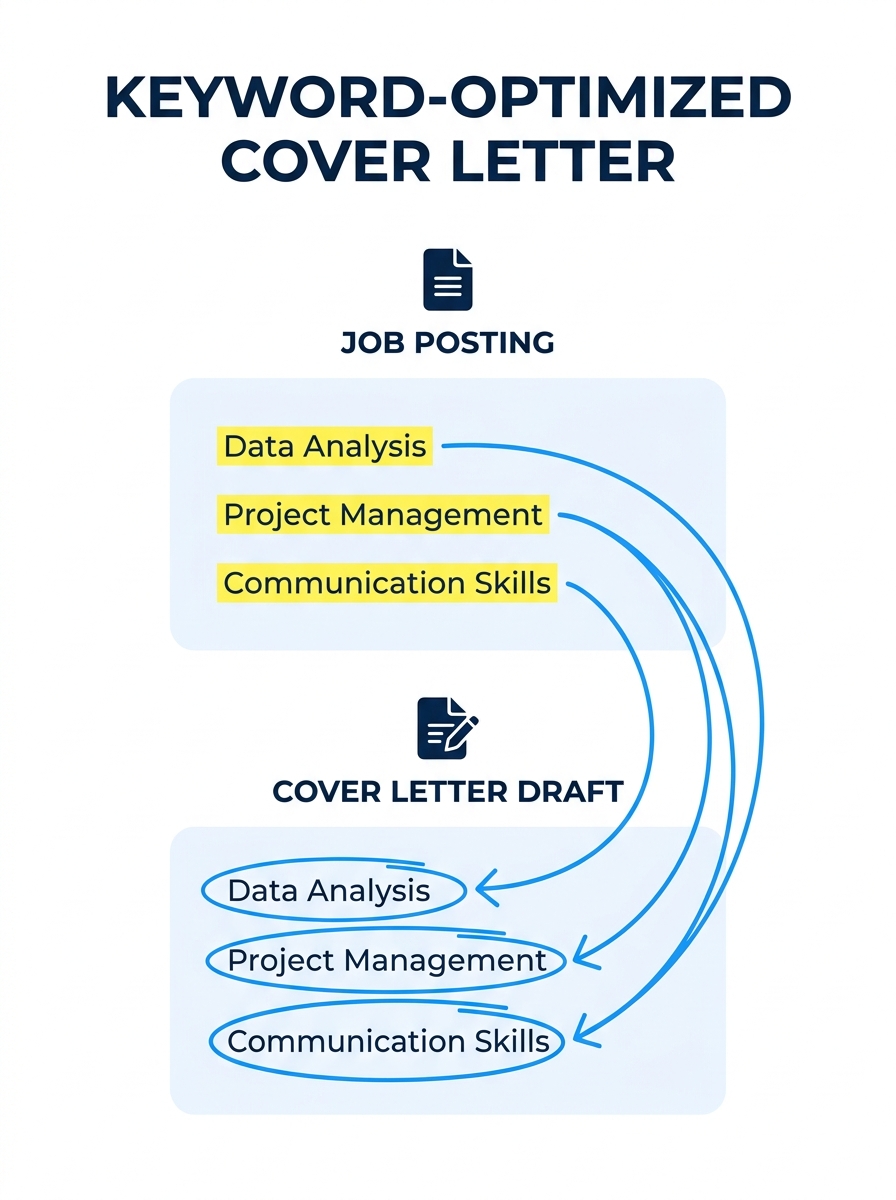
Open the job posting and highlight every skill, tool, and qualification mentioned. ATS platforms scan for exact keyword matches, and missing the right terms means your letter gets filtered before a human reviewer ever sees your name.
Here’s what to pull out:
- Hard skills named in the posting (e.g., “Salesforce,” “financial modeling,” “Python”)
- Soft skills phrased in the employer’s language (e.g., “cross-functional collaboration” instead of your instinct to write “teamwork”)
- Metrics or outcomes the role is responsible for (e.g., “manage a $2M budget,” “grow pipeline by 15%”)
Write each keyword down. You’ll weave these into your letter naturally across the next three steps.
You’ll know this step worked when you have 8–15 specific terms from the posting that you can honestly claim experience with. If you can’t find at least 8, the role may be a poor fit, and your letter will sound forced no matter how well you write it.
Step 2: Write the Opening Paragraph
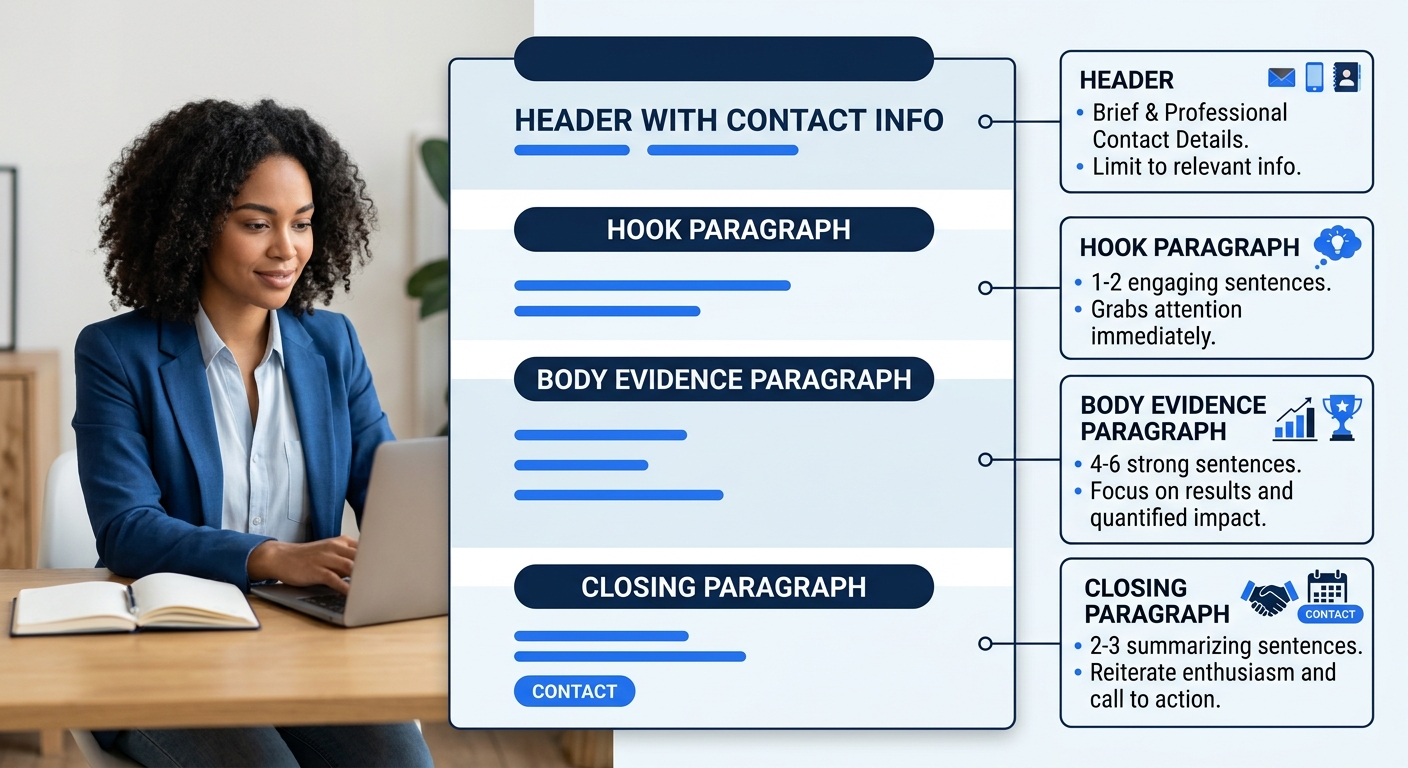
The first paragraph has one job: make the reader want a second paragraph. You accomplish this with three elements in 2–4 sentences: the exact role title, why you’re interested in this specific company, and one headline achievement.
Here’s a sample opening for a marketing coordinator position:
Dear Ms. Nguyen,
I’m applying for the Marketing Coordinator role at Bloomfield Partners, where your team’s recent campaign for the Portland Transit Authority caught my attention for its 23% ridership increase. In my current role at Crane Media, I managed social campaigns that drove a 31% increase in qualified leads over 8 months, and I’d bring that same results-oriented approach to your team.
Notice what’s happening: the applicant names the company, references something specific about the company’s work (not a vague compliment like “I admire your mission”), and drops a quantified achievement. This is the Interest + Evidence + Fit structure that works across every job category.
You’ll know this step worked when your opening paragraph is 3–4 sentences, mentions the company by name, and includes at least one number.
Step 3: Build the Body with Evidence
The body is one to two paragraphs, and every sentence should answer one question: why should this company hire you over the other 250 applicants? (The average corporate job posting attracts 250 applications, according to Glassdoor data.)
Structure each body paragraph around one accomplishment that mirrors a key requirement from the posting. Use this formula: Situation → Action → Result with a number.
Entry-Level and Internship Example
During my internship at Lakeshore Analytics, I built weekly client reports that reduced the team’s reporting time by 4 hours per week. I also coordinated a 12-person volunteer event that raised $8,400 for local literacy programs, developing the project management and scheduling skills your administrative assistant posting emphasizes.
Entry-level applicants worry they don’t have enough experience to fill a cover letter. You do. Course projects, volunteer work, part-time jobs, and academic achievements all count when you tie them back to what the employer needs. LiveCareer’s library of 240+ cover letter examples sorts samples by job title, so you can find phrasing that fits your industry.
Mid-Career Sales Example
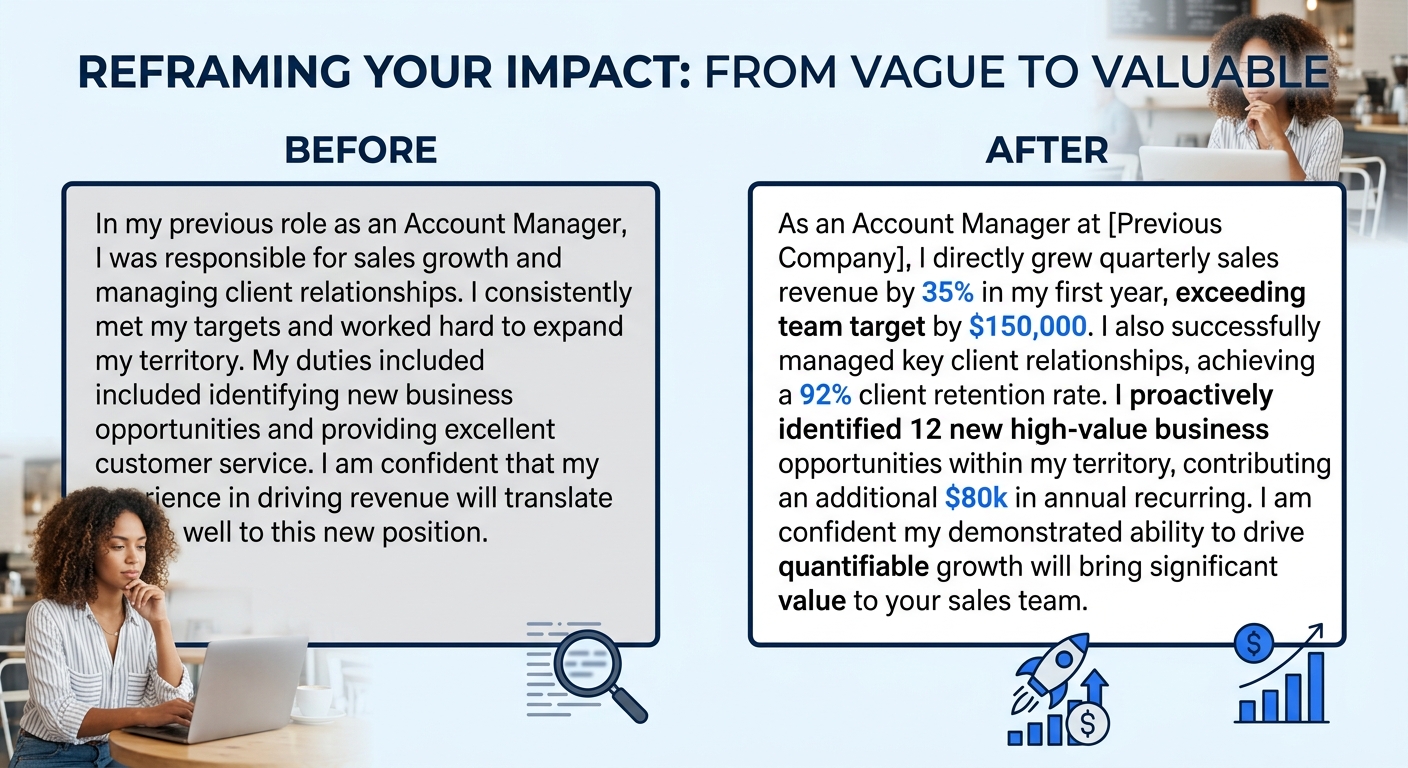
At TerraVox Solutions, I managed a 43-account portfolio generating $1.8M in annual recurring revenue. When the company expanded into the healthcare vertical, I was the first rep to close a hospital system deal, bringing in a $340K contract within 90 days. That experience is directly relevant to your enterprise sales manager role targeting healthcare clients.
The mid-career body paragraph does something the entry-level version can’t: it shows trajectory. You’re demonstrating that your accomplishments got bigger over time, and that you took initiative beyond your job description. If you want to study how to adapt a cover letter template across different industries, we’ve broken that process down separately.
Executive and C-Suite Example
Executive cover letters operate at a different altitude. ResumeBuilder.com’s 2026 executive templates emphasize that body paragraphs should “feature qualifications, experience, and achievements that mirror the employer’s needs” at a strategic level, not a task level.
As CFO at Meridian Industrial, I led a $45M debt restructuring that reduced annual interest costs by $3.2M and repositioned the company for acquisition. I also built the investor relations function from zero, delivering quarterly earnings presentations to analysts covering $12B in combined AUM. These experiences align with your search for a CFO who can prepare Dawson Group for its planned IPO.
The executive sample doesn’t mention day-to-day tasks. It talks about organizational outcomes, dollar figures with multiple commas, and strategic positioning. If you’re applying for a VP or C-suite role and your body paragraph reads like a mid-career letter, you’ve undersold yourself.
Step 4: Close with a Specific Ask
The final paragraph is 2–3 sentences. State what you want (an interview), reaffirm your fit, and thank them.
Administrative / Operations Close
I’d welcome the opportunity to discuss how my experience managing 15-person event logistics and a $120K departmental budget translates to the Operations Coordinator role at Fenwick. I’m available for an interview at your convenience and can be reached at (555) 234-5678 or [email protected].
Career Changer Close
My 6 years in classroom teaching developed the communication, stakeholder management, and data analysis skills your program manager role requires. I’d appreciate 20 minutes to walk you through how these transferable skills apply to your team’s goals.
Technical / IT Close
My 4 years of full-stack development experience, including deploying 3 production applications on AWS, make me a strong fit for your Senior Developer position. I’d be glad to discuss my portfolio and technical approach in an interview at your convenience.
You’ll know this step worked when your closing paragraph names the specific role, includes your contact info, and requests a concrete next step.
Tip: Sign off with “Sincerely” or “Best regards.” Avoid “Warmly,” “Cheers,” or anything overly casual unless the company’s job posting and website make clear that extreme informality is the norm.
How the Letter Changes Across Job Levels
Different roles demand different tones, detail levels, and structures. Here’s how the key elements shift:
| Element | Entry-Level / Intern | Mid-Career | Executive / C-Suite |
|---|---|---|---|
| Greeting | “Dear Hiring Manager” acceptable | Address by name when possible | Address by name always |
| Hook | Enthusiasm + academic or internship win | Quantified professional achievement | Strategic impact at org level |
| Body length | 1 paragraph, 3–5 sentences | 1–2 paragraphs | 2 paragraphs, big-picture focus |
| Metrics | Course projects, volunteer outcomes, GPA if 3.5+ | Revenue, efficiency %, team size | P&L, market share, M&A, board-level |
| Tone | Eager, coachable | Confident, peer-level | Authoritative, strategic |
| Total length | ~200 words | ~250–300 words | ~300–400 words |
The underlying structure stays the same at every level: Interest + Evidence + Fit. What changes is the scale of the evidence and the strategic altitude of the language. If you want to see additional cover letter examples organized by format and scenario, we’ve collected those in a separate resource.
When Things Go Wrong
Three problems account for most cover letter rejections:
The ATS eats your letter. You used creative formatting, headers, tables, or graphics inside the letter file. ATS platforms parse plain text best. Stick to standard fonts (Arial, Calibri, or Times New Roman at 10–12pt), left-aligned text, and no columns. If you’re wondering how ATS screening filters actually work and why so many applications get rejected before human review, we’ve covered the mechanics in detail.
The letter reads like it was written for any company. If you can swap out the company name and the letter still makes sense, you haven’t customized enough. Every letter should reference at least one specific detail about the company that proves you did real research: a recent product launch, a quarterly earnings figure, a leadership change, or a company value you genuinely connect with. The 26% of hiring managers who value personalized greetings are the same readers who notice when the body of the letter feels mass-produced.
You repeated your resume. Your cover letter exists to do something your resume can’t: provide narrative context connecting your experience to the employer’s specific needs. If a sentence in your letter appears almost verbatim on your resume, delete it and replace it with context the resume can’t provide. Explain why you’re interested in this role, what motivated a career decision, or how a particular accomplishment connects to the company’s current challenge. Our guide on writing a cover letter that wins the job digs deeper into this distinction.
Every cover letter should reference at least one specific detail about the company that proves you did real research—not a compliment, but a fact you connected to your own experience.
Where to Go From Here
You now have a repeatable four-step process: mine the posting for keywords, write a hook that names the company and leads with a result, build body evidence using Situation → Action → Result, and close with a specific ask. The sample cover letter examples above cover entry-level, mid-career, executive, administrative, sales, technical, and career-changer scenarios.
Your next move depends on where you are in your search. If you’re applying to more than 5 roles, build a “master letter” with your 10 strongest accomplishment bullets and swap in the 2–3 most relevant for each application. If you’re targeting one dream role, spend 45 minutes instead of 30 and research the hiring manager’s LinkedIn posts for something specific to reference in your opening hook. And if you’re getting interviews but not offers, the cover letter is doing its job. The bottleneck is somewhere else in your process.
The 11% of applicants now using AI tools to generate cover letters have accelerated one trend: generic output is easier to produce than ever, which means it’s also easier for hiring managers to spot and discard. The letters that land interviews are the ones where a specific person connected specific experience to a specific company’s problem, in under a page. That’s what the Interest + Evidence + Fit framework gives you, and the sample cover letter examples above show you exactly what it looks like in practice.