
 4.9
4.9 4.5
4.5This guide takes you from a blank document to a finished, tailored cover letter in about 45 minutes. You’ll follow five sequential steps, each with a specific output you can check before moving on, using a process built around what ATS software and hiring managers actually respond to.
TL;DR: Match every cover letter to the specific job posting by pulling keywords, quantifying 1-2 achievements, and keeping the whole thing between 250 and 400 words. The full sample of cover letter below shows exactly how each paragraph should read.
Before You Start
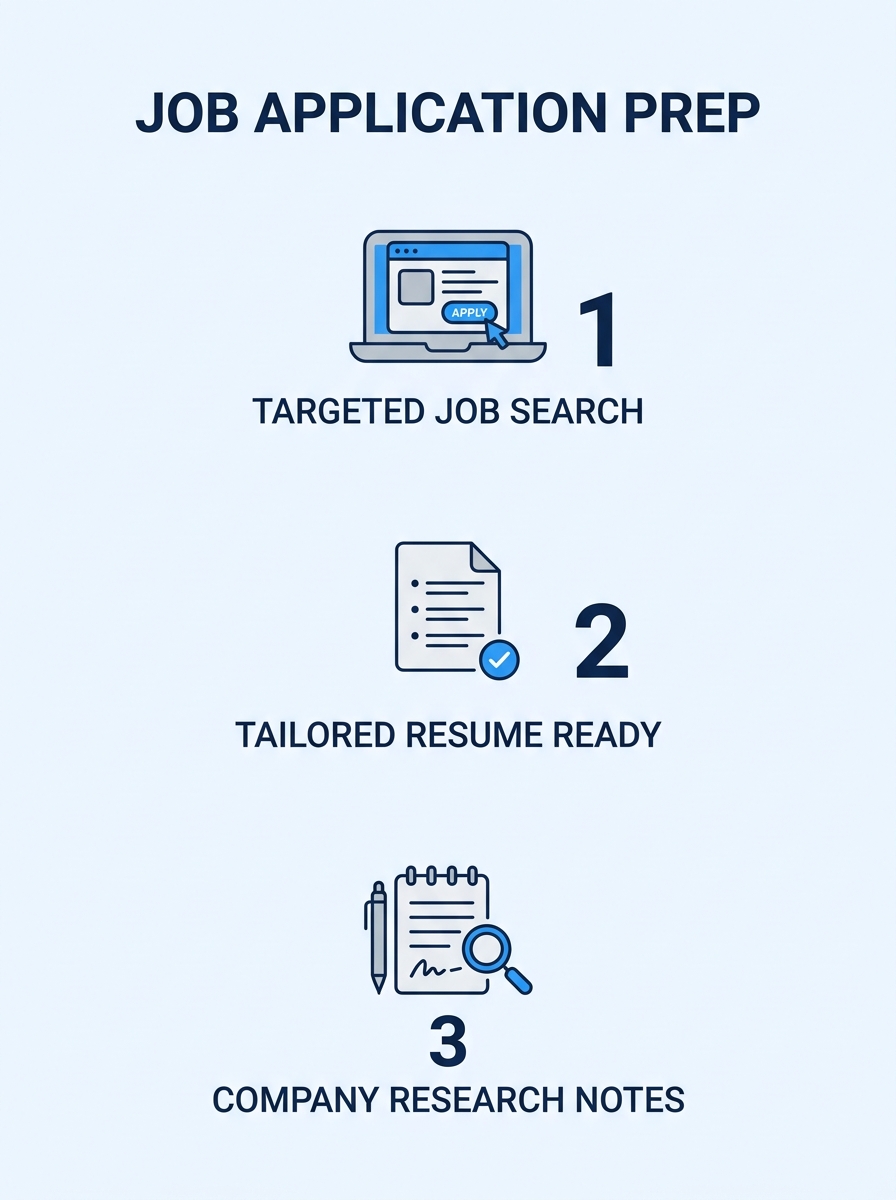
You need three things open on your screen before writing a single word: the full job posting (not a summary), your current resume, and the company’s website or LinkedIn page. A Novoresume analysis of cover letter best practices found that effective cover letters run 250 to 400 words, which translates to roughly one page with standard margins. Anything shorter looks like you didn’t try. Anything longer won’t get read.
Here’s your checklist:
- The job posting URL, saved or printed. You’ll reference it at least 3 times during the writing process.
- Your resume, with quantified achievements highlighted. If your bullet points need work first, browse sample cover letter examples for different roles to calibrate your tone and level of detail.
- 2-3 facts about the company pulled from their website, press releases, or LinkedIn page. Research cited by industry analysts shows that 47% of employers say they would not hire a candidate who lacks knowledge about the company.
- The hiring manager’s name, found on LinkedIn or the company website. “Dear Hiring Manager” works when you genuinely can’t identify a name, but a real name is always stronger.
- About 45 minutes of uninterrupted time. Your second and third letters will take closer to 20-25 minutes once the process feels natural.
Dissect the Job Posting First
Step 1. The job posting is your answer key. Every sentence in your cover letter should trace back to something the employer asked for. Open the posting and do three things:
- Highlight the required skills listed in the “qualifications” or “requirements” section. Copy each one verbatim into a separate document or note.
- Circle the repeated words. If the posting mentions “cross-functional collaboration” three times, that phrase belongs in your cover letter. ATS software can eliminate up to 50% of applicants before a human reviewer sees the application, and keyword matching is a primary filter in that screening.
- Identify the top 2 priorities. Job postings typically bury the real pain point in the first or second bullet of the responsibilities section. That’s your focus.
MIT’s career advising office recommends that applicants “convince the reader that your interest in the job and company are genuine and specific” by connecting their skills directly to those top priorities. Don’t try to address everything. Two well-developed connections beat eight shallow ones.
You’ll know this step is done when you have a list of 5-8 keywords and 2 clear priorities written down. If your list runs longer than 10 keywords, rank them and keep the top 8.
Draft Your Opening Paragraph
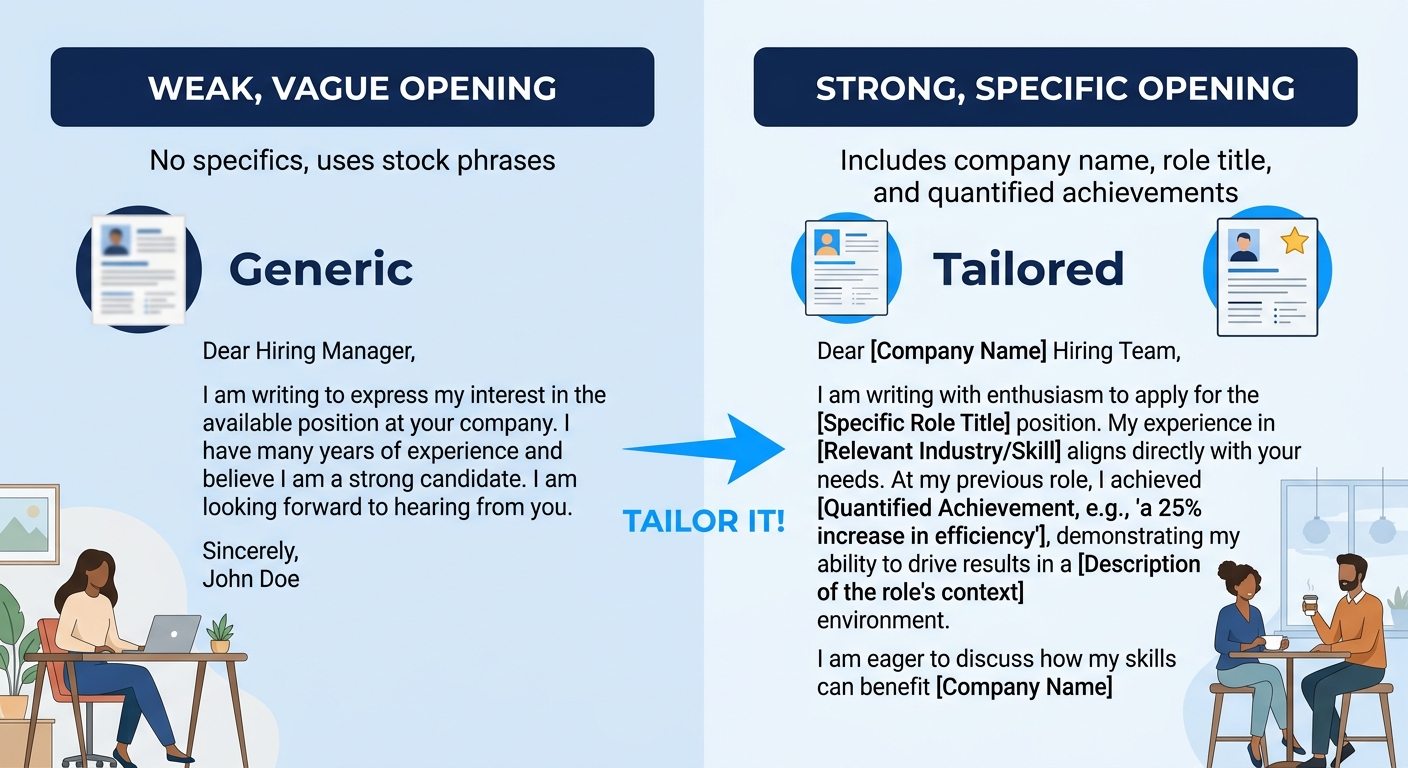
Step 2. Your opening paragraph has one job: make the hiring manager want to read paragraph two. Write 2-3 sentences that name the specific role, mention the company by name, and connect your strongest qualification to their top priority.
Here’s a sample of cover letter opening that follows this formula:
Dear Ms. Alvarez,
I’m writing to apply for the Marketing Coordinator position at Meridian Health. Your recent expansion into telehealth patient acquisition aligns directly with the digital campaign work I led at Beacon Media, where I grew qualified leads by 34% over six months through targeted paid social and email nurture sequences.
Notice what this does: it names the role, shows company research (the telehealth expansion), and delivers a specific result (34% lead growth in 6 months). According to Indeed’s cover letter guidance, you should “focus on one or two achievements and provide specific details about your success, including measurable impacts you made.”
Avoid these common opening mistakes:
- “I am excited to apply for…” appears in roughly half of all cover letters. It tells the reader nothing distinctive about you.
- Starting with your graduation date or degree. Education belongs in your resume.
- Quoting the company’s mission statement back to them. They wrote it. They know.
You’ll know this step worked when your opening paragraph contains the job title, the company name, one company-specific detail, and one quantified achievement.
Build the Evidence Body
Step 3. The middle of your cover letter is where you prove you can do the job. Write 1-2 paragraphs (roughly 100-150 words total) that each follow a simple structure: name the skill the employer wants, describe a time you used it, and report what happened with a number.
Continuing the sample:
At Beacon Media, I managed a $120K quarterly ad budget across Google, Meta, and LinkedIn, optimizing campaigns weekly based on conversion data. When our client’s cost-per-lead rose 22% in Q3, I restructured audience targeting and A/B tested 14 creative variants, bringing CPL back below target within five weeks. I also collaborated with the content team to produce 8 blog posts per month supporting organic acquisition, resulting in a 19% increase in non-paid traffic year over year.
That single paragraph contains 5 specific numbers ($120K budget, 22% CPL rise, 14 creative variants, 8 posts per month, 19% traffic increase). With 11% of applicants now using AI tools to draft their cover letters, hiring managers are seeing more generic, number-free language than ever. Concrete figures are how you separate yourself from AI-generated applications that lack specificity.
Tip: Pull numbers from your resume bullets. If your resume says “managed social media accounts,” go back and calculate the actual follower count, engagement rate, or revenue influenced. Even approximate numbers (“~$85K in pipeline”) carry more weight than vague descriptions.
The University of Michigan’s Career Center advises applicants to “focus on skills and attributes the employer is seeking in applicants” rather than listing every skill they possess. Pick 2-3 skills from the keyword list you built in Step 1 and ignore the rest. Trying to address every qualification makes the letter read like a skills dump instead of a focused argument for your candidacy.
You’ll know this step is done when your body paragraphs contain at least 3 quantified results and reference 2-3 keywords directly from the job posting.
A cover letter with zero numbers reads like a form letter. A cover letter with 3-4 specific figures reads like evidence a hiring manager can weigh.
The Closing Paragraph and Sign-Off
Step 4. Your closing paragraph has three components: a brief restatement of fit, a specific availability statement, and a professional sign-off. Two to three sentences, no more.
Continuing the sample:
I’d welcome the opportunity to discuss how my digital marketing experience can support Meridian Health’s patient acquisition goals. I am available for an interview at your convenience and can be reached at (555) 234-5678 or [email protected].
Sincerely, Maria Santos
One common mistake worth flagging: ending with “I look forward to hearing from you.” That’s passive. State your availability directly instead, which puts a clear next step in front of the hiring manager. ResumeAdapter models this approach with language like “I am available for a technical interview at your convenience,” giving the reader an immediate action rather than a vague hope.
And skip the postscript. The “P.S.” trick that some career advice sites recommend worked in direct mail. In a cover letter, it reads as gimmicky. If something is important enough to say, say it in the body.
You’ll know this step worked when your closing includes a connection to the company’s specific needs, your direct contact information, and a clear availability statement.
Format, Proof, and Send
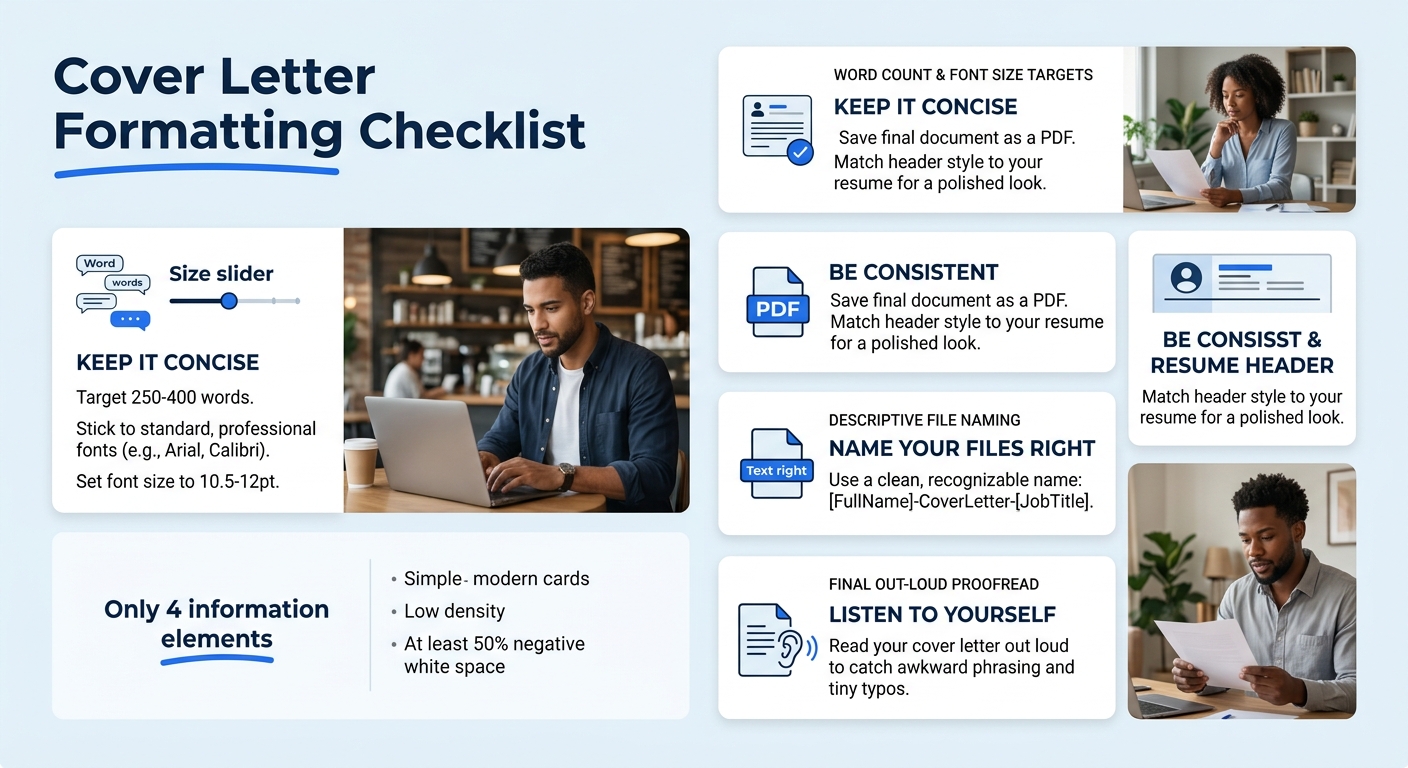
Step 5. Formatting errors signal carelessness faster than weak content. Run through this checklist before you hit send:
- Length check. Your letter should fall between 250 and 400 words. Open your word processor’s word count tool and trim if you’re over.
- Header alignment. Your cover letter header (name, address, phone, email) should match your resume header exactly. Same font, same layout, same contact details.
- Font and margins. Use the same font as your resume, sized between 10.5pt and 12pt. One-inch margins keep the letter on a single page.
- File format. Save as PDF unless the application specifically requests .docx. PDFs preserve formatting across every device and operating system.
- File name. Use the format FirstName-LastName-CoverLetter-CompanyName.pdf. Hiring managers download dozens of files per opening, and descriptive names prevent yours from getting lost.
- Email body placement. When emailing directly (not through an ATS portal), paste the cover letter text into the email body and attach the PDF as a backup. Letters placed in the email body get read more often than those sent only as attachments.
- Final proofread. Read the letter out loud, start to finish. If you stumble on a sentence, rewrite it shorter. Triple-check every instance of the company name and hiring manager’s name for spelling.
You’ll know this step is complete when your file is saved, named correctly, and you’ve read the full letter aloud without tripping over any sentence.
When Something Goes Wrong
Three problems account for most cover letter rejections. Here’s how to recognize and fix each.
You can’t find any numbers to include. This is the single most common blocker, especially for applicants in administrative, creative, or early-career roles. If your previous jobs didn’t track metrics formally, estimate. Managed a team? State the headcount. Handled customer inquiries? Estimate the weekly volume. Organized events? Cite the attendance. Even approximate figures (“served approximately 200 customers per week”) carry more weight than vague descriptions like “handled a high volume of customer interactions.” One practitioner reported doubling their interview response rate after switching from generic descriptions to tailored, quantified responses matched to each posting’s requirements.
The ATS rejects your file. If you’re applying through online portals and hearing nothing back, your formatting is the likely culprit. ATS software screens out up to 50% of applicants before any human reads anything. Avoid tables, text boxes, headers/footers, and unusual fonts inside the document. We’ve covered how ATS parsing affects screening across different resume builders, and the same principles apply to cover letter files.
Your letter sounds identical to the last 10 you sent. If you could swap out the company name and submit the same letter to a different employer, it’s too generic. Indeed’s career team notes that “many people use the same cover letter for every job they apply to and simply substitute the hiring manager’s name and the job specifics from one letter to the next.” That approach fails because it never addresses the specific problems each employer is trying to solve. Go back to Step 1 and pull fresh keywords for each application. If you need a free template to structure your next draft, start there and customize aggressively from the template.
Where to Go From Here
The five steps above produce a single, strong cover letter. The real payoff comes from repeating the process for every application, which speeds up significantly with practice. Your second letter will take around 30 minutes. By the fifth, you’ll spend closer to 20 minutes because the keyword extraction and paragraph structure become automatic.
If you’re sending cover letters and still not landing interviews, the problem usually lives in one of three places: your resume doesn’t align with the same keywords (so the application sends mixed signals), your LinkedIn profile contradicts your cover letter’s narrative, or you’re applying to roles where you match fewer than 60% of the listed qualifications. For the LinkedIn side of this equation, our guide on how profile photos and optimization drive visibility covers what makes your online presence support rather than undercut your applications.
Keep a folder of every cover letter you send, labeled by company and date. After 10-15 applications, patterns emerge. You’ll see which achievement stories get callbacks and which fall flat, and that data becomes more useful than any sample of cover letter you found online, because it’s based on your own results with your own experience.