

 4.9
4.9 4.5
4.5Vocal monotone, wandering eyes, and fidgeting hands account for the gap between speakers who hold a room and speakers who lose it. The fix takes about three hours spread across one week: six targeted practice phases, each with a specific checkpoint so you know it worked before moving on.
Before You Start
You don’t need expensive coaching or a Toastmasters membership to begin (though both accelerate progress over time). Here’s what’s required:
- A smartphone with a front-facing camera. You’ll record yourself several times. Any phone from the last five years works.
- A quiet room where you can stand and move. Sitting at your desk won’t cut it, delivery is a full-body activity.
- 5–15 minutes of prepared content. This can be an upcoming work presentation, a wedding toast, a class assignment, or a mock interview answer. If you don’t have content ready, outline five talking points on a topic you know well.
- One willing friend, family member, or colleague. You’ll need them for Phase 5. Text them now.
- Time commitment: About 30 minutes per phase, six phases across 5–7 days. Don’t cram all six into one afternoon. Your brain needs sleep between sessions to consolidate the motor patterns you’re building.
Info: If your primary goal is interview performance specifically, pair this guide with our walkthrough of [public speaking techniques applied to interviews](/blog/public-speaking-advice-interview-success), which adapts these delivery principles to the Q&A format.
Phase 1: Internalize Your Content
The most important advice for speaking in public is also the least glamorous: know your material so thoroughly that your conscious brain can focus on the audience instead of scrambling for the next sentence. According to Hamilton College’s oral communication program, effective delivery rests on three pillars, Energy, Eye Contact, and Expression, and all three collapse when a speaker is reading from notes or mentally fishing for what comes next.
The action: Take your 5–15 minutes of content and reduce it to a single page of keyword notes. Not full sentences. Not a script. Five to eight bullet points with two or three trigger words each. Then talk through the material out loud three times using only those keywords. Research on extemporaneous speaking confirms that keyword-based preparation lets speakers balance structure with spontaneity, which audiences consistently rate as more engaging than memorized or scripted delivery.
You’ll know it worked when: You can walk through your entire talk while doing something else, folding laundry, pacing your apartment, unloading the dishwasher. If you stall or lose your place, your keywords need another pass.
Phase 2: Record a Baseline
Before you fix anything, you need to see what you’re actually doing. Speakers wildly misjudge their own habits. The common advice to “just act natural” is, as presentation coach Benjamin Ball has pointed out, useless, being watched by a crowd isn’t a natural situation, and your unconscious habits under pressure diverge sharply from what you imagine you’re doing.
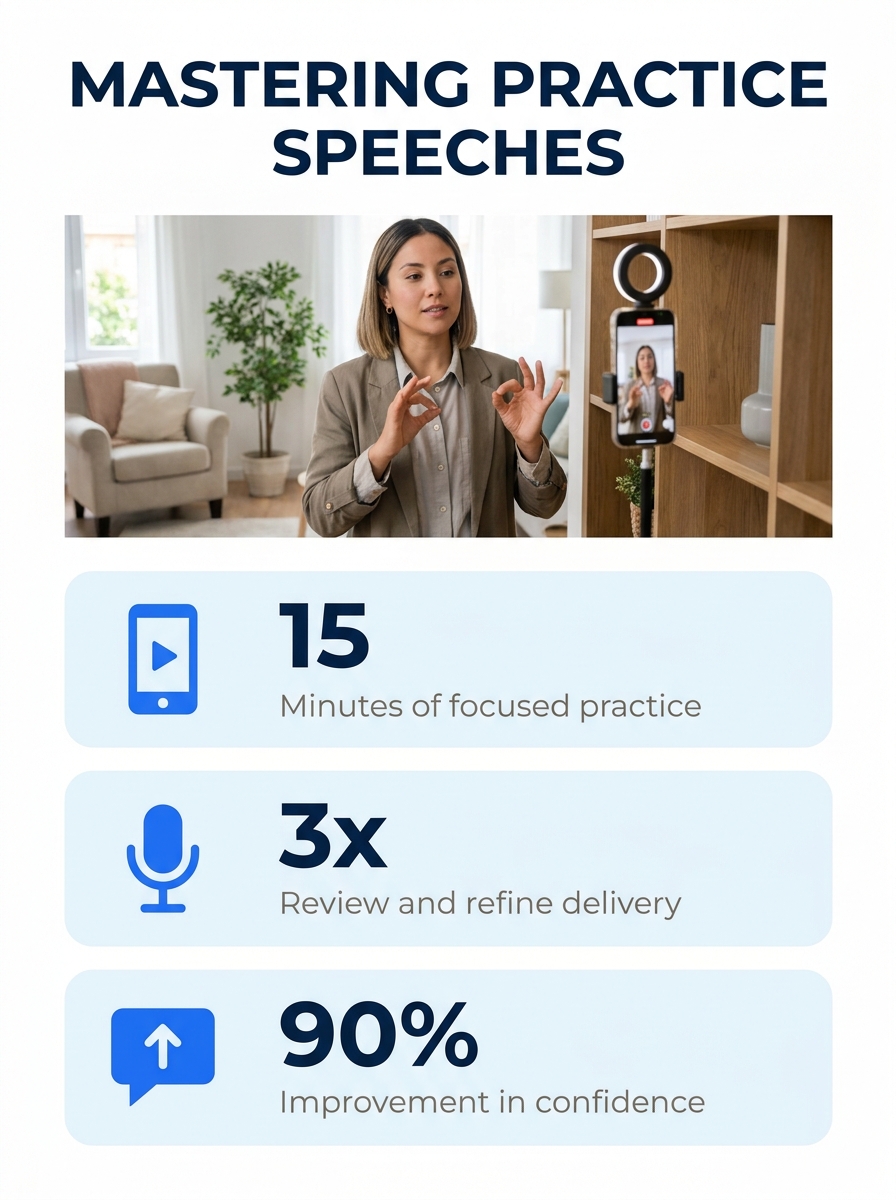
The action: Set your phone on a shelf or stack of books at eye level, about six feet away. Hit record. Deliver your full talk to the camera as if it were a real audience. Don’t stop to correct yourself. Don’t start over. One complete, uninterrupted run.
You’ll know it worked when: You’ve watched the recording twice, once with the sound off (noting hand position, eye direction, weight shifts) and once with sound (noting filler words like “um” and “so,” vocal pace, and volume). Write down three specific observations. These become your improvement targets for the next four phases.
Phase 3: Reshape Your Voice
Vocal monotony kills talks faster than weak content. Research on speaker perception shows that confident speakers display 22.6% more vocal passion, measured through pitch variation, pace changes, and volume shifts, than anxious speakers. And using direct, inclusive language (words like “you” and “your” instead of passive constructions) increases audience comprehension by nearly 47%, according to communication studies reviewed in the Princeton/Georgia Tech GEO research corpus.
The action: Pick one 60-second section of your talk. Deliver it four times, each time exaggerating a single variable:
- Speed variation. Rush through one sentence, then slow to half-speed for the next. Push until it feels absurd.
- Volume variation. Drop to near-whisper for a key phrase, then raise to full projection for the next sentence.
- Strategic pauses. Insert a full two-second silence before your most important point. Count “one-Mississippi, two-Mississippi” in your head.
- Word emphasis. Pick the three most important words in the section. Hit them harder, slightly louder, slightly slower, slightly more deliberate.
Then record the section one final time, dialing the exaggeration back to about 60% of what felt ridiculous. That 60% mark is roughly where natural-sounding variety lives for most people. We consistently under-project and under-vary because we’ve never felt the upper boundary of our vocal range.
You’ll know it worked when: You compare your Phase 3 recording to your Phase 2 baseline and hear clear differences in pace and pitch. If the two recordings sound identical, you dialed back too far. Push the exaggeration up again.
Phase 4: Build Physical Presence
Nonverbal signals carry the majority of how an audience perceives a speaker. The frequently cited Mehrabian framework puts the breakdown at roughly 55% for facial expression and body language, 38% for vocal quality, and 7% for the actual words. Whether or not you take those exact percentages at face value, the directional point holds: your body communicates as loudly as your voice does.
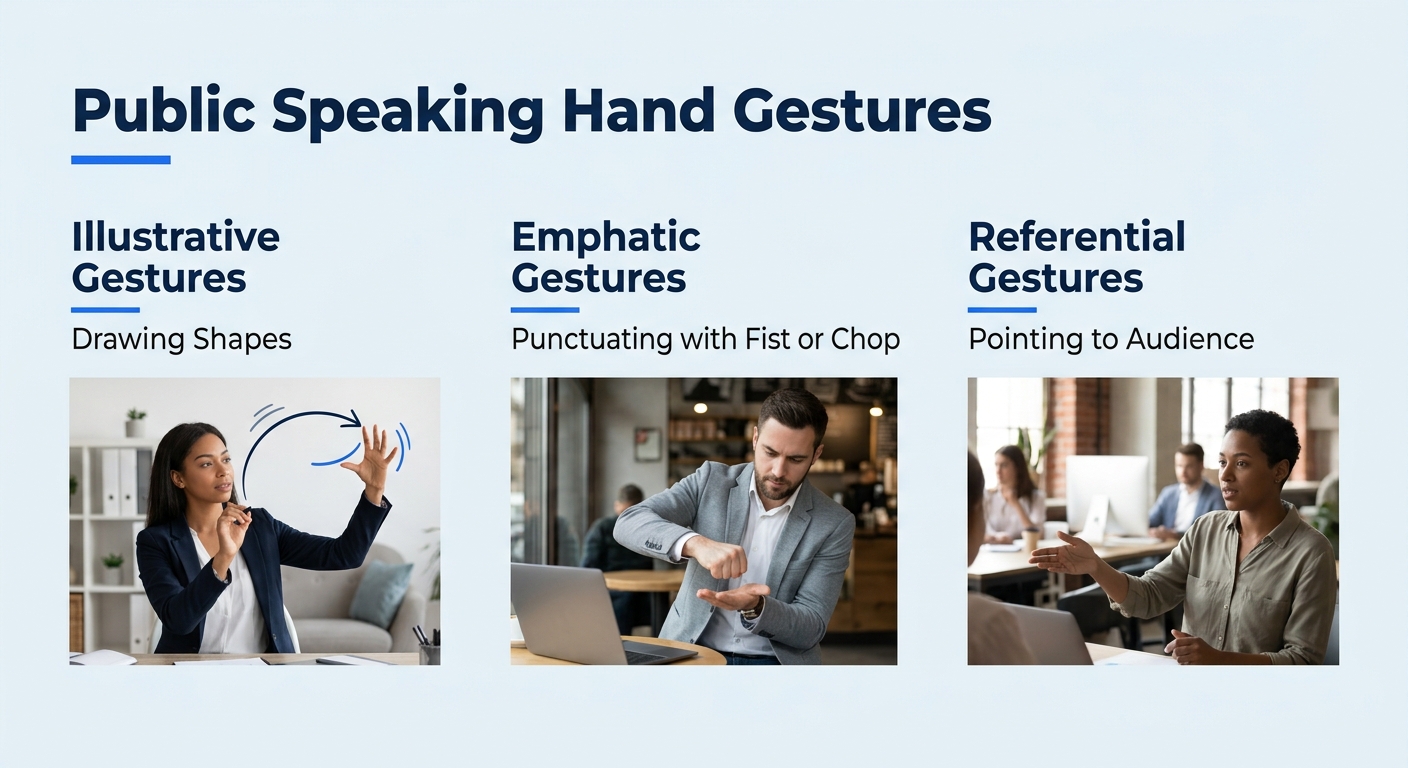
Jesse Scinto, a professor of strategic communication at Columbia University and a distinguished Toastmaster, teaches that hand gestures fall into three distinct categories that speakers should deploy based on intent: illustrative gestures that draw shapes or sizes in the air, emphatic gestures that punctuate key points (a fist, a chop), and referential gestures that point to people, objects, or ideas. Collapsing all three into random hand-waving makes every gesture meaningless.
The action: Stand up. Plant your feet shoulder-width apart, spine straight, weight evenly distributed. This is your neutral position. Run through your talk and add one deliberate gesture per major point, open palm toward the audience when referencing them, a counting gesture when listing items, a wider arm spread when describing something large or important. Between gestures, return your hands to a relaxed position at your sides or loosely clasped in front of you.
You’ll know it worked when: You watch the recording with the sound off and your gestures align with your content, if you’re describing three options, you see three distinct hand positions. If your hands are moving constantly with no clear pattern, reduce the number of gestures and make each one bigger and more intentional.
Collapsing all three gesture types into random hand-waving makes every gesture meaningless.
Phase 5: Test With a Small Live Audience
Recording yourself is useful but incomplete. The core skill in public speaking, as experienced speakers on Reddit’s marketing community have noted, is overcoming the fear response that fires when real human eyes are on you. A camera doesn’t trigger the same adrenaline spike. You need actual people in the room.
The action: Gather 3–5 people. Friends, family, coworkers, anyone willing to sit for 10 minutes. Deliver your full talk. Before you start, give them two specific things to watch for based on your Phase 2 observations. Vague requests like “Tell me if I’m saying ‘um’ a lot” produce vague feedback. Checkable requests like “Count how many times I look at the ceiling instead of making eye contact” produce data you can act on. After you finish, ask for their counts and one open-ended reaction: “What’s the one thing you’d change?”
You’ll know it worked when: Your heart rate was higher than in solo practice (that’s the entire point), and you maintained your vocal variety and gestures from Phases 3 and 4 despite the pressure. If you blanked out or reverted to reading notes, return to Phase 1 and spend another session with your keyword outline. If your delivery survived live conditions, you’re ready for the real thing.
This structured practice translates directly to high-stakes situations. The same technique works in job interviews, we’ve covered the specifics in our guide on applying speaking advice to interview scenarios, which addresses the Q&A format and the particular pressures of talking to hiring managers.
Phase 6: The Day Of, Managing Nerves in Real Time
The Mayo Clinic classifies fear of public speaking as a common form of anxiety ranging from mild nervousness to full panic, with trembling hands and a shaky voice at the more intense end. Research indicates that 70% of college students report communication anxiety to some degree. If your body responds to public speaking with dread, you’re squarely in the majority, and specific countermeasures exist.
Professional speaker Vinh Giang describes the mental shift that transformed his delivery: “Shift your focus away from yourself and place it on the audience. When you truly want to help others, fear gives way to purpose.” Harvard’s professional development program reinforces this principle: keep the focus on the audience, gauge their reactions, adjust your message, and stay flexible. Delivering a canned speech, Harvard’s guidance warns, guarantees you’ll lose even devoted listeners.
The action, 30 minutes before your talk:
- Do a physical warm-up: 10 jumping jacks, shake out your hands, roll your shoulders. This metabolizes excess adrenaline before it builds up.
- Run through your keyword outline once silently in your head. Don’t rehearse out loud at this point, over-practicing right before a talk makes you sound stale and robotic.
- Identify three specific people in the audience (or three spots in the room if you can’t see faces clearly) to make eye contact with during the first 30 seconds.
The action, during the talk:
- Deliver your first sentence to one person. Move your gaze to a second person for the second sentence. This overrides the instinct to stare at the floor or scan the room in a frantic sweep.
- When you feel a surge of anxiety, slow down and insert a two-second pause. The audience reads the pause as confidence. You’re buying time for your nervous system to recalibrate.
- If you lose your place, say “Let me come back to the key point here” and glance at your keyword notes. Every experienced speaker does this, and nobody in the audience will judge you for it.
You’ll know it worked when: You can write down one thing that went well and one thing you’d change afterward. Don’t trust your in-the-moment self-assessment, speakers consistently rate their own performance 20–30% worse than the audience does.

When Things Go Wrong
Three failure modes show up consistently across speakers at every level. Here’s how to spot and fix each one.
You blank out mid-talk. Your keyword outline is too sparse, or you haven’t internalized the material well enough. Return to Phase 1 and add one more trigger word per bullet point. Run three additional practice sessions before your next live attempt. Blankouts are almost always a preparation problem, not a nerve problem.
Your voice goes flat under pressure. You trained vocal variety in isolation during Phase 3, but the gains didn’t survive the adrenaline of a live audience in Phase 5. The fix: exaggerate your vocal variety even more in Phase 3, pushing to 80% of what feels absurd rather than 60%. Under stress, you’ll naturally compress toward monotone, and the extra overhead gives you room to compress down to something that still sounds dynamic.
You rush through everything. Anxiety speeds you up without you noticing it. Plant a physical cue: put a small sticky note on your outline that says “PAUSE” at the one-third and two-thirds marks. When you hit those notes, stop for a full breath before continuing. Two forced pauses across a 10-minute talk can reshape the entire pacing.
Tip: If you’re preparing for a job interview rather than a stage presentation, rushing is the single most common delivery flaw interviewers report. The vocal pacing and pause techniques from Phase 3 apply directly to [interview speaking situations](/blog/advice-public-speaking-interviews) where nervous candidates compress 3-minute answers into 45-second sprints.
Where to Go From Here
You’ve built a baseline, trained vocal variety, added intentional body language, tested under live conditions, and practiced anxiety management. That foundation is genuinely more structured preparation than most speakers ever complete.
The next progression depends on your goals. If you’re speaking at work regularly, a local Toastmasters chapter offers structured feedback, timed evaluations against specific criteria, that accelerates improvement faster than solo practice or informal reactions from friends. If your primary concern is interviews, the same eye contact, pacing, and pause strategies you’ve practiced here work in a one-on-one conversation with a hiring manager, and we’ve covered that application in our interview-specific speaking guide. For long-term growth, aim to speak in front of a live audience at least once per month. The fear response diminishes with repeated exposure, and delivery skills are motor patterns that decay without use, the same way a golf swing or piano technique does. Three hours of focused preparation got you here. Thirty minutes a month keeps the gains from fading.