

 4.9
4.9 4.5
4.5Farah Sharghi, a former recruiter for Google, TikTok, Uber, and The New York Times, told CNBC on August 24 that job seekers who emphasize potential over proof in their resumes are becoming invisible to hiring managers who now demand evidence of immediate competence rather than enthusiasm to learn.
TL;DR: Former Google recruiter Farah Sharghi says resumes focused on potential instead of quantified proof of past results fail to pass the six-second hiring-manager scan, as companies have shifted from developing talent to hiring day-one contributors.
The Six-Second Proof Window
Sharghi, who spent more than a decade in talent acquisition at major technology and media companies, said in the CNBC article that resumes have six seconds to demonstrate a candidate can execute the work immediately. “Every hiring manager has a specific issue they need solved quickly,” Sharghi stated, explaining that the most effective resumes provide evidence the applicant can fix what is broken.
The shift stems from tightened corporate budgets that eliminated dedicated employee development programs, according to Sharghi. Companies that previously devoted resources to training eager learners now require someone capable of performing the role on day one. Job seekers who continue to portray themselves as “eager learners ready to grow” in application materials are being passed over, she said.
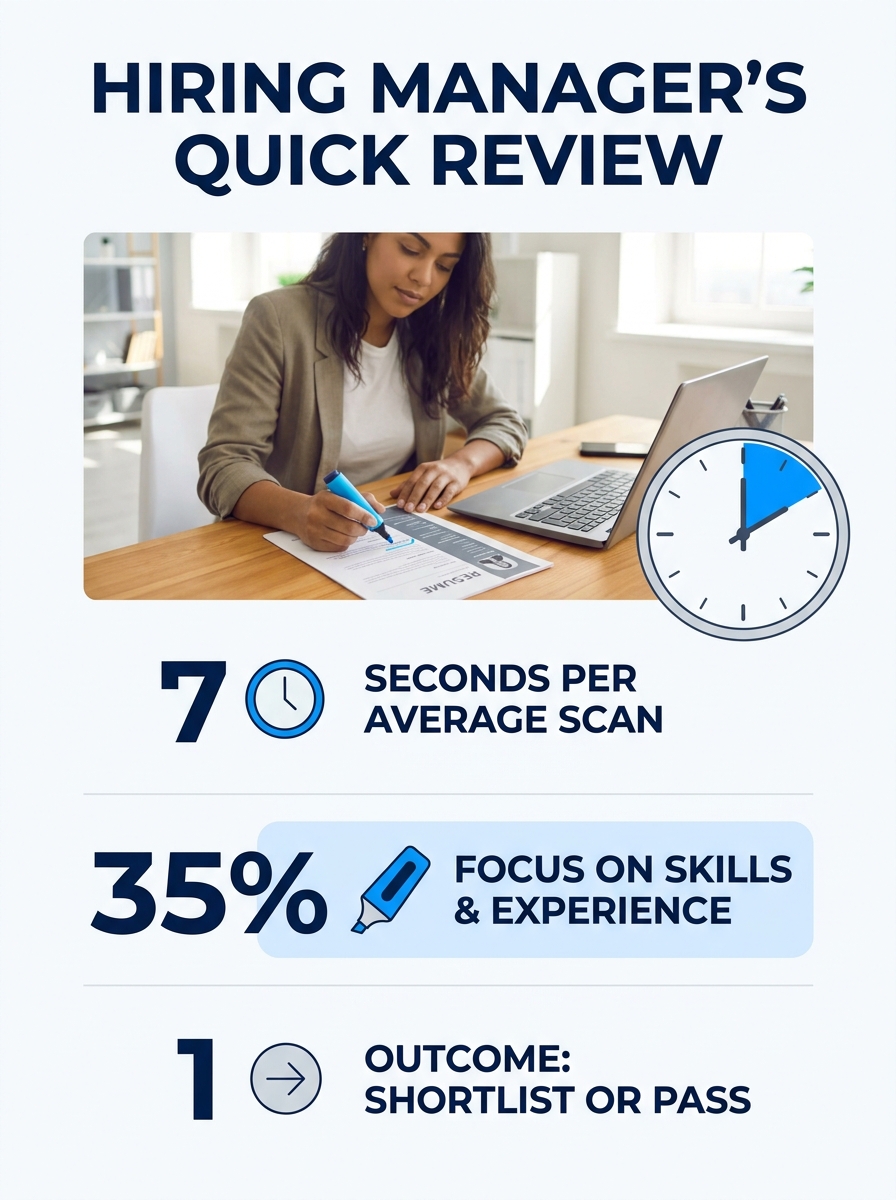
Sharghi outlined three mandatory resume elements: explain what improved at previous employers because of the candidate’s work, provide reference points for every numerical claim, and eliminate empty descriptor phrases such as “detail-oriented” or “collaborative team player.”
Context-Free Numbers Render Accomplishments Invisible
A claim of “grew revenue 40%” communicates nothing without context, Sharghi told CNBC. The percentage requires a baseline figure, a product identifier, a starting point, and a target to be meaningful. “A figure without context is invisible,” she said.
Sharghi gave an example of meaningful quantification: if a task previously required 12 days but the candidate reduced completion time to three days, that specific comparison belongs in the resume. Similarly, “led weekly stakeholder reviews across engineering, legal, and product for eighteen months” demonstrates cross-functional work capacity in a way that “strong communicator” does not, according to the recruiter.
This approach aligns with patterns observed in broader hiring trends. A recent analysis of AI-generated resumes found that 77% of application documents now appear machine-written, which has increased hiring managers’ reliance on concrete, verifiable accomplishments during screening.
Cover Letter Function Has Changed
Sharghi described the most common cover letter mistake as treating the document like a defense of why the candidate would be good at work they have not done. If the resume fails to show competence, no cover letter will compensate, she said.
She recommended two to three short paragraphs: name the specific job and how the candidate found it, identify the problem the role exists to solve based on the posting or public company statements, then cite one or two past projects where the candidate solved a similar problem. “The letter is meant to be even more evidence, not a pitch,” Sharghi stated. If the reader finishes and knows which past project the candidate would draw on for the new job, the cover letter functions correctly.
Entry-Level Development Infrastructure Versus Mid-Career Expectations
Sharghi told CNBC that dedicated development programs for entry-level candidates still exist but require identification of specific infrastructure: a university or campus recruiter on the team, a named internship or rotational program, or a cohort of new graduates. If an “entry-level” role is handled by a general industry recruiter with no development program attached, the company is hiring for low cost rather than growth, she said.
For mid-career professionals, companies want experience and knowledge rather than potential, according to Sharghi. “You’re being hired to fill a specific gap,” she stated. The market for employers who will grow candidates into roles they cannot yet perform has largely disappeared, she said.
The exception is internal mobility, which still operates on potential because the employer holds performance data on the employee. Sharghi said the fastest path to grow into something new is often a lateral or upward move inside the current company rather than an external search.
However, internal mobility only works when a real advancement path exists, Sharghi said. During hiring freezes or on stalled teams, the question is not whether to stay but whether the current role is making the candidate more hireable. “If you’re treading water and calling it patience, you’re not being loyal. You’re depreciating,” she stated. Skills either compound or decay, and the freeze does not pause the resume’s age, according to the recruiter.
If a manager continues assigning substantive work and the problems being solved would matter to another employer, Sharghi recommended staying to cultivate those skills. If not, the candidate should move.
What Happens Next
The proof-over-potential hiring standard that Sharghi described is now embedded across technology, media, and finance sectors where budget constraints have eliminated training programs that once absorbed early-career talent. Job seekers who continue writing resumes as if 2019 hiring norms still apply—highlighting soft skills, expressing eagerness to learn, and summarizing duties rather than quantifying outcomes—will remain invisible in applicant tracking systems and six-second human scans alike.
Candidates revising resumes under this framework should audit every bullet point for three elements: a specific metric with context, a clear before-and-after comparison, and language that names the business problem solved rather than the task performed. Generic descriptors such as “team player,” “fast learner,” and “strong work ethic” should be deleted and replaced with concrete evidence of collaboration, skill acquisition speed measured in weeks or projects, and output volume compared to peers or prior benchmarks. The shift requires treating the resume as a legal brief of past performance rather than a forward-looking statement of intent, a reframing that many mid-career professionals have not yet adopted.
Sharghi posts job-hunting guidance on YouTube, Instagram, and TikTok and works as a career coach and public speaker. Her client work and content focus on interview preparation, salary negotiation, and application optimization for candidates navigating the tightened hiring market she described.