

 4.9
4.9 4.5
4.5The phrase “responsible for” appears on millions of active resumes right now. It tells a recruiter exactly one thing: somebody gave you a task. It says nothing about whether you performed that task well, what changed because of your work, or why a hiring manager should keep reading. And yet people build entire Experience sections around it, bullet after bullet, as if restating their job description counts as making a case for themselves.
Weak resume language is the single fastest way to make a qualified candidate look forgettable. Passive voice resume mistakes, vague duty statements, and buried accomplishments turn sharp professionals into gray text on a screen. The fix isn’t complicated, but it does require you to think differently about what each bullet point is supposed to do. These six rules will get you there.
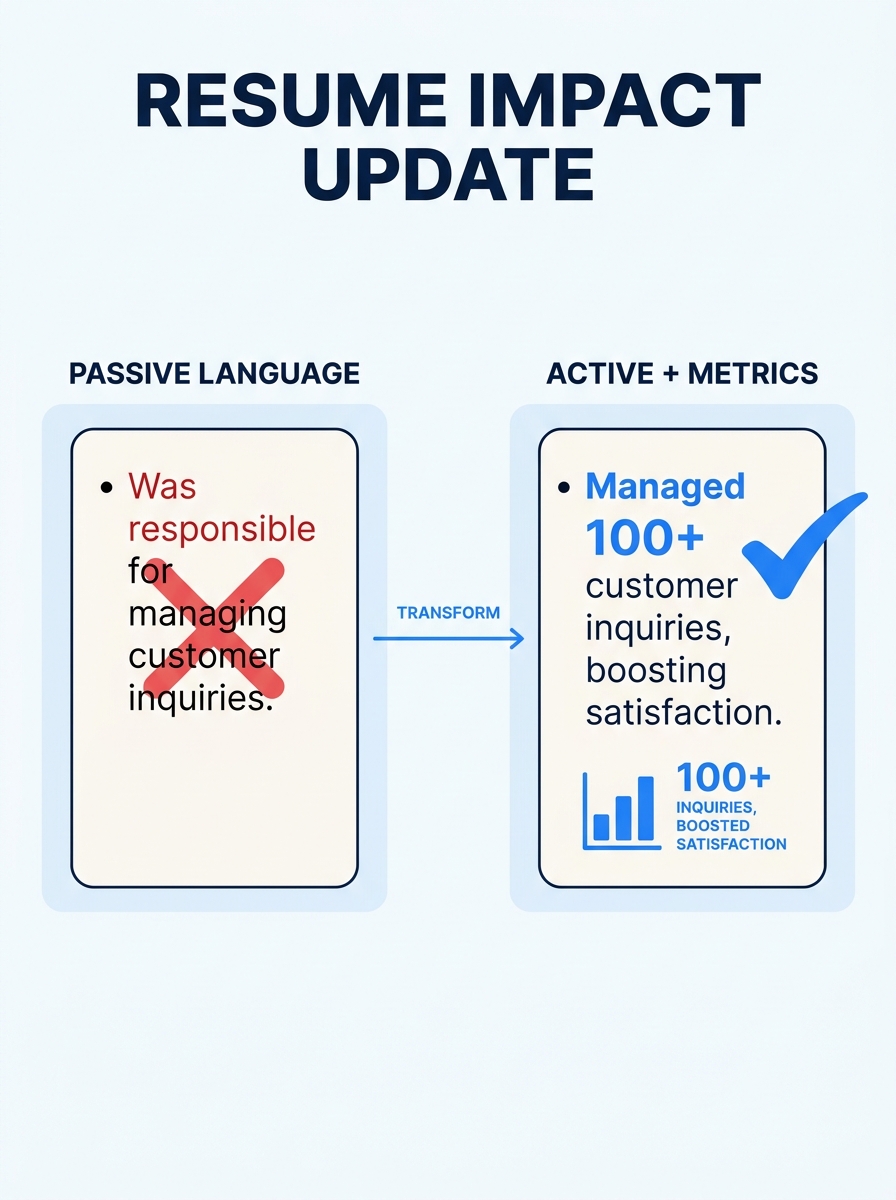
Kill “responsible for” and every phrase like it
“Responsible for,” “duties included,” “tasked with,” and “assisted with” are the four horsemen of weak resume language. They describe assignments, not performance. A hiring manager reading “responsible for managing client accounts” learns that managing client accounts was part of your job. They already assumed that from your title.
MIT’s career advising office puts it directly: action verbs help bring your resume to life by painting a picture for the reviewer and affirming your skills. Passive constructions do the opposite. They flatten your experience into a list of obligations someone else defined for you.
Here’s how the action verb replacement works in practice:
- Before: “Responsible for onboarding new hires and training them on company processes.”
- After: “Onboarded and trained 40+ new hires annually, reducing ramp-up time from 6 weeks to 3.”
- Before: “Tasked with managing social media accounts.”
- After: “Grew Instagram following from 12K to 58K in 14 months through targeted content campaigns.”
The pattern is consistent. Every time you cut a passive preamble and replace it with an action verb, the sentence gets shorter and the meaning gets clearer. Search your resume right now for “responsible,” “duties,” “tasked,” and “assisted.” If you find more than zero, you have work to do.
Begin every bullet with a verb that implies ownership
The Harvard Mignone Center for Career Success notes that action verbs are most visible at the start of bullet points in the employment history section. That first word is prime real estate. If it’s “helped” or “worked on,” you’ve spent your best square footage on the weakest possible material.
The verb you choose should communicate that you drove the outcome, not that you were nearby when it happened. There’s a meaningful difference between “participated in quarterly budget reviews” and “led quarterly budget reviews that identified $200K in annual savings.” Both might describe the same meeting. Only one makes you sound like someone worth hiring.
If you need a deeper reference list, we’ve compiled 25 action verbs that strengthen resume impact across different industries and skill levels. The key principle: pick verbs that could only describe someone who did the work, not someone who watched it happen.
A few reliable categories to pull from:
- Leadership: directed, coordinated, mentored, recruited
- Achievement: exceeded, delivered, secured, earned
- Improvement: redesigned, accelerated, reduced, expanded
- Analysis: evaluated, forecasted, audited, diagnosed
Rotate your verbs. Using “managed” nine times in your Experience section tells a recruiter you either did one thing repeatedly or couldn’t be bothered to describe what you actually did.
Attach a number to every claim you make
“Improved sales performance” is a claim. “Increased regional sales by 34% over two quarters, adding $1.2M in new revenue” is evidence. Recruiters trust numbers because numbers are hard to fake and easy to compare. The strongest impact-driven accomplishments are measurable ones, and according to Indeed, quantified resume accomplishments consistently outperform vague statements in callback rates.
If you can’t put a number on it, a recruiter will assume the number is zero.
You might be thinking: “My job doesn’t have obvious metrics.” That’s almost never true. Consider these dimensions:
- Volume: How many clients, tickets, projects, reports, or transactions did you handle?
- Speed: Did you finish something ahead of schedule? Reduce processing time?
- Money: Did you save costs, increase revenue, manage a budget, or negotiate a contract?
- Scale: How many people did you train, supervise, or collaborate with?
- Quality: Did error rates drop? Did satisfaction scores rise?
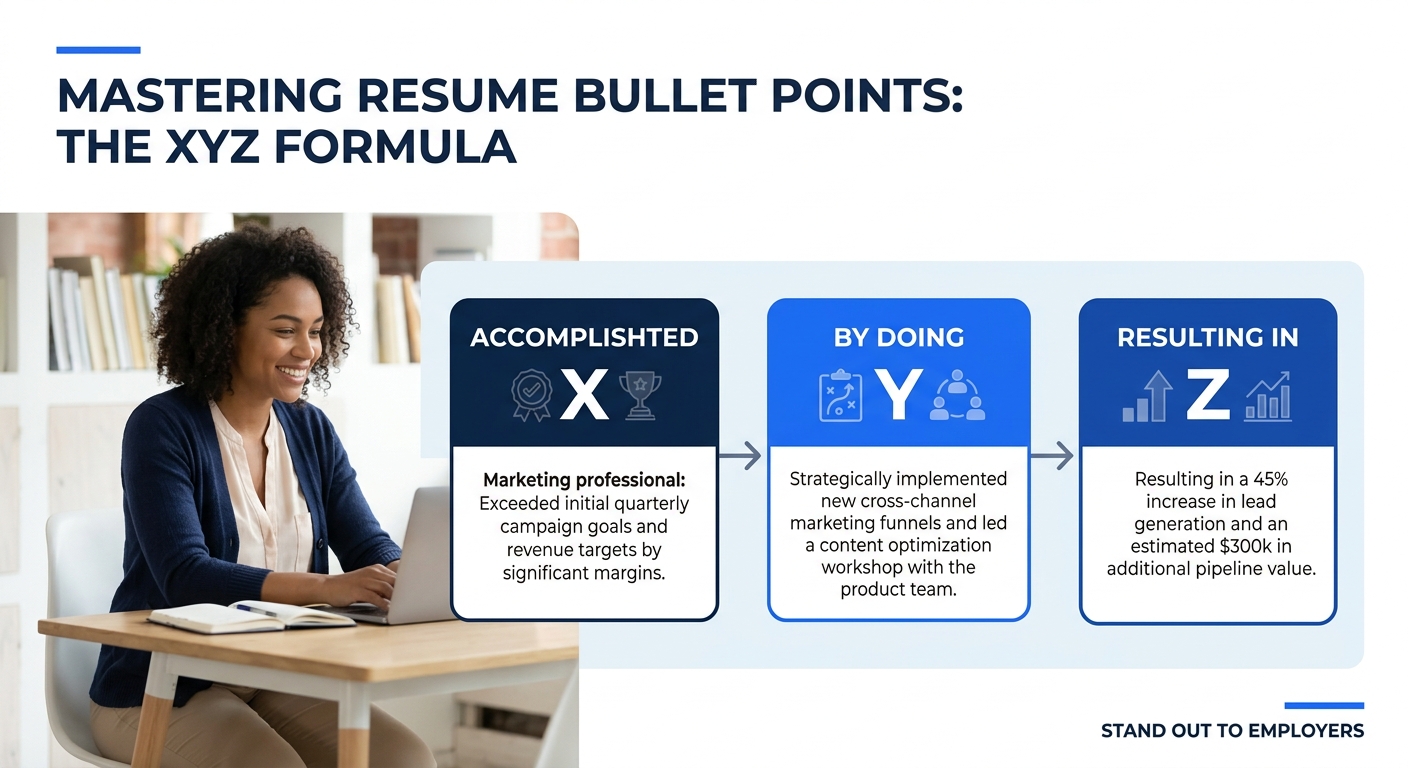
A popular framework (sometimes called the XYZ formula) structures each bullet as: “Accomplished X by doing Y, which resulted in Z.” You don’t need to follow it rigidly, but the underlying logic is sound. Every bullet should answer the question “so what?” with a specific, quantifiable answer.
If your numbers feel small, include them anyway. “Trained 4 junior analysts on SQL reporting” still beats “assisted with training.” A Reddit thread on quantifying achievements with over 200 upvotes reinforces this point: real numbers, even modest ones, outperform adjectives every time.
Describe what changed, not what you did all day
This is where most resume bullet point rewriting goes wrong. People upgrade from passive voice to active verbs but still end up writing task descriptions. “Managed a portfolio of 30 client accounts” is technically active. It starts with a strong verb. But it still reads like a job description because it doesn’t tell anyone what happened as a result of your management.
The goal of every bullet is to communicate transformation. Something was one way before you arrived, and it was different after. Your bullet should capture that delta.
- Task-oriented: “Managed a portfolio of 30 client accounts.”
- Result-oriented: “Grew a 30-account portfolio by 22% in annual recurring revenue, retaining 97% of existing clients.”
Both sentences describe the same job. The second one makes you sound like someone who creates value. If you’re having trouble identifying results, ask yourself these three questions about each role:
- What was the situation when I started?
- What did I specifically do?
- What measurably improved?
Not every bullet will have a dramatic before-and-after. That’s fine. But if none of your bullets describe change, your resume reads like a static snapshot instead of a story about growth. And that’s one of the clearest signs your resume isn’t performing the way it should.

Steal the job posting’s language (on purpose)
An ATS scans for keyword matches. A human recruiter skims for relevance. Both are looking for alignment between what you’ve done and what the role requires. If the posting says “cross-functional collaboration” and your resume says “worked with other teams,” you’re describing the same thing but losing the match.
This doesn’t mean copying the job posting word-for-word. It means studying the verbs, nouns, and phrases a company uses and reflecting them in your bullets where they honestly apply. If a posting emphasizes “data-driven decision making,” and you genuinely made data-driven decisions, say so in those words. Your resume’s job is to make the match obvious, not to make the recruiter infer it.
We’ve covered this alignment process in detail when discussing how to make your resume ATS-friendly, but the short version: pull the five to ten most important keywords from the posting, check whether your resume includes them, and revise any bullets where the concept is present but the language doesn’t match.
This also protects you from a common trap. People sometimes choose obscure or “creative” action verbs to stand out, but if the verb doesn’t match the industry’s vocabulary, it can actually reduce your ATS score. A marketing resume should say “launched a campaign,” not “orchestrated a market activation event.” Precision beats flair.
Read your bullets out loud before you hit submit
This is the simplest rule and the one people skip most often. When you read a bullet out loud and it sounds like a clause from a legal contract, it needs a rewrite. When you read it and you can hear yourself saying it in a job interview, explaining what you did and why it mattered, it’s probably close to done.
Reading aloud catches problems that silent reading misses. You’ll hear the repetition of “managed… managed… managed” across consecutive bullets. You’ll notice when a sentence runs so long that you lose the thread before the period. You’ll feel when a bullet is all filler and no substance.
If you can, read your bullets to someone who doesn’t work in your industry. If they can understand what you accomplished and why it was impressive, you’ve written an effective bullet. If they look confused or say “okay, but what did you actually do?” you need another pass. Many of the common resume mistakes that get applications rejected come down to unclear, jargon-heavy writing that the applicant never tested on a real audience.
Tip: Try reading each bullet as if it’s the answer to an interview question: “Tell me about a time you improved something.” If the bullet works as a spoken answer, it’ll work on paper.
When these rules break down
No rule set covers every situation perfectly. If you’re a recent graduate with limited work experience, you may not have dramatic metrics for every bullet, and that’s expected. Focus on the verbs and the structure, and quantify what you can, even from academic projects, volunteer work, or internships. We have a dedicated guide to resume strategies for recent graduates that addresses this directly.
If you’re in a creative field where portfolio work matters more than bullet-point metrics, these rules still apply to your Experience section, but they carry less overall weight. And if you’re in a highly regulated industry like law or medicine, some of the standard action verbs will feel out of place. “Negotiated a 40% reduction in settlement costs” works. “Disrupted the litigation process” does not.
The underlying principle survives even when individual rules bend: every line on your resume should make the reader think “this person gets things done.” If a bullet doesn’t create that impression, rewrite it or remove it. Hiring managers who spend seven seconds scanning your resume are making snap judgments about your competence based on the words you chose. Passive, vague, duty-focused language tells them you showed up. Active, specific, results-focused language tells them you delivered. The revision work takes time, but it’s the highest-return investment you can make in your job search.