
 4.9
4.9 4.5
4.5Enhancv’s templates average 96.7% parse accuracy on Indeed’s ATS, according to independent testing of 15 platforms conducted earlier this year. A properly formatted Google Doc lands somewhere around 90%. That 6.7-percentage-point gap represents the entire technical parsing advantage of AI resume builders over traditional tools, and the resume-building industry has constructed a billion-dollar narrative around it. The narrative goes like this: AI builders beat ATS filters, traditional tools don’t, so pay $17–$49 a month or risk the void. But the data tells a more complicated story, one where the tool on your screen matters far less than what you type into it.
This article defends a simple claim: the choice between an AI resume builder and a traditional tool like Word or Google Docs is one of the least important decisions in your job search. Three pieces of evidence explain why.
The Parse Accuracy Gap Is Real but Thin
Let’s get the numbers on the table. When testers ran resumes through a sandboxed Greenhouse ATS and Jobscan scoring, AI-native builders like Enhancv, Rezi, and Teal consistently scored higher on formatting compliance than resumes built in Word, Google Docs, or Canva. The Enhancv benchmark of 96.7% parse accuracy is genuinely impressive. Rezi and Resume Optimizer Pro claim a 99% correlation with employer ATS systems. These numbers are real, and if you’re choosing between tools purely on resume parsing and keyword matching, AI builders win.
But here’s the part the marketing pages leave out: a cleanly formatted Word document or Google Doc, using standard section headings and a single-column layout, routinely passes ATS parsing at 88–92% accuracy. The gap between “your resume gets read” and “your resume gets garbled” has almost nothing to do with whether you used Rezi or Microsoft Word. It has everything to do with whether you embedded your contact info in a header, used a two-column text box, or exported from Canva with multimedia elements the parser couldn’t read.
The resumes that fail ATS parsing catastrophically aren’t the ones built in Word. They’re the ones built with design flourishes that break parsing logic: text boxes, custom fonts embedded as images, tables that scramble reading order, PDF exports with flattened layers. An AI builder prevents those mistakes by constraining your template choices. A traditional tool lets you make those mistakes, but if you know the rules (standard headings, no text boxes, .docx or clean PDF export), you avoid them entirely. We covered practical ways to make any resume ATS-friendly in a previous guide, and every recommendation there works regardless of which tool you open.
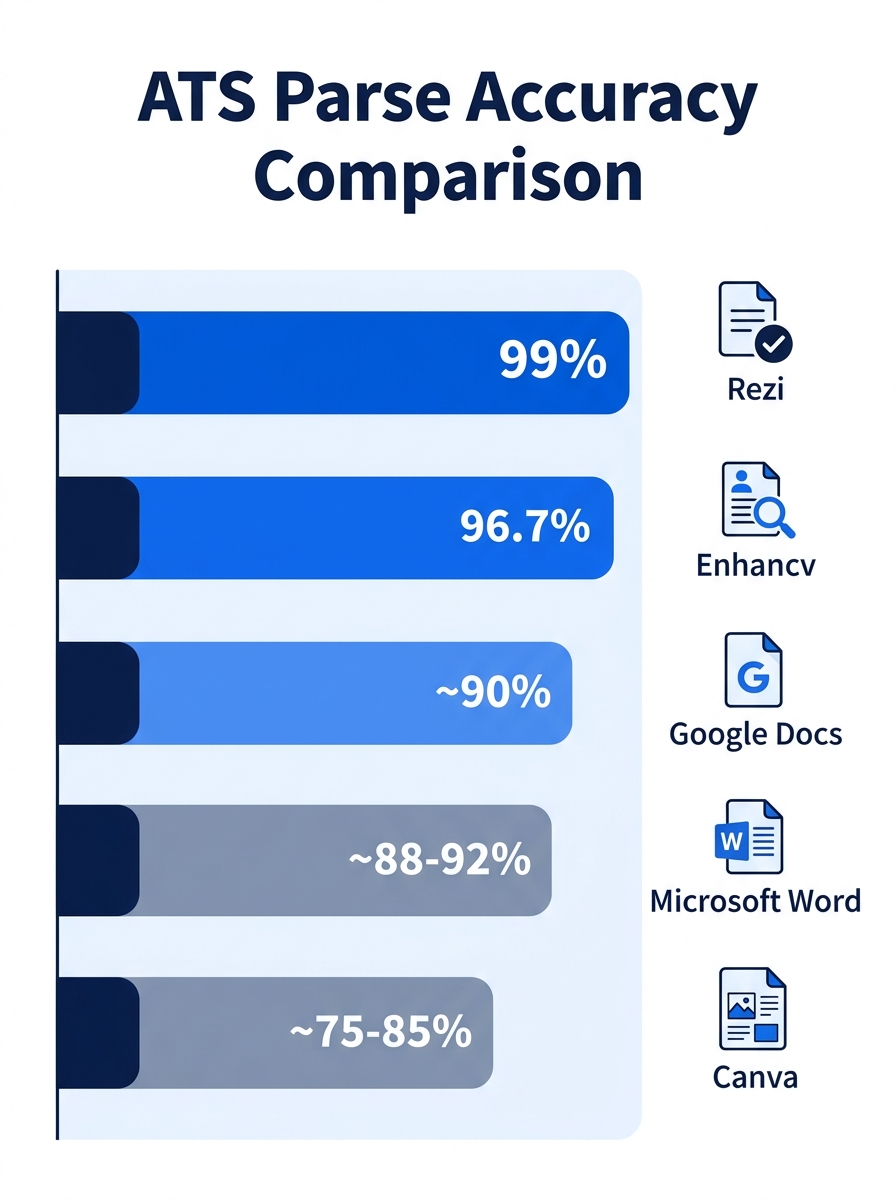
The uncomfortable truth for the resume builder technology comparison conversation is this: the floor for ATS compliance is low. Scores above 75% typically indicate good compatibility, and scores below 60% suggest real problems. A Google Doc clears that bar with room to spare. The difference between 90% and 97% parse accuracy might matter if you’re applying to a role with 3,000 applicants where the ATS is doing hard cutoff scoring. For the vast majority of job searches, it won’t be the deciding factor.
Where AI Builders Actually Earn Their Price Tag
If the formatting advantage is modest, where does the often-cited “58% higher success rate with optimized resumes” come from? The answer reveals the real value proposition of AI resume builders, and it has nothing to do with ATS optimization technology in the way most people understand it.
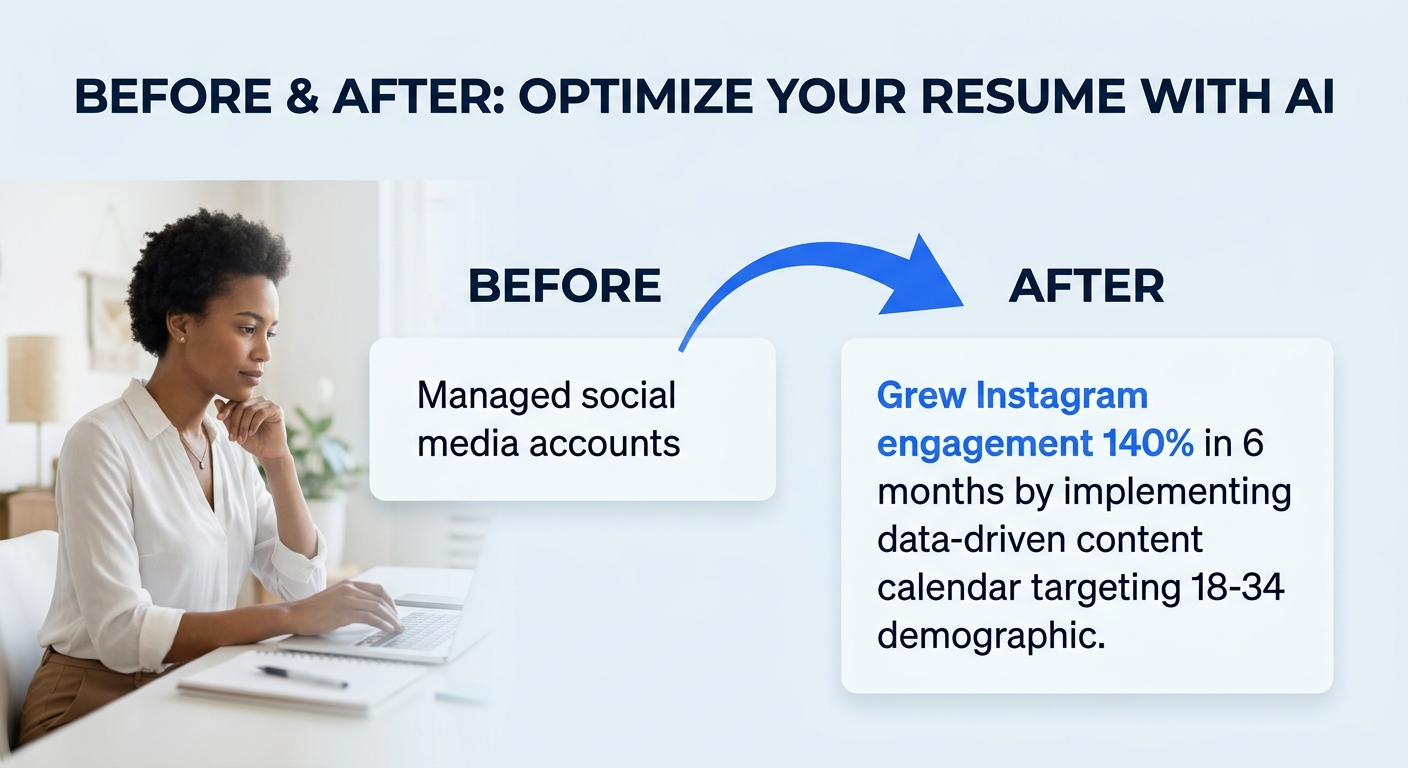
That improvement comes from content optimization. When platforms like Rezi or Teal analyze a job description alongside your resume, they’re doing three things a traditional tool can’t: identifying keyword gaps between your resume and the posting, flagging weak bullet points that lack quantified results, and suggesting rewritten language that mirrors the employer’s terminology. This is where how AI builders beat ATS filters becomes a meaningful question, because modern ATS platforms like Workday and Greenhouse don’t rely on simple keyword matching anymore. They use natural language processing and semantic analysis to evaluate whether your experience contextually aligns with the role requirements.
The 58% improvement stat is about what you write, not where you write it. AI builders force better content practices — that’s their real advantage.
An AI builder that scores your resume against a specific job description and tells you “you’re missing 4 of 8 required skills keywords” is providing genuine strategic value. A blank Word document offers no such feedback. But this is a content coaching function, not a formatting function. You could replicate the same improvement by manually cross-referencing every job posting against your resume, rewriting each bullet point with measurable outcomes, and incorporating the employer’s exact terminology. People have done this successfully for decades. The AI builder’s contribution is speed and consistency, not a secret sauce that a traditional tool locks you out of.
This distinction matters because it changes how you should spend your time and money. If you’re submitting five tailored applications a week, an AI builder that generates job-specific versions in minutes is a genuine productivity tool worth $29/month. If you’re sending out one carefully crafted application every two weeks, the manual approach produces identical results. As our overview of how AI is changing resume screening explains, the screening technology has gotten smarter, but so have the countermeasures available to any applicant willing to do the work.
The Human at the End of the Pipeline
There’s a third piece of evidence that reframes the entire AI resume builders vs traditional tools debate: ATS screening is a filter, not a hiring decision. And the humans making the actual decision don’t care which platform generated your PDF.
A Gartner survey found that only 26% of job candidates trust that AI will fairly evaluate them. That number reflects a real anxiety, but it also reflects a misunderstanding of the process. The ATS doesn’t hire you. It sorts you into a pile. A recruiter or hiring manager then spends — according to eye-tracking research — about six seconds on an initial scan of whatever lands in front of them. During those six seconds, they’re evaluating clarity of layout, relevance of your most recent role, and whether they can find a quantified achievement in the top third of the page. The recruiter looking at your resume at that stage cannot tell whether you built it in Rezi, Word, or on a napkin. They’re looking at content.
This is where the conversation about what hiring managers notice first on a resume becomes more important than any tool comparison. The recruiter wants to see a clear professional summary with a measurable claim, job titles that make sense for the role, and bullet points that prove impact. If your resume delivers those things, the tool is irrelevant. If it doesn’t, no amount of ATS optimization technology will save you.
The four resume builders dominating the 2026 market are dominating because they make it easier and faster to produce strong content at scale. That’s a real benefit for high-volume applicants. But “easier and faster” is a convenience argument, and convenience arguments don’t support the fear-based marketing that dominates this space — the implicit message that submitting a Word resume in 2026 is career suicide.
Tip: If you’re on a tight budget, a well-formatted Google Doc with manually optimized keywords performs within a few percentage points of any paid AI builder. Spend your money on a career coach or professional resume review instead if you can only afford one investment.
The Claim, Reconsidered
So which actually gets you hired — AI resume builders or traditional tools?
Neither. Both. The question is structured wrong.
AI builders win on convenience, speed of tailoring, and prevention of formatting errors that break ATS parsing. If you’re applying to dozens of roles, the time savings alone justify the subscription. Platforms like Rezi and Enhancv provide real-time keyword gap analysis and one-click formatting fixes that would take you 45 minutes to replicate manually in Word. For applicants navigating career transitions after layoffs, where volume and speed of applications matter enormously, an AI builder is a smart investment.
Traditional tools win on cost (free), flexibility (full design control), and the fact that they’ve been producing hirable resumes for thirty years. A Google Doc doesn’t score your keyword density, but a free Jobscan scan does the same thing from the outside. A Word template doesn’t auto-generate bullet points, but strong action verbs and a clear results framework accomplish the same goal with a few extra minutes of effort.
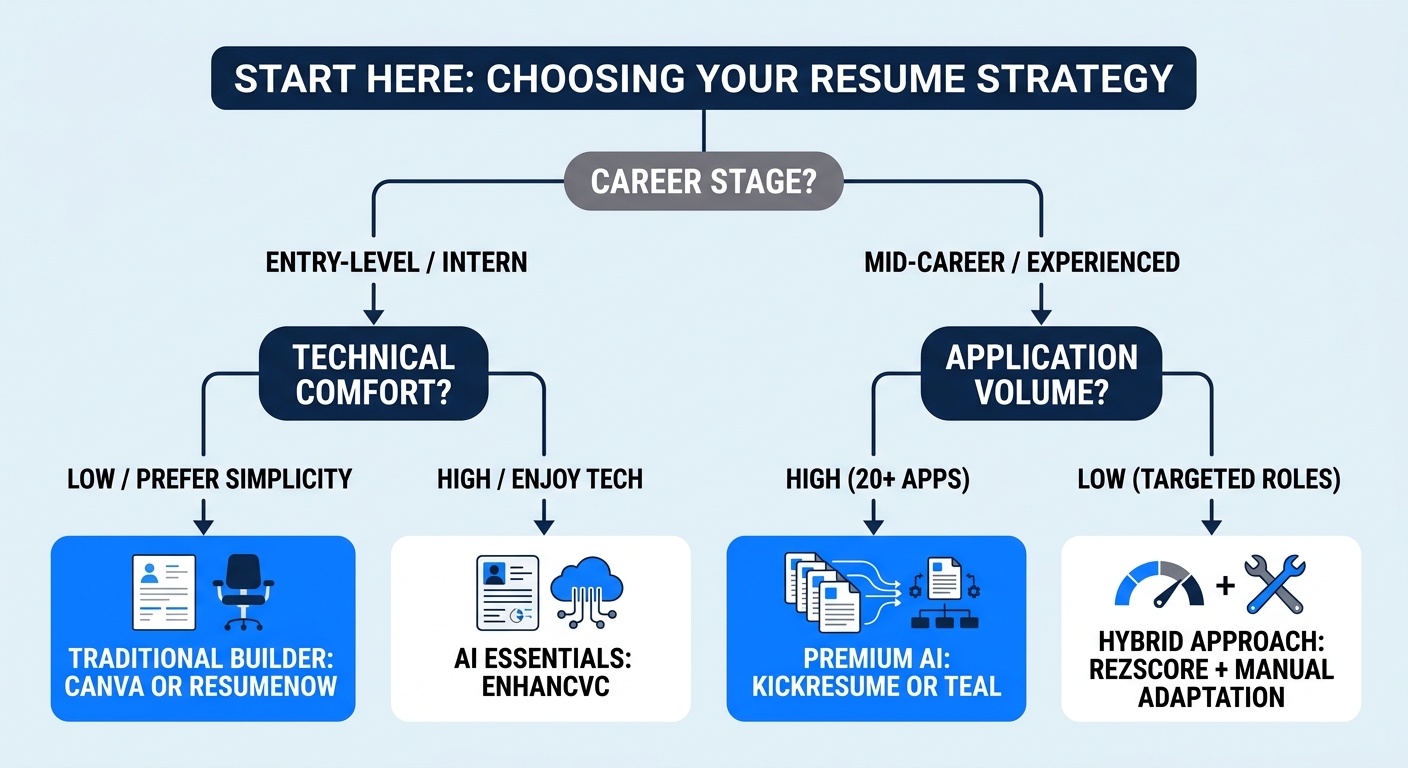
The resume builder technology comparison that matters isn’t AI vs. traditional. It’s optimized content vs. unoptimized content. A beautifully formatted AI-built resume with vague bullet points and no quantified achievements will lose to a plain Word document where every line proves measurable impact. The 58% improvement stat proves this exact point: the improvement comes from what the AI encouraged you to write differently, not from the file format or the template engine.
If you take one thing from this entire showdown, make it this: the best resume tool is whichever one you’ll actually use to tailor every single application to the specific job posting. For some people that’s Teal’s job-tracking dashboard. For others it’s a Google Doc and a highlighted printout of the job description. The ATS doesn’t care. The recruiter on the other side doesn’t care. Your content does the work. Resources at ResumeWriting.net can walk you through the content strategy regardless of which tool sits open on your screen.