

 4.9
4.9 4.5
4.5Job applicants interviewed by AI voice agents received job offers 12% more often than those interviewed by humans, according to a University of Chicago study of more than 70,000 real candidates published May 22, 2026. Economists Brian Jabarian and Luca Henkel found that AI agents conducted more consistent, better-structured interviews that drew out hiring-relevant information, and when given a choice, 78% of applicants selected the AI agent over a human interviewer, according to Forbes.
TL;DR: University of Chicago research shows AI agent interviews yield 12% higher offer rates than human-conducted interviews, with candidates who prepared broadly, gave fuller answers, and engaged conversationally performing best.
The field experiment assigned real job seekers to interview with either human recruiters or AI voice agents, with human recruiters still making final hiring decisions. Candidates interviewed by AI agents showed stronger retention rates and no drop in on-the-job productivity compared to those selected through human interviews. The transcript analysis revealed specific, repeatable behaviors that predicted which candidates received offers.
Why AI Agents Cover More Ground
AI voice agents covered 45% of a firm’s possible interview topics on average, compared with 38% for human-led interviews, the study found. The AI agents did not tire, become distracted, or run short on time, so they moved through the full range of questions they were designed to ask rather than stopping once they formed an early impression. Candidates rated AI agent questions as more relevant to the role than questions from human interviewers.
The broader conversation gave applicants more opportunities to demonstrate fit across the full job description. Human recruiters often zeroed in on one or two areas and formed conclusions quickly, leaving other qualifications unexplored. The AI agents asked about a wider set of qualifications, which meant candidates who prepared across the entire job description had more chances to show relevant experience.
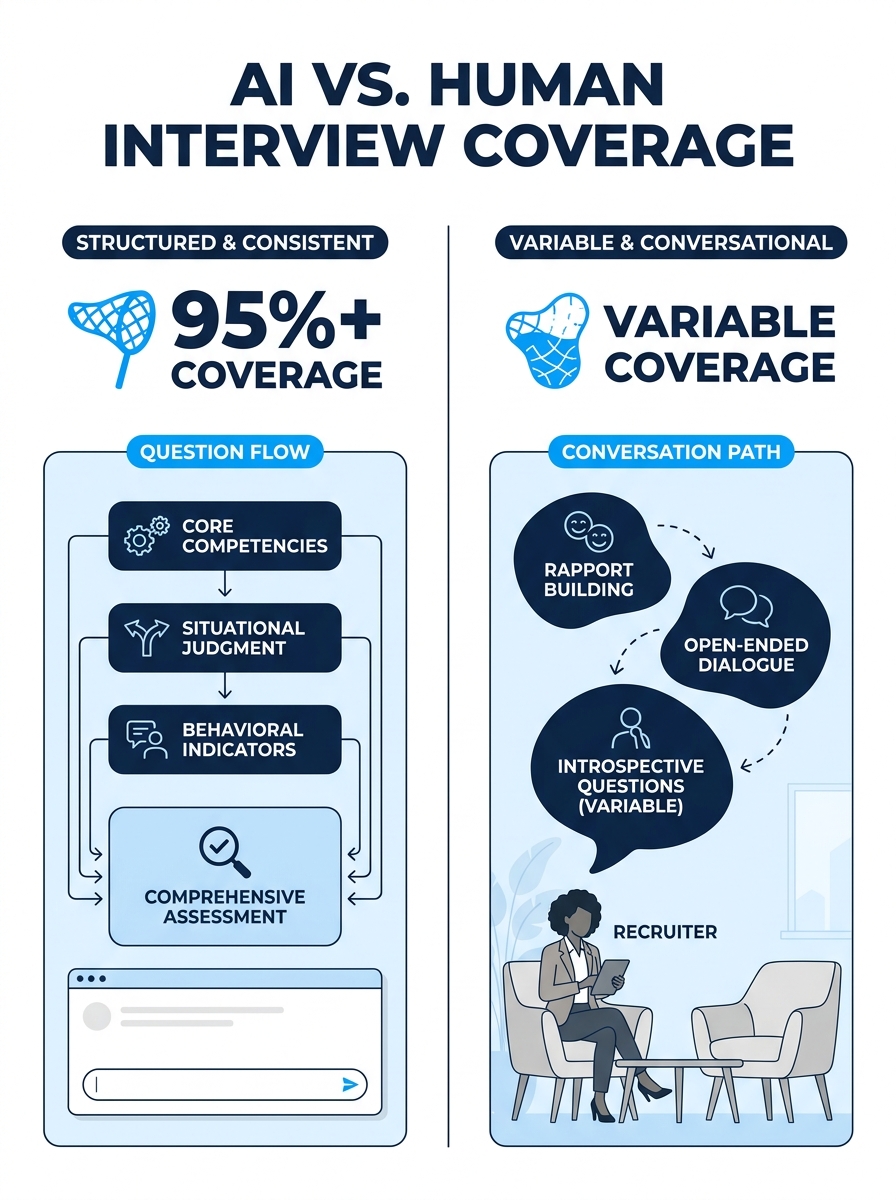
Job seekers preparing for AI agent interviews should map their experience against every major responsibility listed in the job description and prepare a concrete example for each, rather than rehearsing two or three polished stories. AI screening algorithms now extend beyond initial resume sorting, and interview preparation strategy must adapt to systems that cover more ground than human recruiters typically do.
Fuller Answers Predicted Job Offers
Candidates whose answers scored higher on vocabulary richness and syntactic complexity received significantly more job offers, the transcript analysis showed. Vocabulary richness measured the variety of words used, while syntactic complexity measured sentence structure depth. Short, flat replies gave recruiters less material to evaluate, while fuller responses made the candidate’s thinking easier to assess.
“That doesn’t mean you need to use sophisticated words or sound overly polished,” Jabarian said in the Forbes report. “It means your answers should have enough substance, context and detail for your qualifications to come through.” When AI agents asked about past projects, candidates who received offers typically walked through the situation, their specific actions, and measurable outcomes rather than giving one-line summaries.
The finding contrasts with conventional interview advice that emphasizes concise answers. AI agents processed longer, more detailed responses without the fatigue or time pressure that causes human interviewers to prefer brevity. Candidates who treated each question as an invitation to give a complete answer rather than just clearing a bar performed better.
Back-and-Forth Engagement Mattered
The number of conversational turns between the interviewer and applicant emerged as one of the strongest positive predictors of receiving a job offer. The strongest AI agent interviews worked like real conversations, with candidates responding to follow-up questions and adding detail as the exchange developed, rather than proceeding through a rigid question-and-answer sequence.
AI agents probed for more information when initial answers lacked detail, and candidates who engaged with that rhythm gave recruiters more useful material to evaluate. Candidates who rushed through the interview or gave brief answers that did not invite follow-up left less evidence of their fit. The researchers found that applicants who responded to the specific angle raised in follow-up questions and added relevant detail built stronger cases for themselves.
The pattern mirrors findings from research on human-versus-algorithm resume screening, where systems that gather more data points make more accurate predictions. In the interview context, candidates who sustained longer exchanges gave AI agents—and the human reviewers who read the transcripts—more evidence to work with.
Verbal Filler Correlated With Fewer Offers
Backchannel cues—small verbal acknowledgments like “mm-hm,” “right,” and “okay” that people use to show they are listening—correlated with fewer offers in the transcript analysis. With a human interviewer, these cues can help build rapport. With an AI agent, they added noise without adding substance.
Candidates whose responses carried more content rather than conversational filler performed better. The information that reached human reviewers came from what candidates said, and verbal filler contributed nothing to the evaluation. A short pause while gathering thoughts proved more effective than filling space with acknowledgment sounds.
The researchers noted that applicants who let their answers stand on their own, speaking when they had something meaningful to add and staying quiet when they did not, gave AI agents cleaner transcripts to pass to hiring managers. The finding suggests that preparing substantive answers matters more than managing conversational rhythm when the interviewer is an algorithm.
Question Timing Affected Outcomes
Asking questions during an AI agent interview remained valuable, but timing affected results. Applicants who asked more questions while the AI agent was still gathering information were less likely to receive job offers, the study found. Questions posed after the AI agent completed its structured interview sequence did not show the same negative correlation.
The pattern suggests that interrupting the AI agent’s information-gathering process with candidate questions may have disrupted the flow or left gaps in the evaluation record. Candidates who waited until the AI agent finished its questioning and then asked about the role, team, or company preserved the completeness of their own interview record while still demonstrating interest.
The World Economic Forum reports that roughly 88% of companies now use some form of AI to screen candidates early in the hiring process, making AI agent interviews an increasingly common step. The University of Chicago study provides the first large-scale evidence that these interviews may actually improve candidate outcomes when structured properly.
Context and Outlook
The University of Chicago findings arrive as tech layoffs continue to reshape the job market and hiring processes incorporate more AI-driven steps. For job seekers preparing for interviews in 2026, the research offers a clear playbook: prepare broadly across the full job description, give complete answers with concrete examples, engage with follow-up questions, minimize verbal filler, and save candidate questions for after the structured interview completes.
The 12% offer-rate advantage for AI-interviewed candidates suggests that algorithmic consistency may reduce bias and improve hiring decisions when human reviewers still make final calls. The 78% candidate preference for AI agents over humans points to reduced interview anxiety and perceived fairness when the process follows a predictable structure. Interview preparation strategies built for human recruiters—short answers, rapport-building cues, early engagement with questions—may underperform with AI systems that prioritize information density and conversational depth.
Job seekers who treat AI agent interviews as opportunities to deliver thorough, well-structured evidence of their qualifications rather than performances designed to build rapport with a human interviewer will likely see better results. The shift rewards preparation and substance over charisma, which may level the playing field for candidates who struggle with traditional interview formats but possess strong job-relevant skills.